

SUBSCRIBE TO OUR FREE NEWSLETTER
Daily news & progressive opinion—funded by the people, not the corporations—delivered straight to your inbox.
5
#000000
#FFFFFF
To donate by check, phone, or other method, see our More Ways to Give page.
Daily news & progressive opinion—funded by the people, not the corporations—delivered straight to your inbox.
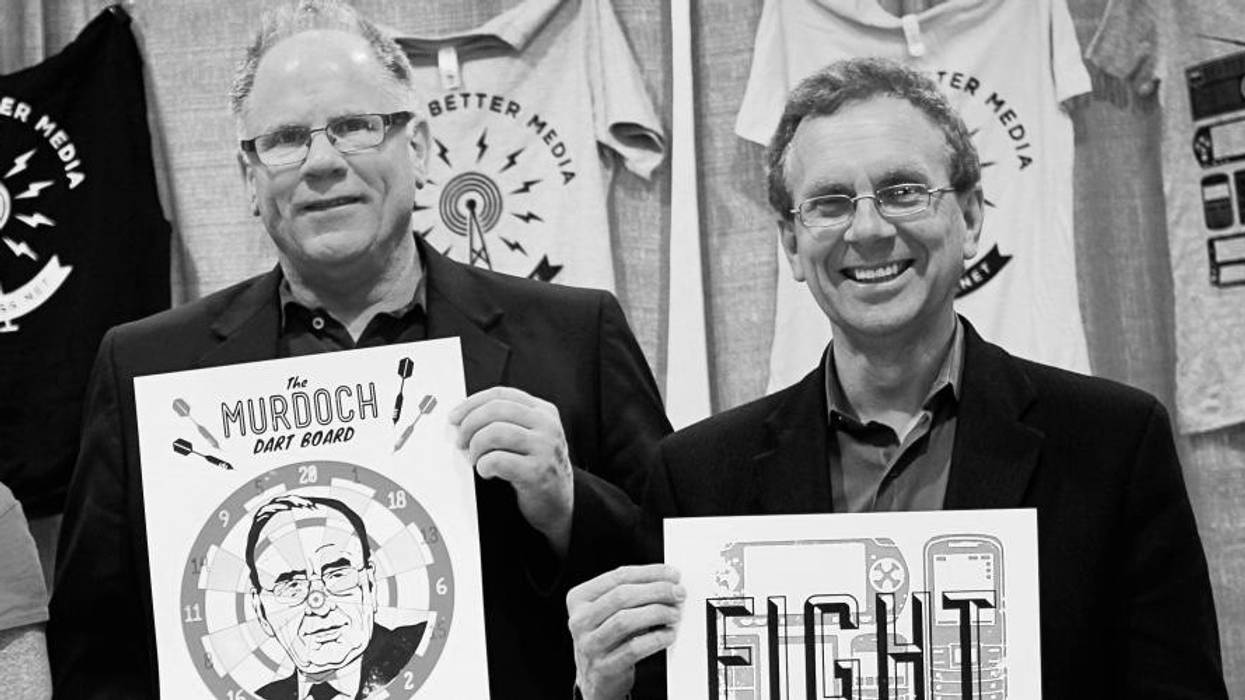
Just like Tom Paine, and until the very end, Bob saw hope in the people who were rising up and demanding a future defined by their humanity, as opposed to corporate power.
Bob McChesney, who died on Tuesday at the age of 72, first introduced himself to me almost 30 years ago, on the set of a public television news program in Madison, Wisconsin. Bob was a distinguished University of Wisconsin professor who was gaining an international reputation for his groundbreaking analysis of the threat to democracy posed by corporate control of media. Raising his arguments in books, speeches, and frequent C-Span appearances, he was well on his way to becoming one of the great public intellectuals of his time. I was a young newspaper editor who had earned a slim measure of recognition for my advocacy on behalf of investigative journalism and press freedom.
The program was framed as a debate about the future of journalism. Bob was positioned as the doomsayer, warning about how media consolidation was killing journalism. I was expected to counter that the future was actually bright. As it turned out, neither of us wanted to follow the script. Instead of arguing, we both agreed that profit-obsessed corporations were destroying American journalism, and that this destruction would pose an ever more serious threat to American democracy.
It wasn’t a particularly satisfying exchange for our hosts that evening, but it was the beginning of a collaboration that would span three decades. Bob and I cowrote half a dozen books and dozens of articles, joined Bill Moyers for a series of PBS interviews that would examine threats to journalism and democracy, and did our best, with more allies than we could have imagined in those early days, to stir up a reform movement that recognized the crisis and endeavored to set the stage for media that serves people rather than corporate bottom lines.
Bob, with his remarkable intellect and even more remarkable capacity for communicating his vision of a media that served citizens rather than corporations, was always the driving force. His research and his insatiable curiosity helped him to see the future more clearly than any scholar of his generation, with such precision that Moyers would compare him to both Tom Paine and Paul Revere. As new political and societal challenges arose in an ever more chaotic moment for America and the world, Bob explained how they should be understood as fresh manifestations of an ancient danger: the concentration of power—in this case, the power of the media, in the hands of old-media CEOs and new tech oligarchs, all of whom cared more about commercial and entertainment strategies than democratic and social values.
Bob, with his remarkable intellect and even more remarkable capacity for communicating his vision of a media that served citizens rather than corporations, was always the driving force.
Bob took the “public” part of “public intellectual” seriously. You knew he wanted to swing into action when he’d say, “We need to put our heads together…” That was his call to write another book, organize another national conference on media reform, or rally another movement to defend the speak-truth-to-power journalism that the founders of the American experiment understood as the only sure footing for representative democracy.
Bob kept issuing the call, even as a series of health challenges slowed him down. He was still doing so a few days before his death following a year-long fight with cancer. His was a life fulfilled in the best sense of the word. He died a happy man, holding the hand of his beloved wife, Inger Stole, and reflecting on time spent with his daughters, Amy and Lucy.
Our last conversations recalled friends and colleagues who had answered his calls to save journalism and renew our democracy: Craig Aaron, Victor Pickard, Josh Silver, Kimberly Longey, Russell Newman, Derek Turner, Ben Scott, Joe Torres, Tim Karr, Matt Wood, Katrina vanden Heuvel, Michael Copps, Noam Chomsky, Amy Goodman, Bernie Sanders, Ralph Nader, the Rev. Jesse Jackson, and too many others to name. Bob loved scholarship, loved activism, and loved collaborating with people who made connections between the two—sharing writing credits with former students at UW-Madison and later at the University of Illinois at Urbana-Champaign, working with unions of media workers and, perhaps above all, strategizing with the team at Free Press, the media reform group he co-founded in 2003 to advocate for diversity in ownership, robust pubic media, net neutrality and always, always, democracy. Bob was frustrated by the oligarchical overreach now on display in the Washington of Donald Trump and Elon Musk—a development he had predicted with eerie accuracy. Yet he remained undaunted to the end, still spinning out fresh ideas for upending corporate control of media, getting Big Money out of politics, and ushering in a new era of freewheeling debate and popular democracy.
That was the essence of Robert Waterman McChesney. He was a globally respected communications scholar who was wholly welcome in the halls of academia, yet he was never satisfied working within an ivory tower. He was a rigorous researcher into the worst abuse of corporate and political establishments. Yet he refused to surrender his faith in the ability of people-powered movements to upend monarchs and oligarchs and, in the words of Tom Paine, “begin the world over again.”
Bob regarded Paine—the immigrant pamphleteer who rallied the people of his adopted country to dismiss King George III and the colonial enterprise, and who spent the rest of his life demanding that this new United States live up to the egalitarian promise of liberty and justice for all—as the essential founder of the American project. Like Paine, Bob believed that with information and encouragement, grassroots activists could carry Paine’s legacy forward into the 21st century. Countless people heeded his call.
“Bob McChesney was a brilliant scholar whose ideas and insights reached far beyond the classroom. He opened the eyes of a generation of academics, journalists, politicians, and activists—including mine—to how media structures and policies shape our broader politics and possibilities,” explained Craig Aaron, the co-CEO of Free Press. “While McChesney spent much of his career charting the problems of the media and the critical junctures that created our current crises, he believed fundamentally in the public’s ability to solve those problems and build a media system that serves people’s needs and sustains democracy. His ideas were bold and transformative, and he had little patience for tinkering around the edges. Rather than fighting over Washington’s narrow vision of what was possible, he always said—and Bob loved a good sports metaphor—that we needed to throw the puck down to the other end of the ice.”
Bob examined the relationship between media and democracy with scholarly seriousness. Yet he coupled that seriousness with a penchant not just for sports metaphors and references to rock-and-roll songs but spot-on cinematic analogies, which invited Americans to recognize the crisis. Speaking to Moyers about how America’s media policies were forged behind closed doors in Washington, by lobbyists and politicians, Bob succintly defined that process: “Pure corruption. This is really where Big Money crowds everything else out. The way to understand how policymakers make media in this country [is to watch] a great movie: The Godfather: Part II. There’s a scene early in the movie where all the American gangsters are on top of a hotel roof in Havana. It’s a classic scene featuring Hyman Roth and Michael Corleone. They’ve got a cake being wheeled out to them. And Hyman Roth is cutting up slices of the cake. The cake’s got the outline of Cuba on it, and they’re giving each gangster a slice of Cuba. And while he’s doing this, Hyman Roth’s [talking about how they can work with government to carve up Cuba in ways that make them all rich]. That’s how media policy is made in the United States.”
The accessibility of his speech—the way it turned something as potentially obscure as communications policy into a readily understandable issue—was Bob’s genius. He wanted to upend the money power and tip the balance toward systems that would empower working-class people—as opposed to billionaires—to shape the future of media: with strategies for giving citizens democracy vouchers that they could use to support independent media, and a host of other remedies. Like his friend Bernie Sanders, Bob believed it essential to have a media free enough from corporate influence to speak truth to economic and political power, boldly critique the excesses of capitalism, and raise the alarm against creeping oligarchy.
The accessibility of his speech—the way it turned something as potentially obscure as communications policy into a readily understandable issue—was Bob’s genius.
This was the premise that underpinned an academic career that saw Bob author or co-author almost 30 books—including the groundbreaking Rich Media, Poor Democracy, his 1999 manifesto on how the decay of journalism would lead to a collapse of democratic norms, and 2013’s Digital Disconnect, his essential assessment of the danger of allowing Silicon Valley billionaires to define online communications. Many of the same themes ran through examinations of the shuttering of newspapers by corporate conglomerates that left communities as news deserts, of the destructive influence of political advertising on the national discourse, and of the failure of political and media elites to bring citizens into debates about automation, machine learning, and artificial intelligence. Noam Chomsky, whose own work on the media’s manufacturing of consent had profoundly influenced Bob’s scholarship (along with that of Ben Bagdikian, the journalist who wrote The Media Democracy), became Bob’s most ardent champion. “Robert McChesney’s work has been of extraordinary importance,” explained Chomsky. “It should be read with care and concern by people who care about freedom and basic rights.”
Bob’s research—and the books, lectures and activism that extended from it—earned him Harvard’s Goldsmith Book Prize, the Kappa Tau Alpha Research Award, the Newspaper Guild’s Herbert Block Freedom Award (for “having done more for press freedom than anyone”), and the International Communications Association’s C. Edwin Baker Award for the Advancement of Scholarship on Media, Markets and Democracy. It also gained him a hearing from thoughtful members of Congress, the Federal Communications Commission, and the Federal Trade Commission. Even if they did not always follow his advice, progressive officials recognized the wisdom of his analysis and incorporated it into their work. That’s one of the reasons why, in 2009, Utne Reader named Bob as one of “50 visionaries who are changing your world.” Charles Lewis, the founder of the Center for Public Integrity, simply referred to Bob as “the conscience of the media in America.”
Bob’s last words to me, though they were a bit more labored due to his illness, were a repeat of his constant call to action: “Let’s put our heads together…”
Lewis wrote those words the better part of two decades ago. Bob remained that conscience, even as “media deserts” spread their arid path across America, as disinformation and misinformation overwhelmed the Internet, as propagandistic advertising warped our politics and as democratic expectations were undermined. It was all as he had predicted. But he was not inclined toward “I told you so” rejoinders.
Rather, Bob kept the faith that popular movements would push back against the decay, and the chaos, just as they had in the Progressive Era, the New Deal years, and the 1960s. “You’ve got to look in the mirror and understand that, if you act like change for the better is impossible, you guarantee it will be impossible,” he would say. “That’s the one decision each individual faces.”
Bob looked in that mirror confidently and courageously throughout a life of scholarship and activism. Some of our last conversations were about the huge crowds Bernie Sanders was attracting for his “Fighting Oligarchy” tour, and the thousands of Americans who have been showing up to challenge Republican members of Congress at town hall meetings. Just like Tom Paine, Bob saw fresh hope in the people who were rising up and demanding a future defined by their humanity, as opposed to corporate power. This might, he suggested, be the opening for a new surge in activism for journalism and democracy, a surge that might “begin the world over again.”
Bob’s last words to me, though they were a bit more labored due to his illness, were a repeat of his constant call to action: “Let’s put our heads together…” In other words, let’s make a plan. Let’s do something. That was his charge to those of us who cherished Bob McChesney’s mission and his spirit. We honor him best by accepting it.
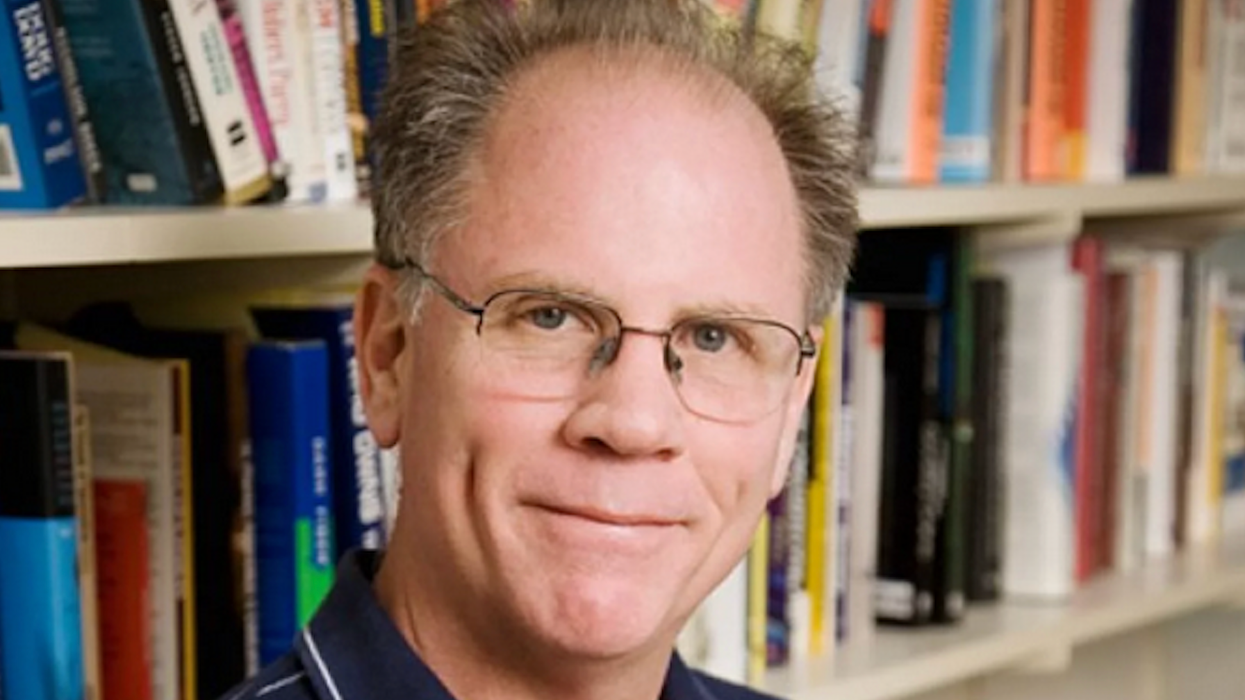
"The world of media scholarship, journalists far and wide, and anyone who cares about a free press, a functioning democracy, and a better world has suffered a tremendous loss," said Common Dreams' managing editor.
Robert McChesney—prominent media scholar, Free Press co-founder, dogged defender of democracy, and friend of Common Dreams—died Tuesday at the age of 72.
McChesney's many books, nearly three dozen in total which he either wrote or edited, include: Rich Media, Poor Democracy (2000); The Problem With the Media (2004); The Death and Life of American Journalism (2010, co-authored with John Nichols); Dollarocracy (2012, also with Nichols); Digital Disconnect (2013); and Digital Democracy (2014).
He was the Gutgsell endowed professor in the Department of Communication at the University of Illinois Urbana–Champaign, and also co-founded the Illinois Initiative on Global Information and Communication Policy with Dan Schiller.
"Bob McChesney was a brilliant scholar whose ideas and insights reached far beyond the classroom. He opened the eyes of a generation of academics, journalists, politicians and activists—including me—to how media structures and policies shape our broader politics and possibilities," said Free Press president and co-CEO Craig Aaron.
Free Press mourns the passing of co-founder Robert W. McChesney, a brilliant scholar & generous mentor who captured corporate media's profound influence on the health of our democracy. https://www.freepress.net/news/press-releases/free-press-mourns-death-co-founder-and-scholar-robert-w-mcchesney
[image or embed]
— Free Press (@freepress.bsky.social) March 27, 2025 at 8:08 AM
"While McChesney spent much of his career charting the problems of the media and the critical junctures that created our current crises, he believed fundamentally in the public's ability to solve those problems and build a media system that serves people's needs and sustains democracy," Aaron continued.
"His ideas were bold and transformative, and he had little patience for tinkering around the edges," he added. "Rather than fighting over Washington's narrow vision of what was possible, he always said—and Bob loved a good sports metaphor—that we needed to throw the puck down to the other end of the ice."
A Common Dreams reader, contributor, promoter, and supporter for over 25 years, McChesney will be deeply missed by all those associated with the independent, nonprofit news organization.
"Both in my personal political development earlier in life and as a working journalist in the profession," said Common Dreams managing editor Jon Queally, "McChesney had a profound influence on how I came to understand media systems and the political economy overall."
"Rich Media, Poor Democracy pretty much changed my life, a book that I once taught to high school students—which they loved, by the way—as it explains, in an accessible but penetrating fashion, just how corrupting the news and information landscape can be when it is controlled wholesale by corporate interests," Queally continued.
"The world of media scholarship, journalists far and wide, and anyone who cares about a free press, a functioning democracy, and a better world has suffered a tremendous loss with the passing of Bob McChesney," he added. "Our hearts go out to his family and many friends."
Rutgers University communications professor Andrew Kennis also highlighted the importance of Rich Media, Poor Democracy. He told Common Dreams that McChesney—who along with Noam Chomsky wrote openers to his 2022 book Digital-Age Resistance: Journalism, Social Movements, and the Media Dependence Model—influenced his own work.
"Bob McChesney's impact on media was immeasurable," Kennis said in a phone interview. "He was a steadfast public intellectual who inspired millions with accessible critiques of capitalism and its corrosive effects on democracy. He argued that the United States' descent into neoliberalism came at the expense of popular sovereignty."
Kennis said he got to know McChesney through Chomsky, adding that "Noam called Bob 'pretty much the best political economist' in the country, and practically the world."
"Bob very much self-identified as a political economist in general, but especially about communications," he explained.
In a 2013 appearance on "Moyers & Company," hosted by Bill Moyers on PBS, McChesney joined with friend and frequent co-author Nichols, national affairs correspondent for The Nation, to discuss their book, Dollarocracy: How the Money and Media Election Complex Is Destroying America.
"Democracy means rule of the people: one person, one vote," McChesney explained to Moyers during the interview. "Dollarocracy means the rule of the dollars: one dollar, one vote. Those with lots of dollars have lots of power. Those with no dollars have no power."
U.S. Sen. Bernie Sanders (I-Vt.) wrote the introduction to Dollarocracy. Jeff Cohen, founder of Fairness and Accuracy in Media (FAIR) and founding director of the Park Center for Independent Media at Ithaca College, called his friend McChesney a "proud socialist" who "told me how glad he was to go door to door" canvassing for Sanders when he ran for president in 2016 and 2020.
Writing for FAIR, Cohen said that "no one did more to analyze the negative and censorial impacts of our media and information systems being controlled by giant, amoral corporations."
"Particularly enlightening was his 2014 book, Digital Disconnect: How Capitalism Is Turning the Internet Against Democracy," Cohen continued, "in which McChesney explained in step-by-step detail how the internet that held so much promise for journalism and democracy was being strangled by corporate greed, and by government policy that put greed in the driver's seat."
"That was a key point for Bob in all his work: He detested the easy phrase 'media deregulation,' when in fact government policy was actively and heavily regulating the media system (and so many other systems) toward corporate control," Cohen added.
In 2015, at the National Conference for Media Reform in Denver hosted by Free Press, McChesney sat down with Common Dreams to discuss the importance of independent outlets as well as the inspiring promise of journalism that can "change the world" by exposing one person at a time to news or information they might not otherwise ever learn or come by:
Robert McChesney on Common Dreams
Nichols wrote for The Nation Thursday that while McChesney was a "globally respected communications scholar who was wholly welcome in the halls of academia," he "was never satisfied working within an ivory tower."
Indeed, a lesser-known aspect of McChesney's work was his immersion in one of the late 20th century's emerging music scenes.
"One of the first things that Bob did to have an impact on society was with the grunge movement in Seattle," Kennis told Common Dreams. "That was kind of his street cred before he went full nerd."
"Bob was doing some independent journalism and was studying in Seattle and was closely covering the emergence of Nirvana and other garage bands back then; that's how he got his first big dip into journalism," he said. "And he was a big fan, and part of the fabric of indie rock."
McChesney—who studied history and political economy at Evergreen State College in Olympia, Washington and earned a Ph.D. in communications from the University of Washington in Seattle in 1989—co-founded the The Rocket, an alternative weekly newspaper that highlighted groups such as Nirvana, Soundgarden, Pearl Jam, Screaming Trees, Sleater-Kinney, and Mudhoney as they rose to prominence. Ironically, The Rocket was sold to a big San Francisco publisher whose financial mismanagement killed the once-independent paper.
"Bob was a towering character," Kennis said, "always dedicated from the beginning to the end to the good fight."
Why people, and radicals in particular, fail to grasp the reasoning behind this argument is truly mind-boggling.
One of the most bewildering reactions on the part of certain segments of the U.S. left (whatever that means these days) is that every time there is a crucial election, and the voice of reason dictates casting a ballot in a direction which will help the most to keep out of public office the most extreme, and often enough the positively nuts, candidate in the race, is to scream that this is a case of “the lesser of two evils” thinking and to imply in turn that the one making such an argument is, somehow, a sellout.
Noam Chomsky, of all people, has been the recipient of such brainless reactions for much of his life as he has repeatedly made the argument that voting for a third-party or independent candidate in a swing state would accomplish nothing but increase the possibility of the most extreme and positively nuts candidate winning the election.
Why people, and radicals in particular, fail to grasp the reasoning behind such an argument is truly mind-boggling. Either they don’t understand the nature of U.S. politics, with its winner-take-all election system, or they are simply wrapped up in the “feel-good” factor in politics to even notice such subtleties. But since even a fairly bright elementary student would most likely be able to understand the difference between a winner-take-all election system and proportional representation, it would be logical to conclude that what we have here is nothing less than a display of the politics of feeling good, which basically translates to acting in whatever manner makes one feel good, politically speaking, regardless of the consequences of those actions.
Now, one might say that when the Comintern adopted Stalin’s thinking in the 1920s that “social democracy is objectively the moderate wing of fascism” and proceeded later to lump together Hitler’s Nazi party and the German Social Democratic Party that it was doing so out of conviction that the capitalist world was teetering on the brink of collapse and that the communists would inevitably emerge as the victorious party.
But what is the excuse of the tiny segment of U.S. self-professed radicals who fail to see that in order to advance the program of socialism we must first defeat Trump at the ballot box? Incidentally, this also happens to be the official stance of the Communist Party USA. Yet, one can already hear the argument that U.S. communists must have also fallen victims of the picking a lesser of two evils mental attitude. However, in numerous conversations I've had with radicals (leftists, anarchists, and communists) across Europe, their own thinking was also in line with the reasoning of the Communist Party USA—namely, that priority number one of U.S. progressive voters should be to defeat wannabe dictator Donald Trump in the upcoming U.S. presidential election.
Can this be done by voting in a swing state for someone like Cornel West or Jill Stein when these candidates have zero chance of winning? My chances of being attacked and killed by a shark, which are estimated to be one in 3.75 million, are far greater than either of these two candidates making it to the White House in November 2024.
Oh, but I forgot! Such realizations hardly matter in comparison to how good it might make one feel by voting for a candidate outside of the two existing parties. Who cares if the candidate who would love to turn the U.S. into an autocracy wins the election? The other candidate is simply the lesser of two evils, which is like saying that it makes no difference to live under a political regime that is inadequate in realizing the ideals of a decent society and one that is bent on a process of societal fasticization.
Still, there is something even more bewildering with the lesser-of-two evils dictum that is thrown around by small segments of the left. Generally speaking, as Noam Chomsky has pointed out, there have been two doctrines about voting: the official doctrine, “which holds that politics consists of showing up every few years, pushing a lever, then going back to one’s private pursuits,” and the “left doctrine.” For the latter, “politics consists in constant direct popular engagement in public affairs, including a wide variety of activism on many fronts. Occasionally an event comes up in the formal political arena called an ‘election….’ It’s at most a brief departure from political engagement.”
The third doctrine about voting, which is the “lesser of two evils” principle, has appeared on the political scene rather recently and, as Chomsky highlighted, is “now consuming much debate on the left.” The debate, he went to say, “also falls within the official doctrine, with its laser-like focus on elections.”
Most leftists, radicals and communists know fully well what the Democratic Party represents. Moreover, the recently held Democratic National Convention, with its pathetic effort to reclaim the mantle of "freedom” in a simultaneous display of militaristic jingoism, gave us ample warnings of what lies ahead. It takes no political genius to see that Kamala Harris is yet another centrist and wholly opportunistic Democrat who will change her tune as the circumstances dictate. Or, as the British political philosopher John Gray aptly put it, to recognize that she has “been abruptly transformed by compliant media from a vice-president commonly acknowledged to be barely competent into an uplifting national leader.”
Leftists, radicals and communists living in capitalist societies know that elections are hardly the stuff of political participation that will turn things around. Only grassroots activism can bring about meaningful change. But whenever elections come up, and proportional representation is not in the picture, we hold our nose and vote for the lesser-known threat to what is left of the democracy we have. And then we go back to real activism in order to change society and the world for the better.
It's not complicated.
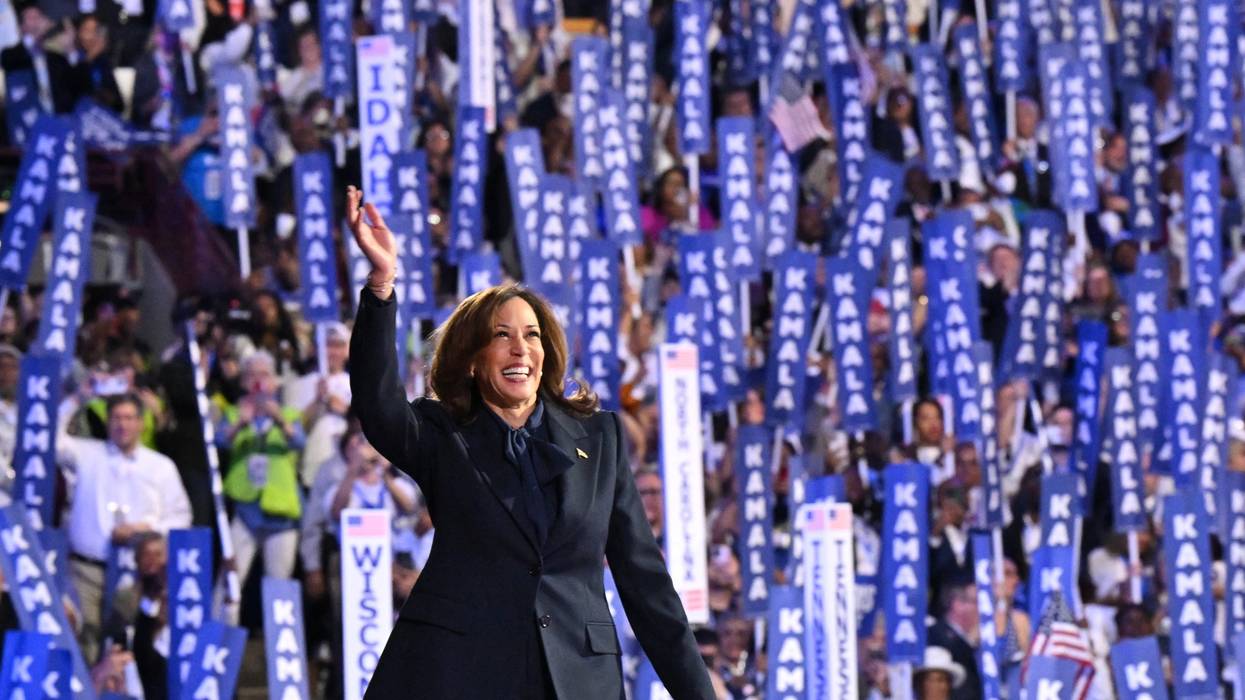
In the crazy, refracted light of bent and broken images, Kamala Harris can simultaneously be part of the administration sending billions of dollars of weaponry to the IDF, and also grieve for those innocents crushed under Gazan rubble.
I suffered through much of the three nights of non-reality programming called the 2024 Democratic National Convention. I watched nearly the whole fucking thing—the jugglers, acrobats, gladiator contests, cock fighting, and the dancers too. I sat mesmerized by an unlimited bounty of bread and circus offerings—lions and Christians, tight-rope walkers and card tricks—I might have been the only person on Earth to view pretty much the entire presentation.
Not exactly the whole thing—I walked my dog, checked baseball scores, spaced out and thought strange things, leafed through my brand new copy of
The Complete Poems of Emily Dickinson—but I came back to the DNC like a musician circling back to a particular theme or motif. And what a spectacular and awful show it was!
It resembled an extended commercial, an infomercial, perhaps, but it also seemed a bit like a funeral where people shuffle to the podium to convey memories that have been denuded of objective content—at a funeral no one wants to hear about DUI arrests and domestic battery, we only want the good stuff about how the departed climbed a tree and saved a kitten.
U.S. Vice President Kamala Harris was given a magnificent send off to the land beyond the sun. We walked away knowing that she is a saintly woman at worst, and the daughter of God sent to save us at best. We heard not mere praise, but blessings, confessions, tears, and astonishment interspersed with tunes from Stevie Wonder, Pink, John Legend, and Sheila E! But what kind of funeral concludes with the deceased in the flesh, telling her own story? And what a story she told, being born into the almost Calcutta-style poverty of the Berkeley flats.
In the physically impossible dreamscape of DNC fantasy, Kamala Harris can say in a single paragraph that she will feed the military industrial complex as if she were a zoo keeper with a bucket of meat entering a cage of famished tigers, and at the same time, fight climate change.
I know something about the mean streets of West Berkeley myself, having lived on Channing Way between Bonar and Browning for over a decade. On the flat plains of Berkeley homes now can be purchased—if you are goddamn lucky—for a hair under a million dollars. But I lived there in the 80s and 90s and Kamala would have been long gone by the time my wife and I moved to the west coast.
The Berkeley flats (as I experienced them 40 years ago) cannot be placed in the usual system of class categories, for Berkeley existed just outside the normal boundaries of our four-dimensional universe. It simultaneously exhibited working class, middle class, and upper-middle class features in some bizarre overlapping glitch of the matrix. On our block lived two doctors, a factory foreman, a preschool teacher, a single grandmother on public assistance, and the proprietor of a crack house. Kamala, in her DNC acceptance speech, attempted to pass herself off as a onetime lower-middle class child oppressed by the disrespect endured by her parents—two immigrants of color.
Kamala wowed us all with social class contortions in which a family headed by two academics with doctorates can be passed off as the embodiment of disadvantage. In the DNC rhetoric of the day, we heard nothing of class, but only about race and immigration status. We were expected to be shocked that Kamala and her younger sister, Maya, somehow, against all odds, excelled in school and went on to elite law schools.
Of course, this is the American myth that corrupts our national soul—the idea that we live in a meritocratic democracy in which all the layers of status reflect pure work ethic, and privilege has no part in the outcome (you know—the meritocracy in which Donald Trump became a self-made man). I would have had so much more respect for Kamala Harris if she had looked the nation in the eye and said:
I was born with two silver spoons in my mouth and you probably were not. My parents each held doctorates and high positions in the worlds of research and academia, and yours most likely have less than a bachelor's diploma. Still, despite having had encouragement to study hard and succeed every day of my childhood, I do my best to imagine what it would be like to grow up in a family that owned no books, and I try to put myself in the shoes of someone forced to muddle through school with no guidance and no expectations. Of course, that is not easy for me, because my hyper educated parents made it almost impossible to envision what it might be like to feel that you are a stranger in school. But I will do my best to step outside myself and wear your five-year-old Nikes.
In the fun-house mirrors of American political theater, one has to know that every moment of election programming amounts to a pile of bullshit. In the crazy, refracted light of bent and broken images, Kamala Harris can simultaneously be part of the administration sending billions of dollars of weaponry to the IDF, and also grieve for those tens of thousands (hundreds of thousands according to The Lancet) of innocents crushed under Gazan rubble. In the physically impossible dreamscape of DNC fantasy, Kamala Harris can say in a single paragraph that she will feed the military industrial complex as if she were a zoo keeper with a bucket of meat entering a cage of famished tigers, and at the same time, fight climate change.
With all the trapeze artists, ballet dancers, and magicians beguiling us with feats of virtuosity, two things remained conspicuously absent at the DNC convention—a voice representing the agony of Palestinians and Kamala's father. I had assumed that professor of economics, Donald Harris, must be long dead, but a quick run to Wikipedia proved that he still resides on our planet. Is Dr. Harris Kamala's Mary Trump—the alienated family member in charge of family skeletons? If so, he bears witness oddly in silence and does not forcefully deposit his obscure secrets in public as does Dr. Mary Trump. Does his absence speak of something ominous? Mary Trump lets loose her family secrets with no inhibition and little enlightenment. She tells us nothing about her putrid uncle that we don't already know.
But even more concerning, in a circus promising to lift all of humanity out of the muck of discouragement and horror, the failure of the directors and producers of the DNC extravaganza to produce a solitary, sympathetic Palestinian voice cannot be dismissed as an oversight. The blue honchos who must have meticulously agonized about a Palestinian speaker willing to say a reassuring word to amputate Kamala Harris from our doubts about her role in the ongoing genocide in Gaza—they all somehow came up with bupkis.
In an affair of mass manipulation, that must have cost the price of a nuclear delivery system, the DNC could not clear the one very low bar that absolutely needed to be stepped over. Millions of people waited futilely to hear that Kamala Harris would depart from President Joe Biden over the matter of supplying bombs to continue a genocidal attack on Palestinian civilians.
The great fear that many potential voters have is this: Behind the opaque curtain, the Wizard of Oz wears a Donald Trump puppet on one hand, and a Kamala Harris puppet on the other. A vote for either is a vote for more war, beefed up police spending, a military budget big enough to attack every inhabited planet within a hundred light years, and a vote to burn every drop of fossil fuel still buried in the lithosphere. Every vote is a vote for Oz.
There is another narrative, that I can't completely dismiss—that Donald Trump is a monster that makes every run-of-the-mill genocidaire into a comparative Fred Rogers. It may be that we have a choice between something murderously cold hearted and destructive and something much, much worse. Trump gives me the creeps in a way that Kamala Harris does not, but that may just be my own paranoid distortions. I worry about falling into a pond and coming face to face with a basking salt water crocodile wearing an orange wig.
Noam Chomsky called Trump the most dangerous person in human history, or something to that effect. How much longer do we kick the can down the road with the right-wing Democrats wearing their FDR masks, knowing that we get no universal healthcare, no safety net, endless war and CO2? Most of the people that I know agree with Chomsky and will be voting for Harris. I don't hold that against them. Trump scares the shit out of most people with an intact set of wits.
We live in a time of irreconcilable truths: Donald Trump is a putrid psychopath with no more internal complexity than a bullet in a chamber. Kamala Harris can mimic human emotions, but I am not convinced that she feels real pain.
Maybe the choice is whether or not to admit that we have no choice. Welcome to America.
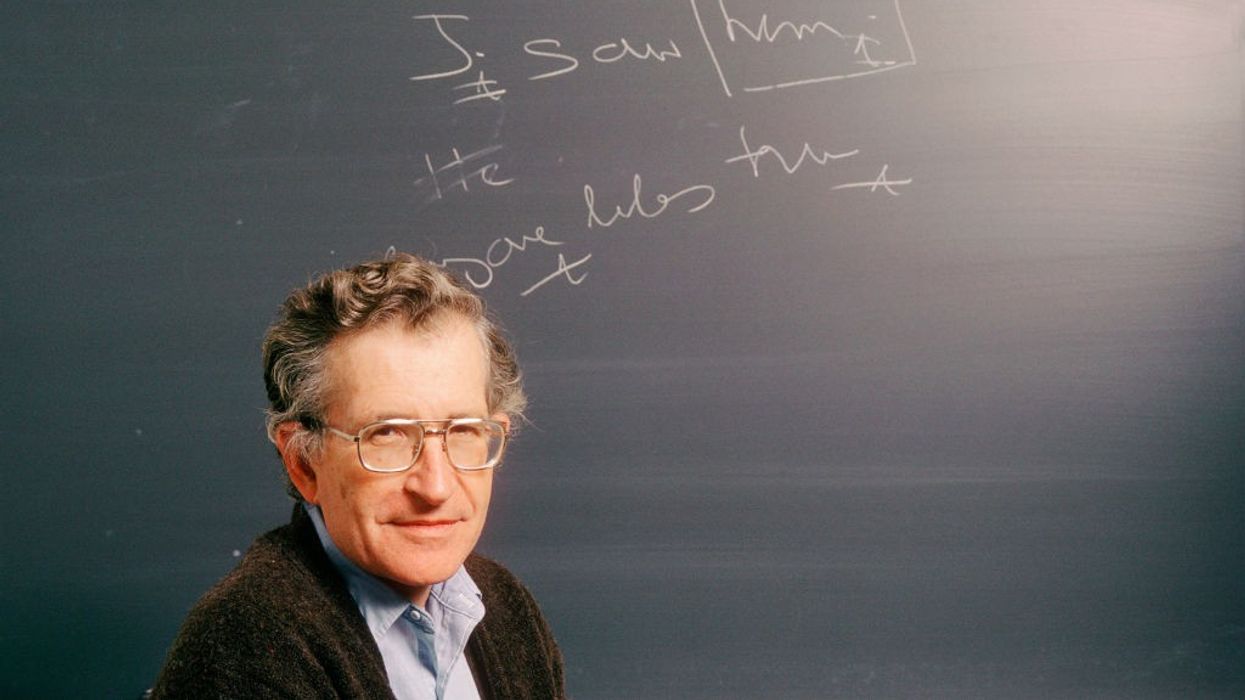
As Noam once said, “if you assume there is no hope, you guarantee there will be no hope.”
In many of his recent writings, Noam Chomsky has warned that humanity has reached a very dangerous point because we are now living in a world of cascading crises. Indeed, when we look around us, we see a global web of crises. Economic inequality is destabilizing democracies and making a mockery of the vision of a decent society; armed conflicts continue to mark human existence; and nuclear weapons and global warming threaten humanity’s survival. Meanwhile, we must feel aghast over the fact that cynicism and irrationality continue to define the mindset of the powers that be. This is precisely the reason why Chomsky has always seen activism as our only hope.
What’s happening in Gaza is an abomination, one that the leaders of this world are watching coldly from a distance. The same can be said about climate collapse, which is as real as the daily slaughtering of scores of innocent women and children in Gaza by Israel’s military. Our global institutions are incapable of doing anything meaningful about these crises. Real power is in the hands of the most powerful nation-states and their leaders have opted to turn a blind eye to both disasters so as not to disrupt business as usual. Profits and geostrategic interests take priority over human lives and the environment. This is as clear as day, and it has always been so since at least the emergence of capitalism and the rise of the nation-state.
The current conflict in Ukraine began on February 24, 2022, and peace remains as elusive as ever. The U.S. wants peace in Ukraine as much as Netanyahu wants to see a ceasefire deal in Gaza. The continuation of the war in Gaza is vital to the continuation of Netanyahu's political career. In fact, Netanyahu will most likely celebrate by uncorking a bottle of champagne if an all-out war exploded in the Middle East. He knows he can’t possibly lose with the U.S. backing Israel. The cost of an all-out war in terms of human lives, either Israeli or Iranian or Arab lives, is simply irrelevant to him--or to Washington. Or what another war might do to the environment. The war in Gaza is also a war on the environment; in fact, it is “a widespread and deliberate act of ecocide,” according to a study by Forensic Architecture.
Profits and geostrategic interests take priority over human lives and the environment. This is as clear as day, and it has always been so since at least the emergence of capitalism and the rise of the nation-state.
As Chomsky has pointed out, “ history is all too rich in records of horrendous wars, indescribable torture, massacres and every imaginable abuse of fundamental rights.” But the great man has gone to great lengths to stress that the climate crisis is “unique in human history” and, like nuclear weapons, can destroy organized human life as we know it. Yet, humanity spends annually trillions of dollars on weapons and the military but finds it economically unrealistic to devote the necessary funds to protect the earth.
So much for rationality.
Indeed, consider the global implications of the melting of the Antarctica sea ice. It may be winter in the Southern Hemisphere, but the Antarctica is experiencing a major heat wave that has made temperatures rise 50 degrees Fahrenheit above normal. This is the second major heat wave in Antarctica in the last two years. The entire planet has experienced more than 1.5 Celsius of warming in the 12-month period between July 2023 and June 2024, but Antarctica warms twice faster than the rest of the world, according to latest observations. If all the ice vanished, sea levels might rise by more than 150 feet.
It is no longer an issue of if but when major coastal cities will go under.
We already know that the super-rich and powerful don’t care about the rest of us, but it seems they also don’t care about the future of their own children and grandchildren. As Chomsky has underscored in some of the email exchanges that we’ve had, their self-gratification is even greater now that they know that the climate crisis is speeding toward catastrophe.
Indeed, as Copernicus Climate Change Service Director Carlo Buontempo recently said in connection with the new record set for the daily global mean temperature “we are now in truly uncharted territory…”
We already know that the super-rich and powerful don’t care about the rest of us, but it seems they also don’t care about the future of their own children and grandchildren.
And this brings us to the question of activism, which, as already pointed out, Chomsky sees as our only hope to save the planet. It’s our only way to stop carnages; our only way to stop the criminal negligence of climate collapse. We need the greatest possible degree of public mobilization for the purpose of exerting influence on policymakers. But without thoughtless methods like destroying works of art that turn the public against climate activism.
Moreover, Chomsky believes that we have the knowledge, money, and technology to transition from fossil fuels to alternative sources of energy that are clean, affordable and sustainable. This is why he feels that the Green New Deal is exactly the right idea and finds the Global Green New Deal initiative laid out by the progressive economist Robert Pollin particularly attractive.
As far as the link between capitalism and the climate crisis goes, suffice to say that Chomsky understands better than most the forces behind environmental degradation and climate collapse. The economic system of capitalism, especially during its neoliberal phase, drives climate breakdown. Global temperatures started increasing at an alarming rate after neoliberalism became the dominant economic force. Nonetheless, Chomsky is also fully aware of the fact that time is running out and we cannot wait for the end of capitalism before the planet can be saved. This is why he finds it so vital that we find ways to get the world off fossil fuels quickly and fairly. We must reach carbon neutrality no later than 2050. And do so in a just manner. For Chomsky, a just transition is imperative to building the political power that would bring about a shift from the fossil-fuel economy to a regenerative economy. Because, again, social activism is our only hope, according to what many have described as the “ world’s conscience keeper for nearly half a century.”
And, no, hope is not an option. As Noam once said, “if you assume there is no hope, you guarantee there will be no hope.”

The biosphere has been sent to hospice, and we are all on a morphine drip called election coverage.
In a recent column, Paul Street wrote how there "are plenty of deadly sirens in contemporary American life but few are as powerful as the savagely time-staggered big money corporate crafted narrow spectrum major party big media candidate-centered 'quadrennial [electoral] extravaganzas'—Noam Chomsky's term—that are sold to the masses as 'politics,' the only politics that matters."
Street is absolutely right. In the thousands of years of bread and circuses—from Roman gladiators to free internet porn—never have the masses been bought off by such vapid shtick.
This is our presidential election year, and a batshit crazy one with two demented geezers slobbering through a debate that would elicit head shakes and chuckles if it occurred in a bar or in the waiting room for a Peter Pan bus. Then one geezer gave up the ghost....I don't have to retell the story. You might not know the name of your home galaxy, but you know Kamala Harris and Donald Trump—you can hear their voices scratching and echoing in the passageways winding through your brain. You see their faces—as though they pressed up threateningly just inches from your nose.
If a mass shooter sprayed your local Big Y with gunfire you might offer a minute of thoughts and prayers, but then the election would gently bring you back to your reserved seat in the collective fantasy, because this election—just like all the others—will decide the fate of creation, the balance of force between democracy and Nazi wannabeism, and pretty much everything else. This election will determine if the greenness of trees, the blueness of skies, the beige hue of dirt and the wetness of water continues for another four years or not.
Now my porch light shines on a dead zone—no moths, no spiders, no nothing. When did this happen? A year ago? Five years ago? I wasn't fucking paying attention. Don't ask me. I am watching election coverage on MSNBC—where no one dares to talk about moths.
But I just discovered something so secretly horrific, that it demands our complete attention—turn off the election coverage. You might have discovered the exact same thing. It is the nature of collapsing cultures to keep secrets out in the open. The collapse itself is a secret, even when it loudly and openly proclaims itself. We are completely riveted to banal spectacles, to siren songs as Street writes, and almost nothing can bring us back to nominal reality. While we are diddling away time on this stupid election, the shit has hit the fan. What sort of jolt would slap us hard enough to wake us all up?
Maybe an alien invasion would knock the cobwebs aside. A techno-superior, intergalactic army of cosmic conquerors claiming our world for the flag of some nameless solar system at the far edge of the Laniakea Supercluster—that might reset our priorities. Let Trump build a wall between Andromeda and the Milky Way—and boast that Andromeda will pay for it.
Another thing that might alter our perspective would be a super volcano eruption. Human history has yet to see the fury that patiently gathers beneath the paper thin layers of crustal plates. We have had tiny pop-gun doses of tectonic rage like Vesuvius or Krakatoa, but never the real deal. If Yellowstone, Campi Flegrei, or Lake Toba blow their calderas, that might reorder our priorities in a hurry. I could describe the cubic miles of homicidal magma, the sulfuric, sun blocking emissions, and subsequent buildup of greenhouse gasses, but you can go to YouTube to savor a limitless collection of videos that recreate volcanic Armageddon with special effects.
Unfortunately, neither an alien takeover nor a super-volcanic display of cross continental lava can equal the destruction already hiding in plain sight.
Scientists tell us that greenhouse gasses now increase in atmospheric density at a speed ten times faster than the velocity created by Permian mega eruptions. The Siberian Traps super volcanoes (that drove the mother of all mass extinctions 252 million years ago) would sit on the bench of a dream team comprised of Exxon, Shell, Chevron, BP and Saudi Aramco.
Allow me to digress and obliquely approach my main point by going back in time - not deep time, but my own time. It is 1964 and I am a high school freshman playing basketball from sunup to sundown with hoop dreams percolating in my head. My two elder companions and summer league teammates (let's call them Doug and Dobie) walk along the border of North Hartford one evening and talk about their philosophy regarding girls and fighting. The topic is about unwritten rules - if you are out with a girl and someone makes a provocative remark, do you stare him down, push him aggressively or throw a sucker punch? This discourse strikes me rather abstractly as I had never been "out with a girl.” The conversation makes me uncomfortable—my naivete will inevitably be targeted. Fortunately, the ritualized display of preening masculinity is preempted by a street light mounted on a telephone pole. Around the light, in a fluttering frenzy, fly thousands of moths.
The sheer number of them creates a mosaic of gyrating shadows at our feet. While each moth flaps silently, the utter mass of them, the aggregate force of weightless creatures, creates a dry, hissing sound—evil and magnetic. These creatures belong to the spirit world—a place greater than our lives of hoops, school and adolescent pretense. We all look up at the lamp and mutter "holy fuck."
That many beating wings have the capacity to induce awe that we don't normally associate with the lowly moth. Moths have, like all insects, the superpower of industrial breeding. They overwhelm the law of averages with such prolific egg production that the remnants of the hungry Mesozoic (birds) can't scarf their way to a mothless world. Moths can gather in dizzying swarms that mock mortality. These communities, swirling vortex-like around every light bulb, prove the strength of numbers.
The ancestors (Holometabola ) of moths and butterflies (Lepitoptera) evolved some 300 million years ago—as such, this superorder that emerged in the late Carboniferous has survived three of the five mass extinctions of deep time—specifically, the aforementioned end Permian, the Triassic and the Cretaceous/Paleogene. The worst, most murderous conditions that mother-nature can concoct in her most terrible moods have never derailed our fluttering masters of hard times.
Moths have evolved spectacular means of adjustment—including the ability to consume the nectar of flowering plants (which emerged in the Cretaceous) and the capacity to sense sonar waves emitted by bats that prey upon them. The leptitopterans have radiated into 180,000 species. This mind blowing fact might be weighed against the six and a half thousand mammalian species currently struggling to limp into the next century.
Moths are one of the most critical pollinators. They also break down rotting leaves and create fertile humus to nourish fields and forests. Their larvae (caterpillars) sustain countless famished species. Moths are the superglue holding the biosphere together—or rather, they once were.
Unfortunately, I have bad news. While I had my face buried in the internet, moths went extinct—at least the sorts that hovered about street lamps in clouds of organic confusion while Doug, Dobie and I looked on in wonder a mere six decades ago. The street lamps in Northampton, Massachusetts—where I now reside as an old man—are now empty, lonely, and silent places.
And in my backyard, funnel spiders would build their webs next to the porch light and grow to enormous sizes feasting on the moths that fell into their ancient traps. Now my porch light shines on a dead zone—no moths, no spiders, no nothing. When did this happen? A year ago? Five years ago? I wasn't fucking paying attention. Don't ask me. I am watching election coverage on MSNBC—where no one dares to talk about moths.
We have gotten the narrative ass backward. The dystopian story of human extinction formulated that we would destroy ourselves, and the bugs would be heirs to our misfortune. But no—the toxic brew of extermination is taking them out first. The good thing about mass extinction is that T-Rex and the Gorgonopsia had ambitious heirs. But we have created a mass extinction so powerful that heirs have become irrelevant - think about that for a moment. The degradation of nature is now threatening to be total. The toxic sludge, industrial fumes, agricultural poisons, plastics, greenhouse gasses, artificial light, nuclear waste and deforested wastelands have snuck up on us like a hooded assailant in a dark ally.
The dystopian story of human extinction formulated that we would destroy ourselves, and the bugs would be heirs to our misfortune. But no—the toxic brew of extermination is taking them out first.
My anecdotal musings may not suffice as an official signature on the Lepitopteran death certificate, but the experts say that bugs are collapsing at record rates—unprecedented in evolutionary history.
While I announce the complete demise of moths in my backyard and my street, a study in the UK has moth populations down 32% since 1968 in the UK. A study in Scotland puts the local moth decline at almost 50%.
A recent study in a small Florida city concluded:
Comparing the rural site with the greatest total abundance and the urban site with the lowest total abundance across the entire year, we documented a 68% reduction in caterpillar frass mass, an 80% reduction in pooled micro-moth abundance, and a staggering 97% reduction in pooled macro-moth abundance.
Macro-moths means simply, big moths. The decline in population referenced above is not about a reduction across time, but a comparison between populations in urban parks and rural woodlands. Proximity to human beings has not gone well for moths.
And it’s not just moths—it’s all insects. Researcher, Francisco Sanchez-Bayo regarding insect population declines, told The Guardian in 2019: “It is very rapid. In 10 years you will have a quarter less, in 50 years only half left and in 100 years you will have none.”
So scientists have been talking about a total insect genocide for a while now, and after a lifetime of obliviousness, I suddenly notice that the moths that have existed in vast numbers throughout my life—creatures that have flourished by the trillions of trillions for almost half the time since the "Cambrian Explosion" have now dropped dead in a finger snap. I could write about birds, bees, butterflies or a million other clades, orders and species getting fucked by humanity’s satanic religion—capitalism.
Imagine yourself going to the doctor for a routine checkup and being told that you have metastatic cancer. "It is in your bones, your brain, in your blood and has colonized the organs in your body." The biosphere has been sent to hospice, and we are all on a morphine drip called election coverage.
I don't know if Kamala Harris and Donald Trump are going to debate, but I am certain that if they do, neither one will say a word about dead and dying moths. Insects are the proletariat of the planet's organic systems, and you can depend on US politicians not to talk about the working class.
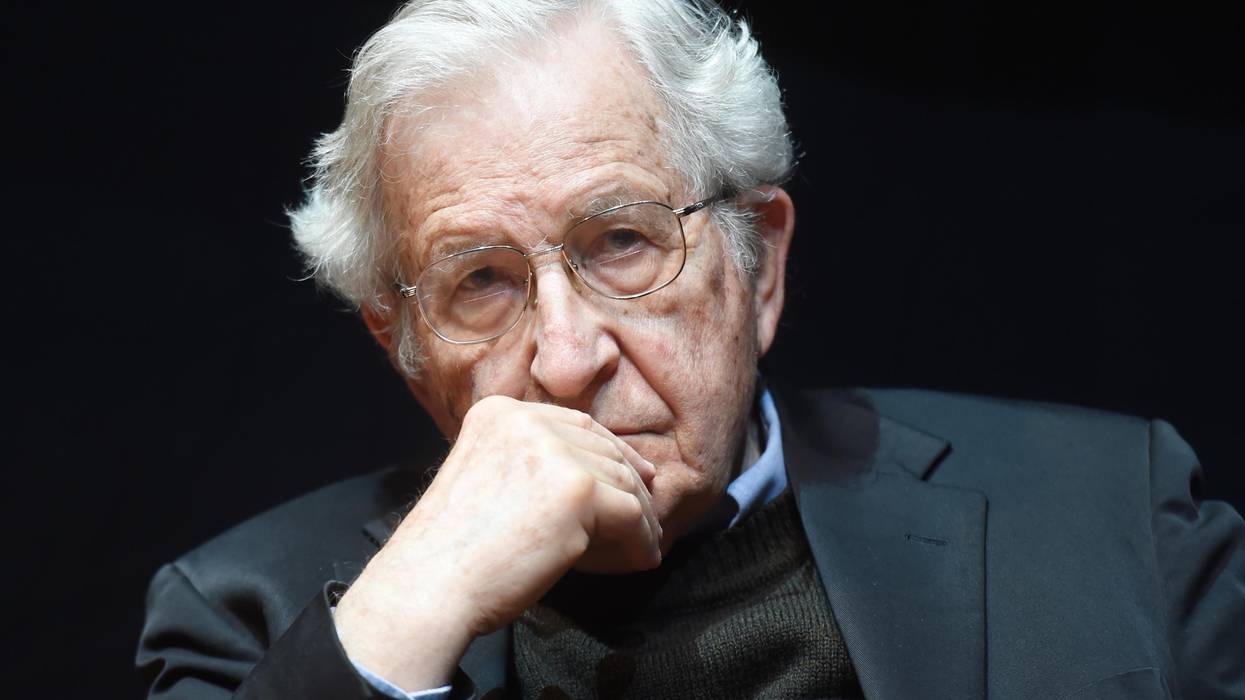
"Shameful and sad that Valéria Chomsky had to deny news of Noam Chomsky's death," said one Brazilian academic who spoke to the renowned leftist's wife.
Some popular media outlets and international political figures came under fire Tuesday for falsely reporting the death of U.S. academic and social critic Noam Chomsky, who is fighting to recover in Brazil after suffering a massive stroke last year.
"Chomsky did not die. I just spoke to Valéria, his wife," said Brazilian journalist Cauê Seigner Ameni.
"He is well," Valéria Chomsky confirmed to ABC's Chris Looft.
Beneficência Portuguesa de São Paulo, a hospital in Brazil's largest city, said in a statement that Chomsky was discharged on Tuesday to continue his treatment at home, according to The Associated Press.
The New Statesman ran—and subsequently deleted—a Chomsky obituary Tuesday following rumors of the 95-year-old's passing. Other outlets including Jacobin kept or tweaked Chomsky obits, with telltale signs like the word "obituary" in their URLs belying their inaccuracy.
Commentators from across the political spectrum also posted reaction—from mournful on the progressive left to gleeful among liberals and right-wingers—to false reports of Chomsky's death.
"Shameful and sad that Valéria Chomsky had to deny news of Noam Chomsky's death over the phone here in Brazil, because a bunch of places decided to publish pre-written obituaries and posts at the first online rumor," Brazilian academic Sabrina Fernandes said on social media.
"Since no outlet that reported the death decided to post an errata, it only got worse," she added, condemning "the online scoop and attention industry... waiting... like vultures."
Responding to numerous reports of Chomsky's death in the Latin American corporate media, Andrew Kennis—a journalism and social media professor at Rutgers University whose book Digital Age Resistance contains a foreword co-authored by Chomsky—told Common Dreams that "it is both a fitting and cruel irony that the fundamentally flawed, trillion-dollar-valued, conglomerate-owned, mainstream news media system has once again erred in its ways."
"No, Noam is not dead. Instead, he's struggling to recover with the unflagging dedication of his partner, who transported him the first chance Noam's health permitted her to do so to receive top-rate medical care in Brazil," Kennis added.
Some observers worked the title of one of Chomsky's more than 100 books—Manufacturing Consent, which he wrote with Edward Herman—into their commentary on the false reports.
"Chomsky is NOT dead. If Chomsky was dead, he would be turning in his grave to see how quickly rumors spread and how social media functions," said Croatian philosopher and Chomsky collaborator Srećko Horvat. "He might as well still call it: 'manufacturing obituaries'."
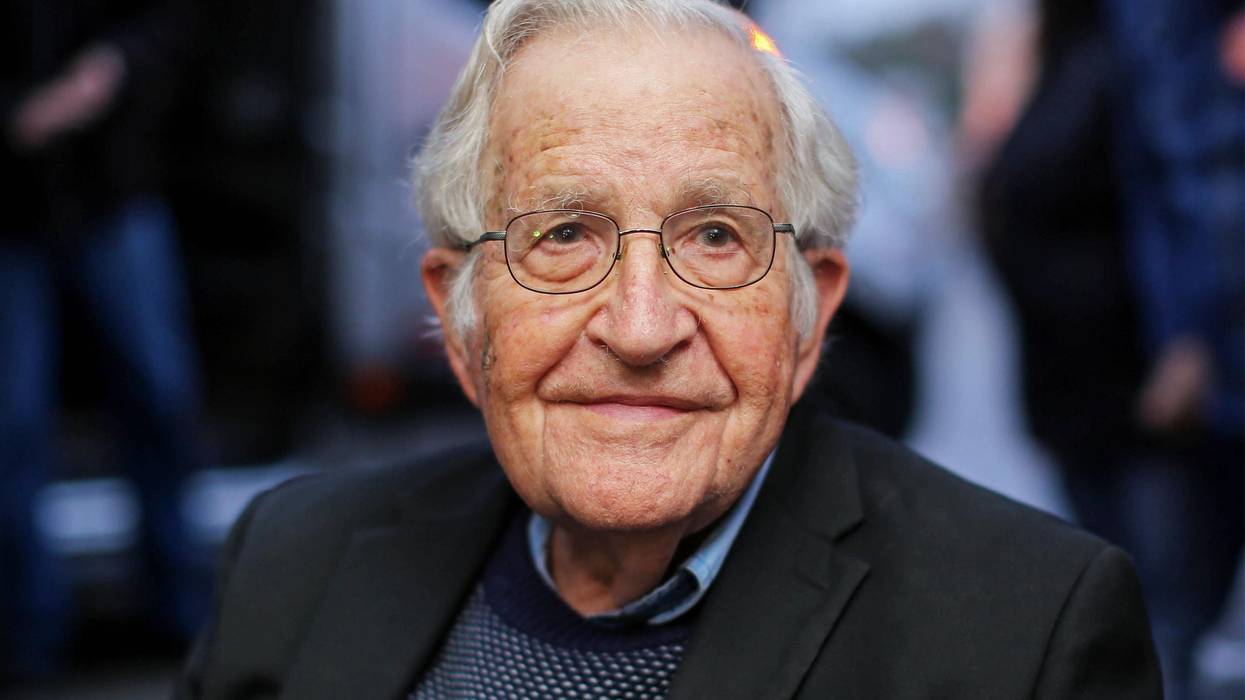
"So many thousands of people have stories about how he has changed their lives," said one admirer. "He certainly changed mine."
News that renowned American linguist, dissident, and author Noam Chomsky is hospitalized in Brazil following a massive stroke he suffered last year was met with an avalanche of accolades and well wishes from members of the international left on Wednesday.
Valeria Chomsky told The Associated Press that her 95-year-old husband—a laureate professor at the University of Arizona and professor emeritus at Massachusetts Institute of Technology (MIT)—is currently in a São Paulo hospital. She took him there on an ambulance jet with two nurses after he was able to travel from the United States following his June 2023 stroke.
Chomsky told Folha de São Paulo that although her husband has difficulty speaking and the right side of his body is numb from the stroke, he follows the news and "when he sees images of the war in Gaza, he raises his left arm in a gesture of lament and anger." She said his condition has improved significantly, and he is seeing a neurologist, speech therapist, and pulmonologist daily.
However, people close to Chomsky say he is unlikely to return to public life.
"Noam is the most influential U.S. intellectual ever. Period," Rutgers School of Communications Professor Andrew Kennis—whose book Digital Age Resistance contains a foreword co-authored by Chomsky—told Common Dreams.
"He has been the largest influence on my life in any way, personal or professional" Kennis added. "As for movements, no other thinker helped positively shape and mold anti-imperialsm analysis and criticism of the U.S. bullying the world on behalf of Wall Street and Silicon Valley better and more effectively than him."
"His work has defined the terms of countless debates and he's been a tireless advocate for—and guide on the path to—a better future."
U.S. journalist and political analyst Anand Giridharadas hailed Chomsky—whom he interviewed in 2020—as a "lion of the left."
"It would be difficult to overestimate the impact Chomsky's work has had," Giridharadas wrote for The.Ink Wednsday. "Beyond the total transformation of his academic field (he's widely acknowledged as the father of modern linguistics and the main force behind the cognitive turn in the sciences), his political impact has been immeasurable."
"As a writer, activist, analyst, and critic of power, and likely the most visible left public intellectual of the late 20th and early 21st centuries, his work has defined the terms of countless debates and he's been a tireless advocate for—and guide on the path to—a better future," he added.
Of the more than 100 books published by Chomsky—who was once voted the world's top public intellectual in an international poll—four are specifically about Israel and Palestine. He has been conspicuously absent from the debate over Israel's current assault on Gaza, which is the subject of an International Court of Justice genocide case.
Current Affairs founder and editor Nathan Robinson—who is the co-author of Chomsky's forthcoming book, The Myth of American Idealism: How U.S. Foreign Policy Endangers the World—said earlier this week on social media that "Chomsky has been unbelievably kind over the years I've known him."
"He treats everyone as an equal. Doesn't care who you are," he continued. "He would give as much of his time to a high school student as some celebrity or New York Times reporter. And devoted himself to attacking cruelty and injustice."
"When I started a tiny lefty magazine with only a few subscribers, he bought a subscription, blurbed us, and would email if his copy didn't show up," Robinson recalled. "He provided countless generous blurbs to authors publishing with tiny presses, giving them a boost that could really help them."
"So many thousands of people have stories about how he has changed their lives," he added. "He certainly changed mine."
Over the decades and with few exceptions, in major U.S. media—notably unlike major media in most of the rest of the world—Chomsky has been persona non grata.
One of the rare times that Noam Chomsky’s name has been mentioned on a big national NPR program came two months ago. On “Weekend Edition” in mid-October, a week into Israel’s murderous assault on civilians in Gaza, a correspondent reported while visiting a bookstore owned by a Palestinian in Jerusalem: “I’m seeing a lot of books by Noam Chomsky.”
Across the globe, people suffering from illegitimate power and violence have a lot of books by Noam Chomsky. A recent interviewer aptly introduced him this way: “One of the world’s most-cited scholars and a public intellectual regarded by millions of people as a national and international treasure, Chomsky has published more than 150 books in linguistics, political and social thought, political economy, media studies, U.S foreign policy and world affairs.”
Ever since his meticulous writing and strong activism against the U.S. war on Southeast Asia in the 1960s and ’70s, Chomsky has been exposing Orwellian and often-deadly maneuvers by the most powerful government on Earth. Along the way, he has been tireless, humanistic, and uncompromising.
For many decades, the core of corporate greed and militarism has remained basically the same. So has the core of Chomsky’s message.
In 1982, while visiting Philadelphia, he appeared as a guest on “Fresh Air”—back then only a local program on WHYY Radio. Host Terry Gross asked: “Your radical thoughts in linguistics completely changed the field. Your radical thoughts in politics hasn’t completely changed America. Has it been interesting for you to watch how your contribution to politics and linguistics has or hasn’t affected things?”
For many decades, the core of corporate greed and militarism has remained basically the same. So has the core of Chomsky’s message.
“I see them very differently,” Chomsky replied. “For one thing, in my view, linguistics is -- well, it’s basically a branch of sciences, it’s hard intellectual work. Political analysis is not, quite frankly. I think it’s easily within the range of an ordinary person who doesn’t have any particular training and is simply willing to use common sense to pay attention to the available documentary record and to use a little diligence in searching beyond what’s on the surface.”
Chomsky continued: “There’s an elaborate pretense that this is an area that must be left to experts. But that’s simply one way of protecting power from scrutiny. So, my own interest in political analysis and writing and so on is simply to bring information to people who I think can use it for the purposes of changing the world.”
His anti-elitism has endured, and so has enmity from some elites. One response is to block access to mainstream media. “Fresh Air” is a case in point. A search of the program’s full archive shows that after it went national on NPR in the mid-1980s, “Fresh Air” never interviewed Chomsky again. The program’s local interview with him back in 1982 was the first and last.
With few exceptions, in major U.S. media—notably unlike major media in most of the rest of the world—Chomsky has been persona non grata.
A key reason is Chomsky’s implacable opposition to the many wars of aggression that the U.S. government has launched or supported. And a particularly unacceptable deviation from approved views has been his illuminating condemnations of Israel’s historic and ongoing suppression of Palestinian rights. For several decades, as a result, vast quantities of hostility and distortion have been directed at him.
Here's a sample: In the mid-1990s, the longtime host of NPR’s “All Things Considered” program, Robert Siegel—operating within a lofty “public radio” bubble—wrote a letter to the industry newspaper Current declaring that Chomsky “evidently enjoys a small, avid, and largely academic audience who seem to be persuaded that the tangible world of politics is all the result of delusion, false consciousness, and media manipulation.”
Chomsky, who turned 95 last week, has been spotlighting the inherent and expansively violent cruelties of Zionism for a very long time. His landmark 1983 book “Fateful Triangle: The United States, Israel and the Palestinians” dispelled many readers’ illusions about the goals and consequences of U.S. support for Israel.
In 1986, journalist David Barsamian launched “Alternative Radio” -- a national one-hour program that got underway by bringing Chomsky’s voice to listeners around the United States and far beyond. In the nearly 40 years since then, the weekly show has aired several hundred speeches and interviews with Chomsky (whose website also overflows with a cornucopia of vital information and analysis).
“Solidarity is not some abstract concept for him,” Barsamian told me. “If you needed advice, a signature, a check, a fundraising talk, Noam would be there.”
Behind the scenes, working with Chomsky for so long while seeing him interact with a wide array of people, “what always impressed me was his kindness and decency,” Barsamian said. “Behind the mental acuity, stunning level of knowledge, and intellectual brilliance is a mild-mannered gentle man. Working with Noam over many years has been the most rewarding experience of my life.”
If you ever receive an email from David Barsamian, the bottom lines of it will be this quote from Noam Chomsky: “If you assume that there is no hope, you guarantee that there will be no hope. If you assume there is an instinct for freedom, that there are opportunities to change things, then there is a possibility that you can contribute to making a better world.”
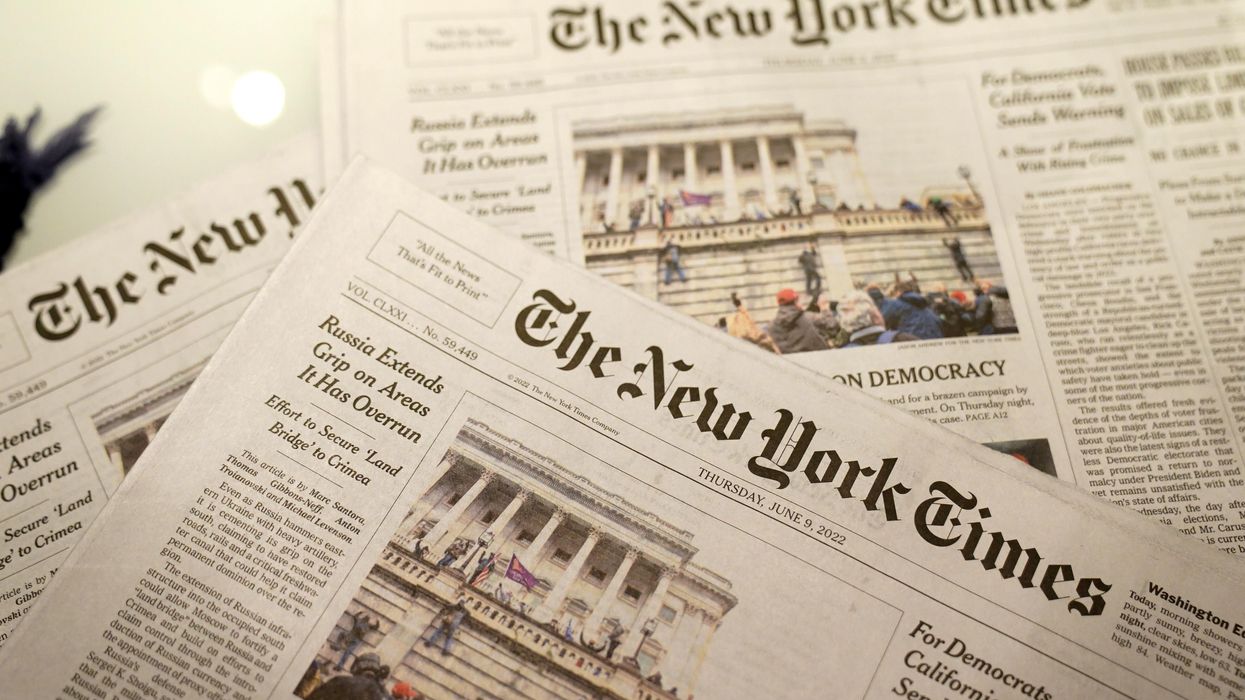
The editors from the "paper of record" write as if from a parallel universe in which the United States has had nothing to do with provoking and sustaining the conflict in Ukraine.
On September 17th, the Sunday edition of the New York Times featured an editorial entitled “How to Support Ukraine Beyond the Next Election.” “Open discussion is essential to shoring up support for the country from Congress and the American public,” read the hard copy subheading, spelling out a foregone conclusion at odds with the notion of democratic exchange that “open discussion” seems meant to signify.
Evidently, any input that might undermine “support” (which the editors go on to specify should be understood as “full support against Russia’s unprovoked invasion”) is supposed to be excluded. So, what is allowed in this debate, according to the Times editorial board? First and foremost, an admission that Ukraine is lagging on the battlefield, that polls reveal diminishing support for further U.S. investment in a losing fight, and that how to end the war has become a hot topic prompting “sometimes nasty” discussion. Or, to put it more bluntly than the Times ever would, measures must be taken lest the public grow disenchanted with the dollar drain required to pay for endless bloodshed, particularly given the obvious failure of Ukraine’s much-hyped counter-offensive.
The Times’s massaging of stale talking points to adapt to unfortunate facts on the ground is a diversionary tactic.
In a sign of things to come later in the piece, which could serve as a textbook example of massaging consent (my term for the job of maintaining manufactured consent in good working order), the editors don’t acknowledge the striking fact that 55% of respondents to a CNN survey released on August 4 opposed further Ukraine funding. Instead, hinting at the pro-war trope that dismisses anti-war sentiment as an exclusively right-wing phenomenon, they cite the poll’s finding that “among liberals, 69 percent back more funding, but only 31 percent among conservatives do.”
The editorial’s crux—the place, so to speak, where the massage therapist bears down on a key trigger point--is a passage slipped in just before the conclusion. Approvingly remarking that the U.S. is negotiating “long-term security commitments” under which to continue arming Ukraine, the editors signal an endless proxy war despite the vanishing probability of battlefield success. Rather than encouraging a genuine peace settlement so Ukraine and Russia might enjoy a future free of civil war, cross-border raids, and the threat of another large-scale conflict, they effectively endorse the Biden administration’s latest bid to keep on targeting Russia.
Clearly, given the Times’s position as the “newspaper of record,” this editorial life-raft for the Pentagon signals concern from on high that messaging on expenditures of upwards of $115 billion taxpayer dollars requires deft massaging to succeed with an increasingly skeptical public. On a more profound level, it hints at anxieties surrounding desperate yet unflagging efforts to retain U.S. dominance as the sole superpower. Having toiled valiantly to manufacture consent (see, for example, this recent article by FAIR’s Bryce Green), the Times now doubles down.
How do the editors pull it off, I wondered? How do they construct an alternate reality so seamlessly fashioned that at first glance it appears impenetrable? These people deserve the cynical compliment famously delivered by Humphrey Bogart’s Sam Spade to a lying lady villain in The Maltese Falcon: “You’re good. You’re very good.”
Taking a closer look, I was struck by the deft deployment of dodgy assumptions that solicit reader complicity. Who would be so churlish as to question, for instance, that the U.S. operates from the noblest of motives? Who has the temerity to complain of the contradiction in calling for open debate while simultaneously forbidding inquiry into basic matters like the stubborn refusal of our policy-makers to engage in diplomacy?
The editors write as if from a parallel universe in which the United States has had nothing to do with provoking and sustaining this conflict. Never mind that it set the wheels of destruction in motion by encouraging Ukraine to join NATO, thus crossing a red line for Putin, who had made it clear that he would not invade if the alliance refused Ukraine’s membership.
Perhaps nervous about the litany of US and NATO provocations, the editors omit any mention of other relevant history, including the U.S. role in the 2014 Euromaidan coup that launched a civil war in the Donbass. Their resort to the hackneyed phrase “Russia’s unprovoked invasion” is yet another sign of their eagerness to forestall uncomfortable questions about that record.
In this universe, the U.S. is not a “decider” but only a kindly upholder of Ukrainian agency, despite having sabotaged a draft peace agreement that might have ended the war in March-April 2022 with a Russian withdrawal in exchange for a pledge of Ukrainian neutrality; despite having either perpetrated or colluded in the destruction of the Nord Stream pipelines; despite having pressured an ill-prepared and reluctant Ukraine to begin its disastrous counter-offensive; and despite being the major funder of this conflict, to the profit of our military-industrial overlords.
Ignoring the obvious fact that the war would already be over absent said funding, the Times insists that “the United States is in no position to compel [the warring parties] to come to the table.” To top it all off, "an open [sic] debate,” on the war must have the objective of ensuring a manifest impossibility: that the U.S. will assist Ukraine to arrive at the negotiating table in tiptop shape after many more months or years of hideous carnage. “In the end, there is no way to tell how long it will take for peace talks to reach the horizon,” the Times concludes from its lofty perch. “America’s duty is to help ensure that Ukraine reaches that point strong and free, and that support can be sustained only by an open discussion and an informed public.”
Never mind that Ukraine is already badly weakened, not only by its massive battlefield losses but by the decimation of its infrastructure and the departure of many millions of war refugees. Never mind that the Zelensky government has banned opposition parties, silenced independent media, failed to counter the significant influence of fascist elements in the military and society at large, and persecuted homegrown peace activists, falsely claiming they are “Russian propagandists.”
Righteously indignant at so many manipulations, I rushed to submit a scathing reader comment, but was halted in my tracks by the truthful simplicity of another reader’s take. Someone identified as Daniel from Boston had posted: “This editorial doesn’t mention ‘death,’ or ‘casualties’ or anything like that even once. But every minute, every hour, and every day, huge numbers of people are dying at the front. [Meanwhile] The lines have barely shifted in 9 months….The barbarism of the conflict simply cannot be understood by Americans at home here in the U.S. imagining the potential success of another stirring offensive.”
This gets to the heart of the matter. The Times’s massaging of stale talking points to adapt to unfortunate facts on the ground is a diversionary tactic. Maintaining the U.S. public’s consent to Ukraine’s destruction as a means to target Russia requires, as always, obscuring not only the actual objectives of our foreign policy but the hideous, ever-mounting human toll it inflicts.