SUBSCRIBE TO OUR FREE NEWSLETTER
Daily news & progressive opinion—funded by the people, not the corporations—delivered straight to your inbox.
5
#000000
#FFFFFF
To donate by check, phone, or other method, see our More Ways to Give page.


Daily news & progressive opinion—funded by the people, not the corporations—delivered straight to your inbox.
"Taking away a child's freedom and deliberately putting them in these conditions is unconscionable, as is denying a parent their most fundamental role of providing their child with a loving and nurturing environment."
Private prison companies in the United States can hardly contain their excitement as the Trump administration moves to revive the practice of detaining migrant families at facilities with records of horrifying abuses, a decision that advocacy groups say highlights the White House's disdain for human rights as it carries out its large-scale assault on immigrants.
"Reopening family detention facilities with devastating histories of abuses, trauma, and long-term psychological damage underscores that cruelty is the point of these Trump administration policies," Amy Fischer, director of the Refugee and Migrant Rights Program at Amnesty International USA, said in a statement Thursday after CBS News reported the administration's moves.
According to CBS, Immigration and Customs Enforcement (ICE)—newly empowered by President Donald Trump—"was detaining the first group of migrant parents and children" on Thursday "in a detention facility in Texas designed to hold families with minors."
"The group includes three children," the outlet added, citing an internal government report.
Separately, NBC News reported Thursday that "U.S. immigration agents are planning a new operation to arrest migrant families with children as part of a nationwide crackdown."
"During the 2024 presidential campaign, Trump and border czar Tom Homan said that plans for mass deportations would initially focus on migrants who had committed crimes," NBC observed. "The new plans for national operations show that many of the families and children to be targeted do not have criminal histories."
As part of the revival of family detention—which was used by the Obama administration and the first Trump administration, and largely ended by the Biden administration—immigration officials are "refitting" two Texas facilities, including the notorious detention center in Dilley, Texas.
CoreCivic, a private prison company, has been newly contracted by ICE to reopen the facility for family detention.
"I've worked at CoreCivic for 32 years, and this is truly one of the most exciting periods in my career," Damon Hininger, CoreCivic's CEO, told investors last month.
George Zoley, executive chairman of the GEO Group, said last week that "we've never seen anything like this before," referring to the speed with which the Trump administration is moving to procure contracts for migrant detention.
The New York Times reported Friday that "a GEO Group subsidiary gave more than $2 million to Republican PACs that accept unlimited donations, with the bulk going to groups that supported House Republicans and Mr. Trump."
"It is enraging to see the Trump administration reinstate family detention, a policy of jailing immigrant parents with their children—including babies."
The Detention Watch Network noted that while the Dilley center was "in operation for family detention, there were reports of foul water and negligent medical treatment, with hospitals confirming that children are consistently released with health issues they dubbed 'Dilley-ish.'"
"In 2018, a 19-month-old girl, Mariee, tragically died after leaving the facility, and in 2019, a guard was accused of physically assaulting a 5-year-old," the organization said.
Sen. Jeff Merkley (D-Ore.) wrote earlier this week that he visited the center in December 2018 and "it was horrifying."
"The cruelty and abuse of Trump's family detention policy is a lasting stain on our nation," Merkley wrote on social media. "I'm calling on the admin to reverse this decision—in no world should this facility reopen."
Setareh Ghandehari, advocacy director of the Detention Watch Network, said Thursday that "it is enraging to see the Trump administration reinstate family detention, a policy of jailing immigrant parents with their children—including babies."
"Detention is harmful and traumatic for everyone, but especially children," said Ghandehari. "Families should be able to navigate their immigration cases in community with support services provided and facilitated by local community-based groups—never Immigration and Customs Enforcement (ICE), an enforcement agency that is plagued by egregiously poor conditions and a culture of violence."
"Taking away a child's freedom and deliberately putting them in these conditions is unconscionable, as is denying a parent their most fundamental role of providing their child with a loving and nurturing environment," Ghandehari added. "Family detention, like all immigration detention, is inhumane, unjust, and unnecessary. Everyone, certainly children and their parents, deserves to freely and safely move for opportunity and stability."
"No amount of rebranding can change the fact that Rahm Emanuel's political career has been an abject failure—neoliberal centrism is exactly the wrong direction for the Democratic Party," said one critic.
Progressives were left fuming and flummoxed over reporting Friday that Rahm Emanuel is considering running for chair of the Democratic National Committee, with many leftists wondering whether the party has learned anything from its loss of the White House, Senate, and, arguably, the country's working-class voters.
Axios first reported that Emanuel—President Joe Biden's ambassador to Japan and a former congressman, Chicago mayor, and chief of staff to former President Barack Obama—is mulling whether to seek the top DNC post. Current DNC chair Jamie Harrison, who was elected to the post in 2021, is unlikely to seek a new term, which would begin in March.
Emanuel has some powerful backers among the war-and-Wall Street wing that has dominated the Democratic party for decades.
"If they said, 'Well, what should we do? Who should lead the party?' I would take Ambassador Rahm Emanuel, and I would bring him back from Japan, and I would appoint him chairman of the Democratic National Committee," prominent political consultant David Axelrod, who ran both of Obama's successful presidential campaigns, said Wednesday on his podcast.
Axelrod followed up the next day with a post on X, the social platform formerly known as Twitter, in which he wrote of Emanuel, "Dude knows how to fight and win."
Reaction came fast and furious, with Jonathan Cohn, policy director at the group Progressive Massachusetts, asking on the social network Bluesky, "How is this not a sick joke?"
Center for International Policy executive vice president Matt Duss, a former foreign policy adviser to Sen. Bernie Sanders (I-Vt.) writing on X that "if you assembled a team of top scientists and told them to come up with a plan to ensure that the Democratic Party continues to lose working-class voters, I doubt they could do better than 'Make Rahm Emanuel head of the DNC.'"
Comedian, author, and podcaster Kate Willett
said on X: "If I had to pick one individual who set the stage for what seems like it may be decades of Trumpism, it's Rahm Emanuel. Imagine if Obama had saved peoples' homes in 2008 and put the bankers in jail? Truly fixed healthcare? Rahm worked diligently to make sure that didn't happen."
Miles Kampf-Lassin, the senior editor at the progressive website
In These Times, wrote, "I've said it before and can't believe I have to say it again: No amount of rebranding can change the fact that Rahm Emanuel's political career has been an abject failure—neoliberal centrism is exactly the wrong direction for the Democratic Party."
Hafiz Rashid argued Friday in a
New Republic article that, if he wins the post, Emanuel could be "the worst possible DNC chair."
"The fact that Emanuel has been disconnected from local and state politics for years... seems unlikely to help," Rashid asserted. "Democrats are currently expected to tap someone with expertise at the grassroots level and an understanding of how Democrats are winning elections now—two things Emanuel sorely lacks."
Apparently questioning the strategic wisdom of Vice President Kamala Harris' failed Democratic presidential run, Warren Gunnels, a staff director for Sanders,
said on X, "Ruling Elite: Let's get Dick Cheney's endorsement and anoint Rahm Emanuel as DNC Chair."
"One word," he added. "No."
"Meanwhile, the U.S. government STILL hasn't provided compensation or other redress to people tortured by U.S. troops in Iraq," said one observer. "These three men are the lucky few."
Two decades after they were tortured by U.S. military contractors at the notorious Abu Ghraib prison near Baghdad, three Iraqi victims are finally getting their day in court Monday as a federal court in Virginia takes up a case they brought during the George W. Bush administration.
The case being heard in the U.S. District Court in Alexandria, Al Shimari v. CACI, was first filed in 2008 under the Alien Tort Statute—which allows non-U.S. citizens to sue for human rights abuses committed abroad—by the Center for Constitutional Rights (CCR) on behalf of three Iraqis. The men suffered torture directed and perpetrated by employees of CACI, a Virginia-based professional services and information technology firm hired in 2003 by the Bush administration as translators and interrogators in Iraq during the illegal U.S.-led invasion and occupation.
"This lawsuit is a critical step towards justice for these three men who will finally have their day in court."
Plaintiffs Suhail Al Shimari, Asa'ad Zuba'e, and Salah Al-Ejaili accuse CACI of conspiring to commit war crimes including torture at Abu Ghraib, where the men suffered broken bones, electric shocks, sexual abuse, extreme temperatures, and death threats at the hands of their U.S. interrogators.
"This lawsuit is a critical step towards justice for these three men who will finally have their day in court. But they are the lucky few," Sarah Sanbar, an Iraq researcher at Human Rights Watch, wrote on Monday. "For the hundreds of other survivors still suffering from past abuses, their chances of justice remain slim."
"The U.S. government should do the right thing: Take responsibility for their abuses, offer an apology, and open an avenue to redress that has been denied them for too many years," Sanbar added.
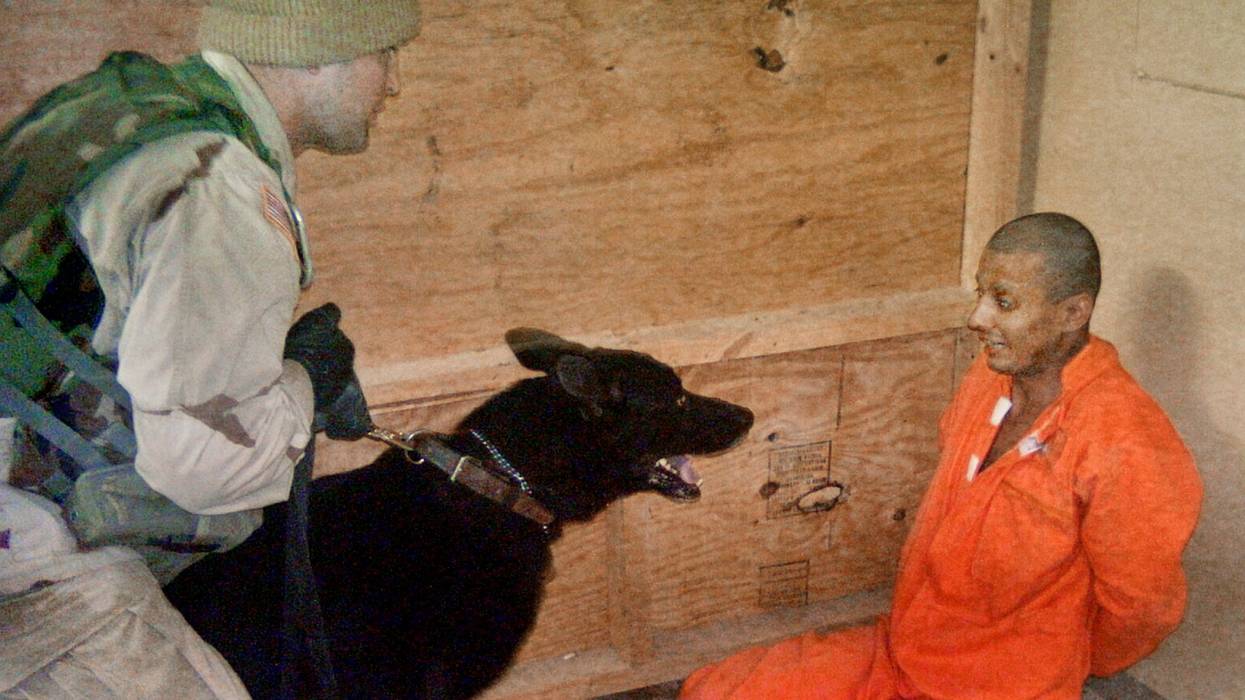
U.S. military investigators found that employees of CACI and Titan Corporation (now L3 Technologies) tortured Iraqi prisoners and encouraged U.S. troops to do likewise. Dozens of Abu Ghraib detainees died in U.S. custody, some of them as a result of being tortured to death. Abu Ghraib prisoners endured torture ranging from rape and being attacked with dogs to being forced to eat pork and renounce Islam.
A May 2004 report by Maj. Gen. Anthony Taguba concluded that the majority of Abu Ghraib prisoners—the Red Cross said 70-90%— were innocent. In addition to thousands of men and boys, some women and girls were also jailed there as bargaining chips meant to induce wanted insurgents to surrender. Some of them said they were raped or sexually abused by their American captors; lesser-known Abu Ghraib photos show women being forced to expose their private parts. Some female detainees were reportedly murdered by their own relatives in so-called "honor killings" after their release.
Eleven low-ranking U.S. soldiers were convicted and jailed for their roles in the Abu Ghraib torture scandal. Brig. Gen. Janis Karpinski, the prison's commanding officer, was demoted. No other high-ranking military officer faced accountability for the abuse. Senior Bush administration officials—who had authorized many of the "enhanced interrogation techniques" used at prisons including Abu Ghraib and Guantánamo Bay—lied about their knowledge of the torture. None of them were ever held accountable.
Bush's successor, former President Barack Obama, promised to investigate—and if warranted, to prosecute—the Bush-era officials responsible for the torture that had become synonymous with the War on Terror. Instead, the Obama administration protected them from prosecution.
In 2013, L3 Technologies agreed to pay $5.28 million to 71 former Abu Ghraib detainees who were subjected to sexual assault and humiliation, rape threats, electrical shocks, mock executions, brutal beatings, and other abuse.
The following year, the 4th U.S. Circuit Court of Appeals overturned a lower court ruling prohibiting Abu Ghraib torture victims from suing U.S. companies implicated in their abuse. But the court later reversed itself, finding the case had sufficient ties to the United States to be heard in an American court. The suit was later dismissed under the political question doctrine, which prevents courts from ruling on issues determined to be essentially political.
However, in 2016, a 4th Circuit panel ruled that "the political question doctrine does not shield from judicial review intentional acts by a government contractor that were unlawful at the time they were committed," allowing the Iraqis' case to proceed.
"This is a historic trial that we hope will deliver some measure of justice and healing for what President Bush rightly deemed disgraceful conduct that dishonored the United States and its values," CCR senior attorney Katherine Gallagher told The Guardian on Monday.
"In many ways, this case may be seen as setting a precedent for holding contractors accountable for human rights violations should they happen in other contexts, too," she added.
CACI—which denies any wrongdoing—has tried to get the case dismissed 20 times. The company still lands millions of dollars worth of U.S. government contracts. In February, Fortune included the firm on its "World's Most Admired Companies" list for the seventh straight year.
"Have we fully learned the lessons from this failed war of aggression, or are we doomed to repeat it?" the progressive lawmaker asked on the eve of the 20th anniversary of the U.S.-led invasion.
Congresswoman Ilhan Omar on Friday marked the upcoming 20th anniversary of the George W. Bush administration's invasion of Iraq—where thousands of U.S. troops remain today—by asking if Americans have learned anything from the "failed war of aggression" and warning that waging another such war will have even more dire consequences.
In a Twitter thread, Omar (D-Minn.) asserted that "20 years later, the Iraq War remains the biggest foreign policy disaster of our generation, one that took thousands of American lives and hundreds of thousands of Iraqi lives."
As Common Dreams reported Wednesday, the Costs of War Project at Brown University's Watson Institute for International and Public Affairs estimates as many as 580,000 people were killed in Iraq and Syria since 2003 and nearly 15 million people were made refugees or internally displaced by the war—which is forecast to cost a staggering $2.9 trillion by 2050.
The war was waged—under false pretenses against a country that had nothing to do with the September 11 attacks—by neoconservative Republicans in the Bush administration who since before 9/11 had sought a way to invade Iraq and oust erstwhile ally Saddam Hussein. The horrors of war and occupation included torture, indiscriminate killing, sex crimes, environmental devastation, and soaring birth defects caused by the use of depleted uranium weapons.
What then-White House Press Secretary Ari Fleischer called Operation Iraqi Liberation—OIL—devastated much of Iraq but enriched multinational corporations while creating a power vacuum that was eventually filled by Islamic State, whose rise to power in much of Iraq and neighboring Syria led to a second phase of the war launched during the administration of former President Barack Obama that continues today.
"Have we fully learned the lessons from this failed war of aggression, or are we doomed to repeat it?" Omar asked.
"Our foreign policy discourse remains fundamentally pro-war," Omar noted. "Think tanks (often the same ones who cheerled the Iraq War) outflank each other to justify armed conflict and derail diplomacy with adversaries like Iran."
Omar—whom Republicans recently ousted from the House Committee on Foreign Affairs—continued:
Instead of seeing China as a geopolitical challenge to be managed, politicians gin up jingoistic sentiment and nationalism to see who can be the most "anti-China."
Our spending on Pentagon waste and new weapons continues to rise uncontrollably—with weapons contractors wielding more lobbying power than ever in Washington.
Our national media too often treat war as a game—a way to juice ratings as fewer Americans turn into TV news—rather than the most horrific state of conditions to be avoided at all costs.
Claims from senior national security officials are reported as fact, even when no evidence for those claims is presented.
Much like the lost Iraqi lives lost were often ignored 20 years ago, we continue to ignore the pain and suffering of Black and Brown people in places like Syria, Yemen, Ethiopia, Myanmar, Haiti, and more.
"To truly be able to avoid another Iraq, we need a national reckoning with how we got into it the first place," argued Omar, who fled civil war in Somalia with her family when she was a child.
"We need accountability for those who got us into this war," Omar said. "But most of all we need to see all of our lives connected as part of the human fabric—to understand that the parent who loses a child in war could be us, that the child who is displaced could be our child."
"Because the next Iraq," she added, "will be even worse."
"If residents of East Palestine... truly knew the reality, a delegation of townsfolk would likely greet Trump with tiki torches and pitchforks," wrote one commentator.
Ahead of former President Donald Trump's Wednesday visit to East Palestine, Ohio—where a Norfolk Southern-owned train transporting carcinogenic chemicals derailed on February 3, prompting a mass evacuation and release of pollutants—progressive critics highlighted the key role his administration played in making the fiery crash and its toxic aftermath more likely.
During his speech, Trump—considered a leading GOP presidential candidate for 2024 despite spearheading a deadly coup attempt following his 2020 loss—criticized how President Joe Biden's administration has responded to the environmental and public health disaster unfolding in East Palestine, a poor rural town of about 4,700 people located a few miles west of the Pennsylvania border.
But as critics noted beforehand, the Trump administration's gutting of train safety rules at the behest of railroad industry lobbyists was instrumental in creating the conditions for the derailment and ensuing chemical spill and burnoff, which has provoked fears of groundwater contamination and air pollution.
"He should be apologizing to that community for his administration rolling back rail regulations," progressive stalwart Nina Turner, a former Ohio state senator, tweeted prior to Trump's address.
Philadelphia Inquirer columnist Will Bunch made a similar point in an opinion piece published earlier this week.
"If residents of East Palestine—a modern news desert of downsized or disappeared news sources, which allows misinformation to fester—truly knew the reality, a delegation of townsfolk would likely greet Trump with tiki torches and pitchforks," Bunch wrote, comparing the former president's visit to "the tendency of a criminal to return to the scene of his crime."
Bunch noted that "Trump acted specifically to sabotage a nascent government effort to protect citizens from the growing threat posed by derailments of outdated, poorly equipped, and undermanned freight trains that were increasingly shipping both highly flammable crude oil from the U.S. fracking boom as well as toxic chemicals like the ones that would derail in East Palestine."
"Trump had been in office for less than a year when he moved to kill the 2015 rule change initiated by the Obama administration that would have required freight trains to upgrade the current braking technology that was developed in the 19th century for state-of-the-art electronic systems," wrote Bunch, who pointed out that this came after Norfolk Southern and other rail carriers donated more than $6 million to Republican candidates in 2016 and spent millions more on lobbying.
"With the investigation into the East Palestine wreck still in its early phases, it's not clear if the modern brakes—originally required for installation by 2021—could have prevented the toxic derailment or whether the specific Obama rule would have applied," Bunch continued. "But experts do believe the new brakes could have mitigated the wreckage—and thus the release of so many hazardous chemicals."
"The rule reversal wasn't the only time that Team Trump sided with Big Rail over the forgotten Americans who live on the wrong side of their tracks," he added. "In 2019, for example, the Trump administration moved to not strengthen but relax regulations on shipping fracked natural gas through communities like East Palestine. The same year, Trump's White House also killed an Obama-era proposal that would have required two crew members in freight-train locomotives."
"The Trump approach to the rail industry was to let the companies do what they wanted, which was to avoid regulations, slash jobs, and extract profit."
Ahead of Trump's visit, More Perfect Union also argued on social media that the ex-president's "attempt to portray himself as a friend of the town and as someone who would have stood up to Norfolk Southern... couldn't be further from the truth."
As the progressive media outlet observed, the Trump administration "withdrew multiple rail safety recommendations and moved toward a 'self-regulatory approach' where rail companies could do as they pleased."
"It's no surprise that the Trump years were filled with dangerous deregulation," More Perfect Union asserted, describing his decision to nominate top rail industry executives to lead the Federal Railroad Administration and the Pipeline and Hazardous Materials Safety Administration as "a prime example of the revolving door between business and government."
"The Trump approach to the rail industry was to let the companies do what they wanted, which was to avoid regulations, slash jobs, and extract profit," the outlet continued. "This approach, and rail companies' greed, has led to over 1,000 derailments each year. Some are massive catastrophes like East Palestine. But every single one is harmful. And if the industry isn't regulated and forced to change, we'll soon be seeing more disasters."
When Trump "pretends to care about rail workers, or the people of East Palestine, we can't believe him," More Perfect Union added. "His record tells a very different story, the story of his own role in creating this problem in the first place."
Even some conservative critics of Trump have questioned the sincerity of his visit.
"It's clear that it's a political stunt," Ray LaHood, a Republican ex-member of Congress who led the U.S. Department of Transportation (DOT) during former President Barack Obama's first term, told Politico on Wednesday. "If he wants to visit, he's a citizen. But clearly his regulations and the elimination of them, and no emphasis on safety, is going to be pointed out."
Sen. Chris Murphy (D-Conn.) wasted little time in doing exactly that, calling the GOP's indignation "fake" soon after Trump announced his travel plans.
Bunch acknowledged that "it's beyond hypocritical for Trump to bring his Harold Hill-huckster shtick to East Palestine when residents are still experiencing headaches and breathing foul air from the kind of catastrophe he didn't lift a finger to stop from the Resolute Desk."
"But also it's a bit baffling why Biden or his Transportation Secretary Pete Buttigieg—who seems to be channeling his inner McKinsey & Co. these days—haven't gone to Ohio," he argued. "Especially when Trump and any other Republicans hoping to make political hay off of East Palestine's misery are coming to town empty-handed."
"None of the anti-Biden critics on this issue have offered a solution, because they can't," wrote Bunch. "The only fix for the kind of runaway abuses of modern capitalism that cause these environmental catastrophes is government regulation, aided by empowering worker safety with strong unions—two things that the Trump-led GOP has opposed at every turn."
Even in the wake of the disaster, Republican lawmakers have refused to demand stronger regulations, as HuffPost reported:
Rep. Bill Johnson (R-Ohio), a vocal Biden critic who represents East Palestine, on Tuesday dismissed immediate calls for stricter rail regulations, saying actions toward accountability will hinge on the findings of a National Transportation Safety Board [NTSB] investigation into the derailment.
"That will dictate whether there are laws, regulations that need to be changed, whether there were rules that were violated," he said during a news conference in East Palestine. "We don't know any of that yet, and we won't know that until NTSB releases its report."
Hours before Trump spoke, Buttigieg announced that he plans to travel to East Palestine on Thursday. His visit is expected to coincide with the publication of the NTSB's preliminary report about its ongoing probe into the crash.
"Trump and any other Republicans hoping to make political hay off of East Palestine's misery are coming to town empty-handed."
On Tuesday, Buttigieg unveiled DOT's recommendations for improving the safety of the nation's rail system, though an inter-union alliance of rail workers immediately criticized the plan as inadequate.
Given the scale of the problems—and in light of the transportation secretary's ongoing refusal to exercise his authority to reinstate previously gutted rules along with his consideration of an industry-backed proposal to further weaken the regulation of train braking systems—union leaders have called for nationalizing the railways and implementing their proposed solutions.
Turner, for her part, emphasized that she has "been outspoken about the two years the Biden administration had [to] fix these problems."
"The Trump administration is at fault, as is the Obama administration," Turner contended, referring to the fact that the latter's regulations were also watered down in response to industry pressure.
"The Ohio GOP is to blame as well," she added, echoing recent reporting on Norfolk Southern's campaign to influence state-level lawmakers and officials. "Failure at every level of government and multiple administrations led to this."
If Joe Biden wins in November, he will have no time to spare to shift our trajectory away from climate disaster. He will need to move quickly to install forward thinking, dynamic, and aggressive advocates for climate action, especially in his Treasury Department.
What does the Treasury department have to do with climate change? The short answer is the fossil fuel industry depends on financial institutions to survive. And banks, for their part, pull in big profits from underwriting climate disaster. The Treasury Secretary has untapped capacity to push Wall Street to take the risks of the climate crisis seriously. Biden's choice for Treasury Secretary is arguably among his most important climate policy decisions.
Wielding the tools of Treasury will require a Secretary who is committed to embracing climate action as a key part of their goals in office. A few names have been floated as potential Biden picks, including progressives like Sarah Bloom Raskin and Senator Elizabeth Warren, who have both made it clear that they would use all the tools available to a Treasury Secretary to combat climate change.
Also in the running is Lael Brainard, who has been one of the more influential, if under the radar, names in Democratic policy-making circles for the past two decades. The former Massachusetts Institute of Technology professor has served the past two Democratic Presidents and is a protege of the infamous deficit hawk and former Goldman Sachs executive Robert Rubin. During the Obama Administration, Brainard played a key role in the development and implementation of trade deals that were widely panned by labor and environmental groups.
Currently a member of the Federal Reserve's Board of Governors, Brainard has been touted as a savvy pick for Treasury Secretary in a potential Biden administration. In her role at the Fed, Brainard has pushed for sensible monetary policy that weighs unemployment rates at a similar level as inflation targets. Additionally, she has adopted a lonely position advocating for the continuation of strict regulatory measures that were introduced in the wake of the Great Recession.
Her energy on these fronts, however, makes her relative quiet on climate-related issues all the more conspicuous. Last year Brainard gave a speech outlining the impacts of climate change on monetary policy, financial stability, and community reinvestment. But when it came time to put words into action, she came up woefully short.
The COVID-19 pandemic's economic fallout has left the Fed as the arbiter at the center of practically every aspect of our economy, including the fossil fuel industry. When it chose to prop up that sector, Brainard went along with the wishes of Federal Reserve Chairman Jerome Powell. In fact, Brainard voted in favor of allowing the Fed's Main Street Lending Program (MSLP) to expand its lending criteria in a way that would enable more loans to fossil fuel companies, prompting criticism from environmentalists, lawmakers, and policy experts.
Brainard also supported expanding the Fed's Secondary Market Corporate Credit Facility (SMCCF). Administered by the notorious fossil fuel industry investor BlackRock, the Fed's SMCCF has purchased the debt of fossil fuel companies invested in some of the most notorious pipelines, including the Dakota Access Pipeline. Since the Fed's bailout, oil and gas companies have borrowed $100 billion from the bond market, according to a new report published by Friends of the Earth, Bailout Watch, and Public Citizen. The report also found that the Fed has purchased debt from 19 oil and gas companies, 12 of which have received downgrades on their securities from major credit rating agencies.
These decisions not only buoyed an industry that is contributing to the destruction of our environment, they also expose taxpayers to massive financial losses. If Brainard was being true to her words in her 2019 speech, she would have used her vote to dissent in 2020.
We cannot afford a Treasury Secretary who doesn't pursue every avenue to fight climate change. Whoever Biden picks must take aggressive action to prevent, mitigate, and prepare for the effects of climate change or else face a massive economic collapse on top of environmental disasters. Treasury has a number of tools at its disposal to ensure our economy remains stable in the face of a worsening climate crisis and an inevitable transition to green energy:
First and foremost, a Biden Treasury Department should use its research capacity to assess the risk of climate change on the economy and financial markets. Treasury's Financial Stability Oversight Council (FSOC), established by the 2010 Dodd-Frank financial overhaul law to monitor our nation's economic stability, can perform a thorough analysis of the economic effects of both the physical damage caused by environmental disasters and financial losses resulting from a transition away from fossil fuels. Financial regulators, including the Office of the Comptroller of Currency (OCC), the Federal Deposit Insurance Corporation (FDIC), the Securities and Exchange Commission (SEC) and the Federal Reserve, can then use this analysis to justify running stress tests to ensure financial institutions can endure losses associated with environmental disaster.
FSOC can also coordinate with financial regulators to implement regulation that ensures financial institutions are integrating climate risk analysis in their investment portfolios. This could include a number of measures, such as requiring banks to submit detailed public disclosures on their exposure to climate risks and their investments in the fossil fuel industry and conduct regular stress tests and, and increasing capital requirements. If it deems fossil fuel investments to be risky, FSOC can even give approval to the Fed to require financial institutions to divest completely from these assets, or urge the SEC to require credit rating agencies to integrate climate risk into their enforcement standards, according to a report published by The Great Democracy Initiative.
As the leading shareholder of the World Bank and a leader in other global financial institutions, Biden's Treasury Department should take a clear stance against fossil fuel investment on the international stage. This should include taking strong positions on emissions standards and spearheading efforts to invest in green energy development.
And of course the Treasury Secretary will help lead the administration's development of a plan to end the deep recession. We need a Treasury Secretary who overcomes the Bill Clinton and early Obama era Democratic technocrat's fixation on budget deficits that Brainard peers and colleagues like Robert Rubin and Tim Geithner exhibited. Austerity and the investments needed for a successful Biden Green New Deal are inherently incompatible.
Brainard has proved that she won't go to bat on climate issues at the Fed. How can we trust that she will, as Treasury Secretary?
Until a few years ago, the word "occupation" was synonymous with power, imperialism and foreign invasion. Today, in the post-Occupy Wall Street era, more and more activists are using their physical presence to make demands. From Manhattan's Zuccotti Park to Tahrir Square in Cairo, occupation has become a powerful method of organizing.
One of the most dramatic such occupations is a growing encampment at the Cannonball River in North Dakota, where indigenous tribes are leading a coalition of environmental activists in protest over the building of a new crude oil pipeline.
The Dakota Access pipeline (DAPL) has stolen more than a name from American Indians ("Dakota" means "friendly" or "allied"). If built, it would pass under the Missouri River twice. The pipeline, which could leak, as many pipelines do, threatens to contaminate the drinking water, crops, and burial grounds of the Standing Rock Sioux tribe. Federal regulatory agencies, including the Army Corps of Engineers, quietly approved DAPL, transporting Bakkan crude oil from North Dakota through South Dakota, Iowa and Illinois.
Last November, President Obama rejected the Keystone XL pipeline, which would have transported tar sands oil from Alberta, Canada, to the U.S. Gulf Coast. The rejection was the result of a years-long, hard-fought battle by thousands of activists, many of whom made personal sacrifices, traveled long distances and were even arrested for their acts of civil disobedience.
DAPL, which is only seven miles shorter than Keystone would have been, has not received the same scrutiny. Now, the only thing standing in the way of the pipeline is a growing army of nonviolent protesters blocking construction. An occupation that began in April has grown to about 2,000 and is still growing. Members of the Standing Rock Sioux have set strict rules at the space they are calling Sacred Stone Camp: No weapons, alcohol, or drugs.
Members of other North American tribes, including Canadian First Nations, are traveling to the site in solidarity. Celebrities such as Leonardo DiCaprio, Shailene Woodle,y and Ezra Miller have lent their support. The protesters are standing firm, and more than 20 people have been arrested.
Jason Coppola, a filmmaker,r and journalist who has been covering the protests, explained in an interview with me that one of the most important aspects of this story is age-old: The U.S. government is violating its treaty obligations to Native American tribes. According to Coppola, "The Fort Laramie Treaty of 1868 guaranteed complete and total access, undisturbed access, [of the land] to the Great Sioux Nation of the Oceti Sakowin [Seven Council Fires]." But that treaty has not been respected. The U.S. National Archives and Records Administration explains how--as a result of an expedition led in 1874 by Gen. George Armstrong Custer in search of gold on the Black Hills reservation in North Dakota--"[t]o this day, ownership of the Black Hills remains the subject of a legal dispute between the U.S. government and the Sioux."
Coppola told me it is "important to see this fight in the broader context" because "the Lakota nation and its people have been fighting situations like this for a very long time." The DAPL dispute is not just about a pipeline running under a river. It is about the rights of the original inhabitants of the United States.
At a time when white-supremacist notions are re-emerging and a major-party presidential candidate is encouraging America to hate again, this battle of government and corporate power against Native American rights is an important reminder of the real power dynamics in the U.S. and of who has been denied rights since the founding of the country.
Earlier this year, a group of armed white men led by Ammon Bundy occupied the Malheur National Wildlife Refuge in Oregon for more than 40 days in protest of federal land ownership. Those occupiers, who garnered far greater mainstream media attention than the DAPL protesters, ignored the fact that the original stewards of the land they were claiming were members of the Burns Paiute tribe. The tribe fought for decades in court to gain rights to the land, only to be given a few hundred dollars per person as compensation.
By contrast, the very people that the U.S. has historically sold out and continues to betray lead the occupation in North Dakota. Just as it served the needs of white settlers in decades past, the government is putting corporate power and fossil fuel interests over Native American rights in the case of the DAPL project.
Energy Transfer Partners, the company building the pipeline, has launched a website with the innocent-sounding name of daplpipelinefacts.com. On it, the company touts seemingly optimistic economic gains, including the creation of "8,000 to 12,000 construction jobs" (contrasted with a mere "40 permanent operating jobs"). It echoes the standard claim of "energy independence" by liberal politicians, saying that the pipeline will help the U.S. be "truly independent of energy from unstable regions of the world" because "every barrel of crude oil produced in the United States directly displaces a barrel of imported foreign oil."
Under the "frequently asked questions" section, the website asks: "What is Dakota Access Pipeline's commitment to protecting sensitive areas and the environment, such as wetlands and culturally important sites?" The lengthy answer addresses only concerns such as restoring seed banks and vegetative cover but says nothing about the "culturally important sites" it raises in its own question. The rest of the page focuses mostly on the concerns of private landowners. There is no mention whatsoever of the Standing Rock Sioux tribe. It is as if the tribe does not exist.
Obama claimed to set his administration apart from previous ones by partnering with Native American communities. He has made it a point to visit reservations, a rare act by presidential standards. In 2014, during a visit to North Dakota, he said he was "determined to partner with tribes ... on just about every issue that touches your lives." Indeed, his rejection of the Keystone XL pipeline could be viewed in light of that partnership (Oglala Sioux leader Bryan Brewer called Keystone "a death warrant for our people" during Obama's visit). In the last few months of Obama's administration, whether it will intervene to stop the DAPL despite the approval of federal permits remains to be seen.
Regardless, indigenous activists are determined to occupy their own land for as long as it takes to stop the construction of the pipeline. If they succeed, it will be one small measure of justice in a line of injustices going back to the founding of this nation.
When American firms dominate a global market worth more than $70 billion a year, you'd expect to hear about it. Not so with the global arms trade. It's good for one or two stories a year in the mainstream media, usually when the annual statistics on the state of the business come out.
It's not that no one writes about aspects of the arms trade. There are occasional pieces that, for example, take note of the impact of U.S. weapons transfers, including cluster bombs, to Saudi Arabia, or of the disastrous dispensation of weaponry to U.S. allies in Syria, or of foreign sales of the costly, controversial F-35 combat aircraft. And once in a while, if a foreign leader meets with the president, U.S. arms sales to his or her country might generate an article or two. But the sheer size of the American arms trade, the politics that drive it, the companies that profit from it, and its devastating global impacts are rarely discussed, much less analyzed in any depth.
So here's a question that's puzzled me for years (and I'm something of an arms wonk): Why do other major U.S. exports -- from Hollywood movies to Midwestern grain shipments to Boeing airliners -- garner regular coverage while trends in weapons exports remain in relative obscurity? Are we ashamed of standing essentially alone as the world's number one arms dealer, or is our Weapons "R" Us role such a commonplace that we take it for granted, like death or taxes?
The numbers should stagger anyone. According to the latest figures available from the Congressional Research Service, the United States was credited with more than half the value of all global arms transfer agreements in 2014, the most recent year for which full statistics are available. At 14%, the world's second largest supplier, Russia, lagged far behind. Washington's "leadership" in this field has never truly been challenged. The U.S. share has fluctuated between one-third and one-half of the global market for the past two decades, peaking at an almost monopolistic 70% of all weapons sold in 2011. And the gold rush continues. Vice Admiral Joe Rixey, who heads the Pentagon's arms sales agency, euphemistically known as the Defense Security Cooperation Agency, estimates that arms deals facilitated by the Pentagon topped $46 billion in 2015, and are on track to hit $40 billion in 2016.
To be completely accurate, there is one group of people who pay remarkably close attention to these trends -- executives of the defense contractors that are cashing in on this growth market. With the Pentagon and related agencies taking in "only" about $600 billion a year -- high by historical standards but tens of billions of dollars less than hoped for by the defense industry -- companies like Lockheed Martin, Raytheon, and General Dynamics have been looking to global markets as their major source of new revenue.
In a January 2015 investor call, for example, Lockheed Martin CEO Marillyn Hewson was asked whether the Iran nuclear deal brokered by the Obama administration and five other powers might reduce tensions in the Middle East, undermining the company's strategy of increasing its arms exports to the region. She responded that continuing "volatility" in both the Middle East and Asia would make them "growth areas" for the foreseeable future. In other words, no worries. As long as the world stays at war or on the verge of it, Lockheed Martin's profits won't suffer -- and, of course, its products will help ensure that any such "volatility" will prove lethal indeed.
Under Hewson, Lockheed has set a goal of getting at least 25% of its revenues from weapons exports, and Boeing has done that company one better. It's seeking to make overseas arms sales 30% of its business.
Good News From the Middle East (If You're an Arms Maker)
Arms deals are a way of life in Washington. From the president on down, significant parts of the government are intent on ensuring that American arms will flood the global market and companies like Lockheed and Boeing will live the good life. From the president on his trips abroad to visit allied world leaders to the secretaries of state and defense to the staffs of U.S. embassies, American officials regularly act as salespeople for the arms firms. And the Pentagon is their enabler. From brokering, facilitating, and literally banking the money from arms deals to transferring weapons to favored allies on the taxpayers' dime, it is in essence the world's largest arms dealer.
In a typical sale, the U.S. government is involved every step of the way. The Pentagon often does assessments of an allied nation's armed forces in order to tell them what they "need" -- and of course what they always need is billions of dollars in new U.S.-supplied equipment. Then the Pentagon helps negotiate the terms of the deal, notifies Congress of its details, and collects the funds from the foreign buyer, which it then gives to the U.S. supplier in the form of a defense contract. In most deals, the Pentagon is also the point of contact for maintenance and spare parts for any U.S.-supplied system. The bureaucracy that helps make all of this happen, the Defense Security Cooperation Agency, is funded from a 3.5% surcharge on the deals it negotiates. This gives it all the more incentive to sell, sell, sell.
And the pressure for yet more of the same is always intense, in part because the weapons makers are careful to spread their production facilities to as many states and localities as possible. In this way, they ensure that endless support for government promotion of major arms sales becomes part and parcel of domestic politics.
General Dynamics, for instance, has managed to keep its tank plants in Ohio and Michigan running through a combination of add-ons to the Army budget -- funds inserted into that budget by Congress even though the Pentagon didn't request them -- and exports to Saudi Arabia. Boeing is banking on a proposed deal to sell 40 F-18s to Kuwait to keep its St. Louis production line open, and is currently jousting with the Obama administration to get it to move more quickly on the deal. Not surprisingly, members of Congress and local business leaders in such states become strong supporters of weapons exports.
Though seldom thought of this way, the U.S. political system is also a global arms distribution system of the first order. In this context, the Obama administration has proven itself a good friend to arms exporting firms. During President Obama's first six years in office, Washington entered into agreements to sell more than $190 billion in weaponry worldwide -- more, that is, than any U.S. administration since World War II. In addition, Team Obama has loosened restrictions on arms exports, making it possible to send abroad a whole new range of weapons and weapons components -- including Black Hawk and Huey helicopters and engines for C-17 transport planes-- with far less scrutiny than was previously required.
This has been good news for the industry, which had been pressing for such changes for decades with little success. But the weaker regulations also make it potentially easier for arms smugglers and human rights abusers to get their hands on U.S. arms. For example, 36 U.S. allies -- from Argentina and Bulgaria to Romania and Turkey -- will no longer need licenses from the State Department to import weapons and weapons parts from the United States. This will make it far easier for smuggling networks to set up front companies in such countries and get U.S. arms and arms components that they can then pass on to third parties like Iran or China. Already a common practice, it will only increase under the new regulations.
The degree to which the Obama administration has been willing to bend over backward to help weapons exporters was underscored at a 2013 hearing on those administration export "reforms." Tom Kelly, then the deputy assistant secretary of the State Department's Bureau of Political-Military Affairs, caught the spirit of the era when asked whether the administration was doing enough to promote American arms exports. He responded:
"[We are] advocating on behalf of our companies and doing everything we can to make sure that these sales go through... and that is something we are doing every day, basically [on] every continent in the world... and we're constantly thinking of how we can do better."
One place where, with a helping hand from the Obama administration and the Pentagon, the arms industry has been doing a lot better of late is the Middle East. Washington has brokered deals for more than $50 billion in weapons sales to Saudi Arabia alone for everything from F-15 fighter aircraft and Apache attack helicopters to combat ships and missile defense systems.
The most damaging deals, if not the most lucrative, have been the sales of bombs and missiles to the Saudis for their brutal war in Yemen, where thousands of civilians have been killed and millions of people are going hungry. Members of Congress like Michigan Representative John Conyers and Connecticut Senator Chris Murphy have pressed for legislation that would at least stem the flow of the most deadly of the weaponry being sent for use there, but they have yet to overcome the considerable clout of the Saudis in Washington (and, of course, that of the arms industry as well).
When it comes to the arms business, however, there's no end to the good news from the Middle East. Take the administration's proposed new 10-year aid deal with Israel. If enacted as currently planned, it would boost U.S. military assistance to that country by up to 25% -- to roughly $4 billion per year. At the same time, it would phase out a provision that had allowed Israel to spend one-quarter of Washington's aid developing its own defense industry. In other words, all that money, the full $4 billion in taxpayer dollars, will now flow directly into the coffers of companies like Lockheed Martin, which is in the midst of completing a multi-billion-dollar deal to sell the Israelis F-35s.
"Volatility" in Asia and Europe
As Lockheed Martin's Marillyn Hewson noted, however, the Middle East is hardly the only growth area for that firm or others like it. The dispute between China and its neighbors over the control of the South China Sea (which is in many ways an incipient conflict over whether that country or the United States will control that part of the Pacific Ocean) has opened up new vistas when it comes to the sale of American warships and other military equipment to Washington's East Asian allies. The recent Hague court decision rejecting Chinese claims to those waters (and the Chinese rejection of it) is only likely to increase the pace of arms buying in the region.
At the same time, in the good-news-never-ends department, growing fears of North Korea's nuclear program have stoked a demand for U.S.-supplied missile defense systems. The South Koreans have, in fact, just agreed to deploy Lockheed Martin's THAAD anti-missile system. In addition, the Obama administration's decision to end the longstanding embargo on U.S. arms sales to Vietnam is likely to open yet another significant market for U.S. firms. In the past two years alone, the U.S. has offered more than $15 billion worth of weaponry to allies in East Asia, with Taiwan, Japan, and South Korea accounting for the bulk of the sales.
In addition, the Obama administration has gone to great lengths to build a defense relationship with India, a development guaranteed to benefit U.S. arms exporters. Last year, Washington and New Delhi signed a 10-year defense agreement that included pledges of future joint work on aircraft engines and aircraft carrier designs. In these years, the U.S. has made significant inroads into the Indian arms market, which had traditionally been dominated by the Soviet Union and then Russia. Recent deals include a $5.8 billion sale of Boeing C-17 transport aircraft and a $1.4 billion agreement to provide support services related to a planned purchase of Apache attack helicopters.
And don't forget "volatile" Europe. Great Britain's recent Brexit vote introduced an uncertainty factor into American arms exports to that country. The United Kingdom has been by far the biggest purchaser of U.S. weapons in Europe of late, with more than $6 billion in deals struck over the past two years alone -- more, that is, than the U.S. has sold to all other European countries combined.
The British defense behemoth BAE is Lockheed Martin's principal foreign partner on the F-35 combat aircraft, which at a projected cost of $1.4 trillion over its lifetime already qualifies as the most expensive weapons program in history. If Brexit-driven austerity were to lead to a delay in, or the cancellation of, the F-35 deal (or any other major weapons shipments), it would be a blow to American arms makers. But count on one thing: were there to be even a hint that this might happen to the F-35, lobbyists for BAE will mobilize to get the deal privileged status, whatever other budget cuts may be in the works.
On the bright side (if you happen to be a weapons maker), any British reductions will certainly be more than offset by opportunities in Eastern and Central Europe, where a new Cold War seems to be gaining traction. Between 2014 and 2015, according to the Stockholm International Peace Research Institute, military spending increased by 13% in the region in response to the Russian intervention in Ukraine. The rise in Poland's outlays, at 22%, was particularly steep.
Under the circumstances, it should be obvious that trends in the global arms trade are a major news story and should be dealt with as such in the country most responsible for putting more weapons of a more powerful nature into the hands of those living in "volatile" regions. It's a monster business (in every sense of the word) and certainly has far more dangerous consequences than licensing a Hollywood blockbuster or selling another Boeing airliner.
Historically, there have been rare occasions of public protest against unbridled arms trafficking, as with the backlash against "the merchants of death" after World War I, or the controversy over who armed Saddam Hussein that followed the 1991 Persian Gulf War. Even now, small numbers of congressional representatives, including John Conyers, Chris Murphy, and Kentucky Senator Rand Paul, continue to try to halt the sale of cluster munitions, bombs, and missiles to Saudi Arabia.
There is, however, unlikely to be a genuine public debate about the value of the arms business and Washington's place in it if it isn't even considered a subject worthy of more than an occasional media story. In the meantime, the United States continues to hold onto the number one role in the global arms trade, the White House does its part, the Pentagon greases the wheels, and the dollars roll in to profit-hungry U.S. weapons contractors.

The Situation Room, a commander-in-chief with rapidly graying hair, a cluster of grim-faced men and women debating the ethics and the legality of a killing. This is how the Obama administration has for years sought to portray its notorious global drone killing program: cautious, calculated and as conscientious as possible.
The Obama administration just released numbers suggesting this depiction is closer to reality than fiction. It announced that drone strikes in countries excluding Iraq, Afghanistan and Syria have resulted in between at least 64 and 116 noncombatant deaths during his administration. The president also issued an executive order effectively directing his successor to do as he is doing, and publish this data going forward.
This is a remarkable shift, even if you're skeptical of numbers this low. Human rights groups and the media have been seeking this information for years. The administration has always refused, citing national security. Instead of openly providing numbers, the administration leaked details about President Obama's personal involvement in decision-making. The public was asked to trust its law professor president. He was no mere mortal, deigning to play judge, jury, and executioner.
Today's announcement may simply reflect that President Obama doesn't trust his successors to be as scrupulous as he believes he has been. And no matter how one views the credibility of this data, that's a good thing: no president should have the authority to kill in secret. President Obama set a harmful precedent of doing just that, carrying out strikes on a kind of global battlefield, spanning Pakistan, Yemen, Somalia, and perhaps places unknown to us. Now, he's starting to dismantle his own dangerous legacy.
The new executive order means it will be harder for the next president to kill in total secrecy. After President Obama leaves, it will stay in effect unless his successor withdraws it. But to go backward on this commitment to disclose casualties annually, the next president would have to explain why - to a Congress that could be hostile, or simply thirsty for information about how the administration is handling counterterrorism operations.
Today's announcements could also have a ripple effect on the dozens of governments currently seeking to acquire drone technology. Obama's use over the last seven years set a disastrous global precedent: using a new weapons technology as an excuse to kill in secret and without regard for international law. Today's developments are an incremental but important step away from the notion that new technology is a license for secrecy - one that was all the more frightening because lethal autonomous robots and weaponized artificial intelligence, though still smacking of science fiction, are actually on the horizon.
The downside, though, is that the drone data could be completely misleading - and provide a veneer of legitimacy to unlawful killings. While Amnesty International has not compiled overall data on drone killings, we know that the law professor president depiction is, at best, only a part of the truth. There are reports of hundreds of unidentified people killed in apparent "signature strikes," where targeting decisions were made on the basis of patterns of behavior rather than identification of a specific individual. Amnesty International and other groups have also documented so-called rescuer strikes, where the US killed or injured individuals who were trying to help the victims of an initial strike.
We don't know how the US counted individuals killed in these strikes, or the basis for those decisions. But if the US presumptively counted all of them as "non-combatants," its data could be dramatically skewed. Indeed, without more information about the government's standards, it's impossible to reliably assess this data - or know whether it includes potentially unlawful killings like those we documented, such as the 2012 killing of a woman who was gathering vegetables in her family's mostly vacant field. If the Obama administration is serious about transparency, it should finally confirm or deny the killings we documented and say whether it counted these individuals as "noncombatants".
The drone numbers could also wrongly obscure how entrenched and systematic impunity has become. The CIA, an agency with an extremely poor record of accountability to the public, is still conducting strikes. Indeed, it is remarkable that on the heels of its abusive program of torture and secret detention under former president Bush, the CIA was entrusted with the authority to conduct hundreds of drone strikes, killing thousands of people. Its continued role is likely one reason we aren't getting fuller answers to our drone questions.
Today's disclosures aren't enough to guard against future CIA or government agency abuse. Congress, while welcoming the transparency, should scrutinize the drone casualty numbers. And the drone data should not be the government's last word on the impact of drone strikes: it should acknowledge, apologize and compensate civilian victims.
The communities that live at the other end of drone fire already suffer a peculiar invisibility in the US public's understanding. Media reports use sanitized terms like "compound" and "convoy". Raw numbers, like today's, could contribute to this process of erasure: we have numbers to assign to the people who were killed, and now the government has assigned categories to them, but no names. Without more, theirs are just the lives of others.
Since 2009, U.S. drone strikes have killed between 64 and 116 civilians in areas outside of active hostilities, the Obama administration claimed in a report released on Friday afternoon, just hours before the start of the Fourth of July holiday weekend.
That number of civilian casualties is much lower than the assessments of independent groups, including the Bureau of Investigative Journalism, which puts the number at between 380 and 801.
Indeed, said Jennifer Gibson of the international human rights group Reprieve: "The only thing those numbers tell us is that this Administration simply doesn't know who it has killed."
The report (pdf) was the subject of advance criticism. Human rights advocates doubted that the government would offer accurate accounting or, as the ACLU's Jameel Jaffer wrote this week, "provide the kind of specificity that would actually be useful to journalists, human rights researchers, and the general public. "
Such predictions appear to have been prescient, as the New York Times reported:
The report named Afghanistan, Iraq and Syria as "areas of active hostilities" excluded from the policy. A senior administration official said tribal Pakistan -- which the government treats as an extension of the Afghan battlefield in certain contexts -- is not such an area; so casualties there are part of the official civilian death numbers.
It is an open secret that the majority of America's drone strikes have taken place in tribal Pakistan as Central Intelligence Agency covert operations, which has meant that the administration's periodic pledges to be more transparent about targeted killings have not been completely fulfilled.
[...] The administration also declined to break down its retroactive estimate of civilian death by year, a decision that permits it to avoid fights about how it addressed several well-known American airstrikes that generated accusations of dozens of civilian deaths -- including one in Yemen in December 2009 and another in Pakistan in March 2011 that together would seem to surpass the low end of its range.
The names and stories of drone victims are also omitted from the report.
Bottom line, said Hina Shamsi, director of the ACLU's National Security Project in a press statement, "The American public can't be confident that the government is using lethal force legally and wisely with a disclosure that's so limited as to be virtually meaningless."
President Barack Obama also on Friday signed an executive order requiring the annual release of civilian casualties caused by drone strikes--described by the Guardian's Spencer Ackerman as Obama's "favored tactic of war"--by future presidents.
Responding on social media, drone experts cataloged how the report fell short.
"Today's casualty data release and issuance of the executive order is a concrete step in the right direction, but more information is still needed for the public to meaningfully evaluate the lawfulness and effectiveness of the targeted killing program," said Human Rights First's Rita Siemion.
"For data on the number of non-combatant deaths to be meaningful, the administration should clarify how it classifies individuals as combatants, name the armed groups those classified as combatants are alleged to be members of, specify the legal basis for using lethal force, and provide strike locations and dates," she added.
And while Friday's revelations may mark Obama "starting to dismantle his own dangerous legacy," as Amnesty International's Naureen Shah put it in an op-ed at the Guardian, "the drone data could be completely misleading--and provide a veneer of legitimacy to unlawful killings."
She wrote:
The drone numbers could also wrongly obscure how entrenched and systematic impunity has become. The CIA, an agency with an extremely poor record of accountability to the public, is still conducting strikes. Indeed, it is remarkable that on the heels of its abusive program of torture and secret detention under former president Bush, the CIA was entrusted with the authority to conduct hundreds of drone strikes, killing thousands of people. Its continued role is likely one reason we aren't getting fuller answers to our questions about drones.
Today's disclosures aren't enough to guard against future abuse by the CIA or other government agencies. Congress, while welcoming the transparency, should scrutinize the drone casualty numbers. And the drone data should not be the government's last word on the impact of drone strikes: it should acknowledge, apologize and compensate civilian victims.
The Obama administration's assessment comes just one day after Reprieve released a report exposing the U.S. government's pattern of lying about the human toll of its aerial bombing campaign.
Meanwhile, a former U.S. drone technician, who spoke out Thursday in Europe about the targeted killing program, described the report on Twitter as "complete & utter horse shit, as expected."