
SUBSCRIBE TO OUR FREE NEWSLETTER
Daily news & progressive opinion—funded by the people, not the corporations—delivered straight to your inbox.
5
#000000
#FFFFFF
To donate by check, phone, or other method, see our More Ways to Give page.


Daily news & progressive opinion—funded by the people, not the corporations—delivered straight to your inbox.
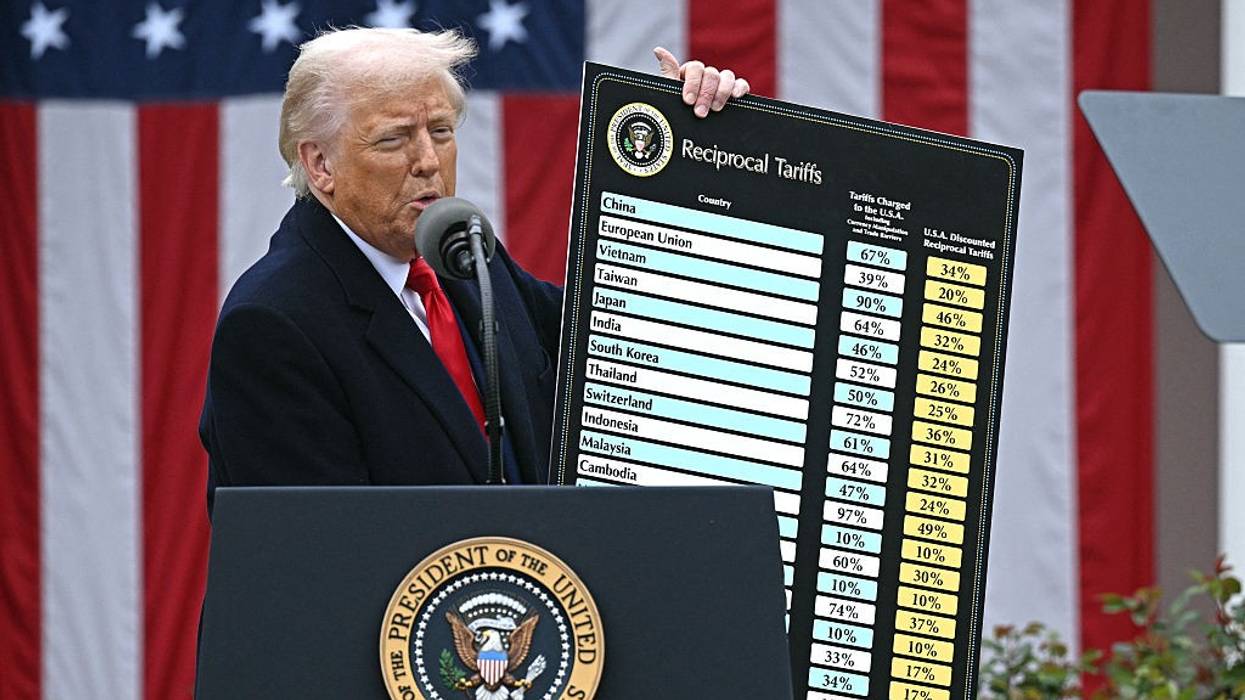
Trump’s tariffs are not a departure from business as usual; they are an extension of it and will overwhelmingly benefit the world’s financial elite.
Global trade systems are not free, nor are they neutral. They were built to facilitate capital transfer and to transfer wealth upward—benefiting the rich while harming workers worldwide. This arrangement can feel too big, too abstract, and too disconnected from our experience. For these reasons, and as a sociologist across decades and schools, I have facilitated this race to the bottom activity to help students understand the problems inherent to our complex global reality.
In the Transnational Capital Auction: A Game of Survival simulation, students role play as leaders of countries with less wealth than GDP leading nation states. They are instructed that they rely on trade and economic development from wealthier countries such as the United States and powerful transnational corporations.
Capital flight occurs when transnational corporations move their factory or industry from one geographical area to another in order to seek better conditions for their bottom line, profits, or for shareholders. These moves highlight the antagonism between the working class and the owning class. For example, in the activity, teams gain points when they satisfy corporate demands: being lax on child labor laws and environmental regulations, maintaining a low minimum wage and corporate tax rate, and suppressing unionization of workers. This is not just a game with hypothetical conditions, it is a microcosm which echoes real-world socioeconomic and political dynamics.
Rather than denying our power and privilege in order to justify more bad behavior, we need to do our part to realign around policies that are internationally, socially, and environmentally sustainable.
We have seen this play out domestically and internationally. Sociologists have documented how corporations leave the United States to go to places more favorable to capital. For example, when an area develops unions, industry can flee to what it considers a safer space for business. In this way, capital for transnational corporations can accumulate faster when workers’ rights and environmental policy is lax. These conditions have led to countless deaths, especially among women and people of color, and have fueled global climate destabilization. These corporations are helped by policies and loopholes such as international tax havens like Nauru.
The human cost of this system is staggering. Body-catching nets were installed around Foxconn buildings because workers were unaliving themselves by jumping off their job site. Women, including mothers, leave their families and countries in order to work in other locations where the wages are higher.
The unjust arrangements are often complex by design. There are free trade zones or “special economic zones” in places like Jamaica, which allow companies to operate under a different set of laws than the rest of their country—sometimes with fewer worker protections. Meanwhile, local markets neglect or dispose of their natural resources because of the flux of imported goods dictated by trade agreements.
To be sure, the global working class harmed by these lopsided systems includes American workers who have lost their jobs, houses, and communities through capital flight. And yet, American consumers love the low prices these systems enable. The products we rely on—the food, the technology, the entertainment—these things are not created in a vacuum, and they are also not free. We have access to fast fashion and too soon obsolete technologies because people spend their lives working in conditions and receiving wages that we would consider un-American. Yet they are so very American.
The United States is no one’s victim. It helped create the race to the bottom and continues to benefit from its downward spiral. Trump’s narrative, justification, and chaotic enactment of tariffs are more than problematic. They are not a departure from business as usual, they are an extension of it and will overwhelmingly benefit the world’s financial elite.
Change is needed. The United States needs to reevaluate its relationship with itself and as part of a global community. We need reciprocal, resilient, and renewable structures in place. We will not get there by the same policies of violence, domination, and extraction that got us to the asymmetrical and disproportionate power that we have now. Rather than denying our power and privilege in order to justify more bad behavior, we need to do our part to realign around policies that are internationally, socially, and environmentally sustainable. We can all start by reflecting on our personal commodity chains, which tether us to global enterprise and its bottom rungs.
The 50-plus years of neoliberal policies have undercut unions, deregulated industry, enabled wild corporate profits, padded the pockets of politicians, and enabled corruption.
When a leader has ignored the legislative and judicial branches of government, has made hundreds disappear like under Pinochet, has targeted people based on speech, and rules by executive order, there is no other way to describe them but as a dictator.
Who, then, is to blame for the American dictator’s rise? It’s neoliberalism, stupid.
The 50-plus years of neoliberal policies have undercut unions, deregulated industry, enabled wild corporate profits, padded the pockets of politicians, and enabled the revolving door whereby elected figures could become lobbyists after leaving office.
On the American dictator’s first day in office, he began dismantling democracy by creating an executive order to end the 14th Amendment’s guarantee of birthright citizenship.
Other neoliberal policies that have harmed the American people are free trade and the outsourcing of jobs. Complementing job loss from overseas, the unregulated development of industrial robots and AI has swallowed even more employment. The U.S. political leadership gave minimal attention to planning what would be next for the unemployed and underemployed that resulted from their job gutting policies.
Ever true to hyper-capitalist policies, the “market forces” were allowed to play out. So, service industry jobs became the default for many, although this industry, too, has seen the increase in “efficiency,” or using AI and machines rather than people. For those employed in the service industry, with its minimal benefits and lower salary, it’s a far cry from manufacturing and white-collar jobs that they would have likely had if not for the neoliberal agenda.
This has led to extreme economic and social precarity.
A corollary to neoliberal industrial policies was media deregulation, particularly the repeal of the Fairness Doctrine in 1987, which led to “The Rush Limbaugh Show” and a media ecosystem that allowed for the creation of Fox News and MSNBC.
For the less educated, it became more challenging to discern fact from fiction. People listened to outrageous media personalities who were often flat-out lying and began miming them in pointing to and decrying shadows on the wall. Rising demagogues made use of these scapegoat shadows, defining them as immigrants and those who oppose the Palestinian genocide.
Exacerbating decades of decline and a decade of xenophobic populism, inflation rose after the Covid-19 pandemic and was often misattributed to former U.S. President Joe Biden. The American people chose the alternative to Biden’s vice president even though President Donald Trump had ignited an insurrection against the United States on January 6, 2021, and embraced (with a wink) the extremist-right Project 2025 plan before the 2024 election.
On the American dictator’s first day in office, he began dismantling democracy by creating an executive order to end the 14th Amendment’s guarantee of birthright citizenship.
In just three months, the dictator has set to work destroying American democratic institutions and civil rights protections. And for this mammoth calamity, we have decades of neoliberal deregulation to thank.
What we are witnessing is not just economic decline—it is a calculated transfer of power, wealth, and dignity from the people who built this country to the corporate and political class who believe they own it.
America is not being lost. It's being taken.
Taken from the factory worker in Michigan whose job was shipped overseas. From the farmer in Indiana watching crops wither while markets close, subsidies disappear, and tariffs crush their bottom line. From the mother in Ohio who can't feed her children because her food stamps have been cut. From the young man in Kentucky forced to choose between insulin and rent. From the senior in Pennsylvania being told to drive to a Social Security office to collect their check—only to find their local office closed, and the nearest one hours away.
This isn't just mismanagement—it's betrayal.
We are not spectators. We are not statistics. We are the heart of this nation. And it's time we acted like it.
Major companies that were built by American labor—Ford, Caterpillar—are moving out. They're being driven out by a political agenda that's sent material costs soaring through reckless tariffs. To stay afloat, they chase cheaper labor overseas, leaving hollowed-out towns and broken families in their wake.
Meanwhile, politicians slash food assistance, threaten Social Security and Medicaid, and then have the audacity to tell us the economy is strong and it's in our best interest. They smile on TV while the working class suffers.
The elites in Washington tell us to be patient. To wait. That it's complicated. But we know what we see. Our communities are drying up. The jobs are gone. The wages are stagnant. Our groceries are more expensive. The promises are broken.
What we are witnessing is not just economic decline—it is a calculated transfer of power, wealth, and dignity from the people who built this country to the corporate and political class who believe they own it.
Consider the typical of a lifelong resident of a small town in Ohio. A person who worked at the local manufacturing plant for over 20 years, a job that provided her family with stability and a sense of pride. When the plant closed due to outsourcing, she found herself unemployed, struggling to make ends meet. The ripple effect was felt throughout the community—local businesses shuttered, schools faced budget cuts, and the town's spirit diminished. Her story is not unique; it's a narrative echoed in countless towns across America.
Politicians tout stock market highs and corporate profits as indicators of economic health, but these metrics are detached from the reality most Americans face. While the wealthiest accumulate more, the average worker sees little improvement. The gig economy grows, offering precarious employment without benefits or security. The middle class shrinks as the dream of upward mobility becomes increasingly elusive.
Enough.
We are not spectators. We are not statistics. We are the heart of this nation. And it's time we acted like it.
Get off your knees. Don't just sit on the couch and watch it happen. Rise up! Use your voice. Post your grievances. Use social media. Call your representatives. Write letters. Talk to your neighbor. See what's happening. What they're doing isn't how a country should treat its people—and it damn sure isn't right.
Rise up by showing up. At the ballot box. At the school board. At the union hall. At the town meeting. Wherever decisions are made, do what you can. Your presence matters.
Rise up because this country wasn't built by the connected—it was built by the committed. By steelworkers and carpenters. Nurses and truck drivers. Teachers and veterans. People who worked with their hands, loved with their hearts, and built the greatest nation on Earth.
It's time to take it back.
Take back our jobs. Demand fair trade policies that protect American workers and hold corporations accountable for outsourcing. Support local businesses and invest in community initiatives that foster economic resilience.
Take back our towns. Advocate for infrastructure projects that create jobs and improve our communities. Push for affordable housing and quality education that ensure a brighter future for the next generation.
Take back our dignity. Stand up against policies that favor the wealthy at the expense of the working class. Demand transparency and integrity from our leaders.
Take back our rights. Protect the social safety nets that safeguard our most vulnerable. Fight for healthcare, fair wages, and the right to organize.
And take back America.
We are many. Let them hear us. Let them know—we will not be silent.
To the politicians in power—the ones slashing our benefits, outsourcing our jobs, gutting our economy—then turning around and telling us it's for our own good... I've got one thing to say to you:
Don't piss on my leg and tell me it's rain.
Take Back America.
Faced with the largest student uprisings since South Africans toppled apartheid, President Jacob Zuma pledged Friday to halt tuition fee increases in 2016. This prompts declarations of victory and calls to continue the mass mobilizations until free education is achieved for all.
"A famous victory won by the hard struggle of students. We are all humbled," Salim Vally, associate professor of education and director of the Center for Education Rights and Transformation at the University of Johannesburg, told Common Dreams. "The determination and resoluteness of the students forced the hand of government. This was clear to many even before the sun rose this morning."
"Many lessons learned and an incredibly important educational experience for us all," Vally continued. "Foremost of which is that unity and mass struggle works."
Following a meeting with student organizers and university management, Zuma told reporters, "On the matter at hand, we agreed that there will be a zero increase in university fees in 2016."
The president's concessions were widely celebrated, but not everyone was satisfied. "We should have free education," said Bongani Shabangu, 18, who is studying at a Pretoria university, in an interview with The Irish Independent. Most of us are from poor families."
And, when large crowds rallied outside the main government complexes in Pretoria on Friday to demand that Zuma address them directly, police forces pelted them with water cannons, stun grenades, and tear gas.
What's more, many are still furious at police brutality against protesters and are calling for the government to drop steep charges levied against dozens of demonstrators who were detained.
Patrick Bond, professor of Political Economy at the University of the Witwatersrand in Johannesburg, told Common Dreams that students have won a "historic victory over South African neoliberalism."
However, he continued: "Other student demands remain outstanding: free tertiary education for poor and working people as the overall goal, and an end to labor casualization and outsourcing for low-paid university workers. Many such workers barely receive $100/month, and with a poverty line of $60/person/month, raising a family on starvation wages is impossible."
Sparked by tuition hikes of up to 11.5 percent at numerous universities, weeks of student protests have swept at least 18 campuses and shut down the country's top universities. Many call for free education in a society beset with deep inequities. "The current system continues to exclude most black South Africans and other historically disadvantaged groups," anthropologist Vito Laterza explained on the blog Africa is a Country.
As thousands rallied Thursday at the ruling ANC's headquarters in Johannesburg, student leader Mcebo Dlamini declared: "The ANC government will never give us free education. We must take it." Students' speeches at the demonstration are captured in the video below.
The protests follow the ongoing Rhodes Must Fall movement of "students and staff members mobilizing for direct action against the reality of institutional racism at the University of Cape Town,"--which is working towards the long-term goal of decolonizing higher education. Their demands include the implementation of "a curriculum which critically centers Africa and the subaltern" and the removal of "all statues and plaques on campus celebrating white supremacists."
According to Bond, the mass protests that led to Friday's concessions constitute a "boost to anti-austerity activism," especially relevant given Finance Minister Nhlanhla Nene's punishing reforms.
"A victory has been won, but the battle for free quality public education from pre-primary to higher education continues," Vally said. "The market orientation of higher education remains, reproducing and reflecting the inequalities of the wider society. This includes privatization, outsourcing, competitiveness, user fees, racism, patriarchy, and managerialism."
Vally added: "We now have the beginning of a new movement increasingly steeled in the struggle."

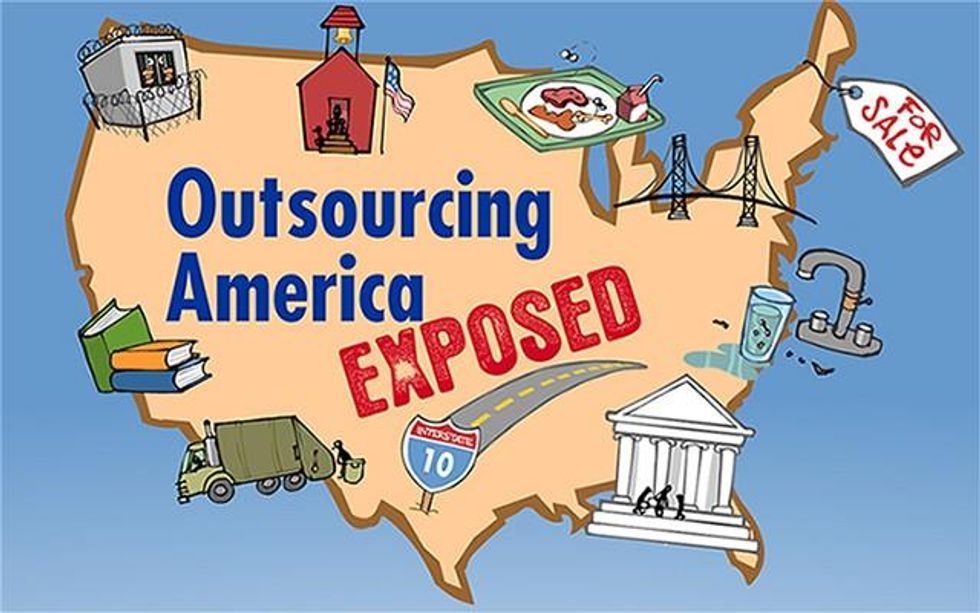
An online tool launched by the Center for Media and Democracy (CMD) on Tuesday provides an in-depth look into the multinational corporations behind the privatization of public services across the U.S..
CMD, the creators of ALECexposed.org--a web resource that shines a light on the American Legislative Exchange Council (ALEC) and its dealings with U.S. lawmakers--says the new web-tool, OutsourcingAmericaEXPOSED.org, will provide weekly "corporate profiles of America's most notorious corporations that are quietly working with state and local lawmakers to take over public services with little accountability."
"Across the country, for-profit companies are engaged in a hostile takeover of our schools, roads, prisons, drinking water, and even local government itself," said Lisa Graves, Executive Director of the CMD, adding that the "project will give taxpayers the tools they need to identify these privatizers and profiteers, their eye-popping salaries, and the raw deals contained in their contracts that puts taxpayers on the hook, and it will tell taxpayers how they can take back control of public assets and public services."
Some of these privatizers, as highlighted recently by CMD, include for-profit prison corporations who enter into contracts with state governments that ensure profits through mandated "lock-up quotas." If a state enters into one of these contracts and fails to incarcerate the number of prisoners required by the quota, the private prison company can seek financial retribution from that state. This forced compensation falls on the taxpayers.
Such private prison companies, including Corrections Corporation of America and GEO Group, will be highlighted in CMD's new site tool with other corporations from around the world that seek to privatize U.S. public services.
The site's first corporate profile is that of Sodexo, a French multinational that supplies food to school kids, soldiers, universities, public hospitals, and other governmental entities. According to CMD, Sodexo "has a lengthy record of paying workers poverty wages, overcharging clients, opposing unions, and violating food and safety standards."
Accompanying CMD's new resource is this video created by cartoonist Mark Fiore, which offers a colorful explanation of the privatization deals being made across the country:
Outsourcing America ExposedThis video exposes the privatizers and profiteers selling out our democracy. https://www.outsourcingamericaexposed.org/