

SUBSCRIBE TO OUR FREE NEWSLETTER
Daily news & progressive opinion—funded by the people, not the corporations—delivered straight to your inbox.
5
#000000
#FFFFFF
To donate by check, phone, or other method, see our More Ways to Give page.
Daily news & progressive opinion—funded by the people, not the corporations—delivered straight to your inbox.
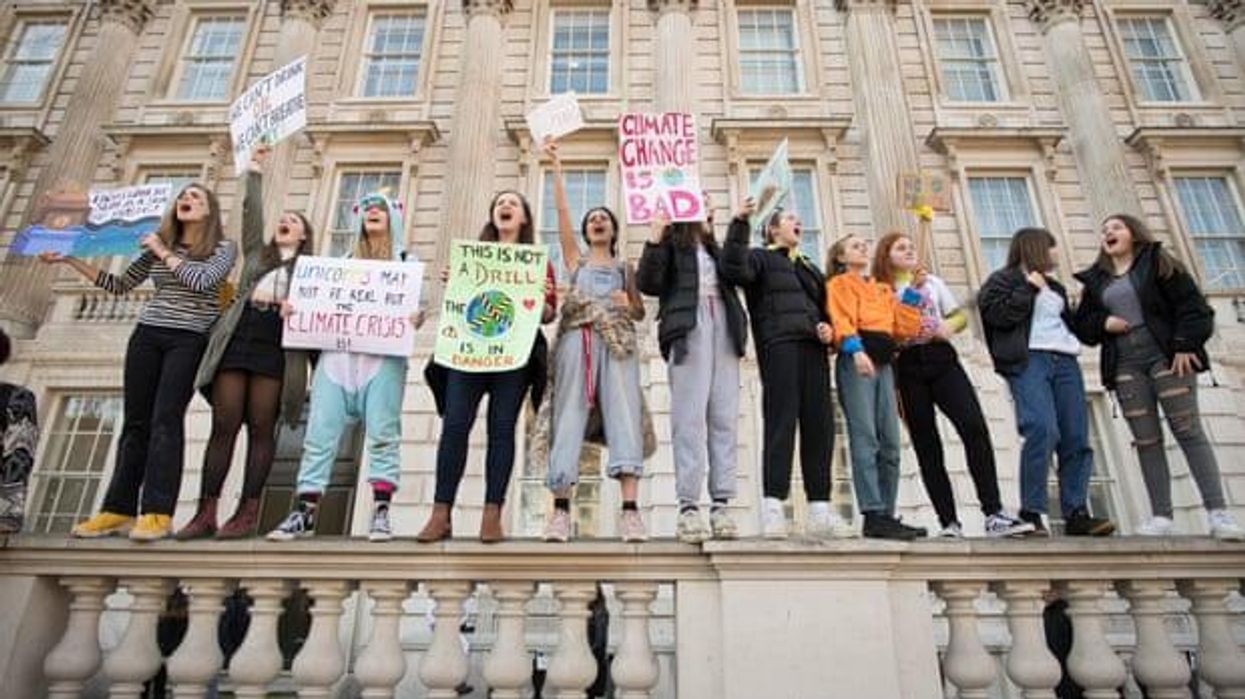
I want to say to all the climate strikers today: thank you so much for being unreasonable. That is, if reasonable means playing by the rules, and the rules are presumed to be guidelines for what is and is not possible, then you may be told that what you are asking for is impossible or unreasonable. Don't listen. Don't stop. Don't let your dreams shrink by one inch. Don't forget that this might be the day and the pivotal year when you rewrite what is possible.
What climate activists are asking for is a profound change in all our energy systems, for leaving fossil fuel in the ground, for taking action adequate to the planet-scale crisis of climate change. And the rules we are so often reminded of by those who aren't ready for change are not the real rules. Because one day last summer a 15-year-old girl sat down to stage a one-person climate strike, and a lot of adults would like to tell you that the rules say a 15-year-old girl cannot come out of nowhere, alone, and change the world.
Sweden's Greta Thunberg already has.
They will tell you the rules are that those we see in the news and the parliaments and boardrooms hold all the power and you must be nice to them and perhaps they will give you crumbs, or the time of day, or just a door slammed in your face. They will tell you that things can only change in tiny increments by predictable means. They're wrong. Sometimes you don't have to ask for permission or for anything because you hold the power and you yourselves decide which way the door swings. Nothing is possible without action; almost anything is when we rise up together, as you are doing today.
I am writing you in gratitude and enthusiasm as someone who has lived for almost six decades, which has been time enough to see extraordinary change. To see what had been declared impossible happen over and over again. To see regimes topple when ordinary people rise up in nonviolent direct action. To see dramatic expansions of rights in both law and imagination. To see what were once radical new ideas about gender and sexual orientation and race, about justice and equality, about nature and ecology become ordinary accepted ideas - and then to see people forget how our minds were changed, and how much that process matters too.
The world I was born into no longer exists. The role of women has changed extraordinarily since then, largely for the better. The entire Soviet empire collapsed suddenly 30 years ago, a few years after the east bloc of communist countries liberated themselves through the actions of people who were themselves supposed to be powerless to topple regimes backed by great militaries and secret police. I saw apartheid fall in South Africa, and a prisoner doing life become its president. I was born into a world where to be gay or lesbian or trans was criminalized, and I watched those laws and attitudes be change in states, in my country, the US, and in many countries.
I saw wind and solar power go from awkward, ineffectual, expensive technologies only 20 years ago to become the means through which we can leave the age of fossil fuel behind. I have seen a language to recognize the Earth's environmental systems arise in my lifetime, a language that can describe how everything is connected, and everything has consequences. Through studying what science teaches us about nature and what history teaches us about social forces I have come to see how beautiful and how powerful are the threads that connect us. Here's one. Who did Greta Thunberg describe as a key influence on her actions? Rosa Parks.
That a black woman born in Tuskegee, Alabama, in 1913 would influence a white girl born in Sweden 90 years later to take direct action about climate change is a reminder that everything is connected and your actions matter even when the results aren't immediate or obvious. The way Rosa Parks broke the rules and lived according to her ideals still matters, still has power, still has influence beyond what she could have imagined, beyond her lifetime, beyond her continent, beyond her particular area of activism.
The rules are the rules of the obvious, the easy assumptions that we know who holds power, we know how change happens, we know what is possible. But the real lesson of history is that change often comes in unpredictable ways, power can suddenly be in the hands of those who appear out of what seems to the rest of us like nowhere. I did not see Thunberg coming, or the Sunrise Movement or Extinction Rebellion or Zero Hour.
When I went to Standing Rock I never dreamed this indigenous-led uprising against an oil pipeline would inspire Alexandria Ocasio-Cortez to run for office. Nor that she would go on to win a victory that broke all the rules and become the great spokesperson for a Green New Deal. I didn't dream it, but I knew that something powerful, magical, alive with possibility was happening. That's why I wasn't surprised when it did, and why I don't assume we have seen all of what that gathering in 2016 achieved, either. It is not over, any more than Rosa Parks's impact is over. Good work matters. Acting on your ideals matters. How it matters is not always immediate or obvious.
Today you are standing up for people not yet born, and those ghostly billions are with you too.
What I see all around me is what I call climate momentum: people from New Zealand to Norway stepping up their response to climate change. I see pipeline blockades in Canada and the US, I see investors backing off from fracking and coal, I see universities and pension funds divesting from fossil fuel, I see solar farms and wind turbines going in all over the world and engineers working to make the technologies better, I see lawsuits against oil companies and coal companies, I see politicians, newspaper editorialists, businesspeople and others who have power under the usual rules getting on board in a way they never have before. There is so much happening, in so many ways, to respond to the biggest disaster our species has ever faced.
It is not yet enough, but it is a sign that more and more are facing the catastrophe and are doing something about it. I don't know what will happen, because what will happen is what we make happen. That is why there's a global climate strike today. This is why I've started saying, Don't ask what will happen. Be what happens. Today, you are what is happening. Today, your power will be felt. Today, your action matters. Today in your individual action you may stand with a few people or with hundreds, but you stand with billions around the world. Today you are standing up for people not yet born, and those ghostly billions are with you too. Today you are the force of possibility that runs through the present like a river through the desert.
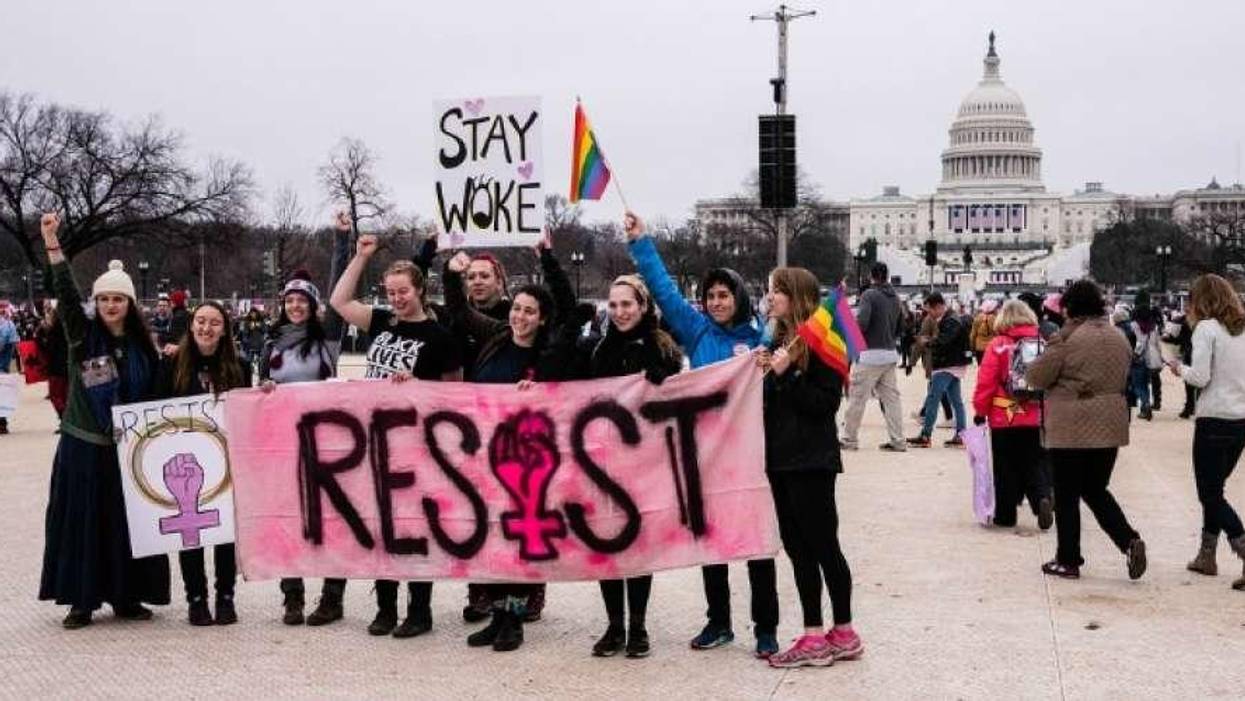
'Wathint' Abafazi, Wathint' Imbokodo'- You Strike A woman, You Strike Rock! Famous words by South Africa women resisting and standing up to racial oppression in 1956 when 20, 000 women of all races refused to be subjugated by the apartheid government. Although the women's March was against restrictive pass laws, this movement proved to be a turning point in the struggle against an unjust political system. The women's march to the Union Buildings in Pretoria led to significant changes in the law and the emancipation women in South Africa.
History provides examples of women who refused the status quo and forever changed the course of events. From American civil society activist Rosa Parks to Kenyan environmental and women's rights campaigner Wangari Maathai who are recognised for their contribution and their place in the revolution.
Today, nothing has changed. Women remain at the forefront of the civil society movement, ensuring their rightful place in bringing about peace and building equality in communities at national and international levels.
While there has been significant progress and commitments made in the gender narrative, we still have a long way to go to ensure women are no longer on the fringes of society. This is where education plays a crucial role as an equaliser and is an indispensable tool to truly transforming women's place in society. According to UNWomen, gender inequality still remains a vital cause of hunger and poverty. "It is estimated that 60 percent of chronically hungry people are women and girls" as stated by 2015 - WFP Gender Policy 2015-2020. When it comes to employment, men's average wages remain higher than that of women and women, the backbones of society, work longer hours than men. Women still lag behind men in decision making and leadership positions.
In education, gender inequality still exists. Women make up more than two-thirds of the world's 796 million illiterate people. In Sub-Saharan Africa, a region with the highest rate of out-of-school children, girls are most excluded, with 24% of girls not in school compared to 18% of boys. In Northern Africa and Western Asia, 12% of girls are out of school compared to 10% of boys. These numbers indicate that the stakes are high when it comes to bridging the gender gap and ensuring that girls and women are not left behind.
The role of education in emancipating women
It goes without saying that an educated woman is more likely to have greater decision-making power within her household. Educated girls have great potential to bring about positive change to their immediate families and to society at large. A good example is the formidable Malala Yousafzai, Nobel Prize Laureate and staunch activist for female education and the young 16 year old Greta Thunberg, who is shaking things up in the climate movement.
TheGlobal Campaign for Education,is a worldwide civil society movement. The campaign is committed to defend education as a basic human right and mobilises public pressure on governments and the international community to provide free, compulsory public basic education for all people, in particular for children, women and those from excluded communities. GCE recognises that gender equality is a human right and a requisite for achieving broader social, political and economic development goals, as stated in the Agenda for Sustainable Development.
This year the UN celebrates International Women's Day under the theme "Think equal, build smart, innovate for change" and spotlights innovative ways in which we can all enforce gender equality and the empowerment of women. In the 21st century, women no longer occupy undervalued roles in society. Now more than ever it is imperative that women are celebrated and elevated at the highest level for their immense contribution to shaping a world that is non-sexists, non-gender biased and unequivocally builds gender equitable systems for all.
GCE celebrates this day and enforces the call for education systems that take into account a full analysis of the gendered barriers girls and boys face to complete a free, inclusive, public quality education. In order to tell a different gender story next year, a wider systematic approach must challenge and transform patriarchal societies into ones that value equality and inclusion.

In a recent confrontation with representatives of the Sunrise Movement, Senator Diane Feinstein referred to herself as a "realist" when challenged to support the Green New Deal.
She's not alone. Speaker of the House Nancy Pelosi referred to the GND as a dream, and nearly every article about it alludes to it being unrealistic, while the pundits pile on with charges of political doom for the Dems if they support it.
Ponder this for a moment. We are faced with a planet wrecking problem - something that, if left unchecked, could literally lead to the deaths of billions of people, the extinction of nearly half of all species, and the destruction of the ecological systems which allowed for the development of civilization - and the people who want to do something about it are labelled unrealistic, and those who advocate ineffective half-measures are considered "realists."
This tells us a great deal about the state of our politics, and none of it is good.
For starters, it tells us that our entire political process has been overtaken by monied interests. The Constitution and its principles have been discarded in exchange for campaign funds and a revolving door that allows politicians to cash in on public service.
It also tells us that leadership is a scarce commodity. The so-called "realists" read polls and try to regurgitate back in simple soundbites what the polls are telling them. This amounts to government by tautology, and it means politicians hone their positions to appeal to the least common denominator. In normal times this can work, but these are not normal times. We are actively sabotaging our ecological life support systems.
Not only is leadership a rare phenomenon, but when leaders do appear, they are assaulted by a collective, reactionary ignorance. Exhibit A has to be Bernie Sanders' 2016 run, in which the DNC, the press, big money and the punditry gathered against him in a confederacy of dunces. It's happening again, with Alexandria Ocasio-Cortez and other progressives, who the folks in the know are dismissing. It's happening with the GND, with proposals to tax the ultra-wealthy, with no-brainer issues like Medicare for All.
Now, it's worth noting that the ideas Sanders' introduced in 2016, which were dismissed as happy dreams, are now embraced by the majority of Americans. But the realists continue to talk about them as if they were pipe dreams, and offer up useless Pablum like paygo, instead. If you wanted to conjure up a way of depressing voter turnout, you couldn't do much better than what the "realists" are doing, and the only way Trump wins is if you depress turnout.
Admiral William Halsey Jr said, "There are no great men [or women] there are only great challenges that ordinary men [or women] are forced by circumstances to meet." Yet our history seems punctuated by people of great foresight and moral courage appearing on history's horizon when needed. Washington, Madison, Jefferson, Hamilton, Lincoln, both Roosevelts, Mother Jones, Rosa Parks, Rachel Carson, Martin Luther King, Jr - each emerged at a critical juncture in our history, and each became a leader in the long march toward a just, fair, prosperous and sustainable society.
But today, the "realists" have a firm grip on our social, political and economic system, and they are doing a tremendous job at keeping us from seeing reality. The stakes of their failures have never been higher, the consequences never more dire. It is time for another hero to appear, and it must be us. We the people must rise up and demand more from our leaders than a faux realism rooted in greed, fear and myopia.

February 4, 2019 marks the 106th birth anniversary of visionary movement leader Rosa Parks. Anniversaries such as this are not just moments for celebration. They are a time to rededicate ourselves to the struggles they commemorate.
Rosa Parks is best remembered for her role in the bus boycott in Montgomery, Alabama. The legally sanctioned racial discrimination in access to public transit that the bus boycott campaign targeted has ended. But barriers to adequate public transit access remain, making it harder for people -- particularly people of color and poor people -- from being able to get to jobs, school, and wherever else they need to go. The lack of adequate public transit service also exacerbates environmental disparities and climate change.
"Barriers to adequate public transit access remain, making it harder for people--particularly people of color and poor people--from being able to get to jobs, school, and wherever else they need to go."
Only 5.2 percent of commuters nationwide use public transit to get to work, but 11 percent each of Black and Asian-American commuters and 7.7 percent of Latinx commuters use transit. People of color are clearly more dependent on transit.
This is partly because of vehicle ownership disparities. Nationwide, 84 percent of households own vehicles, but the corresponding numbers are 69 percent for Black households and 78 percent for Latinx households.
Yet when it comes to reductions in transit service, communities of color bear the brunt.
In Portland, Oregon, transit service cuts have been steepest in Black and Latinx neighborhoods, where -- as one Census Bureau analysis observed -- residents often have to "negotiate obstacles such as busy and dangerous intersections, poor street lighting, and limited sidewalk availability" just to get to their bus stop.
In San Francisco, communities of color are impacted by long wait times and overcrowded buses compared to the citywide average, even as fares have risen.
In Minnesota's Twin Cities, the transit agency was planning a commuter rail line that would pass through a historically Black community without even stopping there -- after cutting bus service in the community. Fortunately, the federal government stepped in and compelled the agency to change course.
These are just three examples of a wider trend.
Proximity of transit stops doesn't guarantee access either. For low-income households, fares are a critical determinant of access. From 1990 through 2014 (the latest year for which we have data), nationwide average transit fare per trip decreased 2 percent when accounting for inflation. (A word of explanation -- most of us have experienced transit fares increasing, which they have in terms of face-value dollars. In inflation adjusted terms, however, they fell slightly over this period.)
In the same period, however, the 10th percentile of household income (the income such that 10 percent of households earn less) actually fell 4.7 percent in inflation adjusted terms -- meaning, the rate at which poorer households became poorer outstripped the slight fall in transit fares. Concretely, this means that poor households spent a greater share of their income on transit in 2014 compared to 1990.
To this mix of lack of service for communities of color and rising fares as a share of income for low-income households, add the environmental impact of our auto-dependent transportation system, a dependence perpetuated by underinvestment in transit.
Automobile engines emit pollutants such as nitrogen oxides, which are strongly associated with asthma and other illnesses. And some populations are disproportionately more exposed to these pollutants than others. A 2017 study found striking racial disparities in transportation-related nitrogen dioxide emissions, with Black, Latinx, and Asian-America populations being exposed to significantly more than white neighborhoods.
More transit use (especially electrified transit) will reduce these exposures and narrow the disparities. Even a traditional internal combustion engine bus consumes about 15 percent less fuel per passenger transported than a personal car. Less fuel consumed translates into less emissions of any kind.
"Transit is an arena of continuing struggles for racial, economic and environmental justice. And with the needed investment and the right policies, transit can be a key component of the transition to a just and climate-friendly economy, and can create lots of good union jobs."
Internal combustion engines also emit carbon dioxide, which traps solar radiation and warms the planet. A hotter planet means more blistering heat waves, violent storms, devastating droughts and wildfires, and rising seas. These phenomena pose an existential threat to humanity worldwide and in the United States.
As with everything in our unequal society, climate change impacts aren't equally distributed. Black Americans are 52 percent likelier to be exposed to extreme heat than their white counterparts. Native Alaskan communities are losing their ancestral homelands to rising seas. And disasters such as hurricanes have a particularly devastating impact on places like Puerto Rico, which has a 44.4 percent poverty rate that's almost three and a half times the national rate of 12.3 percent -- and no representation in Congress.
Transportation is the largest and fastest growing source of greenhouse gas emissions in the U.S. economy. Clearly, expanding and electrifying public transit to give large numbers of people a meaningful alternative to driving to work can go a long way in reducing our emissions. Doing so will give us a better chance of avoiding the most dangerous impacts of climate change, and begin to reverse the profound injustices that characterize our unequal, warming world.
But investing in transit expansion isn't all about undoing the bad. It's also about expanding the good. Transit creates lots of good jobs. In 2017, there were more than 176,000 bus drivers in the U.S., with median hourly wages of $19.61, and more than 12,000 streetcar and subway operators in the U.S., with median hourly wages of $31.93. Compare this to the $18.12 median wage for all occupations and the $15.19 median wage for all transportation occupations.
Plus, many of these are union jobs. The 190,000 members of the Amalgamated Transit Union and the 140,000 members of the Transport Workers Union include large numbers of transit workers. Union membership gives these workers legally protected rights on the job that non-union workers lack. And union members earn more -- the median weekly earnings of union workers is $1,041, compared to $829 for nonunion workers.
So transit is an arena of continuing struggles for racial, economic and environmental justice. And with the needed investment and the right policies, transit can be a key component of the transition to a just and climate-friendly economy, and can create lots of good union jobs.
So let's organize for better, more accessible public transit for all to honor Rosa Parks' legacy.

It is easy to forget that in his day, in his own country, Rev. Martin Luther King Jr. was considered a dangerous radical. He was harassed by the FBI and vilified in the media. The establishment's campaign to denigrate King worked. In August 1966 - two years after he was awarded the Nobel Peace Prize at age 35--the Gallup Poll found that 63 percent of Americans had an unfavorable opinion of King, compared with 33 percent who viewed him favorably.
Today Rev. Martin Luther King Jr. is viewed as something of an American saint. The most recent Gallup Poll discovered that 94 percent of Americans viewed him in a positive light. His birthday is a national holiday. His name adorns schools and street signs. Americans from across the political spectrum invoke King's name to justify their beliefs and actions.
He opposed US militarism and imperialism, especially the country's misadventure in Vietnam.
In fact, King was a radical. He believed that America needed a "radical redistribution of economic and political power." He challenged America's class system and its racial caste system. He was a strong ally of the nation's labor union movement. He was assassinated in April 1968 in Memphis, where he had gone to support a sanitation workers' strike. He opposed US militarism and imperialism, especially the country's misadventure in Vietnam.
If he were alive today, he would certainly be standing with Walmart employees and other workers fighting for a living wage and the right to unionize. He would be on the picket lines with striking school teachers, demanding smaller class sizes and more resources for schools so that every student can have a first-rate education. He would be in the forefront of the battle for strong gun controls and to thwart the influence of the National Rifle Association. He would protest the abuses of Wall Street banks, standing side-by-side with homeowners facing foreclosure and crusading for tougher regulations against lending rip-offs.
As he did in his own day, King would be calling for dramatic cuts in the military budget to reinvest public dollars in jobs, education and health care. He would surely be marching with immigrants and their allies in support of comprehensive immigration reform. He would no doubt travel to the US-Mexico border to protest the mistreatment of children and their parents seeking asylum and refuge. He would be joining hands with activists seeking to reduce racial profiling by police and ending the mass incarceration of young people. Like most Americans in his day, King was homophobic, even though one of his closest advisors, Bayard Rustin, was gay. But today, King would undoubtedly stand with advocates of LGBT rights and same-sex marriage, just as he challenged state laws banning interracial marriage. We don't know what King's views were on abortion, but in 1966, he was pleased to receive Planned Parenthood's Margaret Sanger Award in Human Rights. Accepting the award, he wrote: "There is a striking kinship between our movement and Margaret Sanger's early efforts. ... Margaret Sanger had to commit what was then called a crime in order to enrich humanity, and today we honor her courage and vision."
King began his activism in Montgomery as a crusader against racial segregation, but the struggle for civil rights radicalized him into a fighter for broader economic and social justice and peace.
Indeed, King's views evolved over time. He entered the public stage with some hesitation, reluctantly becoming the spokesperson for the Montgomery bus boycott in 1955, at the age of 26. King began his activism in Montgomery as a crusader against racial segregation, but the struggle for civil rights radicalized him into a fighter for broader economic and social justice and peace. Still, in reviewing King's life, we can see that the seeds of his later radicalism were planted early.
King was born in Atlanta, Georgia, in 1929, the son of a prominent black minister. Despite growing up in a solidly middle-class family, King saw the widespread human suffering caused by the Depression, particularly in the black community. In 1950, while in graduate school, he wrote an essay describing the "anticapitalistic feelings" he experienced as a youngster as a result of seeing unemployed people standing in breadlines.
During King's first year at Morehouse College, civil rights and labor activist A. Philip Randolph spoke on campus. Randolph predicted that the near future would witness a global struggle that would end white supremacy and capitalism. He urged the students to link up with "the people in the shacks and the hovels," who, although "poor in property," were "rich in spirit."
After graduating from Morehouse in 1948, King studied theology at Crozer Theological Seminary in Pennsylvania (where he read both Mohandas Gandhi and Karl Marx), planning to follow in his father's footsteps and join the ministry. In 1955, he earned his doctorate from Boston University, where he studied the works of Reinhold Niebuhr, the influential liberal theologian. While in Boston, he told his girlfriend (and future wife), Coretta Scott, that "a society based on making all the money you can and ignoring people's needs is wrong."
When King moved to Montgomery to take his first pulpit at the Dexter Avenue Baptist Church, he was full of ideas but had no practical experience in politics or activism. But history sneaked up on him. On Thursday, December 1, 1955, Rosa Parks, a seamstress and veteran activist with the National Association for the Advancement of Colored People (NAACP), decided to resist the city's segregation law by refusing to move to the back of the bus on her way home from work. She was arrested. Two other long-term activists in the black community - E. D. Nixon (leader of the NAACP and of the Brotherhood of Sleeping Car Porters) and Jo Ann Robinson (a professor at the all-black Alabama State College and a leader of Montgomery's Women's Political Council) - determined that Parks' arrest was a ripe opportunity for a one-day boycott of the much-despised segregated bus system. Nixon and Robinson asked black ministers to use their Sunday sermons to spread the word. Some refused, but many others, including King, agreed.
The boycott was very effective. Most black residents stayed off the buses. Within days, the boycott leaders formed a new group, the Montgomery Improvement Association (MIA). At Nixon's urging, they elected a hesitant King as president, in large part because he was new in town and not embroiled in the competition for congregants and visibility among black ministers. He was also well educated and already a brilliant orator, and thus would be a good public face for the protest movement. The ministers differed over whether to call off the boycott after one day but agreed to put the question up to a vote at a mass meeting.
That night, 7,000 blacks crowded into (and stood outside) the Holt Street Baptist Church. Inspired by King's words - "There comes a time when people get tired of being trampled over by the iron feet of oppression" - they voted unanimously to continue the boycott. It lasted for 381 days and resulted in the desegregation of the city's buses.
During that time, King honed his leadership skills, aided by advice from two veteran pacifist organizers, Bayard Rustin and Rev. Glenn Smiley, who had been sent to Montgomery by the pacifist group, Fellowship of Reconciliation. During the boycott, King was arrested, his home was bombed, and he was subjected to personal abuse. But--with the assistance of the new medium of television--he emerged as a national figure.
Between 1957 and 1968, King traveled over six million miles, spoke more than 2,500 times, and was arrested at least 20 times, always preaching the gospel of nonviolence.
In 1957, King launched the Southern Christian Leadership Conference (SCLC) to help spread the civil rights crusade to other cities. He helped lead local campaigns in different cities, including Selma and Birmingham, Alabama, where thousands marched to demand an end to segregation in defiance of court injunctions forbidding any protests. While participating in these protests, King also sought to keep the fractious civil rights movement together, despite the rivalries among the NAACP, the Urban League, the Student Nonviolent Coordinating Committee (SNCC), the Congress of Racial Equality (CORE) and SCLC. Between 1957 and 1968, King traveled over six million miles, spoke more than 2,500 times, and was arrested at least 20 times, always preaching the gospel of nonviolence. King attended workshops at the Highlander Folk School in Tennessee, which connected him to a network of radicals, pacifists and union activists from around the country whose ideas helped widen his political horizons.
It is often forgotten that the August 1963 protest rally at the Lincoln Memorial, where King delivered his famous "I Have a Dream" speech, was called the March on Washington for Jobs and Freedom. King was proud of the civil rights movement's success in winning the passage of the Civil Rights Act in 1964 and the Voting Rights Act the following year. But he realized that neither law did much to provide better jobs or housing for the masses of black poor in either the urban cities or the rural South. "What good is having the right to sit at a lunch counter," he asked, "if you can't afford to buy a hamburger?"
"We know through painful experience that freedom is never voluntarily given by the oppressor; it must be demanded by the oppressed."
King had hoped that the bus boycott, sit-ins and other forms of civil disobedience would stir white southern moderates, led by his fellow clergy, to see the immorality of segregation and racism. His famous "Letter from a Birmingham Jail," written in 1963, outlines King's strategy of using nonviolent civil disobedience to force a response from the southern white establishment and to generate sympathy and support among white liberals and moderates. "The purpose of our direct-action program is to create a situation so crisis-packed that it will inevitably open the door to negotiation," he wrote, and added, "We know through painful experience that freedom is never voluntarily given by the oppressor; it must be demanded by the oppressed."
King eventually realized that many white Americans had at least a psychological stake in perpetuating racism. He began to recognize that racial segregation was devised not only to oppress African Americans but also to keep working-class whites from challenging their own oppression by letting them feel superior to blacks. "The Southern aristocracy took the world and gave the poor white man Jim Crow," King said from the Capitol steps in Montgomery, following the 1965 march from Selma. "And when his wrinkled stomach cried out for the food that his empty pockets could not provide, he ate Jim Crow, a psychological bird that told him that no matter how bad off he was, at least he was a white man, better than a black man."
When King launched a civil rights campaign in Chicago in 1965, he was shocked by the hatred and violence expressed by working-class whites as he and his followers marched through the streets of segregated neighborhoods in Chicago and its suburbs. He saw that the problem in Chicago's ghetto was not legal segregation but "economic exploitation" - slum housing, overpriced food and low-wage jobs - "because someone profits from its existence."
These experiences led King to develop a more radical outlook.
He became increasingly committed to building bridges between the civil rights and labor movements. Invited to address the AFL-CIO's annual convention in 1961, King observed:
"The labor movement did not diminish the strength of the nation but enlarged it. By raising the living standards of millions, labor miraculously created a market for industry and lifted the whole nation to undreamed of levels of production. Those who today attack labor forget these simple truths, but history remembers them."
"Call it democracy, or call it democratic socialism, but there must be a better distribution of wealth within this country for all God's children."
In a 1961 speech to the Negro American Labor Council, King proclaimed: "Call it democracy, or call it democratic socialism, but there must be a better distribution of wealth within this country for all God's children."
King supported President Lyndon B. Johnson's declaration of the War on Poverty in 1964, but, like his friend and ally Walter Reuther, the president of the United Auto Workers, King thought that it did not go nearly far enough. As early as October 1964, he called for a "gigantic Marshall Plan" for the poor--black and white. He began talking openly about the need to confront "class issues," which he described as "the gulf between the haves and the have-nots."
In 1966 King confided to his staff:
"You can't talk about solving the economic problem of the Negro without talking about billions of dollars. You can't talk about ending the slums without first saying profit must be taken out of slums. You're really tampering and getting on dangerous ground because you are messing with folk then. You are messing with captains of industry. Now this means that we are treading in difficult water, because it really means that we are saying that something is wrong with capitalism. There must be a better distribution of wealth, and maybe America must move toward a democratic socialism."
Speaking to a meeting of Teamsters union shop stewards in 1967, King said, "Negroes are not the only poor in the nation. There are nearly twice as many white poor as Negro, and therefore the struggle against poverty is not involved solely with color or racial discrimination but with elementary economic justice."
King's growing critique of capitalism coincided with his views about American imperialism. By 1965 he had turned against the Vietnam War, viewing it as an economic as well as a moral tragedy. But he was initially reluctant to speak out against the war. He understood that his fragile working alliance with LBJ would be undone if he challenged the president's leadership on the war.
King called America the "greatest purveyor of violence in the world today" and linked the struggle for social justice with the struggle against militarism.Although some of his close advisers tried to discourage him, he nevertheless made the break in April 1967, in a bold and prophetic speech at the Riverside Church in New York City, entitled "Beyond Vietnam - A Time to Break Silence." King called America the "greatest purveyor of violence in the world today" and linked the struggle for social justice with the struggle against militarism. King argued that Vietnam was stealing precious resources from domestic programs and that the Vietnam War was "an enemy of the poor." In his last book, Where Do We Go from Here: Chaos or Community? (1967), King wrote, "The bombs in Vietnam explode at home; they destroy the hopes and possibilities for a decent America."
In early 1968, King told journalist David Halberstam, "For years I labored with the idea of reforming the existing institutions of society, a little change here, a little change there. Now I feel quite differently. I think you've got to have a reconstruction of the entire society, a revolution of values."
King kept trying to build a broad movement for economic justice that went beyond civil rights. In January, 1968, he announced plans for a Poor People's Campaign, a series of protests to be led by an interracial coalition of poor people and their allies among the middle-class liberals, unions, religious organizations and other progressive groups, to pressure the White House and Congress to expand the War on Poverty. At King's request, socialist activist Michael Harrington (author of The Other America, which helped inspire Presidents Kennedy and Johnson to declare a war on poverty) drafted a Poor People's Manifesto that outlined the campaign's goals. In April, King was in Memphis, Tennessee, to help lend support to striking African American garbage workers and to gain recognition for their union. There, he was assassinated, at age 39, on April 4, a few months before the first protest action of the Poor People's Campaign in Washington, DC.
President Johnson utilized this national tragedy to urge Congress to quickly enact the Fair Housing Act, legislation to ban racial discrimination in housing, which King had strongly supported for two years. He signed the bill a week after King's assassination.
The campaign for a federal holiday in King's honor, spearheaded by Detroit Congressman John Conyers, began soon after his murder, but it did not come up for a vote in Congress until 1979, when it fell five votes short of the number needed for passage. In 1981, with the help of singer Stevie Wonder and other celebrities, supporters collected six million signatures on a petition to Congress on behalf of a King holiday. Congress finally passed legislation enacting the holiday in 1983, 15 years after King's death. But even then, 90 members of the House (including Richard Shelby of Alabama, now in the Senate) voted against it. Senator Jesse Helms, a North Carolina Republican, led an unsuccessful effort - supported by 21 other senators, including current Senator Charles Grassley (R-Iowa) - to block its passage in the Senate.
The holiday was first observed on January 20, 1986. In 1987, Arizona governor Evan Mecham rescinded King Day as his first act in office, setting off a national boycott of the state. Some states (including New Hampshire, which called it "Civil Rights Day" from 1991 to 1999) insisted on calling the holiday by other names. In 2000, South Carolina became the last state to make King Day a paid holiday for all state employees.
In his final speech in Memphis the night before he was killed, King told the crowd about a bomb threat on his plane from Atlanta that morning, saying he knew that his life was constantly in danger because of his political activism.
"I would like to live a long life," he said. "Longevity has its place. But I'm not concerned about that now. I just want to do God's will. And he's allowed me to go up to the mountain, and I've looked over, and I've seen the promised land. I may not get there with you. But I want you to know tonight that we as a people will get to the promised land."
We haven't gotten there yet. But Dr. King is still with us in spirit. The best way to honor his memory is to continue the struggle for human dignity, workers' rights, racial equality, peace and social justice.
Before there was Christine Blasey Ford, there was Recy Taylor, an African-American woman who was raped by six white men in 1944 and fought for justice with the help of Rosa Parks. And in between the two of them, there was Anita Hill, Tarana Burke, Alyssa Milano, Lupita Nyong'o, Tanya Selveratnam, Aly Raisman, and many, many more.
For centuries, women have experienced violence and harassment, and many have spoken out. #MeToo brought us to a new phase in building the movement to end gender-based violence, magnifying and connecting thousands of voices as they shared their stories. Despite women's achievement of formal equality, #MeToo exposed how common such violence is, the widespread silencing and dismissal of survivors, and the myriad ways violence undermines survivors' security, dignity, and opportunities.
The President and Senate Judiciary Committee are far from the only powerful people and institutions that limit investigations, disbelieve survivors, and fault people for coming forward. Discrimination against survivors infiltrates all aspects of life, including the responses of law enforcement, employers, housing providers, and schools, to name a few. Speaking out about violence is a crucial step. But law enforcement, employers, housing providers, and schools must also step up and acknowledge how their policies and practices contribute to violence.
"Why didn't you report?" is the refrain so many survivors face when they disclose violence for the first time. But too often, police dismiss survivors who go to law enforcement. This attitude results in governments' decisions not to test thousands of rape kits in cities like Detroit, Albuquerque, and Washington DC, based on officers' assumptions that there was no sexual assault. It also explains why one in three survivors feel less safe after contacting police.
Survivors also bear punishment for filing complaints. They are ostracized by their communities or accused of lying and prosecuted for false reporting, only to be exonerated years later. Sometimes cities enforce policies that hold victims responsible for crimes in their homes, resulting in their eviction.
Survivors are frequently denied employment, educational support, housing, and other benefits due to violence and harassment. They are retaliated against by supervisors for breaking their silence. Schools ignore their requests for accommodations or protection, pushing them out. Landlords evict them for resisting sexual demands. Veterans seeking disability benefits based on PTSD as a result of military sexual trauma are rejected unjustly, because they cannot meet a standard of corroboration that is not demanded of veterans with other forms of PTSD.
And victims have gone to law enforcement only to face sexual harassment and assault by officers themselves. Filling a criminal report can subject survivors to further violence, committed by those who are supposed to hold perpetrators accountable.
The multiple layers of discrimination that survivors experience, and the network of systems that foster it, could leave one feeling hopeless. But what we saw with so many of the survivors who have spoken out is that they are challenging the institutions that further perpetuate violence. In telling their stories, they are survivors, and also advocates and leaders pushing for change.
I have witnessed this first-hand as an attorney at the ACLU representing survivors of gender-based violence. I have been awed by Lakisha Briggs, Nancy Markham, and Rosetta Watson, who are all survivors of domestic violence who either faced eviction or were evicted because they called 911. They successfully challenged local nuisance laws adopted by their cities in Pennsylvania, Arizona, and Missouri, ensuring that other survivors no longer are forced to choose between their homes and police protection.
I had the honor of working with Rachel Bradshaw-Bean, a student in Texas who was sent to a disciplinary program for engaging in "lewd behavior" after she reported being sexually assaulted at her high school. She filed a Title IX civil rights complaint against the school district, leading to major reforms for how they respond to sexual harassment and violence. And this month, PBS is featuring the Home Truth documentary on the life and work of Jessica Lenahan, a Colorado woman who became a human rights activist after Colorado police refused to enforce her restraining order against her ex-husband, leading to the death of her three daughters.
Our society is one that has long accepted and encouraged the victimization of women and other marginalized people. Today, survivors are building power by coming forward, seeing and hearing each other, calling on and providing support, and challenging the norms that have silenced victims. We will continue our work to dismantle the policies and practices that have allowed violence and discrimination to flourish.

These words did in G. Harrold Carswell nearly five decades ago:
"I am Southern by ancestry, birth, training, inclination, belief and practice. And I believe that segregation of the races is proper and the only practical and correct way of life in our states. I have always so believed and I shall always so act.
"I shall be the last to submit to any attempt on the part of anyone to break down and to weaken this firmly established policy of our people.
"If my own brother were to advocate such a program, I would be compelled to take issue with him and to oppose him to the limit of my ability.
"I yield to no man, as a fellow candidate or as a fellow citizen, in the firm, vigorous belief in the principles of white supremacy, and I shall always be so governed."
Wow, white supremacy once had "principles," but that was in 1948. Carswell, then a young man, delivered these words to an American Legion chapter in a small town in Georgia when he was running for a seat in the state legislature. Twenty-two years later, when Richard Nixon nominated him for the Supreme Court, these words from a different era were unearthed and Carswell immediately apologized: "I renounce and reject the words themselves and the thoughts that they represent. They're obnoxious and abhorrent to my personal philosophy."
Too late.
Thirteen Republicans abandoned ship and voted against the nomination, leading to his defeat in the Senate. It was Nixon's second straight Supreme Court nominee not to make it. Six months earlier, Clement Haynsworth's nomination had also been rejected, at least partly because of pro-segregation court decisions he'd made.
He's suddenly the poster boy of disrespect for women's rights -- for their safety, for their humanity -- at a moment when the wrong of it is suddenly apparent.
Something bigger than politics was going on in this moment. The national consciousness had shifted, thanks to the civil rights movement, and suddenly the monstrous ugliness of white supremacy -- no matter that it had quietly festered at the nation's psychological foundation for two centuries, fomenting laws and wars and national policy -- was unavoidably, politically apparent. It could no longer be defended. An apology couldn't remove its stain. White supremacy had officially been shoved to the political margins, at least for the moment.
Welcome to 2018. Is something similar happening today in the uproar over Brett Kavanaugh? If so, what?
As I write, his nomination remains a possibility, but what seems unavoidably apparent is that Kavanaugh and his defenders have been caught, unexpectedly, in another profound shift in national consciousness. What's different is that the shift is occurring right now. Kavanaugh is the movement, or rather, its trigger. He's the bus driver, telling Rosa Parks to move to the back of the bus, even though he adamantly denies having done so.
He's suddenly the poster boy of disrespect for women's rights -- for their safety, for their humanity -- at a moment when the wrong of it is suddenly apparent. "It's a man's world" is suddenly not the way things are anymore, just as "the principles" of good, old-fashioned white supremacy had collapsed into non-existence by the time Carswell was nominated for the Supreme Court in 1970.
As the fight to stop Kavanaugh's nomination struggles forward, I think it's crucial to nurture this moment and see it for what it is, regardless what happens next. This moment transcends politics. It transcends a man's past behavior. It transcends legal procedure and the possibility that Kavanaugh lied under oath.
"It's a man's world" is suddenly not the way things are anymore, just as "the principles" of good, old-fashioned white supremacy had collapsed into non-existence by the time Carswell was nominated for the Supreme Court in 1970.
Kavanaugh doesn't belong on the nation's highest court because what he stands for is too small, too arrogant, too buried in prejudice and the devaluation of many lives. The sexual assault accusations aren't his only disqualifying actions. Like Carswell and Haynsworth, his political and judicial record indicate obeisance to beliefs that should not control the nation's future.
During his tenure in the George W. Bush administration, as both associate White House counsel and, later, White House staff secretary, Kavanaugh was involved in the administration's controversial decisions on the rights of detainees, including the use of "enhanced interrogation" techniques, i.e., torture. When he became part of the U.S. Court of Appeals, he continued to function as a force to let the Bush administration torture and indefinitely detain its prisoners, maintaining in his decisions that the United States was not obligated to obey the norms of international law, such as the Geneva Conventions, which ban torture.
"Kavanaugh's radical views have momentous implications," Jamie Mayerfeld writes at Just Security. "A core purpose of international law is to shield individuals from the worst abuses of state power. If Kavanaugh is elevated to the Supreme Court, his insistence on marginalizing international law will severely undermine human rights."
We're at another moment of change. People are crying out to build a better world, one that does not devalue anyone. As Mayerfeld notes, Donald Trump once said, during his campaign, "I would bring back waterboarding, and I'd bring back a hell of a lot worse than waterboarding."
The past and the future are colliding once again.
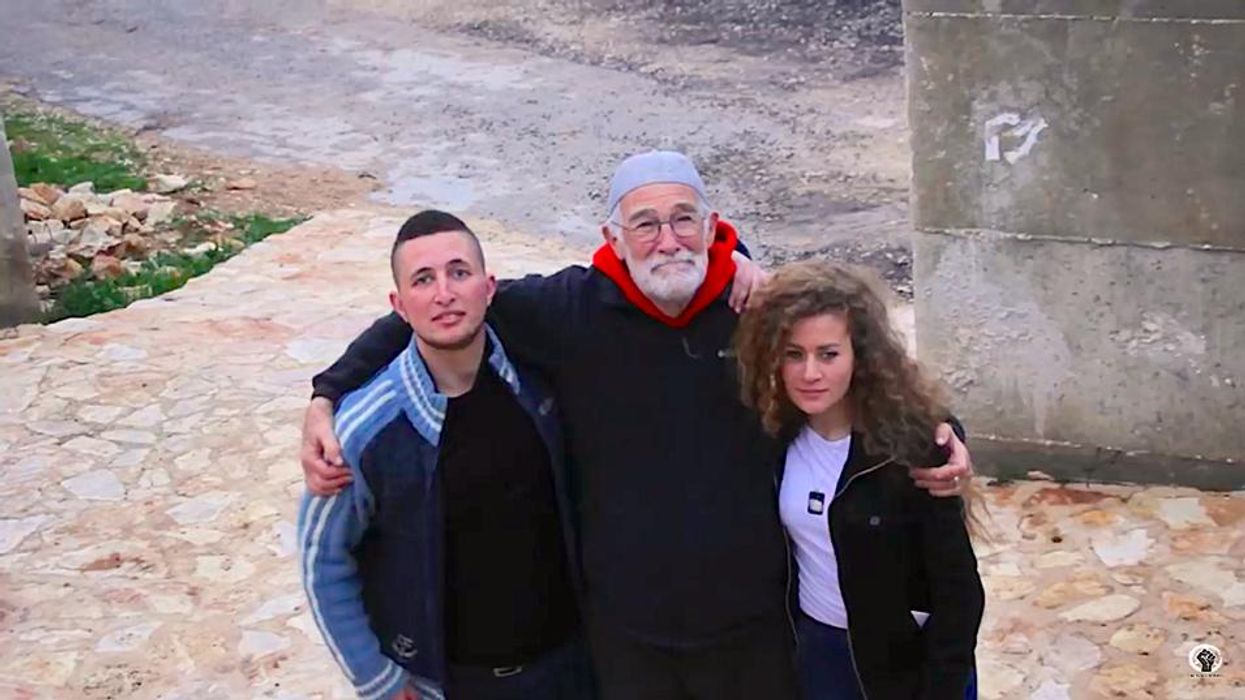
When they left prison on Sunday Ahed Tamimi and her mother Nariman received a hard-earned heros' welcome from Palestinians and others opposed to Israel's occupation and colonization of Palestinian lands seized in 1948 and enlarged by the Israeli army in 1967.
Ahed is 16 years old. Last December, an Israeli soldier shot her cousin in the face. The next day Israeli soldiers menacingly showed up at her house the West Bank village of Nabi Saleh. What would you do?
Ahed slapped one of the armed-to-the-teeth soldiers. While some Israeli politicians said she should be put away for life and others demanded a sentence of at least ten years, the Israeli occupiers sentenced her to eight months for the slap seen around the world. Her mother Nariman filmed the incident and was thrown in jail too, this time for incitement. (It was not the activist Nariman's first time in an Israeli prison.)
Most Americans -- except for the relatively few who have spent more than a few days in Israeli-occupied territories -- find it hard to understand why Palestinians like Nariman and Ahed "persist." Most people in the U.S. are blissfully unaware of the history of Palestine and of the continuing injustices inflicted on its people today. The explanation for this lies largely in the way the U.S. mass media reports the story, almost entirely from the Israelis' point of view.
For those malnourished on Establishment media, here's a bit of history, without which it is impossible to understand the anger and the courage-against-all-odds shown by those who continue to use what they have -- even their open palms -- to make clear that they will never acquiesce in Israeli occupation.
How a Homeland Gets Occupied
The Israeli attack starting the Six-Day War in early June 1967 fits snugly into the category of "war of aggression" as defined by the post-WWII Nuremberg Tribunal. "Pre-emptive" attacks, when there is nothing to pre-empt, are now -- post Iraq war -- labeled more euphemistically as "wars of choice," but that too fits the Nuremberg definition.
To begin to appreciate the injustices inflicted on millions of Palestinians, whose land Israel coveted for itself, one must un-learn the legend that in attacking its neighbors in 1967 Israel was acting in self-defense. None other than then-Prime Minister Menachem Begin (1977 - 83) undermined that piece of propaganda in a speech to the U.S. National Defense University on August 8, 1982. (Apparently, even accomplished dissimulators get cocky on occasion and let the truth slip out.) Here are Begin's words:
"In June, 1967, we had a choice. The Egyptian Army concentrations in the Sinai approaches do not prove that [President Gamal Abdel)] Nasser was really about to attack us. We must be honest with ourselves. We decided to attack him. ... The government decided unanimously: we will take the initiative and attack the enemy, drive him back, and thus assure the security of Israel and the future of the nation."
And now, a half-century after its successful six-day war of aggression with U.S. backing, Israel has been unlawfully colonizing the occupied territories, oppressing the Palestinians still living there, and thumbing its nose at UN Security Council Resolution 242.It was approved unanimously on Nov. 22, 1967, calling on Israel to withdraw from the lands it seized in June of that year. That was then.
And This is Now...
In February--March 2017, I was part of a small Veterans For Peace delegation in Palestine. One of our last visits was to a village named Nabi Saleh, where Ahed's father Bassem Tamimi, his wife Nariman, and Ahed's three siblings live when they are not in prison. Her older brother is in prison now. After two weeks of experiencing what life is like for Palestinians under Israeli occupation in the West Bank, I had a chance to ask Bassem about the nonviolent, but frontal, resistance to Israeli occupation and colonization.
"Your sons have been beaten and badly wounded and one's still in prison; your wife is in and out of prison: your brother-in-law was killed by a sniper bullet; you yourself have been tortured in prison; your house is on the list for demolition -- why do you persist; why encourage such actions?" I asked.
"We have no alternative," Bassem replied matter-of-factly, "it is our land and our life. I will not tell my children or my people to acquiesce in the Israeli occupation -- ever."
The following day we Veterans For Peace took part in a protest march to the separation Wall. Later, underneath the tear-gas and sheltered from the ensuing rifle fire, we watched the teens of Nabi Saleh dodge the Israeli soldiers chasing them through the village for two hours. When the Israeli soldiers, so heavily burdened with weaponry they could hardly run, finally went back behind their Wall, the young folk emerged shouting, "We won." It was a privilege to be there to welcome them back to the Tamimi house and some relative peace and quiet.
Chris Smiley, our delegation videographer, created an excellent 38-minute documentary as part of a serieson our experience in Nabi Saleh called: "One Day, One Village, One Family."
The Palestinian Spirit is Universal
Ahed "Didn't Get It From the Moon". This is the expression my Irish grandmother would use to make it clear that tribute and praise should go to the seed-sowers as well as the protagonists themselves. Other traditions use some variant of: "The apple does not fall far from the tree." Suffice it to say that, from what I was able to witness of the attitude and behavior of Ahed and her three brothers, they are clearly determined to honor the rich legacy of courage and Palestinian patriotism they inherit from Bassem and Nariman -- and not only from them.
One might say that Ahed and her siblings are honor graduates of the Bassem/Nariman Folk School, just as Rosa Parks was a graduate of The Highlander Folk School. The common curriculum has to do with courageous persistence in the pursuit of justice. Moreover, our delegation was to discover that Rosa Parks is a revered figure in the Israeli Knesset -- well, at least in the modest conference room allocated to Arab members.
Hanging prominently on the main wall were pictures of Rosa Parks, as well as of Rev. Martin Luther King, Jr. And now I can hear Ahed Tamimi's voice beneath that of Rosa Parks, who explained in 1992:
"I did not want to be mistreated ... It was just time... there was opportunity for me to take a stand to express the way I felt about being treated in that manner. I had not planned to get arrested. ... But when I had to face that decision, I didn't hesitate to do so because I felt that we had endured that too long. The more we gave in, the more we complied with that kind of treatment, the more oppressive it became".
Nonetheless, they persisted.
Welcome home, Ahed and Nariman.
Originally published at Consortiumnews.com.

What's the Constitution got to do with climate? Current legal cases are now addressing that question. They are using the U.S. Constitution to bring climate protection into the courthouse. These cases range from youth demanding their constitutional right to a stable climate to activists who block fossil fuel pipeline construction and justify their action as necessary to protect constitutional rights.
While legal action has contributed to social change in the past, it also is notoriously slow and uncertain. But action in the streets can accelerate the legal process and pressure the courts to act. Conversely, courts can establish legal principles that encourage action in the streets. Can we combine the two to jumpstart climate protection?
Early in the 21stcentury environmental University of Oregon law professor Mary Christina Wood concluded that existing environmental law had become an enabler of the world's wild rush to environmental catastrophe. The greenhouse gas [GHG] emissions that cause catastrophic climate change were actually authorized by thousands of permits issued annually by the government agencies that are supposed to protect the environment.
Wood proposed an alternative legal paradigm based not on the political discretion of government officials but on their constitutionally-grounded legal duty to protect the common property rights of the people. Its basis is the ancient principle known in American law as the public trust doctrine. Under the public trust doctrine governments have a constitutional responsibility to protect essential natural resources. Wood argued that the earth's climate was part of an "atmospheric public trust" that governments had no right either to destroy or to permit others to destroy.
Environmental lawyer Julia Olson organized the non-profit Our Children's Trust (OCT) to take that theory to court. In 2011, it launched a legal campaign in 50 states and Federal court arguing that under the public trust doctrine, government action causing global warming violated the rights of the plaintiffs - young people and their posterity. The cases were derided by defendants as nothing but "a child's wish for a better world." But there are currently five state cases and a federal case, Juliana vs. U.S., moving through the U.S. courts, multiple related actions in other nation's courts, and several actions working their way through state administrative rulemaking procedures. In addition to constitutional and public trust claims, several of the cases also argue that current GHG emissions discriminate against young people and future generations, since they will get little benefit from current energy policy but will have to pay a terrible price for it in future climate change.
In the Juliana case, Judge Ann Aiken of the federal district court in Oregon ruled that "the right to a climate system capable of sustaining human life is fundamental to a free and ordered society."
Two days after the election of Donald Trump as President, 21 youth plaintiffs won a court ruling that could become a critical weapon in the struggle against climate change. In the Juliana case, Judge Ann Aiken of the federal district court in Oregon ruled that "the right to a climate system capable of sustaining human life is fundamental to a free and ordered society." A stable climate system is quite literally the foundation of society, "without which there would be neither civilization nor progress."
Judge Aiken did not rule on the claim of intergenerational discrimination -- but she did find that everybodyhas a right to a stable climate. She framed the fundamental right at issue as "the right to a climate system capable of sustaining human life." If "governmental action is affirmatively and substantially damaging the climate system in a way that will cause human deaths, shorten human lifespans, result in widespread damage to property, threaten human food sources, and dramatically alter the planet's ecosystem," then the plaintiffs have a claim for protection of their life and liberty under the fifth amendment. "To hold otherwise would be to say that the Constitution affords no protection against a government's knowing decision to poison the air its citizens breathe or the water its citizens drink."
Judge Aiken also ruled that the public trust doctrine was applicable to climate change. She quoted a judicial opinion that the right of future generations to a "balanced and healthful ecology" is so basic that it "need not even be written in the Constitution" for it is "assumed to exist from the inception of humankind."
Shortly after Trump's inauguration the government asked the Ninth Circuit Court of Appeals to overturn Judge Aiken's ruling. In March, 2018 -more than a year later - Trump's appeal was rejected and the federal magistrate judge set a new trial date for October 29, 2018 in federal district court in Eugene, Oregon. Further delays are possible; the Trump administration has until June 5 to ask the Supreme Court to intervene and issue a stay, and there are other procedural ploys that could conceivable delay the trial. And, when Judge Aiken gets the chance to finally rule on the case, the parties will almost certainly engage in appeals all the way to the U.S. Supreme Court.
Constitutional climate arguments are also reaching the courts as part of a necessity defense for civil disobedience. The necessity defense is well established in Anglo-American common law. While judges very often resist such necessity claims, since the 1970s hundreds of people who have committed civil disobedience in service of the public good have been acquitted on the grounds that their actions were taken to prevent a greater harm. To make a necessity defense the accused must prove that they believed their act was necessary to avoid or minimize a harm; that the harm was greater than the harm resulting from the violation of the law; and that there were no reasonable legal alternatives.
While judges very often resist such necessity claims, since the 1970s hundreds of people who have committed civil disobedience in service of the public good have been acquitted on the grounds that their actions were taken to prevent a greater harm.
Two lawyers involved with these cases argue that public trust and constitutional arguments "make the case for climate necessity more compelling."
The political fight in which climate activists find themselves, rather than being a mere difference of personal opinion -- should the government permit oil pipelines or not? --involves the violation of fundamental rights. As in many instances of civil disobedience throughout American history, climate activists are driven by a necessity to vindicate guarantees secured under the Constitution."
In October, 2013, a climate activist named Alec Johnson (aka Climate Hawk) locked himself to a Keystone XL construction excavator in Tushka, Okla. and announced he would argue in court that his action was necessary in order to protect the atmospheric public trust. Johnson ran into an article about the atmospheric public trust and followed up by reading Mary Christina Wood's book Nature's Trust. Johnson was the first defendant anywhere to make a necessity defense based on the Constitutional duty of government to protect the climate under the public trust doctrine.
In a statement he prepared for the jury, Johnson argued that his blockade of Keystone XL pipeline construction was necessary because the pipeline threatens our atmospheric public trust, and state and national governments were failing to protect us against that threat. He proclaimed on the basis of the public trust principle, "I wasn't breaking the law that day -- I was enforcing it." The judge refused to let Johnson present a necessity defense, but he was allowed to explain his motivation to the jury. Although Johnson could have been sentenced to up to two years in the Atoka County jail, the jury, which under Oklahoma law determined his sentence, gave him to no jail time and a fine of just over $1,000.
In 2014, Delta 5 activists blocked trains carrying Bakken crude oil in Bellingham, Washington. The judge let the defense present six witnesses on the dangers of climate change and local environmental risks of the trains, but ultimately ruled out a necessity defense on the grounds that the defendants had reasonable alternatives to civil disobedience. The defendants were acquitted of "obstructing a train" but convicted of trespass. In an Amicus Curiae "friend of the court" brief supporting their appeal, the Climate Defense Project, with assistance from a senior staff attorney with Our Children's Trust, linked public trust and constitutional climate rights to the climate necessity defense asserted by the Delta 5. The necessity defense is supported "not just by the severity of the harms Defendants sought to avert" but by the "concrete and immediate constitutional legal injuries suffered by the Defendants and the citizens of Washington, as public trust beneficiaries." The judge's refusal to allow a necessity defense is under appeal.
In 2016, activists associated with 350 Vermont chained themselves to construction equipment building a gas pipeline. They were charged with criminal trespass. They asked the court to allow them to defend themselves "on the basis of the Public Trust doctrine," asserting that the state Public Service Board had violated its public trust duties by permitting the pipeline despite the global warming consequences. The court refused to allow a necessity defense.
In October, 2016 "Shut It Down" activists in Minnesota, Montana, North Dakota, and Washington turned valves to shut off tar sands oil flowing from Canada. In Washington, Ken Ward was charged with second degree burglary and criminal sabotage. The court refused to let him present a necessity defense. His first trial resulted in a hung jury; a second trial convicted him for burglary, which is under appeal. In Minnesota, Shut It Down activists were charged with committing or aiding criminal damage and trespass. They will be allowed to present a necessity defense. The necessity arguments of both cases will test the constitutional rights established by the Aiken decision.
In a year-long campaign, 198 people were arrested blocking construction of the West Roxbury Lateral Pipeline in Massachusetts. Thirteen of them were charged with crimes and the judge allowed them to present a necessity defense. The defendants' pre-trial filings emphasized the imminent local and global harms the pipeline would cause, but they also discussed the public trust duties of government and the right to a stable climate.
The failure by the federal and state governments to take action commensurate with the severity of the climate crisis is a violation of government's public trust and constitutional duties and represents an additional imminent and ongoing injury.
Recently, the federal District of Oregon . . . ruled that climate change harms federal public trust resources, including land beneath tidal waters, and that the government's contributions to climate change may amount to a breach of fiduciary duty.
The Julianaopinion likewise recognized that constitutional guarantees are implicated by ongoing climate-related harms. Accepting plaintiffs' arguments that the government's knowing contributions to climate change and the resulting damage to life, liberty and property, if proven, would violate their Fifth Amendment due process rights and unenumerated rights under the Ninth Amendment.
A week before the trial date the prosecutor unexpectedly reduced the criminal charges to a mere infraction - the equivalent of a parking ticket. By only charging an infraction, the prosecutor was able to prevent a trial that would have put the pipeline and the whole climate destruction it represented on trial. According to Marla Marcumof the Climate Disobedience Center, lead organizer on the sustained campaign of nonviolent direct action in West Roxbury and coordinator of its legal defense, "the charges were probably reduced in order to avoid the trial for which the defendants, their legal team, nine expert witnesses, and many supporters had prepared."
Judge Mary Ann Driscoll then said, "Based on the very heartfelt expressions of the defendants" who "believe in their cause" and who "believe they were entitled to invoke the necessity defense," I "find them all not responsible." "Not responsible" is the equivalent for an infraction of a finding of "not guilty" in a criminal case. Marcum says, "this is the first time that defendants were acquitted by a U.S. judge based on climate necessity."
Constitutional climate arguments are not a magic bullet that will allow protestors to escape legal penalties, let alone halt climate destruction. Ted Hamilton of the Climate Defense Project notes that a criminal defense cannot be based solely "a constitutional right to a safe climate or on a public trust claim." These constitutional arguments work best as supplements to the main necessity argument. But constitutional claims can illustrate "the failure of legal alternatives" -- because the government is not only failing to address the climate crisis, but is "violating its own duties and citizens' rights through its failure." And constitutional arguments can highlight the harm protestors are targeting -- because that harm constitutes "a violation of constitutional rights and the public trust."
To understand how law cases seeking to establish constitutional climate rights can be synergistic with action on the streets, it helps to look back on the history of the civil rights movement.
The finding of a fundamental Constitutional principle by the courts empowered millions of people to take direct action to establish rights based on that principle.
For decades court cases challenged government-enforced racial segregation as a violation of the equal protection of the laws guaranteed by the 14thamendment to the U.S. Constitution. In 1954 the Supreme Court consolidated several of these cases in Brown vs. Board of Education. It found that racial segregation in public schools violated the 14thamendment's equal protection clause - thereby implying that the same was true for voting, public transportation, and other areas of government action.
Segregationists responded with what they called "massive resistance" to integration, ranging from closing public schools and sending state troops to block school integration to brutalizing demonstrators and burning black churches. Meanwhile, government made little effort to enforce the law as embodied in the Supreme Court's desegregation decision. In the vacuum there arose a direct action civil rights movement that vowed to enforce the law even if governments wouldn't. The nonviolent "shot heard 'round the world" was Rosa Parks' refusal to move to the back of the bus as people of color were required to do by local ordinance. Her arrest was answered by the Montgomery bus boycott. 381 days after the start of the boycott, the Supreme Court ruled that racial segregation on public buses was unconstitutional.
The bus boycott was soon followed by sit-ins at segregated lunch counters, freedom rides on segregated interstate buses, and voter registration drives in counties that had legally blocked African Americans from voting. All were met by violence, but all ultimately achieved substantial success. The 1964 Civil Rights Act and the 1965 Voting Rights Act finally began to implement the equal protection of the laws that had been asserted in the Brown decision a decade before.
Two lessons can be drawn from this history. First, the finding of a fundamental Constitutional principle by the courts empowered millions of people to take direct action to establish rights based on that principle. Second, if those millions of people had waited for the courts to enforce that principle it would have been centuries longer before black people would have gained the rights won by the civil rights movement. Civil rights advocates used the law by taking the law into their own hands.
The climate movement can use this synergism of the courts and the streets in two ways.
1.Backing the courtroom struggle for climate rights with action in the streets.
According to Julia Olson, Executive Director and Chief Legal Counsel for Our Children's Trust:
One thing that is important to understand about the legal system is that judges and courts are part of the public. They see what goes on in the media, they see what public sentiment and public opinion is, and while the judges make decisions on the law and the facts of the case, what is happening outside that courtroom has mattered throughout history, in terms of the way our judiciary reacts to crises of social justice.
Olson provides a powerful recent example:
We saw that with the gay marriage decision. It was really important: The court noted in its opinion how times had changed, and there was public support for LGBT marriage.
There are many other historical examples of the synergism between legal and social movement action in leading to changes of judicial interpretation of the law. It is difficult to imagine that courts would have legitimated the Wagner Act, overthrown the "separate but equal" doctrine in theBrowndecision, established women's reproductive rights in the Griswold andRoecases, or more recently supported the right of gay people to marry in Obergefell, without the sit-down strikes, the civil rights movement, the women's movement, or the gay rights movement.
OCT's support for action beyond the courthouse goes back to its earliest days. From the beginning, the youth plaintiffs have been organizing youth marches for climate protection, participating in climate movement demonstrations, and reaching out to other young people to engage in climate action.
Now Julia Olson says, "We need the whole climate movement to help us mobilize for this trial." Speaking to a webinar co-sponsored by the Labor Network for Sustainability and 350.org, she added,
What is happening with the movement, and everything 350.orgis doing, is critical, and connects and helps build the intersectionality and the strength of the public trust. Because when people are out in the streets and doing things to support firm climate action and action that is based on science, it helps support what we are doing in the courtroom.
One in six Americans say they would personally engage in nonviolent civil disobedience against corporate or government activities that make global warming worse. That's about forty million adults. If one percent of them did so it would immediately transform the politics of climate.
The importance of "people out in the streets" for the Julianacase will extend beyond the initial trial. If the case is not won at trial, appeals and cases in other venues will be necessary; popular support will be required both to legitimize such efforts and to pay for them. If the case is won at trial, popular support will be needed to carry the case through appeals, and to ensure that the defendants - the federal government agencies - create and implement a National Climate Recovery Plan capable of lowering and sequestering GHG emissions in line with the best available science, thus staving off the worst climate impacts. Public mobilization is the best guarantee that court-ordered changes required for climate protection will actually be implemented, rather than being blocked by pushback from the fossil fuel industry and their supporters.
2. Use constitutional arguments as part of climate action on the streets.
The Aiken decision empowers the climate protection movement. It provides principles that justify the movement's demands for a rapid end to the burning of fossil fuels and its replacement by climate-safe energy. It provides organizations and activists a vision of how they can use the constitutional right to a stable climate and protection of the public trust as a common unifying and mobilizing weapon in all their efforts and arenas.
An example of how constitutional principles can be incorporated in climate campaigns was provided by the global Break Free From Fossil Fuels days of actions in May, 2016. The U.S. organizers of 350.org issued a "Break Free Proclamation" which drew on the principles asserted in Julianacase.
We are upholding fundamental principles embodied in the laws and constitutions of countries around the world.
We are upholding the unalienable rights to life and liberty.
We are implementing the public trust doctrine, which requires that vital natural resources on which human well-being depend must be cared for by our government for the benefit of all present and future generations.
Governments have no right to authorize the destruction of the public trust.
Governments have no right to wreck the rights to life and liberty for future generations.
We are here to enforce the law on governments and corporations that are committing the greatest crime in human history.
Now that federal judge Aiken has ruled that the atmospheric public trust and the right to a stable climate are indeed guaranteed by the U.S. Constitution, these arguments can be used as part of every climate action from blocking pipeline construction to demanding that city councils and state legislatures ban new fossil fuel infrastructure and establish targets and plans for a fossil free future.
One in six Americans say they would personally engage in nonviolent civil disobedience against corporate or government activities that make global warming worse. That's about forty million adults. If one percent of them did so it would immediately transform the politics of climate.
The Brown decision didn't cause the civil rights revolution, but it did create an opportunity that millions of people seized on to make America a more just country. Judge Aiken's Juliana decision gives us an opportunity to make it a more climate safe one.

President Trump announced Thursday that he would pardon Dinesh D'Souza, the loopy conservative operative who pleaded guilty to violating campaign finance law:
It is a spectacular abuse of the pardon power and a barely-veiled announcement that Trump will use that power to protect odious conservative criminals and undermine the Mueller investigation.
D'Souza is best known today for being too weird for polite company and incredibly racist -- though his arguments and positions also have a strange tendency to flip around all over the place. As Alex Nichols writes, he got his start in politics with a deeply racist newspaper at Dartmouth, and then with moldy-oldie arguments about how slaves in the antebellum South were treated "pretty well." He got wide notoriety with one racist tirade after another against President Obama and blacks in general, leavened with stomach-churning fabrications about Obama's mother.
In 2014, he pleaded guilty to a felony count of using two straw donors (one of them his mistress, in classic Conservatives Values fashion) to arrange $20,000 in illegal contributions to Republican New York Senate candidate Wendy Long in 2012. The remarkable thing about this is that not only was D'Souza stupid and careless enough to run afoul of the few remaining shreds of campaign finance law not yet torched by the Republican hack majority on the Supreme Court, but he was stupid enough to do it on behalf of a Republican in New York state in a presidential election year. Long lost to Kirsten Gillibrand by 46 points.
After getting out of eight months of community confinement, D'Souza veered to a new position, making a maudlin documentary claiming that actually, Democrats are the Real Racists. That is a pretty common conservative trope, but aside from being ludicrously dishonest, it was totally at odds with his previous position that American racism was not so bad. In the age of Trump, conservatives increasingly don't even bother to make their propaganda internally consistent, but in any case D'Souza was soon up to his old tricks:
Trump has now exercised his pardon power on behalf of three big-time conservatives: Scooter Libby, Joe Arpaio, and D'Souza. The defense of racism and police brutality is a big factor here -- indeed, not only is Arpaio a bilious racist, he was literally convicted for racist acts (namely, refusing to stop racially profiling Latinos). But probably more important now is the signal sent to all the people facing prosecution as part of the Mueller investigation or other probes into conservative crimes. Trump didn't even bother to argue that D'Souza wasn't guilty, just that he was "treated unfairly."
So if he'll pardon Libby, Arpaio, and D'Souza, who won't he pardon? Later Thursday it was reported he was also considering a pardon of Martha Stewart (convicted of insider trading) and former Illinois Democratic Gov. Rod Blagojevich (convicted on corruption charges) -- a bizarre development, but likely explained by Blagojevich having appeared on The Apprentice, and Stewart having hosted an Apprentice spin-off.
The message is clear: Trump's criminal associates get prime access to pardons. Several of those people, including Michael Flynn and George Papadapoulos, have already agreed to work with the Mueller investigation. But several others, like Paul Manafort and Michael Cohen, have not. It seems extremely likely that if they continue to refuse to cooperate and are convicted, then Trump will immediately pardon them. (They could probably increase their chances by publicly calling Obama a bunch of racial slurs on Fox News.)
So long as Trump remains in office, it seems beyond question that he will continue to abuse his powers of office to protect himself and his criminal associates from the rule of law, and that Republicans in Congress will continue to look the other way or actively enable him. If Trump is going to be reined in at all, Democrats are going to have to win some elections.
Read the original article at The Week.