SUBSCRIBE TO OUR FREE NEWSLETTER
Daily news & progressive opinion—funded by the people, not the corporations—delivered straight to your inbox.
5
#000000
#FFFFFF
To donate by check, phone, or other method, see our More Ways to Give page.
Daily news & progressive opinion—funded by the people, not the corporations—delivered straight to your inbox.
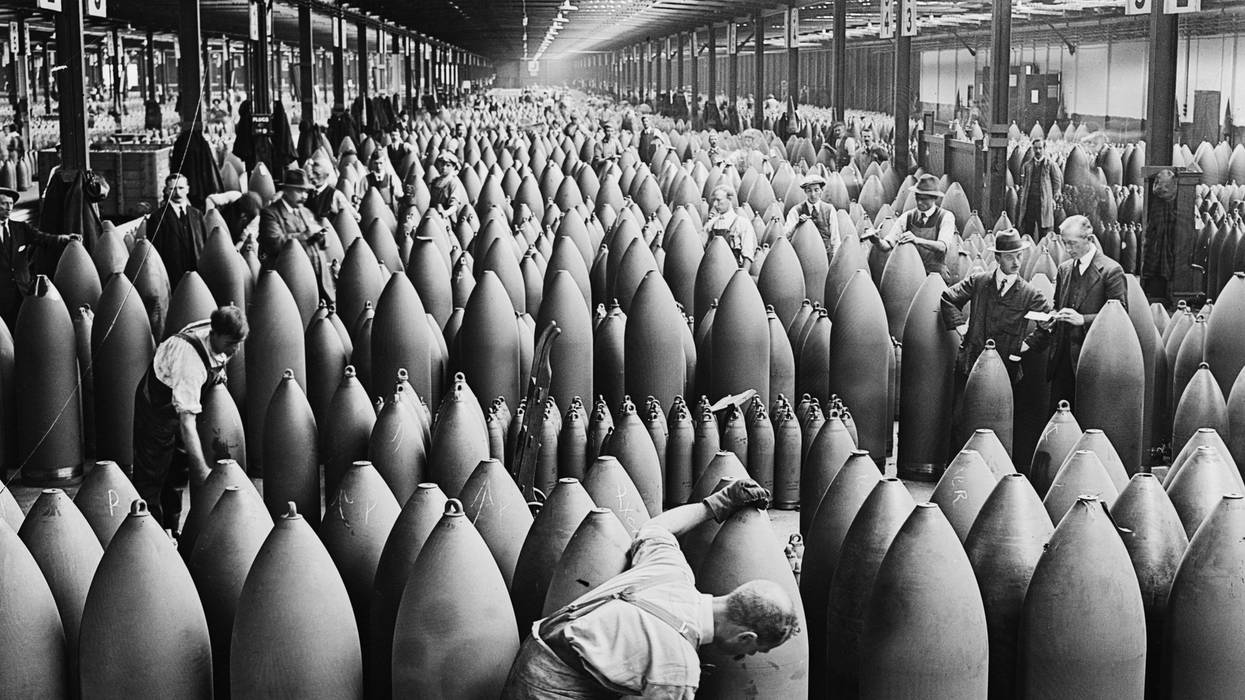
As they did over a century ago ahead of World War I, the Merchants of Death thrive behind a veil of duplicity and slick media campaigns.
The senseless slaughter of World War I began with the murder of a single man, a Crown Prince of a European empire whose name no one was particularly familiar with at the time. Archduke Franz Ferdinand Carl Ludwig Joseph Maria was the presumptive heir to the Austrian-Hungarian empire in June of 1914.
His assassin was a young Bosnian Serb student and the murder of the Crown Prince set off a cataclysmic series of events resulting in the deaths of over 20 million people, half of whom were civilians. An additional 20 million people were wounded.
Entire generations of young men from England, France, Russia, Austria, and Germany were lost. National economies were ruined. In economic terms, World War I caused the greatest global depression of the 20th century. Debts by all the major countries (except the USA) haunted the post-war economic world. Unemployment soared. Inflation increased, most dramatically in Germany where hyperinflation meant that a loaf of bread costs 200 million marks.
World War I ended a period of economic success. Twenty years of fiscal insecurity and suffering followed. It is thought that veterans returning home from World War I brought with them the Spanish Flu, which killed almost one million Americans. The war also laid the groundwork for World War II.
Wherever they go, suffering and death, war crimes and atrocities, profits, and stock buybacks follow.
Was it simply the murder of the Crown Prince that caused a world war or were other factors at work? Why did the United States get involved in a European conflict, particularly when an overwhelming number of Americans were against the United States being involved?
Despite major public opposition to the war, Congress voted overwhelmingly in favor of it: 373 to 50 in the House of Representatives, 82 to six in the Senate. The politicians defied the wishes of the people they were supposed to represent. What happened? Was something else driving their votes?
J.P. Morgan and Company was one of the largest investment banking firms in the world. J.P. Morgan himself was the official business agent in the United States for the British government and the main contact for Allied loans during the war. Similarly, E.I. du Pont Company was the largest chemical firm in America. These two phenomenally wealthy and powerful companies along with other US manufacturers, including US weapons manufacturers, were closely aligned with President Woodrow Wilson.
When World War I began, JP Morgan had extensive loans to Europe which would be lost if the allies were defeated. Du Pont and other US weapons manufacturers stood to make astronomical profits if the United States entered the war. Historian Alan Brugar wrote that for every soldier who died in battle, the international bankers made a profit of $10,000. As J.P. Morgan wrote to Wilson in 1914, “The war should be a tremendous opportunity for America.”
When the war concluded and the dead and wounded were counted, suspicions grew in the United States that nefarious business interests had propelled US involvement into the great slaughter. Investigative reporting and congressional hearings were initiated.
In 1934 a book written by Helmuth Engelbrecht called The Merchants of Death became a best seller. The book exposed the unethical business practices of weapons manufacturers and analyzed their enormous profits during World War I. The author concluded that “the rise and development of the arms merchants reveals them as a growing menace to World Peace.” While not the only reason for the US entering the war, it became clear the Merchants of Death lobbied both Congress and the President for war.
The American public was incensed. In 1934 almost 100,000 Americans signed a petition opposing increased armament production. Veterans paraded through Washington DC in 1935 in a march for peace. And Marine Major General Smedley Butler, two-time Medal of Honor winner, published his book War is a Racket, claiming he had been “a high-class muscle man for big business, for Wall Street and the bankers. In short, I was a racketeer; a gangster for capitalism.” His book too became a bestseller.
The growing wave of public outrage led Senator Gerald Nye to initiate congressional hearings investigating whether US corporations, including weapons manufacturers, had led the United States into World War I. In two years, the Nye committee held 93 hearings and called more than 200 witnesses to testify, including JP Morgan and Pierre S. DuPont.
The committee conducted an extensive investigation searching the records of weapons manufacturers. They uncovered criminal and unethical actions including bribery of foreign officials, lobbying the United States government to obtain foreign sales, selling weapons to both sides of international disputes, and the covert undermining of disarmament conferences.
“The committee listened daily to men striving to defend acts which found them nothing more than international racketeers, bent upon gaining profit through a game of arming the world to fight itself,” Senator Nye declared in an October 1934 radio address.
The Senate Nye Committee recommended price controls, the transfer of Navy shipyards out of private hands, and increased industrial taxes. Senator Nye suggested that upon a declaration of war by Congress, taxes on annual income under $10,000 should automatically be doubled and higher incomes should be taxed at 98%. A journalist wrote at the time, “If such policies were enacted, businessmen would become our leading pacifists.”
The American public was outraged at the committee’s findings and so created some of the largest peace organizations the country had ever known. Committed to staying out of all future European wars, American college campuses in the 1930s had thousands of students taking oaths swearing they would never fight in a foreign war.
Farmers, laborers, intellectuals, ministers, people from all walks of life declared they would never again participate in a war fought to increase the profits of corporations.
And then, business fought back. They lobbied those in Congress to cut off funding for the Nye committee, which they soon did. A smear campaign was orchestrated against Senator Nye. The committees’ days were numbered.
In the end, the Nye Committee demonstrated that “these businesses were at the heart and center of a system that made going to war inevitable. They paved and greased the road to war.” With World War II, the Military Industrial Complex would explode and come to dominate American economic and political life.
Today, the Merchants of Death thrive behind a veil of duplicity and slick media campaigns. They have assimilated mainstream media and academia into their conglomerate. But their crimes are clear, and the evidence is overwhelming. Wherever they go, suffering and death, war crimes and atrocities, profits, and stock buybacks follow.
Ninety years after the original Merchants of Death hearings, the 2023 Merchants of Death War Crimes Tribunal will hold United States weapons manufacturers accountable for aiding and abetting the United States government in the commission of war crimes and crimes against humanity. This Tribunal will shine a light on those who profit from war and will seek to end their bloody franchise. Let this time be the last time. We may not have another chance.

"Patriotism, in the trenches, was too remote a sentiment, and at once rejected as fit only for civilians, or prisoners." -- Robert Graves, Goodbye To All That (1929).
I'm one of the lucky ones. Leaving the madness of Army life with a modest pension and all of my limbs intact feels like a genuine escape. Both the Army and I knew it was time for me to go. I'd tired of carrying water for empire and they'd grown weary of dealing with my dissenting articles and footing the bill for my seemingly never-ending PTSD treatments. Now, I'm society's problem, unleashed into a civilian world I've never gazed upon with adult eyes.
I entered West Point in July 2001, a bygone era of (relative) peace, the moment, you might say, before the 9/11 storm broke. I leave an Army that remains remarkably engaged in global war, patrolling an increasingly militarized world.
In a sense, I snuck out of the military at age 35, my early retirement an ignominious end to a once-promising career. Make no mistake, I wanted out. I'd relocated 11 times in 18 years, often enough to war zones, and I simply didn't have another deployment in me. Still, I wouldn't be honest if I didn't admit that I'll mourn the loss of my career, of the identity inherent in soldiering, of the experience of adulation from a grateful (if ill-informed) society.
Perhaps that's only natural, no matter how much such a hokey admission embarrasses me. I recognize, at least, that there's a paradox at work here: the Army and the Global War on Terror (GWOT) made me who I now am, brought a new version of me to life, and gifted me (if that's the right phrase for something so grim) with the stories, the platform, and the pain that now make my writing possible. Those military deployments to Iraq and Afghanistan in particular turned a budding neocon into an unabashed progressive. My experiences there transformed an insecure, aspiring dealer-in-violence into someone who might be as near as a former military man can get to a pacifist. And what the U.S. Army helped me become is someone who, in the end, I don't mind gazing at in the mirror each morning.
Should I thank the Army then? Maybe so, no matter the damage that institution did to my psyche and my conscience over the years. It's hard, though, to thank a war machine that dealt so much death to so many civilians across significant parts of the planet for making me who I am. And no matter how much I told myself I was different, the truth is that I was complicit in so much of that for so long.
In a way, I wonder whether something resembling an apology, rather than a statement of pride in who I've become, is the more appropriate way of saying goodbye to all that. Nonetheless, the story is all mine, the burdensome, the beautiful, the banal, and the horrific. War, violence, and bigotry--as I've written--are America's original sins and, looking back, it seems to me that they may be mine as well. In that context, though I'm now officially retired, I think of this as my last piece authored as an active military dissenter--a clearing of the air--before moving on to a life of activism, as well as an unarmed life of words.
What I Won't Be Missing
It's time to wave goodbye to a litany of absurdity that I witnessed in the institution to which I dedicated my adult life. Some peers, even friends, may call this heresy--a disgruntled former major airing dirty laundry--and maybe in some way it is. Still, what I observed in various combat units, in conversation with senior officers, and as a horrified voyeur of, and actor in, two dirty wars matters. Of that, I remain convinced.
So here's my official goodbye to all that, to a military and a nation engaged in an Orwellian set of forever wars and to the professional foot soldiers who made so much of it all possible, while the remainder of the country worked, tweeted, shopped, and slept (in every sense of the word).
Goodbye to the majors who wanted to be colonels and the colonels who wanted to be generals--at any cost. To the sociopaths who rose in the ranks by trampling on the souls of their overburdened troopers, trading lives for minor bumps in statistics and pats on the shoulder from aggressive superiors.
Goodbye to the generals who led like so many lieutenants, the ones who knew the tactics but couldn't for the life of them think strategically, eternally proving the Peter Principle right with every promotion past their respective levels of incompetence.
So long to the flag officers convinced that what worked at the squad level -- physical fitness, esprit de corps, and teamwork--would win victories at the brigade and division level in distant, alien lands.
Farewell to the generals I served under who then shamelessly spun through Washington's revolving door, trading in their multi-starred uniforms for six- and seven-figure corporate gigs on the boards of weapons manufacturers, aka "the merchants of death" (as they were known once upon a distant time), and so helped feed the unquenchable appetite of the military-industrial beast.
Farewell to the senior generals, so stuck in what they called "their lane" that they were unwilling (or intellectually unable) to advise civilian policymakers about missions that could never be accomplished, so trapped in the GWOT box that they couldn't say no to a single suggestion from chickenhawk militarists on the Hill or in the Oval Office.
Goodbye to the devotees of American exceptionalism who filled the Army's ranks, stalwart evangelists of a civic religion that believed there was a secret American inside every Arab or Afghan, ready to burst forth with the slightest poke from Uncle Sam's benevolent bayonet.
Ciao to staff officers who mistook "measures of performance" (doing lots of stuff) for "measures of effectiveness" (doing the right stuff). I won't miss the gaggles of obtuse majors and colonels who demanded measurable "output"--numbers of patrols completed, numbers of houses searched, counts of PowerPoint slides published--from already overtasked captains and the soldiers they led and who will never learn the difference between doing lots and doing well.
Goodbye to battalion and brigade commanders who already had their hands full unsuccessfully "pacifying" entire districts and provinces in alien lands, yet seemed more concerned with the cleanliness of troopers' uniforms and the two-mile-run times of their units, prioritizing physical fitness over tactical competence, empathy, or ethics.
Godspeed to the often-intolerant conservatism and evangelical Christianity infusing the ranks.
See ya to the generals who lent their voices, while still in uniform, to religious organizations, one of whom even became the superintendent of West Point, and at worst got mere slaps on the wrist for that. (And while we're at it, here's a goodbye wave to all those chaplains, supposedly non-denominational supporters of every kind of soldier, who regularly ended their prayers with "in Jesus's name, amen." So much for church-state separation.)
Farewell to the still-prevalent cis-gender patriarchy and (strangely erotic) homophobia that infuses the ranks of the U.S. military. Sure, "don't ask, don't tell" is a thing of the past, but the Army remains a (straight) boys' club and no easy place for the openly gay, while the president remains intent on banning transgender enlistees. And even in 2019, one in four women still reports at least one sexual assault during her military tour of duty. How's that for social progress?
So long to the adrenaline junkies and power-obsessed freaks atop so many combat units, folks who lived for the violence, the rush of nighttime raids without a thought for their often counterproductive and bloody consequences. It's a relief to leave them behind as they continue--prisoners of counterinsurgency, or COIN, math--to feed the insurgencies the U.S. fights far faster than they kill "terrorists."
Goodbye to officers, especially generals, who place "duty" above ethics.
Sayonara to those who canonize "martyrs" like former commander James "Mad Dog" Mattis, a hero for resigning as defense secretary rather than implement (gasp!) modest troop withdrawals from our endless wars in Syria and Afghanistan. (As for a Pentagon-backed war in Yemen that starved to death at least 85,000 kids, he was apparently fine with that.)
Toodle-oo to the vacuous, "thanks-for-your-service" compliments from civilians who otherwise ignore soldiers' issues, foreign policy, and our forever wars, who never give a thought to placing the country's disastrous conflicts up there with healthcare on anyone's election-year priorities list.
Parting is such sweet sorrow when it comes to the neo-Confederate backgrounds and cheerleading of far too many troopers and officers, to a military academy that still has a Robert E. Lee Road on which you drive from a Lee Housing Area to a Lee Barracks, part of an Army that has named at least 10 of its stateside bases after Confederate generals.
Farewell to rampant Islamophobia in the ranks and the leaders who do so little to counter it, to the ubiquitous slurs about Arabs and Afghans, including "hajis," "rag-heads," "camel jockies," or simply "sand niggers." What a way to win Muslim "hearts and minds!"
Ta-ta to the paradox of hyper-capitalism and Ayn Randian fiscal conservatism among the officers of the nation's most socialist institution, the military. Count me in as sick of the faux intellectuals reading books by economists Friedrich Hayek and Milton Friedman in Iraq or their less sophisticated peers toting around Ann Coulter, Sean Hannity, or Glenn Beck volumes, all the while enjoying their publicly-financed, co-pay-less government healthcare.
Adieu to a military justice system that boots out soldiers who commit "alcohol-related" offenses or "piss hot" for marijuana while rarely investigating the Army's role as a catalyst for their addictions--and so long as well to a discipline-over-treatment model for dealing with substance abuse that's only now beginning to change.
Goodbye to infighting among the Army, Navy, and Air Force over funds and equipment and to those "Pentagon Wars" that prioritize loyalty to your service branch over fealty to the nation or the Constitution.
See you later, when it comes to the predictable opinions of a legion of semi-retired generals on 24-hour cable news who count on their public stature to sell Americans yet more guns and militarism.
So long to the faux-intellectualism of men like former "surge" general David Petraeus and his sycophantic army of "warrior monks" and COINdinistas who have never seen a problem to which slightly improved counterinsurgency tactics wasn't the answer and are incapable of questioning the efficacy of force, intervention, and occupation as ways to alter complex societies for the better.
Farewell to the pride and value military leaders place on superficial decorations--patches and badges and medals--rather than true mission-accomplished moments. (Don't hold your breath waiting for even a single senior commander to ever admit that his forces wasted their time, or worse, during their year-long deployment in one of America's distant war zones.)
Cheerio to the prevailing consensus among U.S. officers that our NATO allies are "worthless" or "weak" because they aren't aggressive enough in taking on certain missions or types of patrols, while fighting and sometimes dying for Uncle Sam's global priorities. (This is the nonsense that led to French fries being banned and "freedom fries" served in the congressional cafeteria after France had the gall to oppose Washington's invasion of Iraq in 2003.)
Goodbye to the colonels and generals who speak at the funeral ceremonies of soldiers they hardly know in order to "rededicate" the mourning survivors to the never-ending mission at hand.
Farewell to the soldiers and officers who regularly complained that the Army's Rules of Engagement were too strict--as if more brutality, bombing, and firepower (with less concern for civilians) would have brought victory--as well as to the assumption behind such complaints that Americans have some sort of inherent right to wage wars of choice overseas.
So long to the chauvinism in the senior ranks that asserts some sort of messianic American right and mission to police the globe, dot it with bases, and give its military men license to strut around the villages and alleyways of sovereign states as if they were their own.
America's servicemen have taken to believing in their own myth: that they really do constitute a special caste above all you measly civilians--and now, of course, me, too. In this way, military men actually reflect a toxic society's values. Few ask why there aren't teachers, nurses, and social workers honored like U.S. military personnel in America's vaunted sports stadiums. True servants--as we soldiers, in my years of service, were so fond of dubbing ourselves--should stick to humility and recognize that there are other, far nobler ways to spend one's life.
And here, finally, is what I can't say goodbye to: a society that's come to value its warriors above all others.
A Farewell Coda
So what should this now-retired Army major make of it all? The inconvenient truth is perhaps very little. It's unlikely that anything I'll write will change many minds or affect policy in any way. In the decade following World War I, when Major General Smedley Butler, the most decorated Marine of his time, took up the pen to expose the ills of American-style corporate warfare, he (unlike me) made a true splash. As today, however, the American intervention machine just rolled on. So what chance does a former Army major have of moving the needle on U.S. militarism?
I'm active now in what little there is of an antiwar movement in this country. That was part of the genius of President Richard Nixon's cynical decision in 1973, following years of large-scale antiwar activity in this country and in the U.S. military itself during the Vietnam era, to end the draft. He replaced a citizen's army with an all-volunteer force. By turning the military into a professional caste, a kind of homegrown foreign legion, rather than a responsibility of every citizen, by transforming its officers into an isolated, fawned-upon caste, he effectively ensured that the public would look elsewhere and that antiwar movements would largely become things of the past.
Maybe it's hopeless to fight such a beast. Still, as the child of a blue-collar, outer-borough New York City family, I was raised on the romance of lost causes. So I hope to play a small role in my version of a lost cause--as a (lonely) response to the pervasive stereotypes of modern American soldiers, of the officer corps, of West Point. I plan on being there whenever the militarists insist that Army types are all politically conservative, all model patriots, all devout "moral" Christians, all... you name it and I'll be there as an inconvenient counterpoint to a system that demands compliance.
And here's the truth of it: no matter what you may think, I'm not alone. There are a precious few other public voices from the forever wars speaking out and--as various supportive texts and emails to me have made clear--more silent dissenters in the ranks than you might imagine.
So count on this: I'll be hoping that more serving officers as well as troops gather the courage to speak out and tell the American public the score when it comes to our brutal, hopeless, never-ending wars. Sure, it's just a dream for now, but what would those at the top of that war system do if the troops, officers, and commanders they've so consciously placed on a pedestal begin doubting, then questioning, then dissenting? That would be a problem for a war machine that, even in the age of AI and drones, still needs its obedient foot soldiers to hump a ruck and patrol a block.
I was, until recently, one of them, the obsequious grunt at the pointy end of the spear fashioned by a warlike government ruling over an apathetic citizenry. But no longer. I'm only 35 and maybe it won't make a difference, but I must admit that I'm looking forward to my second act. So think of this goodbye to all that as a hello to all that as well.

Hope and US Aid at the Border: the title of a recent New York Times video deodorizes the US attempt to overthrow President Maduro of socialist Venezuela and replace him with a hand-picked member of the Venezuelan elite, capitalist class.
As the major media presents it, the US is altruistically rushing to feed a people in economic crisis. And, of course, our government knows what is best for the Venezuelan people (just as we did for Afghani, Iraqi and Vietnamese peoples). Yet, photos of mass rallies reveal that millions of darker-skinned - indigenous and mixed-race Venezuelans, of poorer classes support their elected president, while smaller number of white descendants of early Spanish colonizers back the US-selected and designated new president, a legislator named Juan Guaido. Our troops and aid anywhere near Venezuela smell like regime change.
Our troops and aid anywhere near Venezuela smell like regime change.
How to make sense of this?
First, let's acknowledge a major contradiction at the heart of our Trojan horse of "humanitarian aid" at the Venezuelan border. Trump has fixated on pulling the US out of UN treaties, UN agencies, maybe NATO, Syria and Afghanistan, with the mantra that we need to stop fixing the world. Why then stir up a new conflict in South America? If we want to give aid, give it through the Red Cross, already in Venezuela.
Second, what menace is Venezuela to us? None at all, but as with Cuba, the US government is struck apoplectic by socialism, as if it is a threat to our national security. Well maybe it is, if we consider national security in its truest sense of human well-being and security. Venezuela, like Cuba and the social democrat countries of Europe, dramatically lowered child poverty, infant mortality, illiteracy, and homelessness when compared to the wealthier US. Here youth poverty, infant mortality, incarceration, income inequality and obesity are highest of all the developed countries.
Why has our government compounded its crushing economic sanctions on Venezuela, while offering crumbs in humanitarian aid?
Further, if the Trump administration cares so about the looming economic crisis in Venezuela and the growing need for food and medications, why have they assisted Saudi Arabia in its war on Yemen, which has generated the worst humanitarian crisis in the world. Why have they left Puerto Rico to wither and waste away from the devastation of Hurricane Maria? Why have they callously separated migrant children fleeing violence in Central American from their parents? And why has our government compounded its crushing economic sanctions on Venezuela, while offering crumbs in humanitarian aid.
Finally, it's not possible to dissociate our intrusion into Venezuelan politics from oil, given that country has the largest proven oil reserves in the world. National Security Advisor John Bolton couldn't have been clearer when he recently broadcast that we are there to take Venezuela's oil. Have we learned nothing from our war in Iraq and the CIA-induced overthrow in 1953 of the democratically elected prime minister Mohammad Mosaddeq, after he nationalized Iran's oil?
The arc of U.S. militarism across the 20th century and into the 21st is neither moral nor does it bend toward justice. At each end of this ongoing arc, the words of two military veterans of U.S. foreign wars distill and corroborate the US history of imperial reach. Brigadier General Smedley Butler, born in 1881, began his career as a teenage Marine combat soldier assigned to Cuba and Puerto Rico during the US invasion of those islands. He fought next in the US war in the Philippines, ostensibly against Spanish imperialism but ultimately against the Philippine revolution for independence. He gained the highest rank and a host of medals during subsequent US occupations and military interventions in Central America and the Caribbean, popularly known as the Banana Wars.
War is the oldest, most profitable racket, he wrote - one in which billions of dollars are made for millions of lives destroyed.
As Butler confessed in his iconoclastic book War Is a Racket, he was "a bully boy for American corporations," making countries safe for U.S. capitalism. More an isolationist than anti-war, he nonetheless nailed the war profiteers - racketeers, in his unsparing lexicon - for the blood on their hands. War is the oldest, most profitable racket, he wrote - one in which billions of dollars are made for millions of lives destroyed.
Making the world "safe for democracy" was, at its core, making the world safe for war profits. Of diplomacy Butler wrote, "The State Department...is always talking about peace but thinking about war." He proposed an "Amendment for Peace": In essence, keep military (Army, Navy, Air Force) on the continental U.S. for purpose of defense against military invasions here.
In the 21st century, Major Danny Sjursen, who served tours with reconnaissance units in Iraq and Afghanistan, proposes that the Department of Defense should be renamed the Department of Offense. His reasons: American troops are deployed in 70 percent of the world's countries; American pilots are currently bombing 7 countries; and the U.S., alone among nations, has divided the six inhabited continents into six military commands. Our military operations exceed U.S. national interests and are "unmoored" from reasoned strategy and our society's needs, he concludes.
The enlightenment of another Iraq and Afghanistan veteran, Kevin Tillman, pierces the benighted world of Washington. "As one of the soldiers who illegally invaded Iraq...I know an illegal coup/invasion when I see one...if Venezuelans believe [their president] Maduro has mismanaged the nation's most valuable asset [oil], it is their right to seek change, but this is not a right enjoyed by Donald Trump, Nancy Pelosi or Elliot Abrams."

As America enters the 18th year of its war in Afghanistan and its 16th in Iraq, the war on terror continues in Yemen, Syria, and parts of Africa, including Libya, Niger, and Somalia. Meanwhile, the Trump administration threatens yet more war, this time with Iran. (And given these last years, just how do you imagine that's likely to turn out?) Honestly, isn't it time Americans gave a little more thought to why their leaders persist in waging losing wars across significant parts of the planet? So consider the rest of this piece my attempt to do just that.
Let's face it: profits and power should be classified as perennial reasons why U.S. leaders persist in waging such conflicts. War may be a racket, as General Smedley Butler claimed long ago, but who cares these days since business is booming? And let's add to such profits a few other all-American motivations. Start with the fact that, in some curious sense, war is in the American bloodstream. As former New York Times war correspondent Chris Hedges once put it, "War is a force that gives us meaning." Historically, we Americans are a violent people who have invested much in a self-image of toughness now being displayed across the "global battlespace." (Hence all the talk in this country not about our soldiers but about our "warriors.") As the bumper stickers I see regularly where I live say: "God, guns, & guts made America free." To make the world freer, why not export all three?
Add in, as well, the issue of political credibility. No president wants to appear weak and in the United States of the last many decades, pulling back from a war has been the definition of weakness. No one -- certainly not Donald Trump -- wants to be known as the president who "lost" Afghanistan or Iraq. As was true of Presidents Lyndon Johnson and Richard Nixon in the Vietnam years, so in this century fear of electoral defeat has helped prolong the country's hopeless wars. Generals, too, have their own fears of defeat, fears that drive them to escalate conflicts (call it the urge to surge) and even to advocate for the use of nuclear weapons, as General William Westmoreland did in 1968 during the Vietnam War.
Washington's own deeply embedded illusions and deceptions also serve to generate and perpetuate its wars. Lauding our troops as "freedom fighters" for peace and prosperity, presidents like George W. Bush have waged a set of brutal wars in the name of spreading democracy and a better way of life. The trouble is: incessant war doesn't spread democracy -- though in the twenty-first century we've learned that it does spread terror groups -- it kills it. At the same time, our leaders, military and civilian, have given us a false picture of the nature of the wars they're fighting. They continue to present the U.S. military and its vaunted "smart" weaponry as a precision surgical instrument capable of targeting and destroying the cancer of terrorism, especially of the radical Islamic variety. Despite the hoopla about them, however, those precision instruments of war turn out to be blunt indeed, leading to the widespread killing of innocents, the massive displacement of people across America's war zones, and floods of refugees who have, in turn, helped spark the rise of the populist right in lands otherwise still at peace.
Lurking behind the incessant warfare of this century is another belief, particularly ascendant in the Trump White House: that big militaries and expensive weaponry represent "investments" in a better future -- as if the Pentagon were the Bank of America or Wall Street. Steroidal military spending continues to be sold as a key to creating jobs and maintaining America's competitive edge, as if war were America's primary business. (And perhaps it is!)
Those who facilitate enormous military budgets and frequent conflicts abroad still earn special praise here. Consider, for example, Senator John McCain's rapturous final sendoff, including the way arms maker Lockheed Martin lauded him as an American hero supposedly tough and demanding when it came to military contractors. (And if you believe that, you'll believe anything.)
Put all of this together and what you're likely to come up with is the American version of George Orwell's famed formulation in his novel 1984: "war is peace."
The War the Pentagon Knew How to Win
Twenty years ago, when I was a major on active duty in the U.S. Air Force, a major concern was the possible corroding of civil-military relations -- in particular, a growing gap between the military and the civilians who were supposed to control them. I'm a clipper of newspaper articles and I saved some from that long-gone era. "Sharp divergence found in views of military and civilians," reported the New York Times in September 1999. "Civilians, military seen growing apart," noted the Washington Post a month later. Such pieces were picking up on trends already noted by distinguished military commentators like Thomas Ricks and Richard Kohn. In July 1997, for instance, Ricks had written an influential Atlantic article, "The Widening Gap between the Military and Society." In 1999, Kohn gave a lecture at the Air Force Academy titled "The Erosion of Civilian Control of the Military in the United States Today."
A generation ago, such commentators worried that the all-volunteer military was becoming an increasingly conservative and partisan institution filled with generals and admirals contemptuous of civilians, notably then-President Bill Clinton. At the time, according to one study, 64% of military officers identified as Republicans, only 8% as Democrats and, when it came to the highest levels of command, that figure for Republicans was in the stratosphere, approaching 90%. Kohn quoted a West Point graduate as saying, "We're in danger of developing our own in-house Soviet-style military, one in which if you're not in 'the party,' you don't get ahead." In a similar fashion, 67% of military officers self-identified as politically conservative, only 4% as liberal.
In a 1998 article for the U.S. Naval Institute's Proceedings, Ricks noted that "the ratio of conservatives to liberals in the military" had gone from "about 4 to 1 in 1976, which is about where I would expect a culturally conservative, hierarchical institution like the U.S. military to be, to 23 to 1 in 1996." This "creeping politicization of the officer corps," Ricks concluded, was creating a less professional military, one in the process of becoming "its own interest group." That could lead, he cautioned, to an erosion of military effectiveness if officers were promoted based on their political leanings rather than their combat skills.
How has the civil-military relationship changed in the last two decades? Despite bending on social issues (gays in the military, women in more combat roles), today's military is arguably neither more liberal nor less partisan than it was in the Clinton years. It certainly hasn't returned to its citizen-soldier roots via a draft. Change, if it's come, has been on the civilian side of the divide as Americans have grown both more militarized and more partisan (without any greater urge to sign up and serve). In this century, the civil-military divide of a generation ago has been bridged by endless celebrations of that military as "the best of us" (as Vice President Mike Pence recently put it).
Such expressions, now commonplace, of boundless faith in and thankfulness for the military are undoubtedly driven in part by guilt over neither serving, nor undoubtedly even truly caring. Typically, Pence didn't serve and neither did Donald Trump (those pesky "heel spurs"). As retired Army Colonel Andrew Bacevich put it in 2007: "To assuage uneasy consciences, the many who do not serve [in the all-volunteer military] proclaim their high regard for the few who do. This has vaulted America's fighting men and women to the top of the nation's moral hierarchy. The character and charisma long ago associated with the pioneer or the small farmer -- or carried in the 1960s by Dr. King and the civil-rights movement -- has now come to rest upon the soldier." This elevation of "our" troops as America's moral heroes feeds a Pentagon imperative that seeks to isolate the military from criticism and its commanders from accountability for wars gone horribly wrong.
Paradoxically, Americans have become both too detached from their military and too deferential to it. We now love to applaud that military, which, the pollsters tell us, enjoys a significantly higher degree of trust and approval from the public than the presidency, Congress, the media, the Catholic church, or the Supreme Court. What that military needs, however, in this era of endless war is not loud cheers, but tough love.
As a retired military man, I do think our troops deserve a measure of esteem. There's a selfless ethic to the military that should seem admirable in this age of selfies and selfishness. That said, the military does not deserve the deference of the present moment, nor the constant adulation it gets in endless ceremonies at any ballpark or sporting arena. Indeed, deference and adulation, the balm of military dictatorships, should be poison to the military of a democracy.
With U.S. forces endlessly fighting ill-begotten wars, whether in Vietnam in the 1960s or in Iraq and Afghanistan four decades later, it's easy to lose sight of where the Pentagon continues to maintain a truly winning record: right here in the U.S.A. Today, whatever's happening on the country's distant battlefields, the idea that ever more inflated military spending is an investment in making America great again reigns supreme -- as it has, with little interruption, since the 1980s and the era of President Ronald Reagan.
The military's purpose should be, as Richard Kohn put it long ago, "to defend society, not to define it. The latter is militarism." With that in mind, think of the way various retired military men lined up behind Donald Trump and Hillary Clinton in 2016, including a classically unhinged performance by retired Lieutenant General Michael Flynn (he of the "lock her up" chants) for Trump at the Republican convention and a shout-out of a speech by retired General John Allen for Clinton at the Democratic one. America's presidential candidates, it seemed, needed to be anointed by retired generals, setting a dangerous precedent for future civil-military relations.
A Letter From My Senator
A few months back, I wrote a note to one of my senators to complain about America's endless wars and received a signed reply via email. I'm sure you won't be surprised to learn that it was a canned response, but no less telling for that. My senator began by praising American troops as "tough, smart, and courageous, and they make huge sacrifices to keep our families safe. We owe them all a true debt of gratitude for their service." OK, I got an instant warm and fuzzy feeling, but seeking applause wasn't exactly the purpose of my note.
My senator then expressed support for counterterror operations, for, that is, "conducting limited, targeted operations designed to deter violent extremists that pose a credible threat to America's national security, including al-Qaeda and its affiliates, the Islamic State in Iraq and Syria (ISIS), localized extremist groups, and homegrown terrorists." My senator then added a caveat, suggesting that the military should obey "the law of armed conflict" and that the authorization for the use of military force (AUMF) that Congress hastily approved in the aftermath of 9/11 should not be interpreted as an "open-ended mandate" for perpetual war.
Finally, my senator voiced support for diplomacy as well as military action, writing, "I believe that our foreign policy should be smart, tough, and pragmatic, using every tool in the toolbox -- including defense, diplomacy, and development -- to advance U.S. security and economic interests around the world." The conclusion: "robust" diplomacy must be combined with a "strong" military.
Now, can you guess the name and party affiliation of that senator? Could it have been Lindsey Graham or Jeff Flake, Republicans who favor a beyond-strong military and endlessly aggressive counterterror operations? Of course, from that little critical comment on the AUMF, you've probably already figured out that my senator is a Democrat. But did you guess that my military-praising, counterterror-waging representative was Elizabeth Warren, Democrat of Massachusetts?
Full disclosure: I like Warren and have made small contributions to her campaign. And her letter did stipulate that she believed "military action should always be a last resort." Still, nowhere in it was there any critique of, or even passingly critical commentary about, the U.S. military, or the still-spreading war on terror, or the never-ending Afghan War, or the wastefulness of Pentagon spending, or the devastation wrought in these years by the last superpower on this planet. Everything was anodyne and safe -- and this from a senator who's been pilloried by the right as a flaming liberal and caricatured as yet another socialist out to destroy America.
I know what you're thinking: What choice does Warren have but to play it safe? She can't go on record criticizing the military. (She's already gotten in enough trouble in my home state for daring to criticize the police.) If she doesn't support a "strong" U.S. military presence globally, how could she remain a viable presidential candidate in 2020?
And I would agree with you, but with this little addendum: Isn't that proof that the Pentagon has won its most important war, the one that captured -- to steal a phrase from another losing war -- the "hearts and minds" of America? In this country in 2018, as in 2017, 2016, and so on, the U.S. military and its leaders dictate what is acceptable for us to say and do when it comes to our prodigal pursuit of weapons and wars.
So, while it's true that the military establishment failed to win those "hearts and minds" in Vietnam or more recently in Iraq and Afghanistan, they sure as hell didn't fail to win them here. In Homeland, U.S.A., in fact, victory has been achieved and, judging by the latest Pentagon budgets, it couldn't be more overwhelming.
If you ask -- and few Americans do these days -- why this country's losing wars persist, the answer should be, at least in part: because there's no accountability. The losers in those wars have seized control of our national narrative. They now define how the military is seen (as an investment, a boon, a good and great thing); they now shape how we view our wars abroad (as regrettable perhaps, but necessary and also a sign of national toughness); they now assign all serious criticism of the Pentagon to what they might term the defeatist fringe.
In their hearts, America's self-professed warriors know they're right. But the wrongs they've committed, and continue to commit, in our name will not be truly righted until Americans begin to reject the madness of rampant militarism, bloated militaries, and endless wars.

Many Americans are reluctant to accept that coup conspiracies are part of country's history. We tend believe that plots to overthrow the government are totally foreign to our national character. But we do do coups. In fact, the country itself was founded on an armed coup to replace the legal ruler, King George III, with a gang of revolutionary upstarts. One coup that most of us haven't heard of is The Wall Street Putsch of 1933. The financial establishment -- along with its media and political henchmen -- rushed out to bury the story and protect the gentlemen of Wall Street implicated in the part. It's a heck of a story about capitalist skullduggery by a few Lords of Wealth trying to overthrow the government and enthrone a fascist regime friendly to them.
In 1933, the Great Depression was in full force, spreading mass unemployment, waves of bankruptcies and abject poverty. The people's boiling political anger was scaring the aloof denizens of Wall Street, as more and more people joined in open rebellion against all things the plutocrats considered sacrosanct: unfettered capitalism.
The year before, Franklin D. Roosevelt had scored a landslide presidential victory over Wall Street's man, then-President Herbert Hoover, by promising a New Deal for millions of Americans impoverished by the Depression. To the bankers' horror, the new president's government policies and programs to help people get back on their feet included new taxes on wealth.
Such Wall Street multimillionaires as Grayson M-P. Murphy (banker and Anaconda Copper Mining Co. head) and Robert Sterling Clark (heir to the Singer sewing machine fortune) were enraged by FDR's moves. "Class war," they wailed, claiming that their "liberty" to grab as much wealth as possible was being shackled. Calling Roosevelt a traitor to his class, these men implemented a plan to oust him by enlisting a private military force made up of thousands of destitute World War I vets who were protesting the failure to receive promised federal bonus payments. Gerald MacGuire, Murphy's bond salesman, was an ex-soldier and an active member of The American Legion. MacGuire reached out to retired Marine Maj. Gen. Smedley Darlington Butler, a respected advocate for veterans. After several meetings spent discussing veterans' issues, MacGuire finally explained that the financial powers he represented wanted Butler to create a paramilitary corps of 500,000 vets and march on Washington to force FDR from the White House.
MacGuire told Butler that the Wall Street cohort plus a new group called American Liberty League (made up of the right-wing bosses of such corporate giants as DuPont, Colgate, General Foods and General Motors) were prepared to fund the cause to the tune of $300 million (about $5.6 billion in today's money), and that Remington Arms would supply the weapons. The conspirators thought that FDR would go down without a fight and would welcome the coup. Once in place, the financiers and militarists would install a "secretary of general affairs" to run the country. And one of their choices was Smedley Butler.
But he was the wrong general. Butler was a patriot and a lifelong soldier for democracy, and he was astounded and repulsed by the hubris and treachery of these aristocrats from Wall Street. Butler enlisted investigative reporter Paul Comly French to help gather proof of the bankers' intent. With evidence in hand, Butler got the House Special Committee on Un-American Activities to conduct an investigation, which convinced members of the committee that Butler's story was "alarmingly true." The committee then opened public hearings with Butler giving detailed testimony.
Wall Street responded by immediately launching a coordinated counterattack assailing Butler and dismissing the idea that very idea of a coup was preposterous. They got the establishment media to pile on to discredit him. But the House committee final report concluded that it was "able to verify all the pertinent statements made by General Butler," and that "There is no question that these attempts were discussed, were planned, and might have been placed in execution when and if the financial backers deemed it expedient."
Nonetheless, officials failed to punish the perpetuators of this outrageous assault on our democracy. And with the help of a Wall Street-loving media, the coup attempt was sealed off from our history books.
Fortunately, a real patriot was able to expose the traitors, nipping the coup d'etat in the bud. Their attempt reveals the threat of concentrated wealth and the ever-present danger that the imperious rich pose to majority rule. Not only should this real-life drama be highlighted in history books; it should be a blockbuster movie.

Whether the rationale is the need to wage a war on terror involving 76 countries or renewed preparations for a struggle against peer competitors Russia and China (as Defense Secretary James Mattis suggested recently while introducing America's new National Defense Strategy), the U.S. military is engaged globally. A network of 800 military bases spread across 172 countries helps enable its wars and interventions. By the count of the Pentagon, at the end of the last fiscal year about 291,000 personnel (including reserves and Department of Defense civilians) were deployed in 183 countries worldwide, which is the functional definition of a military uncontained. Lady Liberty may temporarily close when the U.S. government grinds to a halt, but the country's foreign military commitments, especially its wars, just keep humming along.
As a student of history, I was warned to avoid the notion of inevitability. Still, given such data points and others like them, is there anything more predictable in this country's future than incessant warfare without a true victory in sight? Indeed, the last clear-cut American victory, the last true "mission accomplished" moment in a war of any significance, came in 1945 with the end of World War II.
Yet the lack of clear victories since then seems to faze no one in Washington. In this century, presidents have regularly boasted that the U.S. military is the finest fighting force in human history, while no less regularly demanding that the most powerful military in today's world be "rebuilt" and funded at ever more staggering levels. Indeed, while on the campaign trail, Donald Trump promised he'd invest so much in the military that it would become "so big and so strong and so great, and it will be so powerful that I don't think we're ever going to have to use it."
As soon as he took office, however, he promptly appointed a set of generals to key positions in his government, stored the mothballs, and went back to war. Here, then, is a brief rundown of the first year of his presidency in war terms.
In 2017, Afghanistan saw a mini-surge of roughly 4,000 additional U.S. troops (with more to come), a major spike in air strikes, and an onslaught of munitions of all sorts, including MOAB (the mother of all bombs), the never-before-used largest non-nuclear bomb in the U.S. arsenal, as well as precision weapons fired by B-52s against suspected Taliban drug laboratories. By the Air Force's own count, 4,361 weapons were "released" in Afghanistan in 2017 compared to 1,337 in 2016. Despite this commitment of warriors and weapons, the Afghan war remains -- according to American commanders putting the best possible light on the situation -- "stalemated," with that country's capital Kabul currently under siege.
How about Operation Inherent Resolve against the Islamic State? U.S.-led coalition forces have launched more than 10,000 airstrikes in Iraq and Syria since Donald Trump became president, unleashing 39,577 weapons in 2017. (The figure for 2016 was 30,743.) The "caliphate" is now gone and ISIS deflated but not defeated, since you can't extinguish an ideology solely with bombs. Meanwhile, along the Syrian-Turkish border a new conflict seems to be heating up between American-backed Kurdish forces and NATO ally Turkey.
Yet another strife-riven country, Yemen, witnessed a sixfold increase in U.S. airstrikes against al-Qaeda on the Arabian Peninsula (from 21 in 2016 to more than 131 in 2017). In Somalia, which has also seen a rise in such strikes against al-Shabaab militants, U.S. forces on the ground have reached numbers not seen since the Black Hawk Down incident of 1993. In each of these countries, there are yet more ruins, yet more civilian casualties, and yet more displaced people.
Finally, we come to North Korea. Though no real shots have yet been fired, rhetorical shots by two less-than-stable leaders, "Little Rocket Man" Kim Jong-un and "dotard" Donald Trump, raise the possibility of a regional bloodbath. Trump, seemingly favoring military solutions to North Korea's nuclear program even as his administration touts a new generation of more usable nuclear warheads, has been remarkably successful in moving the world's doomsday clock ever closer to midnight.
Clearly, his "great" and "powerful" military has hardly been standing idly on the sidelines looking "big" and "strong." More than ever, in fact, it seems to be lashing out across the Greater Middle East and Africa. Seventeen years after the 9/11 attacks began the Global War on Terror, all of this represents an eerily familiar attempt by the U.S. military to kill its way to victory, whether against the Taliban, ISIS, or other terrorist organizations.
This kinetic reality should surprise no one. Once you invest so much in your military -- not just financially but also culturally (by continually celebrating it in a fashion which has come to seem like a quasi-faith) -- it's natural to want to put it to use. This has been true of all recent administrations, Democratic and Republican alike, as reflected in the infamous question Madeleine Albright posed to Chairman of the Joint Chiefs Colin Powell in 1992: "What's the point of having this superb military you're always talking about if we can't use it?"
With the very word "peace" rarely in Washington's political vocabulary, America's never-ending version of war seems as inevitable as anything is likely to be in history. Significant contingents of U.S. troops and contractors remain an enduring presence in Iraq and there are now 2,000 U.S. Special Operations forces and other personnel in Syria for the long haul. They are ostensibly engaged in training and stability operations. In Washington, however, the urge for regime change in both Syria and Iran remains strong -- in the case of Iran implacably so. If past is prologue, then considering previous regime-change operations in Afghanistan, Iraq, and Libya, the future looks grim indeed.
Despite the dismal record of the last decade and a half, our civilian leaders continue to insist that this country must have a military not only second to none but globally dominant. And few here wonder what such a quest for total dominance, the desire for absolute power, could do to this country. Two centuries ago, however, writing to Thomas Jefferson, John Adams couldn't have been clearer on the subject. Power, he said, "must never be trusted without a check."
The question today for the American people: How is the dominant military power of which U.S. leaders so casually boast to be checked? How is the country's almost total reliance on the military in foreign affairs to be reined in? How can the plans of the profiteers and arms makers to keep the good times rolling be brought under control?
As a start, consider one of Donald Trump's favorite generals, Douglas MacArthur, speaking to the Sperry Rand Corporation in 1957:
"Our swollen budgets constantly have been misrepresented to the public. Our government has kept us in a perpetual state of fear -- kept us in a continuous stampede of patriotic fervor -- with the cry of grave national emergency. Always there has been some terrible evil at home or some monstrous foreign power that was going to gobble us up if we did not blindly rally behind it by furnishing the exorbitant funds demanded. Yet, in retrospect, these disasters seem never to have happened, seem never to have been quite real."
No peacenik MacArthur. Other famed generals like Smedley Butler and Dwight D. Eisenhower spoke out with far more vigor against the corruptions of war and the perils to a democracy of an ever more powerful military, though such sentiments are seldom heard in this country today. Instead, America's leaders insist that other people judge us by our words, our stated good intentions, not our murderous deeds and their results.
Perpetual Warfare Whistles Through Washington
Whether in Iraq, Afghanistan, or elsewhere in the war on terror, the U.S. is now engaged in generational conflicts that are costing us trillions of dollars, driving up the national debt while weakening the underpinnings of our democracy. They have led to foreign casualties by the hundreds of thousands and created refugees in the millions, while turning cities like Iraq's Mosul into wastelands.
In today's climate of budget-busting "defense" appropriations, isn't it finally time for Americans to apply a little commonsense to our disastrous pattern of war-making? To prime the pump for such a conversation, here are 10 suggestions for ways to focus on, limit, or possibly changeWashington's now eternal war-making and profligate war spending:
1. Abandon the notion of perfect security. You can't have it. It doesn't exist. And abandon as well the idea that a huge military establishment translates into national safety. James Madison didn't think so and neither did Dwight D. Eisenhower.
2. Who could have anything against calling the Pentagon a "defense" department, if defense were truly its focus? But let's face it: the Pentagon is actually a war department. So let's label it what it really is. After all, how can you deal with a problem if you can't even name it accurately?
3. Isn't it about time to start following the Constitution when it comes to our "wars"? Isn't it time for Congress to finally step up to its constitutional duties? Whatever the Pentagon is called, this country should no longer be able to pursue its many conflicts without a formal congressional declaration of war. If we had followed that rule, the U.S. wouldn't have fought any of its wars since the end of World War II.
4. Generational wars -- ones, that is, that never end -- should not be considered a measure of American resolve, but of American stupidity. If you wage war long, you wage it wrong, especially if you want to protect democratic institutions in this country.
5. Generals generally like to wage war. Don't blame them. It's their profession. But for heaven's sake, don't put them in charge of the Department of "Defense" (James Mattis) or the National Security Council (H.R. McMaster) either -- and above all, don't let one of them (John Kelly) become the gatekeeper for a volatile, vain president. In our country, civilians should be in charge of the war makers, end of story.
6. You can't win wars you never should have begun in the first place. America's leaders failed to learn that lesson from Vietnam. Since then they have continued to wage wars for less-than-vital interests with predictably dismal results. Following the Vietnam example, America will only truly win its Afghan War when it chooses to rein in its pride and vanity -- and leave.
7. The serious people in Washington snickered when, as a presidential candidate in 2004 and 2008, Congressman Dennis Kucinich called for a Department of Peace. Remind me, though, 17 years into our latest set of wars, what was so funny about that suggestion? Isn't it better to wage peace than war? If you don't believe me, ask a wounded veteran or a Gold Star family.
8. Want to invest in American jobs? Good idea! But stop making the military-industrial complex the preferred path to job creation. That's a loser of a way to go. It's proven that investments in "butter" create double or triple the number of jobs as those in "guns." In other words, invest in education, health care, and civilian infrastructure, not more weaponry.
9. Get rid of the very idea behind the infamous Pottery Barn rule -- the warning Secretary of State Colin Powell offered George W. Bush before the invasion of Iraq that if the U.S. military "breaks" a country, somehow we've "bought" it and so have to take ownership of the resulting mess. Whether stated or not, it's continued to be the basis for this century's unending wars. Honestly, if somebody broke something valuable you owned, would you trust that person to put it back together? Folly doesn't decrease by persisting in it.
10. I was an officer in the Air Force. When I entered that service, the ideal of the citizen-soldier still held sway. But during my career I witnessed a slow, insidious change. A citizen-soldier military morphed into a professional ethos of "warriors" and "warfighters," a military that saw itself as better than the rest of us. It's time to think about how to return to that citizen-soldier tradition, which made it harder to fight those generational wars.
Consider retired General John Kelly, who, while defending the president in a controversy over the president's words to the mother of a dead Green Beret, refused to take questions from reporters unless they had a personal connection to fallen troops or to a Gold Star family. Consider as well the way that U.S. politicians like Vice President Mike Pence are always so keen to exalt those in uniform, to speak of them as above the citizenry. ("You are the best of us.")
Isn't it time to stop praising our troops to the rooftops and thanking them endlessly for what they've done for us -- for fighting those wars without end -- and to start listening to them instead? Isn't it time to try to understand them not as "heroes" in another universe, but as people like us in all their frailty and complexity? We're never encouraged to see them as our neighbors, or as teenagers who struggled through high school, or as harried moms and dads.
Our troops are, of course, human and vulnerable and imperfect. We don't help them when we put them on pedestals, give them flags to hold in the breeze, and salute them as icons of a feel-good brand of patriotism. Talk of warrior-heroes is worse than cheap: it enables our state of permanent war, elevates the Pentagon, ennobles the national security state, and silences dissent. That's why it's both dangerous and universally supported in rare bipartisan fashion by politicians in Washington.
So here's my final point. Think of it as a bonus 11th suggestion: don't make our troops into heroes, even when they're in harm's way. It would be so much better to make ourselves into heroes by getting them out of harm's way.
Be exceptional, America. Make peace, not war.

The eleventh hour of the eleventh day of the eleventh month was the day that the Armistice between WWI Allies and Germany went into effect in 1918.
World War I or the War To End All Wars was fought from July 28, 1914 to November 11, 1918 mobilizing 70 million military personnel. Sixteen million died in this war (9 million combatants and 7 million civilians).
As WW II and subsequent wars bear out, including the Endless Wars of today, wars are still with us, fueled by a global arms industry and competing international interests seeking resources and hegemony.
As a long time peace activist, I have marched many times for peace, to object to wars and military actions that the U.S. wages. I could even say most of my adult life has been affected by wars - the millions killed and wounded in the War on Vietnam, the hundreds of thousands killed in Central America during the eighties, and the U.S. Global War on Terror waged without mercy or heed following the attacks of September 11, 2001 that has killed and wounded millions across the Middle East, widened to engulf more countries and has caused millions of people to flee their homes, adding to the global refugee crisis of 65 million.
I live in the Boston area where we are fortunate to have a number of Vietnam War veterans (and still a couple of Korean War vets) who are part of a very strong chapter of Veterans For Peace: the Smedley Butler Brigade.
The Brigade took its name from Smedley D. Butler, one of the most highly decorated Marines in history, who later became an outspoken critic of U.S. wars. "War is a racket. It is the only one international in scope. It is the only one in which the profits are reckoned in dollars and the losses in lives."
The Smedleys (as they are affectionately known amongst the peaceniks) have tried many times to march in the official Veteran's Day Parade (Armistice Day was changed to Veteran's Day in 1954) but they are denied a place. Veterans For Peace are not wanted. Member Pat Scanlon has a song about it. Click the hyperlink, it's a great video on Youtube!
Therefore, they march after the official parade (after the street sweepers) every November 11th and invite friends and allies to join them.
I go as often as I can and my love for these men and women cannot be overstated. I have seen members of the brigade angrily attacked by an onlooker surround the angry man and speak with him in gentle, knowing terms. And I have seen the angry man weep and be embraced by brothers who knew his pain in a way no one else could.
Many years, the Smedleys leaflet young recruits who have been bused into Boston and then out again to march in the parade. The recruits take the flyers and engage in (hopefully) useful conversations with the veterans.
There is always a rally at the end, at an outdoor plaza by Boston's historic Faneuil Hall, with speeches, poetry and song.
I look forward to accompanying Veterans For Peace Smedley Butler Brigade this year - we can even bring our own signs because they say the current moment is so dangerous and crazy. We meet at the Parade Ground between Boston Common and The Public Garden at noon on Saturday November 11th.
Thea Paneth serves on the coordinating committee of United for Peace and Justice.
The United States is now engaged in perpetual war with victory nowhere in sight. Iraq is chaotic and scarred. So, too, is Libya. Syria barely exists. After 15 years, "progress" in Afghanistan has proven eminently reversible as efforts to rollback recent Taliban gains continue to falter. The Islamic State may be fracturing, but its various franchises are finding new and horrifying ways to replicate themselves and lash out. Having spent trillions of dollars on war with such sorry results, it's a wonder that key figures in the U.S. military or officials in any other part of America's colossal national security state and the military-industrial complex ("the Complex" for short) haven't spoken out forcefully and critically about the disasters on their watch.
Yet they have remained remarkably mum when it comes to the obvious. Such a blanket silence can't simply be attributed to the war-loving nature of the U.S. military. Sure, its warriors and warfighters always define themselves as battle-ready, but the troops themselves don't pick the fights. Nor is it simply attributable to the Complex's love of power and profit, though its members are hardly eager to push back against government decisions that feed the bottom line. To understand the silence of the military in particular in the face of a visible crisis of war-making, you shouldn't assume that, from private to general, its members don't have complicated, often highly critical feelings about what's going on. The real question is: Why they don't ever express them publicly?
"Perpetual war is a far greater threat to democracy in our country than ISIS, Russia, or any other external threat you want to mention."
To understand that silence means grasping all the intertwined personal, emotional, and institutional reasons why few in the military or the rest of the national security state ever speak out critically on policies that may disturb them and with which they may privately disagree. I should know, because like so many others I learned to silence my doubts during my career in the military.
My Very Own "Star Wars" Moment
As a young Air Force lieutenant at the tail end of the Cold War, I found myself working on something I loathed: the militarization of space. The Air Force had scheduled a test of an anti-satellite (ASAT) missile to be launched at high altitude from an F-15 fighter jet. The missile was designed to streak into low earth orbit to strike at the satellites of enemy powers. The Soviets were rumored to have their own ASAT capability and this was our answer. If the Soviets had a capability, Americans had to have the same -- or better. We called it "deterrence."
Ever since I was a kid, weaned on old episodes of "Star Trek," I'd seen space as "the final frontier," a better place than conflict-ridden Earth, a place where anything was possible -- maybe even peace. As far as I was concerned, the last thing we needed was to militarize that frontier. Yet there I was in 1986 working in the Space Surveillance Center in Cheyenne Mountain in support of a test that, if it worked, would have helped turn space into yet another war zone.
It won't surprise you to learn that, despite my feelings, which couldn't have been stronger, I didn't speak up against the test. Not a peep. I kept my critical thoughts and doubts to myself. I told myself that I was doing my duty, that it wasn't my place to question decisions made at high levels in the administration of then-President Ronald Reagan. You can't have a disciplined and orderly military if troops challenge every decision, can you? Orders are to be obeyed, right? Ours not to reason why, ours but to do or die -- especially since we were then at war with the Soviets, even if that war fell under the label of "cold."
So I buried my misgivings about facilitating a future shooting war in orbit. I remember, in fact, hoping that the ASAT test would go well and that I'd be seen as effective at my job. And in this I think I was probably pretty typical of military people, then and now.
The F-15 ASAT program was eventually cancelled, but not before it taught me a lesson that's obvious only in retrospect: mission priorities and military imperatives in such a hierarchical situation are powerful factors in suppressing morality and critical thinking. It's so much easier, so much more "natural," to do one's job and conform rather than speak out and buck a system that's not made for the public expression of dissenting views. After all, a military with an ethos of "we're all volunteers, so suck it up -- or get out" is well suited to inhibiting dissent, as its creators intended.
To those who've been exposed to hierarchical, authority-heavy institutions, that lesson will undoubtedly come as no surprise. Heck, I grew up Catholic and joined the military, so I know something about the pressures to conform within such institutions. In the Church, you learn -- or at least you did in my day -- that the beginning of wisdom is the fear of God, and the "old guard" priests and nuns I encountered were more than ready to encourage that fear. In the military, you learn from day one of basic training that it's best to put up and shut up. No grumbling in the ranks. No quibbling. Yes, sir; no, sir; no excuse, sir. Cooperate and graduate. That conformist mentality is difficult to challenge or change, no matter your subsequent rank or position.
There's a sensible reason for all this. You can't herd cats, nor can you make a cohesive military unit out of them. In life and death situations, obedience and discipline are vital to rapid action.
As true as that may be, however, America doesn't need more obedience: it needs more dissent. Not only among its citizens but within its military -- maybe there especially.
Unfortunately, in the post-9/11 era, we've exalted and essentially worshipped the military as "our greatest national treasure" (the words of former Defense Secretary and CIA Director Leon Panetta at the recent Democratic convention). The military has, in fact, become so crucial to Washington that aspiring civilian commanders-in-chief like Hillary Clinton and Donald Trump lean on retired generals to anoint them as qualified for the job. (For Trump, Lieutenant General Michael Flynn did the honors; for Hillary, General John Allen.)
The Pentagon has, in a very real sense, become America's national cathedral. If we're going to continue to worship at it, we should at least ask for some minimal level of honesty from its priests. In militarized America, the question of the moment is how to encourage such honesty.
Call it patriotic dissent. By "dissent" I mean honest talk from those who should know best about the hazards and horrors of perpetual war, about how poorly those conflicts have gone and are going. We desperately need to encourage informed critics and skeptics within the military and the Complex to speak their minds in a way that moves the national needle away from incessant bombing and perpetual war.
Yet to do so, we must first understand the obstacles involved. It's obvious, for example, that a government which has launched a war against whistleblowers, wielding the World War I-era Espionage Act against them and locking away Chelsea Manning for a veritable lifetime in a maximum security prison, isn't likely to suddenly encourage more critical thinking and public expression inside the national security state. But much else stands in the way of the rest of us hearing a little critical speech from the "fourth branch" of government.
Seven Reasons Why It's So Hard to Break Ranks
As a start, it's hard for outsiders to imagine just how difficult it is to break ranks when you're in the military. So many pressures combine to squelch dissent -- everything from feelings of loyalty and patriotism to careerist concerns and worries about punishment. I wasn't immune from such pressures, which is why my story is fairly typical. As I've said, I had my criticisms of the military, but I didn't begin to air them until 2007, two years after I'd retired.
Why the delay? I can offer explanations but no excuses. Unless you've been in the military, you have little idea how all-enveloping and all-consuming such a life can be. In a strange way, it may be the closest thing to true socialism in America: base housing provided and tied to your rank, government doctors and "socialized" medicine for all, education for your children in base schools, and worship at the base chapel; in other words, a remarkably insular life, intensified when troops are assigned to "Little Americas" abroad (bases like Ramstein in Germany). For Star Trek: The Next Generation fans, think of Ramstein and similar bases around the world as the Borg cubes of American life -- places where you're automatically assimilated into the collective. In such a hive life, resistance is all but futile.
This effect is only intensified by the tribalism of war. Unit cohesion, encouraged at all times, reaches a fever pitch under fire as the mission (and keeping your buddies and yourself alive) becomes all-consuming. Staring at the business end of an AK-47 is hardly conducive to reflective, critical thinking, nor should it be.
Leaving military insularity, unit loyalty, and the pressure of combat aside, however, here are seven other factors I've witnessed, which combine to inhibit dissent within military circles.
1. Careerism and ambition: The U.S. military no longer has potentially recalcitrant draftees -- it has "volunteers." Yesteryear's draftees were sometimes skeptics; many just wanted to endure their years in the military and get out. Today's volunteers are usually believers; most want to excel. Getting a reputation for critical comments or other forms of outspokenness generally means not being rewarded with fast promotions and plum assignments. Career-oriented troops quickly learn that it's better to fail upwards quietly than to impale yourself on your sword while expressing honest opinions. If you don't believe me, ask all those overly decorated generals of our failed wars you see on TV.
2. Future careerism and ambition: What to do when you leave the military? Civilian job options are often quite limited. Many troops realize that they will be able to double or triple their pay, however, if they go to work for a defense contractor, serving as a military consultant or adviser overseas. Why endanger lucrative prospects (or even your security clearance, which could be worth tens of thousands of dollars to you and firms looking to hire you) by earning a reputation for being "difficult"?
3. Lack of diversity: The U.S. military is not blue and red and purple America writ small; it's a selective sampling of the country that has already winnowed out most of the doubters and rebels. This is, of course, by design. After Vietnam, the high command was determinednever to have such a wave of dissent within the ranks again and in this (unlike so much else) they succeeded. Think about it: between "warriors" and citizen-soldiers, who is more likely to be tractable and remain silent?
4. A belief that you can effect change by working quietly from within the system: Call it the Harold K. Johnson effect. Johnson was an Army general during the Vietnam War who considered resigning in protest over what he saw as a lost cause. He decided against it, wagering that he could better effect change while still wearing four stars, a decision he later came deeply to regret. The truth is that the system has time-tested ways of neutralizing internal dissent, burying it, or channeling it and so rendering it harmless.
5. The constant valorization of the military: Ever since 9/11, the gushing pro-military rhetoric of presidents and other politicians has undoubtedly served to quiet honest doubts within the military. If the president and Congress think you're the best military ever, a force for human liberation, America's greatest national treasure, who are you to disagree, Private Schmuckatelli?
America used to think differently. Our founders considered a standing army to be a pernicious threat to democracy. Until World War II, they generally preferred isolationism to imperialism, though of course many were eager to take land from Native Americans and Mexicans while double-crossing Cubans, Filipinos, and other peoples when it came to their independence. If you doubt that, just read War is a Racket by Smedley Butler, a Marine general in the early decades of the last century and two-time recipient of the Medal of Honor. In the present context, think of it this way: democracies should see a standing military as a necessary evil, and military spending as a regressive tax on civilization -- as President Dwight D. Eisenhower famously did when he compared such spending to humanity being crucified on a cross of iron.
Chanting constant hosannas to the troops and telling them they're the greatest ever -- remember the outcry against Muhammad Ali when, with significantly more cause, he boasted that he was the greatest? -- may make our military feel good, but it won't help them see their flaws, nor us as a nation see ours.
6. Loss of the respect of peers: Dissent is lonely. It's been more than a decade since my retirement and I still hesitate to write articles like this. (It's never fun getting hate mail from people who think you're un-American for daring to criticize any aspect of the military.) Small wonder that critics choose to keep their own counsel while they're in the service.
7. Even when you leave the military, you never truly leave: I haven't been on a military base in years. I haven't donned a uniform since my retirement ceremony in 2005. Yet occasionally someone will call me "colonel." It's always a reminder that I'm still "in." I may have left the military behind, but it never left me behind. I can still snap to attention, render a proper salute, recite my officer's oath from memory.
In short, I'm not a former but a retired officer. My uniform may be gathering dust in the basement, but I haven't forgotten how it made me feel when I wore it. I don't think any of us who have served ever do. That strong sense of belonging, that emotional bond, makes you think twice before speaking out. Or at least that's been my experience. Even as I call for more honesty within our military, more bracing dissent, I have to admit that I still feel a residual sense of hesitation. Make of that what you will.
Bonus Reason: Troops are sometimes reluctant to speak out because they doubt Americans will listen, or if they do, empathize and understand. It's one thing to vent your frustrations in private among friends on your military base or at the local VFW hall among other veterans. It's quite another to talk to outsiders. War's sacrifices and horrors are especially difficult to convey and often traumatic to relive. Nevertheless, as a country, we need to find ways to encourage veterans to speak out and we also need to teach ourselves how to listen -- truly listen -- no matter the harshness of what they describe or how disturbed what they actually have to say may make us feel.
Encouraging Our Troops to Speak More Freely
Perpetual war is a far greater threat to democracy in our country than ISIS, Russia, or any other external threat you want to mention. To again quote former President Eisenhower, who as supreme commander of Allied forces in World War II had learned something of the true nature of war, "Only Americans can hurt America."
The military and the entire apparatus of the burgeoning national security state should exist for a single purpose: to defend the country -- that is, to safeguard the Constitution and our rights, liberties, and freedoms. When it does that, it's doing its job, and deserves praise (but never worship). When it doesn't, it should be criticized, reformed, even rebuilt from the ground up (and in more modest, less imperial fashion).
But this process is unlikely to begin as long as our leaders continue to wage war without end and we the people continue to shout "Amen!" whenever the Pentagon asks for more weapons and money for war. To heal our increasingly fractured democracy, we need to empower liberty and nurture integrity within the institution that Americans say they trust the most: the U.S. military. Dissenting voices must be encouraged and dissenting thoughts empowered in the service of rejecting the very idea of war without end.
Some will doubtless claim that encouraging patriotic dissent within the military can only weaken its combat effectiveness, endangering our national security. But when, I wonder, did it become wise for a democracy to emulate Sparta? And when is it ever possible to be perfectly secure?
In the decades since the draft ended in 1973, a strange new military has emerged in the United States. Think of it, if you will, as a post-democratic force that prides itself on its warrior ethos rather than the old-fashioned citizen-soldier ideal. As such, it's a military increasingly divorced from the people, with a way of life ever more foreign to most Americans (adulatoryas they may feel toward its troops). Abroad, it's now regularly put to purposes foreign to any traditional idea of national defense. In Washington, it has become a force unto itself, following its own priorities, pursuing its own agendas, increasingly unaccountable to either the president or Congress.
Three areas highlight the post-democratic transformation of this military with striking clarity: the blending of military professionals with privatized mercenaries in prosecuting unending "limited" wars; the way senior military commanders are cashing in on retirement; and finally the emergence of U.S. Special Operations Command (SOCOM) as a quasi-missionary imperial force with a presence in at least 135 countries a year (and counting).
The All-Volunteer Military and Mercenaries: An Undemocratic Amalgam
I'm a product of the all-volunteer military. In 1973, the Nixon administration ended the draft, which also marked the end of a citizen-soldier tradition that had served the nation for two centuries. At the time, neither the top brass nor the president wanted to face a future in which, in the style of the Vietnam era just then winding up, a force of citizen-soldiers could vote with their feet and their mouths in the kinds of protest that had only recently left the Army in significant disarray. The new military was to be all volunteers and a thoroughly professional force. (Think: no dissenters, no protesters, no antiwar sentiments; in short, no repeats of what had just happened.) And so it has remained for more than 40 years.
"A military force effectively unaccountable to the people tears at the very fabric of the Constitution, which is at pains to mandate firm and complete control over the military by Congress, acting in the people's name. Combine such a military with a range of undeclared wars and other conflicts and a Congress for which cheerleading, not control, is the order of the day, and you have a recipe for a force unto itself."
Most Americans were happy to see the draft abolished. (Although young men still register for selective service at age 18, there are neither popular calls for its return, nor serious plans to revive it.) Yet its end was not celebrated by all. At the time, some military men advised against it, convinced that what, in fact, did happen would happen: that an all-volunteer force would become more prone to military adventurism enabled by civilian leaders who no longer had to consider the sort of opposition draft call-ups might create for undeclared and unpopular wars.
In 1982, historian Joseph Ellis summed up such sentiments in a prophetic passage in an essay titled "Learning Military Lessons from Vietnam" (from the book Men at War):
"[V]irtually all studies of the all-volunteer army have indicated that it is likely to be less representative of and responsive to popular opinion, more expensive, more jealous of its own prerogatives, more xenophobic -- in other words, more likely to repeat some of the most grievous mistakes of Vietnam ... Perhaps the most worrisome feature of the all-volunteer army is that it encourages soldiers to insulate themselves from civilian society and allows them to cling tenaciously to outmoded visions of the profession of arms. It certainly puts an increased burden of responsibility on civilian officials to impose restraints on military operations, restraints which the soldiers will surely perceive as unjustified."
Ellis wrote this more than 30 years ago -- before Desert Storm, the invasions of Afghanistan and Iraq, or the launching of the War on Terror. These wars (and other U.S. military interventions of the last decades) have provided vivid evidence that civilian officials have felt emboldened in wielding a military freed from the constraints of the old citizen army. Indeed, it says something of our twenty-first-century moment that military officers have from time to time felt the need to restrain civilian officials rather than vice versa. Consider, for instance, Army Chief of Staff General Eric Shinseki's warning early in 2003 that a post-invasion Iraq would need to be occupied by "several hundred thousand" troops. Shinseki clearly hoped that his (all-too-realistic) estimate would tamp down the heady optimism of top Bush administration officials that any such war would be a "cakewalk," that the Iraqis would strew "bouquets" of flowers in the path of the invaders, and that the U.S. would be able to garrison an American-style Iraq in the fashion of South Korea until hell froze over. Prophetic Shinseki was, but not successful. His advice was dismissed out of hand, as was he.
Events since Desert Storm in 1991 suggest that the all-volunteer military has been more curse than blessing. Partially to blame: a new dynamic in modern American history, the creation of a massive military force that is not of the people, by the people, or for the people. It is, of course, a dynamic hardly new to history. Writing in the eighteenth century about the decline and fall of Rome, the historian Edward Gibbon noted that:
"In the purer ages of the commonwealth [of Rome], the use of arms was reserved for those ranks of citizens who had a country to love, a property to defend, and some share in enacting those laws, which it was their interest, as well as duty, to maintain. But in proportion as the public freedom was lost in extent of conquest, war was gradually improved into an art, and degraded into a trade."
As the U.S. has become more authoritarian and more expansive, its military has come to serve the needs of others, among them elites driven by dreams of profit and power. Some will argue that this is nothing new. I've read my Smedley Butler and I'm well aware that historically the U.S. military was often used in un-democratic ways to protect and advance various business interests. In General Butler's day, however, that military was a small quasi-professional force with a limited reach. Today's version is enormous, garrisoning roughly 800 foreign bases across the globe, capable of sending its Hellfire missile-armed drones on killing missions into country after country across the Greater Middle East and Africa, and possessing a vision of what it likes to call "full-spectrum dominance" meant to facilitate "global reach, global power." In sum, the U.S. military is far more powerful, far less accountable -- and far more dangerous.
As a post-democratic military has arisen in this country, so have a set of "warrior corporations" -- that is, private, for-profit mercenary outfits that now regularly accompany American forces in essentially equal numbers into any war zone. In the invasion and occupation of Iraq, Blackwater was the most notorious of these, but other mercenary outfits like Triple Canopy and DynCorp were also deeply involved. This rise of privatized militaries and mercenaries naturally contributes to actions that are inherently un-democratic and divorced from the will and wishes of the people. It is also inherently a less accountable form of war, since no one even bothers to count the for-profit dead, nor do their bodies come home in flag-draped coffins for solemn burial in military cemeteries; and Americans don't approach such mercenaries to thank them for their service. All of which allows for the further development of a significantly under-the-radar form of war making.
The phrase "limited war," applied to European conflicts from the close of the Thirty Years' War in 1648 to the French Revolution in 1789, and later to conventional wars in the nuclear age, has fresh meaning in twenty-first-century America. These days, the limits of limited war, such as they are, fall less on the warriors and more on the American people who are increasingly cut out of the process. They are, for instance, purposely never mobilized for battle, but encouraged to act as though they were living in a war-less land. American war efforts, which invariably take place in distant lands, are not supposed to interfere with business as usual in the "homeland," which, of course, means consumerism and consumption. You will find no rationing in today's America, nor calls for common sacrifice of any sort. If anything, wars have simply become another consumable item on the American menu. They consume fuel and resources, money, and intellect, all in staggering amounts. In a sense, they are themselves a for-profit consumable, often with tie-ins to video games, movies, and other forms of entertainment.
In the rush for money and in the name of patriotism, the horrors of wars, faced squarely by many Americans in the Vietnam War era, are now largely disregarded. One question that this election season has raised: What if our post-democratic military is driven by an autocrat who insists that it must obey his whims in the cause of "making America great again"?
Come 2017, we may find out.
Senior Military Men: Checking Out and Cashing In
There was a time when old soldiers like Douglas MacArthur talked wistfully about fading away in retirement. Not so for today's senior military officers. Like so many politicians, they regularly go in search of the millionaires' club on leaving public service, even as they accept six-figure pensions and other retirement benefits from the government. In the post-military years, being John Q. Public isn't enough. One must be General Johannes Q. Publicus (ret.), a future financial wizard, powerful CEO, or educator supreme. Heck, maybe all three.
Consider General David Petraeus, America's "surge" general in Iraq and later head of U.S. Central Command. He left the directorship of the CIA in disgrace after an adulterous affair with his biographer-mistress, with whom he illegally shared classified information. Petraeus has since found teaching gigs at the University of Southern California, the City University of New York, and Harvard's Kennedy School while being appointed chairman of the investment firm KKR Global Institute. Another retired general who cashed in with an investment firm is Ray Odierno, the former Army chief of staff, who became a special adviser to JP Morgan Chase, the financial giant. (Indeed, the oddness of Odierno, an ex-football player known for his total dedication to the Army, being hired by a financial firm inspired this spoof at a military humor site.)
But few men have surpassed retired Air Force General John Jumper. He cashed in by joining many corporate boards, including the board of directors for Science Applications International Corporation (SAIC), a major defense contractor. After five years he became its CEO with a seven-figure salary. Then you have retired general officers who pull down more than $300 an hour (no $7.25 federal minimum wage for them) advising their former subordinates at the Pentagon as "senior mentors."
No one expects generals to take vows of poverty upon retirement. Indeed, those hefty government pensions and assorted other benefits would preclude such vows. But in the post-democratic military world, duty, honor, country has become duty, honor, cash.
For today's crop of retiree generals, no Cincinnatus need apply. Of course, there's long been a revolving door between Pentagon offices and corporate boardrooms, but that door seems to be spinning ever faster in the twenty-first century.
The peril of all this should be obvious: the prospect of cashing-in big time upon retirement can't help but affect the judgment of generals while they're still wearing the uniform. When you reach high rank, it's already one big boys' club where everyone knows everyone else's reputation. Get one for being an outspoken critic of a contractor's performance, or someone who refuses to play ball or think by the usual rules of Washington, and chances are you're not going to be hired to lucrative positions on various corporate boards in retirement.
Such an insular, even incestuous system of pay-offs naturally reinforces conventional thinking. Generals go along to get along, embracing prevailing thinking on interventionism, adventurism, and dominance. Especially troublesome is the continued push for foreign military sales (arms exports) to some of the world's most active war zones. In this way, weaponry and wars are increasingly the business of America, a "growth" industry that is only reinforced when retired generals are hired to lead companies, to advise financial institutes, or even to teach young adults in prestigious schools.
For Petraeus is not the only retired general to lecture at such places. General Stanley McChrystal, who infamously was fired by President Obama for allowing a command climate that was disrespectful to the nation's civilian chain of command, is now a senior fellow at the Jackson Institute at Yale University. Admiral William McRaven, former head of U.S. Special Operations Command during the era of black sites and deaths by torture, is now the chancellor of the entire University of Texas system. McRaven had no prior background in education, just as Odierno had no background in finance before being hired to a top-tier position of authority. Both of them were, however, the military version of "company men" who, on retirement, possessed a wealth of contacts, which helped make them highly marketable commodities.
If you're wearing three or four stars in the military, you've already been carefully vetted as a "company man," since the promotion process screens out mavericks. Independent thinkers tend to retire or separate from the military long before they reach eligibility for flag rank. The most persistent and often the most political officers rise to the top, not the brightest and the best.
Special Operations: The American Military's Jesuits
As Nick Turse has documented at TomDispatch, post-9/11 America has seen the rapid growth of U.S. Special Operations Command, or SOCOM, a secretive military within the military that now numbers almost 70,000 operatives. The scholar and former CIA consultant Chalmers Johnson used to refer to that Agency as the president's private army. Now, the commander-in-chief quite literally has such an army (as, in a sense, he also now has a private robotic air force of drone assassins dispatchable more or less anywhere). The expansion of SOCOM from a modest number of elite military units (like the Green Berets or SEAL Team 6) into a force larger than significant numbers of national armies is an underreported and under-considered development of our post-democratic military moment. It has now become the regular go-to force in the war on terror from Iraq to Afghanistan, Syria to Cameroon, Libya to Somalia.
As Gregory Foster, a Vietnam veteran and professor at the National Defense University noted recently, this now-massive force "provides an almost infinite amount of potential space for meddling and 'mission creep' abroad and at home due, in part, to the increasingly blurred lines between military, intelligence, police, and internal security functions... [T]he very nature of [special ops] missions fosters a military culture that is particularly destructive to accountability and proper lines of responsibility... the temptation to employ forces that can circumvent oversight without objection is almost irresistible."
Like the Jesuit order of priests who, beginning in the sixteenth century, took the fight to heretical Protestants and spread the Catholic faith from Europe and Asia in the Old World to nearly everywhere in the New World, today's SOCOM operators crusade globally on the part of America. They slay evildoers while advancing U.S. foreign policy and business goals in at least 150 countries. Indeed, the head of SOCOM, General Joseph Votel III, West Point grad and Army Ranger, put it plainly when he said that America is witnessing "a golden age for special operations."
A military force effectively unaccountable to the people tears at the very fabric of the Constitution, which is at pains to mandate firm and complete control over the military by Congress, acting in the people's name. Combine such a military with a range of undeclared wars and other conflicts and a Congress for which cheerleading, not control, is the order of the day, and you have a recipe for a force unto itself.
It used to be said of Prussia that it was a military with a state attached to it. America's post-democratic military, combined with the proliferation of intelligence outfits and the growth of the country's second defense department, the Department of Homeland Security, could increasingly be considered something like an emerging proto-state. Call it America's 51st state, except that instead of having two senators and a few representatives based on its size, it has all the senators and all the representatives based on its power, budget, and grip on American culture.
It is, in other words, a post-democratic leviathan to be reckoned with. And not a single Democratic or Republican candidate for commander-in-chief has spent a day in uniform. Prediction for November: another overwhelming victory at the polls for America's 51st state.
"To jaw-jaw is always better than to war-war," as Sir Winston Churchill put it at a White House luncheon on June 1954. The aphorism applies in spades today as the U.S., Russia and other key countries involved in troubles in Syria decide whether to jaw or to war.
Russia's recent military intervention in Syria could open up new possibilities for those working for a negotiated solution - or not. There does seem to be considerable overlap in U.S. and Russian interests and objectives.
"To jaw-jaw is always better than to war-war," as Sir Winston Churchill put it at a White House luncheon on June 1954. The aphorism applies in spades today as the U.S., Russia and other key countries involved in troubles in Syria decide whether to jaw or to war.
Russia's recent military intervention in Syria could open up new possibilities for those working for a negotiated solution - or not. There does seem to be considerable overlap in U.S. and Russian interests and objectives.
For instance, both sides say they want to suppress terrorism, including the Islamic State (also known as ISIL, ISIS or Daesh) and Al Qaeda's affiliate, the Nusra Front, and both the U.S. the Russia talk about the need for political reconciliation among Syria's disparate religious and ethnic groups. The chief disagreement is over the future of Syrian President Bashar al-Assad, whether he "must go," as U.S. officials insist, or whether that issue should be left to the ballots of the Syrian people, the view favored by Russia.
Yet, what happens in the next week or so - whether it turns out to be a belated "jaw-jaw" or an escalated "war-war" - will have a significant effect on bilateral U.S.-Russian relations, as well as developments in Syria, Iraq and the whole neighborhood, which now includes Europe because of the destabilizing flow of refugees.
So, I think it makes sense for me to undertake what we did at some of the best moments inside the CIA's analytical branch: view a crisis from where the other side stood and thus project how an adversary (or a friend) might react to a U.S. initiative. A common trap in intelligence analysis is mirror-imaging - assuming that others, whether adversaries or friends, look at facts and intentions the same way we do.
It can be helpful to step into the other side's shoes and consider how its leaders are likely to see us. I make a stab at that below.
In what follows, I imagine myself working within Russia's Foreign Intelligence Service (the SVR, Russia's CIA equivalent) in the analysis office responsible for preparing The President's Daily Brief for President Vladimir Putin. I further imagine that his daily brief resembles what the U.S. Intelligence Community prepares for the U.S. President. So, I pattern the item below after the (now declassified) PDB for President George W. Bush that - on Aug. 6, 2001 - famously warned him, "Bin Laden Determined to Strike in U.S." (In my paper, intelligence assessments are presented in italics.)
The President's Daily Brief
Oct. 28, 2015
Re Syria: Obama Trying to Fend Off US Hawks
President Obama is under severe pressure from senior military and intelligence officials and Congress to raise the ante in Syria.
Yesterday's Washington Post lead story, sourced to unnamed U.S. officials, reported that Obama is considering Pentagon proposals to "put U.S. troops closer to front lines" in Iraq and Syria.
Diplomats at our embassy in Washington note that this kind of story often reflects decisions already made and about to be formally announced. In this particular case, however, the embassy thinks it at least equally likely that the Post is being used by officials who favor more aggressive military action, in order to put pressure on the President. During Obama's first year in office, senior military leaders used the media to make it extremely difficult for Obama to turn down leaked Pentagon proposals to "surge" troops into Afghanistan.
Yesterday, Sen. John McCain, the Republican chair of the Senate Armed Services Committee, used a Senate hearing to ridicule administration policy on Syria and grill Defense Secretary Ashton Carter and Joint Chiefs Chairman Gen. Joseph Dunford on the policy's embarrassing failings. Carter said attacks against ISIL in Syria and Iraq would increase, including "direct action on the ground." But Dunford admitted, "The balance of forces now are in Assad's advantage."
Facing heavy criticism for indecisiveness, Obama still seems reluctant to put many more U.S. Army or "moderate rebel" boots into the "quagmire" that he warned us against when we began our airstrikes. He would also wish to avoid the kind of destructive attacks that would pour still more Syrian refugees into Europe.
We do not think occasional "direct action on the ground" will change much. Indeed, a White House spokesman reiterated yesterday that the administration has "no intention of long-term ground combat."
As for the "no-fly zone" advocated by McCain and presidential candidate Hillary Clinton, Secretary Carter said, "We have not made that recommendation to the President," adding the obligatory caveat, "He hasn't taken it off the table." Dunford added, "From a military perspective, we can impose a no-fly zone."
Diplomacy
We continue to believe that Obama prefers to regard this past month's events in Syria as an opportunity to bring the main players to the negotiating table rather than the battlefield.
Defense Secretary Carter called attention to talks later this week in Vienna, in which Secretary of State John Kerry will be engaged, that are "precisely aimed at the contours of [a] political settlement." The big news here is that Kerry has dropped the U.S. objection to having Iran, a supporter of the Assad regime, participate.
As for Kerry, unlike his behavior in late summer 2013 and in early 2014, he seems to be following the President's instructions to negotiate an end to the conflict and to the misery in Syria.
Emerging on Friday from contentious talks with the Saudi and Turkish foreign ministers, as well as Foreign Minister Lavrov, Kerry sounded a hopeful note: "Diplomacy has a way of working through very difficult issues that seem to be absolutely contradictory ... but if we can get into a political process, then sometimes these things have a way of resolving themselves."
At the Senate hearing, Defense Secretary Carter called for an early political transition in Syria, but was careful to add, "The structures of the Syrian state are going to be important to the future, and we don't want them to dissolve entirely. ... The U.S. approach to removing Assad has been mostly a political effort."
At which point, Sen. Lindsey Graham, R-South Carolina, a close ally of Sen. McCain, complained bitterly, "Assad is as secure as the day is long," adding, "you have turned Syria over to Russia and Iran."
The vitriol of McCain and Graham is no surprise. We want to make sure you know something about a relatively new player, JCS Chairman Joseph Dunford, who chose at his confirmation hearing on July 9, 2015, to let the world know that he is an unreconstructed Cold Warrior:
"If you want to talk about a nation that could pose an existential threat to the United States, I'd have to point to Russia," Dunford said. "If you look at their behavior, it's nothing short of alarming." Dunford added that he thought it reasonable to send heavy weapons to Ukraine.
Dunford took up his new duties at an inauspicious moment - the day after we began launching air strikes against terrorist targets in Syria. Suffice it to say that, for the U.S. military and CIA, October has been one of the most humiliating months since the inglorious U.S. departure from Vietnam. It is important to bear that in mind.
We think this serves to double the pressure on President Obama to let loose the military on Syria and Iraq, as pushed by most of the corporate media that are attacking Obama for weakness and indecision. You will recall that he faced the same challenge in August 2013, when he came very close to letting himself be mouse-trapped into a major attack on Syria with U.S. forces.
A Special Danger
This time there is a new, quite delicate element of which you need to be aware - the so-called "moderate" rebels whom the U.S. (primarily the CIA) trained, equipped, and inserted into Syria. This issue came up at the Senate Armed Services Committee meeting yesterday, when Chairman McCain expressed particular concern for pro-U.S. Syrian rebels he said are now being bombed by Russia and Syria.
Defense Secretary Carter replied that "no rebel group directly supported by the Defense Department under the law had been attacked." Casting a look of incredulity, McCain replied, "I promise you they have."
This is a particularly sore spot for McCain and his CIA friends. Ten days into our air-strike campaign, another Washington Post lead story with the headline, "Early signs of Russian intent ... Strikes seemed to catch White House flat-footed," claimed that Russian aircraft "pounded" CIA-sponsored "moderate rebel groups ... who appeared to get no warning that they were in Russian jets' crosshairs."
"U.S. officials" told the Post, "CIA Director John Brennan has voiced frustration with U.S. inaction as fighters trained and armed by the agency at camps in Jordan over the past two years face a Russia assault."
CIA officials do not like to be seen as leaving their own in the lurch - whether in the mountains of Syria or on the beaches of the Bay of Pigs in Cuba. Many serious scholars who have investigated the assassination of President John F. Kennedy conclude that Allen Dulles, who was fired by Kennedy after the Bay of Pigs fiasco, led a cabal that killed him - and then sat on the Warren Commission to cover it all up.
We doubt that John Brennan is up to playing that kind of role, or that Dunford, for example, could be persuaded to do what a Marine predecessor, Gen. Smedley Butler, refused to do, join a coup against the sitting U.S. President (in Butler's case he rejected a right-wing scheme to remove President Franklin Roosevelt from office).But there is reason to think that Obama believes he has more to fear than the fate of his policies. One report alleges that he privately told friends of his fear of ending up like Dr. Martin Luther King, Jr.
In sum, Obama has ample reason to be afraid that powerful people in Establishment Washington, convinced they know better than he how to protect the country, might succeed in pinning on his back a "too-soft-on-the-Russians" bulls-eye.