

SUBSCRIBE TO OUR FREE NEWSLETTER
Daily news & progressive opinion—funded by the people, not the corporations—delivered straight to your inbox.
5
#000000
#FFFFFF
To donate by check, phone, or other method, see our More Ways to Give page.


Daily news & progressive opinion—funded by the people, not the corporations—delivered straight to your inbox.
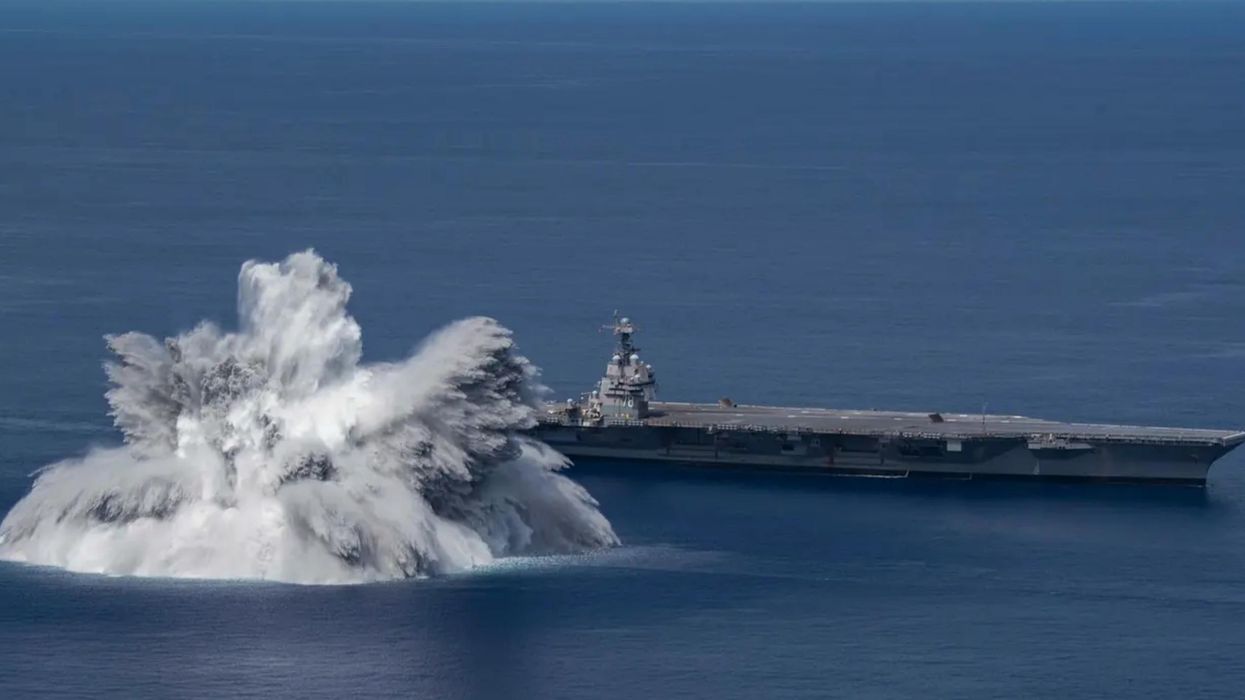
Marine mammal experts this week expressed deep concern over the potentially devastating effects of the U.S. Navy's recent detonation of 40,000 pounds of explosives off the Atlantic coast of Florida on sea life, while progressive observers blasted what they called the government's misplaced spending priorities.
"Some smaller species of marine mammals would be expected to die within one to two kilometers of the blast, and... [others] would suffer injury including hearing loss out to 10 kilometers."
--Michael Jasny, NRDC
The Navy set off the massive blast--which registered as a magnitude 3.9 earthquake on shore--on June 18 about 100 miles off Palm Coast as the first in a series of full ship shock trials on the USS Gerald R. Ford, a $12.8 billion nuclear-powered aircraft carrier commissioned in 2017.
"The U.S. Navy conducts shock trials of new ship designs using live explosives to confirm that our warships can continue to meet demanding mission requirements under harsh conditions they might encounter in battle," the Navy explained in a press release.
The statement claimed the explosion occurred "within a narrow schedule that complies with environmental mitigation requirements, respecting known migration patterns of marine life in the test area."
The region is home to various marine mammal species including bottlenose dolphins, humpback whales, and North Atlantic right whales. While whales are not typically seen off the northern Florida coast in June, marine experts nevertheless expressed alarm over potential harm to mammals and other sea life.
"The Navy's own modeling indicates that some smaller species of marine mammals would be expected to die within one to two kilometers of the blast, and that some marine mammal species would suffer injury including hearing loss out to 10 kilometers of the blast," Michael Jasny, director of the Natural Resources Defense Council's (NRDC) Marine Mammal Protection Project, told The Guardian. "That gives some sense of the power of the explosives we are talking about."
"A large whale might need to be within a few hundred meters of the blast to die, while a small mammal could be a couple of kilometers away," added Jasny, who said that even if the animals survive the blast, potential hearing loss still poses a grave risk to species which use that sense to locate food and their companions.
The U.S. Navy has previously come under fire for its use of undersea sonar, which can injure and kill marine mammals. In 2015, the Navy agreed to limit its use of underwater sonar and explosives in particularly sensitive areas for scores of vulnerable species.
While numerous observers worried about the effects of blast testing on marine life, others expressed concerns about misplaced government priorities, with the advocacy group Public Citizen tweeting that "94% of public school teachers spend their own money on school supplies." Some social media users responded to CBS News' tweet about the explosion lamenting that the United States still does not have universal healthcare.
Janet Weil, an activist with the peace group CodePink and the Portland, Oregon branch of Extinction Rebellion, called the text a "waste of tax dollars and resources."
Turkish citizens head to the polls on Sunday to vote on a historic referendum that could potentially cement autocratic rule in the nation, consolidating power for President Recep Tayyip Erdogan.
If the referendum passes, "it will abolish the office of prime minister, enabling the president to centralize all state bureaucracy under his control and also to appoint cabinet ministers," AFP reports. Erdogan would also "control the judiciary" and essentially "rule by decree," Foreign Policy in Focus columnist Conn Hallinan further noted.
There is little disagreement on how pivotal that change could be. AP observed that the vote "could change the course of [Turkey's] history," while AFP reported that referendum is being regarded "as a crossroads in the modern history of the country that will affect not just the shape of its political system but also its relations with the West."
The vote is taking place against the backdrop of a widespread crackdown on dissent, with tens of thousands of people arrested under the ongoing State of Emergency declared by Erdogan after last summer's failed coup attempt.
Recent polling has shown that the public is split. According to AFP, "A poll by the Konda group showed 'Yes' ahead at 51.5 percent but the Sonar group has projected a 'No' vote of 51.2 percent, and with other polling companies producing different figures the outcome remains uncertain."
But observers note that surveys could be misleading, given the climate of fear and repression. "[P]redictions cannot be trusted," Turkish author and activist Elif Shafak wrote Friday. "The truth is, many people in Turkey have two opinions: a public opinion and a private opinion. Out of fear, many citizens refuse to share their private opinions with pollsters."
On Thursday, four United Nations special rapporteurs criticized the Turkish government, issuing a statement warning that the security crackdown "had undermined the chance for informed debate on the referendum. They said a state of emergency imposed after the abortive putsch had been used to justify repressive measures that might well intensify if Erdogan's powers are enhanced," Reuters reported.
Hallinan also recently outlined how Erdogan has "stacked the deck" for the vote:
Using last summer's failed coup as a shield, he's declared a state of emergency, fired 130,000 government employees, jailed 45,000 people--including opposition members of parliament--and closed down 176 media outlets. The opposition Republican People's Party says it's been harassed by death threats from referendum supporters and arrests by the police.
Meanwhile he's deliberately picked fights with Germany, Austria, and the Netherlands to help whip up a storm of nationalism, and he charges that his opponents are "acting in concert with terrorists." Selahattin Demirtas, a member of parliament and co-chair of the Kurdish-dominated People's Democratic Party, the third largest political formation in Turkey, is under arrest and faces 143 years in prison. Over 70 Kurdish mayors are behind bars.
Erdogan's AKP government, Shafak further noted, "is supported by the far-right and Euro-skeptic MHP (the Nationalist Movement party). Together they form the largest bloc in the parliament."
"The opposition is fragmented, disorganized," she added, noting that it includes the secularist CHP (the Republican People's party), the Kurdish community, and Turkish conservative leader Meral Aksener.
"But the staunchest opponents of the AKP-MHP bloc are ordinary Turkish citizens," Shafak said: "Students, professionals, artists, minorities, and especially feminists. The women's movement in Turkey is going through a transformation and revival. This is not a coincidence. When societies slide into authoritarianism, ultranationalism and fanaticism, women have much more to lose than men. Women have been holding anti-AKP rallies. They organize campaigns on social media, writing hayir (no) with their bodies, urging everyone to hang purple cloth from their windows and balconies as a sign of support for gender equality."
If the referendum passes, the changes will take effect with the next general elections, which are slated for 2019.
It's war in the Gulf and the U.S. Navy is on hand to protect us. No, not that Gulf! I'm talking about the Gulf of Alaska and it's actually mock war -- if, that is, you don't happen to be a fin whale or a wild salmon.
This May, the Navy will again sail its warships into the Gulf of Alaska. There, they will engage in military maneuvers and possibly drop bombs, launch torpedoes and missiles, and engage in activities that stand a significant chance of poisoning those once-pristine waters, while it prepares for future battles elsewhere on the planet. Think of it as a war against wildlife, an assault on the environment and local coastal communities.
And call it irony or call it American life in 2017, but the U.S. military's Alaska Command has branded Emily Stolarcyk "a troublemaker" for insistently pointing this out. In a state where such a phrase is the equivalent of an obscenity, some have bluntly called her "anti-military." The office of Republican Senator Lisa Murkowski has termed her a "rabble-rouser," while a Kodiak Assembly member labeled some of what she's been saying about the Navy "just silly."
As a resident of the tiny fishing town of Cordova, Alaska, the most radical rabble-rousing thing about Stolarcyk may be the passion with which she loves this region of the planet in all its majesty. It's why she's taken a fierce and unwavering stand for years now against the ongoing training exercises the Navy carries out in the Gulf of Alaska during one of the largest migrations of birds and marine life on Earth. These exercises, which inject tons of toxic materials into the Gulf and use significant explosive ordnance, are once again scheduled to take place just as Alaska's commercial fishing season opens.
Located in the state's massive Chugach National Forest, coastal Cordova is nestled between the glacial-clad Chugach Mountains, Prince William Sound, and the Copper River. Fishing is the heart and soul of the town, as well as the foundation of its economy. A rough and tumble place, it regularly lands on lists of the top 10 American fishing ports, whether measured in pounds of fish caught annually or their value. A fish tax pays for its schools and the upkeep of most of its infrastructure. At least a quarter of its jobs are connected to the commercial fishing industry. "Without fishing, the town wouldn't even be here," says Stolarcyk, who knows the intricacies of the Navy's plans better than most people in the Navy do, as we tour Cordova's harbor.
It is impossible to overstate how iconic salmon are here. "What we have in Cordova is one of the last wild places left in the world, and one of the last places on Earth where we still have healthy salmon runs," she tells me. She's the program director for the Eyak Preservation Council, an environmental and social-justice-oriented nonprofit based in Cordova, whose primary mission is to protect wild salmon habitat.
Her partner is about to start his seventh season as a commercial fisherman. Their apartment building even has a fish smoker. "Salmon bring this town to life, you can feel the energy once the fish start returning, it's palpable," she explains, excitement in her voice. "You can hear the boats coming in and people go to stand on the shore to welcome them back."
However, this year, as in 2015, the Navy plans to conduct its part of Northern Edge 2017 (NE 17), a training exercise, right in her neighborhood. These war games, which occur every other year, include ships, aircraft, ordnance, and the widespread use of sonar across more than 42,000 square nautical miles of the marine environment of the Gulf of Alaska. And it is well known that sonar causes injury and death to whales, dolphin, and other marine life. It has been shown that whales will even beach themselves to escape the noise, which is more than 100 decibels louder underwater than even the loudest rock concert. Thanks to a major lawsuit against them, the Navy agreed to limit the use of certain kinds of sonar in Southern California and Hawaii, due to its impact on the endangered Blue Whale along with other species. But not in the Gulf of Alaska.
Fishing for an Answer
As in 2015, the Navy's plans threaten an area of the Gulf that couldn't be more biologically sensitive or rich in wildlife. Their training area includes a State of Alaska Marine Protected Area, a National Oceanic and Atmospheric Administration Fisheries Protected Area, and both the Gulf of Alaska Seamount Protected and Slope Habitat Conservation areas.
Nevertheless, the Navy is requesting permits to use live ordnance including bombs, missiles, and torpedoes, along with active and passive sonar in "realistic" war-training exercises that could release as much as 352,000 pounds of "expended materials" into those waters including, according to the Navy's own Environmental Impact Statement (EIS), missiles, bombs, and torpedoes.
These waters support some of the most valuable fisheries left in the United States and the commercial fishing industry is the single largest private sector employer in the state of Alaska, providing over 63,000 jobs. Nevertheless, the Navy's own EIS claims that fish in the area are at risk of chemical exposures of various sorts because the war games will introduce chromium, lead, tungsten, nickel, cadmium, cyanide, and ammonium perchlorate, along with numerous other heavy metals and toxic substances, into Alaskan waters. According to the EIS, "Little is known about the very important issues of nonmortality damage in the short and long-term, and nothing is known about the effects on behaviour of fish." It adds that "potential effects" include "death or damage" and that "fish not killed or driven from a location by an explosion might change their behavior, feeding pattern, or distribution."
While the Navy itself is aware of some of the damaging impacts of its exercises, others remain unknown and that service is making no effort to learn what they might be. The precautionary principle of do no harm is clearly not operative here.
The Navy's EIS does estimate that, during the years in which these war games are to be conducted, there will be more than 182,000 "takes" -- direct deaths of marine mammals or disruptions of their essential behaviors like breeding, nursing, or surfacing. On fish deaths, it offers no estimates at all.
A partial list of affected species includes blue, fin, gray, humpback, minke, sei, sperm, and killer whales, the highly endangered North Pacific right whale (of which there are only about 30 left), as well as dolphins and sea lions. No fewer than a dozen native tribes including the Eskimo, Eyak, Athabascan, Tlingit, Sun'aq, and Aleut rely on the area for subsistence living, not to speak of their cultural and spiritual identities.
As the May 1st launching day for NE 17 looms, we already have at least some inkling of just what kinds of damage might result. Immediately following Northern Edge 15, Alaska witnessed the single largest whale mortality event ever to occur in its waters. Eighteen carcasses of endangered whales were found floating near Kodiak Island within the area in which the Navy had conducted its exercises, attracting national media attention.
Statewide, in the year that followed, Alaska had its worst pink salmon fishing season in four decades. A federal disaster declaration was even issued to give salmon fishermen some relief, deferring the repayment of loans. That year also saw the biggest die off of Murres, a small seabird, ever recorded in the state.
Human-caused climate disruption impacts had long been noted across the North Pacific, whose climate-change-affected waters were warming to record temperatures that year. While this obviously played a role in such events, what impact the naval exercises had across the Gulf of Alaska remains largely unknown, in part because the Navy refused in 2015 -- as it will again this year -- to allow independent observers on its ships or to conduct follow-up studies focused on how their war games impacted the environment and marine life.
Local opposition is strong, as 10 Alaskan communities have passed resolutions requesting that the Navy move the timing and location of Northern Edge 2017 and all future training events to the fall or winter months and further offshore to minimize their impact on fisheries and migrations. Furthermore, the mayors of Cordova, Girdwood, Tenakee Springs, and Valdez sent letters to Senator Murkowski, requesting that she ask the Navy to relocate NE 17. The senator, hardly a critic of the military, nonetheless wrote the secretary of the Navy last September to "express concern over the manner in which the Navy is approaching its participation in Northern Edge 2017," and called a lack of naval public affairs guidance "extremely troubling."
Assistant Secretary of the Navy Dennis McGinn replied, "I readily admit we could have done a better job reaching out to potentially affected stakeholders leading up to NE 15."
Stolarcyk is truly a David going up against the naval Goliath. Her dedication to this region of the planet has been and continues to be unwavering.
"How could you live in this place and experience all this beauty and not get how precious this is," she asks with typical intensity as we walk near her town's harbor and bald eagles soar above us. "I love this place so much, and I can't even let myself feel all my emotions when I'm working on this issue, because I wouldn't be able to function."
The late afternoon sun is just beginning to hint at the evening to come as she stares out into the waters of the Gulf, takes several deep breaths, and says, "We have to defend our lifestyle here, because if we don't do it, who else is going to do it? If the Navy destroys the Gulf of Alaska, they can just leave, while we're the ones who have to live with whatever is left."
"The Navy Is Getting Away With Murder"
My trip to Alaska to report on the upcoming war games began in the small ski town of Girdwood, a 40-minute drive east of Anchorage. There, Stolarcyk and I met up with her colleague, Christina Hendrickson, as they continued their efforts to push the Navy's schedule for the war games out of prime wildlife season. Hendrickson, who specializes in environmental law, is a former defense contractor. Like two high-octane lawyers before a big trial, she and Stolarcyk instantly begin talking a mile a minute about what their next moves should be.
They bring me up to speed on the latest Navy maneuvers in what is now a publicity war over Northern Edge 17 and the way its officials have officially opted to "work with the stakeholders." On the other hand, as Hendrickson points out to me, "they have refused to meet with Emily and myself" -- and, as it happened at that point, me, too. I'd recently contacted Captain Anastasia Schmidt, director of public affairs for Alaska Command in Anchorage, to arrange a meeting and my request had been denied.
Unfortunately, as Hendrickson points out, the permits the Navy requested from both the National Oceanic and Atmospheric Administration and the National Marine Fisheries Service allow them to war game their hearts out in the Gulf for the next five years without taking the slightest responsibility for analyzingthe potential impact of their actions or dealing with the myriad species migrating through the area during the training period. While those who fish here must adhere to environmental standards, the Navy doesn't have to.
"Imagine that you have a friend who is a subsistence fisherman," Hendrickson says, "who is looking at his nets each season, and on the seasons the Navy trains, there seems to be less fish in them, and there are less whales returning, and then there's a huge Murre die off. There are sick sea otters or sea otters not returning at all. It's obvious to me that the Navy is not connecting these dots."
I ask her what exactly drives her on this issue and she stares out the window at the still snow-covered trees, then looks me dead in the eyes and says, "The Navy is getting away with murder and that upsets me."
"If It Walks, Swims, or Crawls, I've Fished It"
Stolarcyk and I fly on to Kodiak Island where we meet up with Tom Lance, the natural resources director for the Sun'aq tribe. We're there so that the two of them can make a presentation to the island's Borough Assembly in hopes of inspiring another Alaskan community to pass a resolution against the timing of the exercises.
Lance and I sit down in a cafe on the outskirts of town and he immediately begins describing the massive whale carcasses floating in the Gulf of Alaska after Northern Edge 15, many of which washed ashore on Kodiak. As he points out, just before those war games began, the Sun'aq and Afognak tribes "admonished the DOD [Department of Defense] for not respecting their people and their resources, and demanded that NE 15 not take place. The Navy told the tribal council representatives, basically, 'thank you.'"
After essentially being blown off, the tribes requested another meeting, which only happened after the exercises were over. At that time, they insisted that the Navy change the season for the next set of exercises to late fall or winter and the location as well. "Another condition was for them to account for fish take [that is, the disturbance or destruction of fish populations], as if it were a commercial fishing operation where they are given a total allowable catch. To this they responded that they don't harvest fish, so why should they have to track that?"
"From my observation," Lance says, "I see an undercurrent of frustration within the tribes and the community of fishermen that the Navy is going to do what they are going to do no matter what we say." He takes a last sip of coffee and concludes, "Everybody is so focused on the short run right now, they're forgetting about the long run. If we don't save the ocean as a potential place to farm, we're not going to be able to feed ourselves in the future."
Later, I visit with Alexus Kwachka, a Kodiak commercial fisherman for the last 30 years. A bear of a man, he shakes my hand vigorously while welcoming me into his home, which overlooks Kodiak's massive harbor. When I ask him what he's fished for, he responds, "If it walks, swims, or crawls, I've fished it."
He wastes no time going after the Navy. "I question their timing. They say they don't want to train in the winter and instead they plan it for during the largest migratory period of marine life and birds here." Fishermen on the island, he assures me, are increasingly apprehensive about the Navy's plans and its impact on their livelihoods, even though "folks here are patriotic and support the military."
Prior to Northern Edge 15, Kwachka lined his boat up with dozens of others in the harbor in protest. Now, he's concerned again and feels slighted that the military doesn't consider his voice worth listening to. He says emphatically, "We're worried about the fact that they are allowed to bring in a load of boats and blow shit up all over the place." If they do that, he tells me, the ill effects "start out with the little guys then go up through the whole food web, which is another reason not to do it in the Spring when the forage fish are both reproducing and traveling. It's just not a good time to be introducing toxins and blowing things up on top of them. The chemical fallout from those explosions goes down through the food web and is eaten or absorbed by the fish."
"Food Security Is National Security"
That evening, Stolarcyk, Lance, and I head over to the Kodiak Island borough building for their meeting. In a small, cramped basement room, several members of the assembly are around a table, while the rest of us are seated on chairs along the walls.
The two of them give their brief talks with a slide show. As soon as they're done, Councilman Matt Van Deale indicates that he'll sponsor the resolution they want, adding, "Food security is national security and we are a fishing town." A second councilperson responds favorably to the resolution as others nod.
Suddenly, Councilman Kyle Crow speaks up, questioning the threat of toxic wastes. "I know about how hazardous waste is defined and I've seen folks declare a block of concrete with a chip of paint on it as hazardous waste." Stolarcyk promptly projects a slide she's already shown that displays a chart taken from the Navy's environmental impact statement indicating that more than five tons of toxic materials could be introduced into the fertile fishing areas of the Gulf each time the Navy conducts a training event.
Crow also questions the dangers of the Navy's use of sonar, comparing theirs to what he uses on his own fishing boat. Again, Stolarcyk pulls up a slide showing that the Navy's sonar generates audible blasts up to 235 decibels -- humans begin to suffer hearing damage at 85 decibels -- that travel for thousands of miles across the ocean. Crow nods in response to the new information, given that it is straight out of the Navy's own documents.
Councilman Larry LeDoux then requests that the assembly hear the Navy's side of the story and insists that such war games are necessary, as is the missile testing already happening on Kodiak, because of North Korea's ability to reach the United States with a missile. (Not that it can yet.)
Despite these bumps, the majority of the assembly appears to favor the resolution.
The next morning Lance shares an email he sent to councilman Van Deale, thanking him for volunteering to sponsor the resolution. "It is hard to understand," he wrote to Van Deale, "how some people in Kodiak's local government (and outside) distrust others who work to protect the sustainability of the very resources that have built the same Kodiak Archipelago economy and heritage!"
Two weeks later, Kodiak became the 10th Alaskan community to pass a resolution opposing the timing and location of the Navy's exercises.
A day after that, in a letter to the commanders of the Navy's Pacific Fleet and U.S. Pacific Command, Senator Murkowski, who is also the chair of the Senate Committee on Energy and Natural Resources, requested that the Navy "give serious thought" to changing the timing of the 2019 war games and moving their location due to impacts on marine life. "I expect to address these issues with senior leaders when the Navy appears before the Defense Appropriations Subcommittee next month," she wrote.
"We Just Don't Know How Bad It's Going to Be"
Cordova is the image of what coastal Alaska once was. There are no cruise ships and the fishing industry still dominates the town, although some of its fisheries were wiped out in 1989 when the tanker Exxon Valdez spilled at least 11 million gallons of crude oil and they have never recovered.
Two years ago, I met James Wiese here. He is an engineer on an Alaska Department of Fish and Game research vessel. A third generation Cordova mariner, he's also a local city councilman. At that time, he was already expressing his fears that someday his children might not be able to eat the food that comes out of these waters. He returned to the subject recently, telling me, "Anyone trying to consume seafood here knows how fragile everything is and is very concerned about what is going to happen to it because it's part of their everyday life." He adds that, within his department, the bulk of his colleagues support the resolutions calling on the Navy to alter its plans.
Cordova, he assures me, is "very much in opposition to the training" and still can't believe the Navy is unable to find a time for their exercises when the salmon and the rest of the sea life in the Gulf aren't at their height. "It's a food web and if salmon get tested and show contaminants from the Navy, everything is at stake. There are safer places for these Navy drills to happen. They need to be conscientious about what they are affecting."
Clay Koplin is Cordova's mayor. "It's pretty simple," he tells me. "The Navy has the whole span of the year to practice and they picked the absolute worst time to do their exercise. We asked for a conversation in hope of changing the timing," he adds, turning his hands over in a gesture of puzzlement. "That's how a conversation works. We hoped to find some middle ground, but thus far there's been nothing to indicate they are willing to find that middle ground."
That same day, I meet Kelly Weaverling, the first Green Party mayor ever elected in this country. He took office in Cordova in 1990, right after the Exxon Valdez oil spill. A former naval navigator in nuclear fast-attack submarines, he is now a Zen Buddhist monk as well as a fisherman.
Sporting a shaved head and dressed in a black Zen robe, grey turtleneck, and sandals with wool socks, Weaverling strides in quietly, yet purposefully, having come straight from leading a three-hour meditation for the community. "What the Navy is doing, we know it is going to be bad," he begins calmly. "We just don't know how bad it's going to be. It's pretty easy to figure out. Anybody can do that."
I ask him to explain and he responds, as though instructing me before one of his meditation sessions, "Is something positive, negative, or neutral is the question. Anything you do is going to have an effect, even if it's a non-action... So the question is, what effect is it going to have? The Navy's action will not have a positive effect on the ocean or any of its creatures. It's going to be a negative effect, we just don't know how bad."
"In Your Backyard?"
In the end, I even received a response from Captain Schmidt of the Alaska Command, who agreed to answer some of my questions by email. I asked her what measures the Navy had taken in the wake of NE 15 to mitigate impacts on marine life. She responded by claiming flatly and without qualification that the new exercises would have "no significant impacts to marine life," and that the Navy had already gone through "an extensive and comprehensive permit process" with the National Marine Fisheries Service (as they are, in fact, required to do by law).
Why then, I wondered, do its commanders refuse to allow independent wildlife observers aboard their vessels during the training exercises?
To do so, she insisted "would result in unacceptable impacts to readiness," an odd response given that the only "impact" would assumedly be the use of binoculars.
As Northern Edge 2017 approaches, one thing is clear enough. Despite growing opposition in Alaska, the Navy continues to do just what it wants in the state's once-pristine, biologically rich Gulf waters. Who knows how long it will be before parts of its vast marine web begin to test positive for the Navy's toxins?
As a journalist, I've spent time in Iraq and seen the devastation the U.S. military can visit on a society firsthand. But I must admit that I never expected to see it in Alaska, whose tallest mountains I spent a decade of my life climbing -- where, thanks to Denali (the highest peak in North America), I fell madly in love with this planet. As someone who now regularly reports on climate disruption, I wonder daily how many more decades whole areas of the biosphere will even remain habitable. At a purely personal level, that makes the Navy's ongoing war against Alaska's waters and the wildlife in them unconscionable to me. And in the age of Trump, it's unlikely the Navy high command will spend much time worrying about the environmental damage its war games are likely to cause.
For most Americans, Alaska is, of course, a distant, almost mythic place. But don't be fooled. In Alaska, there's a broader lesson to be learned from these war games. Christina Hendrickson makes the point in a way that speaks vividly to my own life experience. "If the Navy is able to come up to this pristine, biologically, ecologically and economically important area and train for war across three training cycles spanning six years and not engage local communities," she says, "and if we're allowing this to happen in areas where subsistence is carried out by people who have relied on it for millennia, why couldn't this happen in your backyard?"
This essay is a joint TomDispatch/Truthout report.
Maybe it's the phrase -- "commander in chief" -- that best captures the transcendent absurdity and unaddressed horrors of the 2016 election season and the business as usual that will follow.
I don't want to elect anyone commander in chief: not the xenophobic misogynist and egomaniac, not the Henry Kissinger acolyte and Libya hawk. The big hole in this democracy is not the candidates; it's the bedrock, founding belief that the rest of the world is our potential enemy, that war with someone is always inevitable and only a strong military will keep us safe.
Maybe it's the phrase -- "commander in chief" -- that best captures the transcendent absurdity and unaddressed horrors of the 2016 election season and the business as usual that will follow.
I don't want to elect anyone commander in chief: not the xenophobic misogynist and egomaniac, not the Henry Kissinger acolyte and Libya hawk. The big hole in this democracy is not the candidates; it's the bedrock, founding belief that the rest of the world is our potential enemy, that war with someone is always inevitable and only a strong military will keep us safe.
In a million ways, we've outgrown this concept, or been pushed beyond it by awareness of global human connectedness and the shared planetary risk of eco-collapse. So whenever I hear someone in the media bring "commander in chief" into the discussion -- always superficially and without question -- what I hear is boys playing war. Yes, we wage war in a real way as well, but when the public is invited to participate in the process by selecting its next commander in chief, this is pretend war at its most surreal: all glory and greatness and hammering ISIS in Mosul.
"What about our safety here?" Brian Williams asked Gen. Barry McCaffrey on MSNBC the other night, as they were discussing the awfulness of terrorism and the need to bomb the bad guys out of existence. I cringed. How long can they keep selling this?
Our safety is far, far more imperiled by the fact that we have a military at all than by any enemy that military is allegedly fighting, but is, in fact, creating as it churns out endless collateral damage, a.k.a., dead and injured civilians.
The essential truth about war is this: The enemies are always on the same side. Regardless who "wins," what matters is that war itself continues. Just ask the military-industrialists.
The only commander in chief I want to vote for is the one who will turn that title over to the historians and cry out that war is an obsolete and monstrous game, revered and coddled for five millennia now as the most sacred of activities that a (male) human can engage in. We need a commander in chief capable of leading us beyond the age of empire and the horrific games of conquest that are killing this planet.
"What about our safety here?"
When Brian Williams threw this question out to the American public, I thought, among much else, about the devastation and contamination the U.S. military has wrought on our deserts and coastal waters over the last seven decades by testing weapons -- both nuclear and conventional -- and playing, good God, war games; and then, sooner or later, by disposing of its obsolete toxins, usually with zero concern for the environmental safety of the surrounding area, whether it be in Iraq or Louisiana. Because the military is what it is, neither EPA regulations nor sanity itself usually applies.
For instance, as Dahr Jamail wrote recently at Truthout: "For decades, the U.S. Navy, by its own admission, has been conducting war game exercises in U.S. waters using bombs, missiles, sonobuoys (sonar buoys), high explosives, bullets and other materials that contain toxic chemicals -- including lead and mercury -- that are harmful to both humans and wildlife."
Why do we need to worry about ISIS when, as Jamail reports, "the batteries from dead sonobuoys will leach lithium into the water for 55 years"?
And then there's depleted uranium, the extraordinarily toxic heavy metal the U.S. military loves; DU missiles and shells rip through steel like it was butter. They also spread radioactive contamination across Planet Earth. And they help poison the waters off the Washington-Oregon coast, where the Navy plays its games, just like they poisoned the waters surrounding Vieques, a tropical paradise island off the coast of Puerto Rico, which, as I wrote several years ago, "was commandeered by the U.S. military as a throwaway site for weapons testing" for 62 years. The Navy finally left, but left behind contaminated soil and water and many thousands of live shells that had failed to detonate, along with a legacy of serious health problems for the island's 10,000 residents.
"They are indeed the largest polluters on Earth," environmental toxicologist Mozhgan Savabieasfahani told Truthout, speaking of the U.S. military, "as they produce more toxic chemicals than the top three U.S. chemical manufacturers combined. Historically, large global ecosystems and significant human food sources have been contaminated by the U.S. military."
What does it mean to vote for the next commander in chief of the largest polluter on the planet?
I confess that I do not know -- at least not in the context of this absurd and superficially debated election, with virtually every serious question or issue pushed to the margins. How do we transcend nationalism and the game of war -- the reality of endless war -- and engage in securing the safety of the whole planet? How do we acknowledge that this planet is not just "a jumble of insensate stuff, a random melee of subatomic particles" for us to exploit, as Charles Eisestein writes, but a living entity of which we are, crucially, a part? How do we learn to love this planet and one another?
Any potential "commander in chief" who asks lesser questions than these is engaging in a childish game with real guns.
Does the concept of a living planet uplift and inspire you, or is it a disturbing example of woo-woo nonsense that distracts us from practical, science-based policies?
The scientifically-oriented nuts-and-bolts environmental or social activist will roll her eyes upon hearing phrases like "The planet is a living being." From there it is a short step to sentiments like, "Love will heal the world," "What we need most is a shift in consciousness," and "Let's get in touch with our indigenous soul."
What's wrong with such ideas? The skeptics make a potent argument. Not only are these ideas delusional, they say, but to voice them is a strategic error that opens environmentalism to accusations of flakiness. By invoking unscientific concepts, by prattling on about the 'heart' or spirit or the sacred, we will be dismissed as naive, fuzzy-headed, irrational, hysterical, over-emotional hippies. What we need, they say, is more data, more logic, more numbers, better arguments, and more practical solutions framed in language acceptable to policy-makers and the public.
I think that argument is mistaken. By shying away from the idea of a living planet, we rob environmentalism of its authentic motive force, engender paralysis rather than action, and implicitly endorse the worldview that enables our destruction of the planet.
The psychology of contempt.
To see that, let's start by observing that the objection to "Earth is alive" isn't primarily a scientific objection. After all, science can easily affirm or deny Earth's aliveness depending on what definition of life is being used. No, we are dealing with an emotional perception here, one that goes beyond 'alive' to affirm that Earth is sentient, conscious, even sacred. That is what upsets the critics. Furthermore, the derisiveness of the criticism, encoded in words like 'hippie' or 'flake,' also shows that more than an intellectual difference of opinion is at stake. Usually, derision comes from insecurity or fear. "Judgment," says Marshall Rosenberg, "is the tragic expression of an unmet need."
"Part of our resistance to the notion of Earth as a living being could be the patriarchal mind feeling threatened by feminine ways of knowing and choosing."
What are they afraid of? (And I--the voice of the derisive critic lives in me as well.) Could it be that the contempt comes in part from a fear that one is, oneself, 'naive, irrational and over-emotional?' Could the target of the derision be the projection of an insecurity lurking within? Is there a part of ourselves that we disown and project, in distorted form, onto others--an innocent, trusting, childlike part? A feminine part? A vulnerable part?
If so, then critics of the infiltration of New Age ideas into the environmental movement may not be serving the movement at all. They may be enacting their own psychological dramas instead. If you are one of those critics, I am not asking you to join hands with me and sing Kumbaya. I ask only that you soberly and honestly consider where your discomfort comes from.
Certainly, much of the discomfort is a healthy revulsion toward the escapism, spiritual bypass, and cultural appropriation that plague so much of the New Age. Certainly, there is a danger that, intoxicated by the idea of cosmic purpose or some-such, we ignore the pain and grief that we must integrate if we are to act effectively and courageously. Certainly, dogma like "It's all good" or "We're all one" can blind us to the exigency of the planetary crisis and discourage us from making changes in our lives. Certainly, borrowed rituals and concepts of sacredness can be an insidious form of colonialism, a strip-mining of cultural treasure to compensate for and enable the continuation of our own cultural vacuity.
However, such criticisms address a mere caricature of the thoughtful work of generations of philosophers, scientists and spiritual teachers, who have framed sophisticated alternatives to conventional phenomenological, ontological and causal narratives. Phew, that was a mouthful. What I'm saying is not to hide behind facile criticisms.
The fear of being emotional, irrational, hysterical, etc. is very close to a fear of the inner feminine, and the exclusion of the fuzzy, the ill-defined, and the emotionally-perceived dimensions of our activism in favor of the linear, rational, and evidence-based, mirrors the domination over and marginalization of the feminine from our social choice-making. Part of our resistance to the notion of Earth as a living being could be the patriarchal mind feeling threatened by feminine ways of knowing and choosing. But that's still pretty theoretical, so let me share a little of my own introspection.
When I apprehend concepts such as "Earth is alive," or "All things are sacred," or "The universe and everything in it bears sentience, purpose and life," there is always an emotion involved; in no case is my rejection or acceptance the result of pure ratiocination. Either I embrace them with a feeling of eager, tender hope, or I reject them with a feeling of wariness, along the lines of "It is too good to be true," or "I'm nobody's fool." Sometimes, beyond wariness, I feel a hot flash of anger, as if I had been violated or betrayed. Why?
"I became an environmentalist out of love and pain: love for the world and its beauty and the grief of seeing it destroyed."
That wariness is deeply connected to the contempt I've described. The derision of the cynic comes from a wound of crushed idealism and betrayed hopes. We received it on a cultural level when the Age of Aquarius morphed into the Age of Ronald Reagan, and on an individual level as well when our childish perception of a living, personal universe in which we are destined to grow into magnificent creators gave way to an adulthood of deferred dreams and lowered expectations. Anything that exposes this wound will trigger our protective instincts. One such protection is cynicism, which rejects and derides as foolish, naive or irrational anything that affirms the magic and idealism of youth.
Our perceived worldview has cut us off, often quite brutally, from intimate connection with the rest of life and with the rest of matter. The child hugs a tree and thinks it feels the hug and imagines the tree is his friend, only to learn that no, I'm sorry, the tree is just a bunch of woody cells with no central nervous system and therefore cannot possibly have the qualities of beingness that humans have.
The child imagines that just as she looks out on the world, the world looks back at her, only to learn that no, I'm sorry, the world consists of a jumble of insensate stuff, a random melee of subatomic particles, and that intelligence and purpose reside in human beings alone. Science (as we have known it) renders us alone in an alien universe. At the same time, it crowns us as its lords and masters, for if sentience and purpose inhere in us alone, there is nothing stopping us from engineering the world as we see fit. There is no desire to listen for, no larger process to participate in, no consciousness to respect.
"The Earth isn't really alive" is part of that ideological cutoff. Isn't that the same cutoff that enables us to despoil the planet?
The wounded child interjects, "But what if it is true? What if the universe really is just as science describes?" What if, as the biologist Jacques Monod put it, we are alone in "an alien world. A world that is deaf to man's music, just as indifferent to his hopes as to his suffering or his crimes." Such is the wail of the separate self. It is loneliness and separation disguised as an empirical question.
While no amount of evidence can prove it false, we must acknowledge that the science that militates against an intelligent, purposeful, living universe is ideologically freighted and culturally bound. Witness the hostility of institutional science to any anomalous data or unorthodox theory that suggest purposiveness or intelligence as a property of inanimate matter.
"What hides behind the contempt? The reactivity?"
Water memory, adaptive mutation, crop circles, morphic fields, psi phenomena, UFOs, plant communication, precognitive dreams...and a living Earth, a living sun, a living universe, all incite scorn. Anyone who believes in these, or even takes them as a valid topic of investigation, risks the usual epithets of 'pseudo-scientist,' 'flake,' or 'woo-woo,' regardless of the merits of the theory or the strength of the evidence.
Of course, simply by making this assertion I open myself to the very same calumny. You can conveniently dismiss me as irrational, scientifically semi-literate, gullible at best and delusional at worst, perhaps knowingly dishonest, bamboozling my audience with learned allusions to impart an illusion of scientific probity to my ravings. But if you really care about this Earth, you'll want to be curious about the emotional content of this judgment. What hides behind the contempt? The reactivity?
What moves the environmentalist?
Our discomfort with New Age-sounding concepts like "The planet is alive" is not entirely rational, but comes in large part from a wound of betrayal, cloaked in the pervasive ideology of our culture. Is it true though? We might play with various definitions of life and come up with logical, evidence-based arguments pro and con, just as we could debate the veracity of anomalous data and unconventional theories, and never come to an agreement. So let us look at the matter through a strategic lens instead. What belief motivates effective action and real change? And what kind of action results from each belief?
Most people reading this probably consider themselves to be environmentalists; certainly most people think it is important to create a society that leaves a livable planet to future generations. What is it, exactly, that makes us into environmentalists? If we answer that, we might know how to turn others into environmentalists as well, and to deepen the commitment of those who already identify as such.
I don't know about you, but I didn't become an environmentalist because someone made a rational argument that convinced me that the planet was in danger. I became an environmentalist out of love and pain: love for the world and its beauty and the grief of seeing it destroyed. It was only because I was in touch with these feelings that I had the ears to listen to evidence and reason and the eyes to see what is happening to our world. I believe that this love and this grief are latent in every human being. When they awaken, that person becomes an environmentalist.
Now, I am not saying that a rational, evidence-based analysis of the situation and possible solutions is unimportant. It's just that it will be compelling only with the animating spirit of reverence for our planet, born of the felt connection to the beauty and pain around us.
Our present economic and industrial systems can only function to the extent that we insulate ourselves from our love and our pain. We insulate ourselves geographically by pushing the worst degradation onto far-away places. We insulate ourselves economically by using money to avoid the immediate consequences of that degradation, pushing it onto the world's poor. We insulate ourselves perceptually by learning not to see or recognize the stress of the land and water around us and by forgetting what healthy forests, healthy streams and healthy skies look like. And we insulate ourselves ideologically by our trust in technological fixes and justifications like, "Well, we need fracking for energy independence, and besides it's not that bad," or "After all, this forest isn't in an ecologically critical area."
The most potent form of ideological insulation though is the belief that the world isn't really in pain, that nothing worse is happening than the manipulation of matter by machines, and that therefore as long as we can engineer some substitute for 'ecosystem services,' there need be no limit to what we do to nature. Absent any inherent purpose or intelligence, the planet is here for us to use.
"When environmentalists cite the potential economic losses from climate change, they implicitly endorse economic gain and loss as a basis for environmental decision-making."
Just today, the borough was removing trees on our street, and I felt grief and rage as I listened to the chainsaws, even as my mind said, "But after all, those are old trees and the branches could fall onto a person or damage a house. They are unsafe. And what does it matter? They are only trees." So here, inhabiting my own mind, was the fundamental ideology of domination (the trees must be removed because they stand in the way of human interests) and separation (they are 'only trees;' they are not-self; they do not have the basic qualities of beingness that I do).
Look around this planet. See the results of that ideology writ large.
The love of life.
The idea that our planet is alive, and further, that every mountain, river, lake and forest is a living being, even a sentient, purposive, sacred being, is therefore not a soppy emotional distraction from the environmental problems at hand; to the contrary, it disposes us to feel more, to care more, and to do more. No longer can we hide from our grief and love behind the ideology that the world is just a pile of stuff to be used instrumentally for our own ends.
True, that ideology is perfectly consistent with cutting carbon emissions, and consistent as well with any environmental argument that invokes our survival as the primary basis for policymaking. A lot of environmental activism depends on appeals to survival anxiety. "We have to change our ways, or else!" Appealing to fear and selfish interest, in general, is a natural tactic for anyone coming from a belief that the planet has no intrinsic value, no value beyond its utility. What other reason to preserve it is there, when it has no intrinsic value?
It should be no surprise that this tactic has failed. When environmentalists cite the potential economic losses from climate change, they implicitly endorse economic gain and loss as a basis for environmental decision-making. Doubtless they are imagining that they must 'speak the language' of the power elite, who supposedly don't understand anything but money, but this strategy backfires when, as is the norm, financial self-interest and ecological sustainability are opposed.
Similarly, calls to preserve the rainforests because of the value of the medicines that may one day be derived from its species imply that, if only we can invent synthetic alternatives to whatever the forest might bear, we needn't preserve the rainforest after all. Even appealing to the well-being of one's grandchildren harbors a similar trap: if that is your first concern, then what about environmental issues that only affect people in far-away lands, or that don't tangibly harm any human being at all? The clubbing of baby seals, the extinction of the river dolphin, the deafening of whales with sonar... it is hard to construct a compelling argument that any of these threaten the measurable well-being of future generations. Are we then to sacrifice these beings of little utility?
Besides, did anyone ever become a committed environmentalist because of all the money we'll save? Because of all the benefits we'll receive? I am willing to bet that even the survival of the species or the well-being of your grandchildren isn't the real motive for your environmentalism. You are not an environmentalist because you are afraid of what will happen if you don't act. You are an environmentalist because you love our planet. To call others into environmentalism, we should therefore appeal to the same love in them. It is not only ineffectual but also insulting to offer someone a venal reason to act ecologically when we ourselves are doing it for love.
Nonetheless, environmental campaigning relies heavily on scare tactics. Fear might stimulate a few gestures of activism, but it does not sustain long-term commitment. It strengthens the habits of self-protection, but what we need is to strengthen the habits of service.
Why then do so many of us name "fear that we won't have a livable planet" as the motive for their activism? I think it is to make that activism acceptable within the ideological framework I have described that takes an instrumentalist view of the planet. When we embrace what I believe is the true motive--love for this Earth--we veer close to the territory that the cynic derides. What is it to make 'rational' choices, after all? Is it ever really rational to choose from love? In particular, is it rational to love something that isn't even alive? But the truth is, we love the Earth for what it is, not merely for what it provides.
"Each of us (in an industrial society) wades against the tide of an old ideology as we dare to act from the felt understanding of our intimate connection to life, our interdependency, our interbeing."
I suspect that even the most hardheaded environmentalist, who derides the Earth-is-alive crowd most vociferously, harbors a secret longing for the very object of his contempt. Deep down, he too believes the planet and everything on it is alive and sacred. He is afraid to touch that knowledge, even as he longs for it. Often, his intellectual reasons are but rationalizations by which he gives himself permission to act on his felt understanding of what is sacred.
This person is all of us. I am no exception: the idea of a living, sentient Earth attracts me and repels me both, mirroring the polarity of opinion I observe at conferences between the nuts-and-bolts and spiritual factions. Accusations of 'naive!,' 'softheaded!' and 'gullible' rattle around in my own brain, expressing a hurting thing within. Maybe if I join the ranks of the critics and turn the criticism outward, accuse others of ignoring science and indulging in fuzzy thinking, I can find some temporary relief. But there is no real healing in that. I want to be whole. I want to feel more and not less. I want to heal these alienated parts of myself, so that I don't act from them unconsciously and sabotage the beautiful vision that asks my contribution.
Each of us (in an industrial society) wades against the tide of an old ideology as we dare to act from the felt understanding of our intimate connection to life, our interdependency, our interbeing. Critiques of the idea of a living planet make that struggle all the harder. In the interests of honesty as well as effective strategy, we need to look at the fear and pain that that critique comes from. Then we can get people in touch with their perception of a living sacred planet, so they can feel the grief and love that perception opens, and act upon it.
Police in the U.S. are rolling out new technology that gives them "unprecedented" power to spy on citizens and determine their "threat score" based on metadata, the Washington Post reported on Monday.
Fresno, California's police department was one of the first to adopt the software, known as "Beware," which allows officers to analyze "billions of data points, including arrest reports, property records, commercial databases, deep Web searches and...social-media postings" to calculate an individual's alleged potential for violence, the Post explained.
Officers say the tool, made by a company called Intrado, can help them thwart mass shootings and other attacks like the ones that took place in Paris and San Bernardino last year. But critics say it's just another weapon in the mass surveillance arsenal, one that further threatens privacy and civil liberties and fuels police overreach.
Journalist D. Brian Burghart, who operates FatalEncounters.org, a searchable database of police killings of citizens, told Common Dreams that the swell of surveillance technology was an "outgrowth" of post-9/11 fear-mongering. "I'm not sure what's new about this except they put a name on it," Burghart said. "I don't think it's going to get any better. Nobody ever puts away technology."
Jennifer Lynch, an attorney with the Electronic Frontier Foundation, told the Post, "This is something that's been building since September 11. First funding went to the military to develop this technology, and now it has come back to domestic law enforcement. It's the perfect storm of cheaper and easier-to-use technologies and money from state and federal governments to purchase it."
Rob Nabarro, a civil rights lawyer in Fresno, added, "It's a very unrefined, gross technique. A police call is something that can be very dangerous for a citizen."
The Post continues:
Nabarro said the fact that only Intrado -- not the police or the public -- knows how Beware tallies its scores is disconcerting. He also worries that the system might mistakenly increase someone's threat level by misinterpreting innocuous activity on social media, like criticizing the police, and trigger a heavier response by officers.
A potential threat that comes from an individual should not be addressed by a machine, he said.
In addition to Beware, police departments are equipping officers with tools like Media Sonar, which analyzes social media for "illicit activity," among other technology, the Post reported.
Others criticized the implementation of such law enforcement tools while police brutality remains widespread and activists continue to call for an overhaul of the policing system.
Matt Cagle, an attorney for the ACLU of Northern California, told the Post, "We think that whenever these surveillance technologies are on the table, there needs to be a meaningful debate. There needs to be safeguards and oversight."
The Post described one incident in which the Fresno police department demonstrated Beware at a town hall meeting following constituent complaints about the use of invasive surveillance technology:
[One] council member referred to a local media report saying that a woman's threat level was elevated because she was tweeting about a card game titled "Rage," which could be a keyword in Beware's assessment of social media.
Councilman Clinton J. Olivier, a libertarian-leaning Republican, said Beware was like something out of a dystopian science fiction novel and asked [Fresno Chief of Police Jerry] Dyer a simple question: "Could you run my threat level now?"
Dyer agreed. The scan returned Olivier as a green, but his home came back as a yellow, possibly because of someone who previously lived at his address, a police official said.
"[Beware] has failed right here with a council member as the example," Olivier said.
As Burghart added, "I spend eight hours a day researching police violence, so I don't know how many times I've typed the words 'police killed.' I imagine I'd probably score pretty good on this thing. Most journalists would."
Last September, I attended a remarkable gathering in Okinawa of impassioned young people from all over the Asia-Pacific. They convened at a critical moment to urgently discuss ramped-up militarism in their region. Thousands of hectares of exquisitely wild marine environments, peaceful communities and local democracy are now under extreme threat. Participants hailed from: Taiwan; Jeju (South Korea); the Japanese Ryukyu islands; Indonesia; New Zealand; and the Japanese Ogasawara islands. I was invited to represent Hawaii, where the headquarters for the U.S. Pacific Command (PACCOM) are located, and where decisions are made that have profound consequences for these young activists, and the rest of the world. These include missile base-building on pristine islands, rampant navy war games that destroy coastlines, reefs and other vital ecosystems, not to mention adding to climate change, pursued with no regard for local opinion.
It's all a result of the "Pacific Pivot," announced by President Obama in 2011, to move 60% of U.S. Navy and Air Force resources from the Middle East to the Asia-Pacific. The stated goal is to maintain "balance" in the ongoing battle with China for regional military and economic hegemony. A particularly dangerous expression in this effort came a few weeks ago, when a U.S. missile-carrying warship challenged China by passing through disputed waters surrounding China's artificial island bases in the South China Sea. It is the latest example of brinkmanship after years of provocative moves by the U.S. in the so-called interest of balance. But, the grim fact is there is no balance in the Pacific. The little publicized reality is that the United States, located thousands of miles from China's coast, already maintains over 400 military installations and 155,000 troops in that part of the world. Meanwhile China, even with its newest artificial island-bases in the South China Sea, will have a grand total fewer than ten.
At the conference, entitled "Peace for the Sea Camp" it was noted that one of the most destructive developments has been Defense Secretary Ashton Carter's 2015 campaign to forge a new network of aggressive bilateral agreements with militaries from other countries such as South Korea, the Philippines, Australia -- and most insidiously, Japan -- to augment American dominance. These alliances are reinforced economically by the Trans-Pacific Partnership (TPP), an essential component of the fool's endeavor to contain China within its own hemisphere. However, no one at the conference took sides with one hegemon or the other. China was also criticized for having smothered thousands of acres of healthy reef with concrete and crushed coral, to build its artificial islands. To be sure, one of the primary purposes of the gathering was to establish a global voice against all military desecration of islands and the seas. Here's the full story on the crisis and resistance.
Outsourcing Military Force
A seismic event took place on the first day of the conference that underscored the gathering with new urgency. Prime Minister Shinzo Abe had managed to push through highly unpopular legislation to disempower Japan's "peace constitution," implemented in 1947 by General Douglas MacArthur. Abe acheiieved this despite 100,000 protestors shouting "NO WAR" for weeks in front of the Japanese Diet. The following day, Abe's public approval rating plummeted to 38.9 percent. Now, Japan's military is permitted to act offensively, no longer only in self-defense mode. It can also surveil other countries for the first time in modern history, and establish a global arms industry (imagine, Honda-quality drones and tanks). According to a Pentagon official, this will give Japan "greater global presence." According to The Nation's Tim Shorrock, it will turn Japan into America's proxy army in Asia.
China is correct to view the watered-down constitution as yet another provocation, especially since it has cleared the way for a turbo-charged reworking of the 64-year-old U.S.-Japan Security Treaty to take effect. The revised treaty essentially encourages Japanese aggression toward its neighbors -- a 20th century scenario that Asia-Pacific people do not want to relive. For them, Abe's politics are like a zombie risen from the dead. Since taking office in 2012, Abe has boosted the military budget, taken an aggressive stance toward China and has also denied Japan's role in forcing hundreds of thousands of women into sexual slavery for its troops during World War II. He is the perfect, barbaric accomplice to carry out the Pentagon's audacious designs on Asia.
For islanders like those at the Okinawa conference who live on the front lines of this new world, the new treaty poses immediate threat. It allows four lovely islands in the Ryukyu archipelago to be transformed into state-of-the-art military bases -- with missiles pointed at China. It's a way the U.S. can "outsource" base-building to client states like, in this case, Japan.
Outsourcing base-building is a fairly new Pentagon strategy. It came about partially due to the U.S. wearying of growing global disgust with its foreign basing. For example, the routine protests of tens of thousands of intractable Okinawans has already succeeded in stalling new base construction there for the past 20 years -- a big headache for the Pentagon. The solution, surrogate base-building, is also an enormous cost-saving measure. For example, the construction of the Jeju naval base is South Korean in name, but it fulfills the Pentagon's directive to contain China. It will also port U.S. aircraft carriers, attack submarines and Aegis-missile carrying destroyers. Because the base is "officially" South Korean, costs are externalized -- of construction, of environmental responsibility, and of policing eight years of still ongoing protests. Now four Japanese Ryukyu islands will also be put to service to menace China -- at no direct expense to the U.S.
The Ryukyu basing project, now under construction, would not have been able to move forward without the culmination of a longstanding collaboration between the U.S. and Japan to finalize three milestones during 2015. The milestones, which work together symbiotically, are: 1) Disabling Japan's pacifist Constitution; 2) Beefing up of the U.S.-Japan Security Treaty; and 3) Reaching a TPP agreement which would work hand-in-glove with military force to pair economic dominance with military hegemony. More on this later.
Environmental Impacts
The Ryukyu Islands stretch like a strand of emeralds 900 miles south from mainland Japan to Taiwan. They are rich with crystalline rivers, vital reefs, and endemic flora and fauna. The Japanese people, still coping with the post-apocalyptic effects of a triple-reactor meltdown at Fukushima, understandably celebrate the Ryukus (those which are still pristine) as priceless natural treasures. But alas, Japan's government has begun carving up mountains, dredging coral and bulldozing forests in order to rapidly build the massive, multi-island military infrastructure. To witness the lush habitats of hundreds of remarkable species ripped off the face of the Earth is a sobering spectacle, equivalent to the Taliban blasting away the 1,700-year-old Buddha statues carved into Afghan cliffs.
Though the bases would be Japanese in jurisdiction, their function would be essentially American. They are intended to extend the encirclement of China started by South Korea's Jeju base and those on Okinawa. Three lush, wondrous islands -- Amami-Oshima, Miyakojima, and Ishigaki -- are now slated for missile-launching capability and live-fire training ranges. On Yonaguni, so far south it is only 69 miles from Taiwan, the plan is to build microwave radar antennas to spy on China -- an activity that would have been illegal before the implementation of the new constitution. Yonaguni residents are not happy. "There's a lot of worry that the island could become a target for attack if a base is built there," a Japanese defense ministry official told the Mainichi Shimbun.
Oddly, the defense ministry first revealed the base construction plans directly to the national media, but not to the island residents. Mayumi Arata, a respected elder of Amami-Oshima, the most northerly island slated for construction, said the only information that people were given was a 15-minute talk by a government official in July 2014. The bureaucrat said troops would be stationed on the island. Nothing was ever mentioned of the missile base, the radar station, the firing range, the heliport, or any accoutrements. It wasn't until newspapers published the plans that the people learned they were to be heavily militarized. Anti-base groups quickly formed on all the affected islands, but not without blowback from the draconian Abe regime. On Miyakojima, a lawsuit was filed against the government for blacklisting protestors from employment.
The 275-square-mile island of Amami-Oshima is a place so teeming with biodiversity that it has been nominated for UNESCO World Heritage status. Seventy-three thousand people live on 30 percent of the island. The other 70 percent is comprised of rolling hills that are entirely wild and carpeted with a thick green tangle of endemic, original forest. A crab-filled mangrove swamp is set inland. Ringing the island is a coral reef with adorable pufferfish noted for sculpting astonishing undersea sand mandalas, and loads of calico-shelled cone snails. Drinkable water bleeds from cracks in fern-covered cliffs. The island is home to 300 species of birds, butterflies as big as your hand, jade and gold frogs, salamanders, sea and freshwater turtles, the unique Ryukyu ayu fish, endemic orchids and rare ficus trees. The small-eared Amami rabbit, one of many species found only here, is sometimes called a "living fossil" because it represents an ancient Asian lineage that has elsewhere disappeared. There has even been a sighting off the coast of the extremely rare North Pacific right whale, a species of which it is believed only 30 remain.
Needless to say, a firing range in the forest and state-of-the-art missile base will decimate Amami-Oshima's natural wonders. Mamoru Tsuneda, a natural park counselor of the Environmental Ministry, laments, "There are no laws to protect the nature on this island."
Residents have economic concerns as well. Kyoko Satake, an artist and boutique owner, observed, "We see how the United States has only the very rich or the very poor. That's because you spend all your money on war. We don't want to be like that. We want to keep our middle class."
The most southerly island to be militarized is the 11-square-mile island of Yonaguni. It is strategically positioned less than 100 miles from the uninhabited Senkaku islands, a piece of geography being hotly contested with China. When I visited Yonaguni before the activist gathering began, I saw herds of wild, endemic ponies roaming freely on fenceless pastures and even on streets. But now their main watering hole has been replaced by bulldozers churning out a radar surveillance station, scheduled for completion in 2017. Entomologists are alarmed that the radar will kill many of the island's celebrated, but fragile, butterfly species.
As on Amami-Oshima, there has been no transparency in its construction, let alone any kind of Environmental Impact Statement. Residents were told that such information is "top secret." It wasn't until the bulldozers began that they saw that the high-intensity microwave antennas were to be only about 600 feet from neighborhoods, including an elementary school. Several mothers with young children decided to move off the island forever.
At a certain point, all this preparation for war becomes indistinguishable from war itself. The fight against terror becomes terror itself. No one knows that better than the Jeju islanders of South Korea, whose farms, fisheries and freshwater springs were destroyed to build a base. The Okinawans also know it. They live daily with military jets and helicopters searing through the skies. It seems the same hellish fate is in store for all people and creatures of the islands targeted for militarization. A high school science teacher and Amami-Oshima native, Hirohumi Hoshimura, observed, "Tokyo says my island is for defense. But to me, this is my home."
Meanwhile, defense industries on both sides of the Pacific are salivating. Japan's Ministry of Defense has a proposed a record-high budget, to equip the new bases with 17 Mitsubishi anti-submarine warfare helicopters, 12 Boeing V-22 Osprey tilt-rotor aircraft, three Northrop Grumman Global Hawk drones, six F-35 fighter planes and Aegis destroyers (both manufactured by Lockheed Martin), one Kawasaki military transport aircraft, three Boeing Pegasus tanker aircraft, and 36 maneuver combat vehicles. Other purchases include BAE Systems amphibious assault vehicles and mobile missile batteries. And Japanese arms manufacturers have begun - for the first time ever -- producing armaments for export. It's a merger between militarism and corporate capitalism.
Butter, Guns and the TPP
From a strictly trade perspective, the TPP is confounding. From a geopolitical perspective, it makes a lot of sense. Jean-Pierre Lehmann elaborates in Forbes:
"TPP is a really strange melange of 12 members, including five from the Americas (Canada, Chile, Mexico, Peru and the US), five from Asia (Brunei, Japan, Malaysia, Singapore and Vietnam), along with Australia and New Zealand. ... Missing are large Asian economies, notably South Korea, India and Indonesia, all three members of the G20. Also missing of course is China; but that would seem to be deliberate ... to contain China. Thus TPP is above all a geopolitical ploy with trade as a decoy."
Given the dearth of economically significant Asian member nations in the pact, it is not perplexing why many analysts were predicting early on that the whole deal would collapse if Japan never signed on. It finally did in 2013. But as recently as April 19, 2015, gridlock prevailed at a Tokyo meeting between U.S. Trade Representative Michael Froman and Japan's Economic Minister Akira Amari. The U.S. wanted Japan to eliminate its extremely high tariffs on agriculture -- hundreds of a percent on rice and beef. Japan wanted to sell more cars in the U.S. but wasn't keen to reciprocate by buying American cars.
It took the perceived threat of China establishing the Asian Infrastructure Investment Bank and other international deals to loosen the logjam. "The growing Chinese presence in the region has prompted Japan and the United States to speed up talks," Masayuki Kubota, chief strategist at Rakuten Securities in Tokyo, told Agence France-Presse at the time. "Japan and the United States are feeling pressed to take the initiative before China crafts its own rules."
So, only eight days after the Tokyo trade meeting flopped in April, Shinzo Abe arrived for a much-regaled week-long visit to Washington. He landed the same day that his Defense Minister Nakatani and Foreign Minister Kishida met in New York with Secretary of State John Kerry and Ashton Carter. There, the four cabinet members settled on a new set of defense guidelines that would expand Japan's military.
The new guidelines articulated that Japan would now be permitted to take part in "an armed attack against a country other than Japan," a radical departure from the original treaty. Other new activities included minesweeping to keep sea lanes open, intercepting and shooting down ballistic missiles, and disrupting shipping activities providing support to hostile forces - all responsibilities that the Ryukyu missile bases would be perfectly positioned to execute.
Apparently, granting Japan military powers was what it took to secure the TPP concessions. The next day, Abe and Obama were all smiles and waves in the Rose Garden, boasting about their new defense treaty in the same breath that they stressed they were committed to reaching a "swift and successful conclusion" to the TPP. And the very next day, Abe promised Congress he would have "his" legislature dismantle the peace Constitution by summer, so the new defense guidelines could take effect. He got a standing ovation.
It was not the following summer, but rather in autumn, that Abe made good on his word, managing to push through his aggressive interpretation of the constitution, much to the sorrow of the Japanese people. Sixteen days later, like clockwork, the TPP was reached.
TPP: It's Not Just about Tariffs and Toyotas
When Defense Secretary Ashton Carter said in April, "The TPP is as important to me as an aircraft carrier," he revealed the inextricable connection between the Trans-Pacific Partnership and militarism. Until that statement, the TPP had been treated as nothing other than the biggest, baddest free trade agreement to come along since NAFTA, CAFTA, TTIP and the rest. However, unlike the TPP, none of these other global trade deals were implemented to thwart a rival world power. President Obama summed things up last spring when he said of the TPP, "If we don't write the rules, China will write the rules in that region." So, TPP provides the rules; the Pentagon enforces them.
A look at the map clarifies how forces at play in the Asia-Pacific give a geopolitik context to the TPP. Off the southeast coast of China lies the South China Sea, through which over $5 trillion worth of trade passes annually, after squeezing through the Strait of Malacca. This is also the gateway through which all oil from the middle-east passes before it reaches China, Japan, and South Korea. Whoever controls the Strait of Malacca and South China Sea controls Asia's economy, which, in turn, drives the world economy. In order for the U.S. to maintain authority over these far-flung hotspots, it must project military might - the most resented and costly form of power. That's why Ashton Carter needs the TPP so bad: to justify mega-militarizing Pacific trade routes.
Is it any coincidence that all the Asia-Pacific TPP signatories, with the exception of Japan, Australia and New Zealand, can be found surrounding the South China Sea? Those nations are Malaysia, Singapore, Brunei, and Vietnam. For years, they, along with the Philippines and Taiwan, have been in heated disagreement with China over territory that includes critical sea lanes. China is claiming most of the sea for itself, a move which would castrate the TPP. (What good is a trade agreement without access to trade routes?) The stakes are so high that China went so far as to build seven artificial islands, totaling 2,000 acres, in the middle of the disputed Spratly Islands. China claims sovereignty over the new islands, as well as the surrounding sea within twelve nautical miles.
In such unpredictable circumstances, solid alliances with the China-vulnerable countries are indispensable to the Pentagon. Their membership in the TPP exacts deference to U.S. hegemony. In exchange, they get the American muscle they need to stake out their own territorial claims, such as the warship that Carter sent directly into the contentious waters surrounding the artificial islands. This military excess is shaping 21st-century Asia, warping cultures, destroying countless ecosystems, and costing billions of dollars. Other examples: four Littoral Combat Ships (at about $700 million apiece) have been ported in Singapore; Marines have begun rotating between bases in Australia, Okinawa, Guam and Hawaii. Most ecologically destructive are the unprecedented number of joint naval exercises taking place in the western Pacific with tens of thousands of troops at a time. Participating militaries come from Malaysia, Singapore, Brunei, Vietnam, the Philippines, Indonesia, Australia, New Zealand, South Korea, Japan, Bangladesh, Cambodia, Thailand, and Timor Leste. Across both northern and southern hemispheres, the fury of torpedoes, sonar and bombs blasts through reefs and marine habitats almost year-round with no meaningful environmental regulation whatsoever.
To put it bluntly, the TPP is not merely a set of rules; it locks in and justifies a defense empire to counter China.
But many U.S. lawmakers need more incentive to sign onto any trade deal. "When the administration sells me on this, it's all geopolitics, not economics: We want to keep these countries in our orbit, not China's," said Sen. Charles E. Schumer, D-N.Y. "I agree with that. But I need to be sold on the economics."
Teens Stand Up to Oppose War Law
In Japan, those who remember the horrors of war have always been stalwart pacifists. So it came as an enormous surprise when legions of the younger generation camped out for a month in front of the Diet, chanting and beating drums, as Abe forced through his despised militaristic legislation. Spearheading the movement has been Students' Emergency Action for Liberal Democracy (SEALDs), a group that skyrocketed to popularity by incorporating a hip-hop aesthetic into its political messaging. Other organizations sporting their own acronyms have popped up like mushrooms: Teens Stand Up to Oppose War Law (T-ns SOWL), MIDDLEs and even OLDs. Regardless of age, though, they all brandish signs with the same message, such as "War is Over," "Change the Prime Minister" and "TPP - NO! People's Pacific Partnership - YES!"
Equally significant is the wide-sweeping, movement of young Asia-Pacific visionaries that seemingly came out of nowhere to organize Peace for the Sea Camp. Its very trans-national quality flies in the face of what a Pentagon official on Guam once told me: "Unlike European countries, Asian countries will never be able to get along - that's why we're there, in Asia."
But they didn't come out of nowhere; they had emerged from the highly organized Christian movement opposed to base construction on Jeju Island, South Korea. The ferociously peaceful opposition had attracted pilgrim pacifists from across Asia, and every other peopled continent. They had come to take part in daily religious services that blocked traffic at the gates of the construction site for the past eight years. It was a tearful irony that it was during the Peace for the Sea Camp when the first Aegis-missile destroyer ported at the Jeju base.
One evening of Peace for the Sea Camp was devoted to screening a 2014 Irish documentary about the Jeju navy base protests. The announcer voice-over posited that the completion of the base will herald the beginning of the Cold War in the 21st century, between the U.S. and China. Hindsight has proven him correct; in only one year, tension has increased with the U.S. race to solidify an anti-China political bloc through Japan's shady new legislation, trade, and epidemic joint military exercises. Not to mention the inflammatory plan to lasso China with a string of new missile bases in the Ryukyu Islands.
Shortly after the conference, the activists produced a manifesto to articulate the voices of those impacted by the Pacific Pivot. Here is an excerpt:
"We fully understand that this shift will not bring about greater human security but will instead yield the conditions for a far greater risk of war and tremendous environmental destruction. We further recognize that these changes have been fueled by the global weapons industry, which reaps enormous profits from increased military tension and conflict, while ordinary people and the wider ecosystem suffer the inevitable consequences.
We cannot leave this work to political leaders and governments, which largely answer to corporate interests and the military-industrial complex. We challenge the prevailing assumptions behind the current configuration of geopolitics that takes for granted the precedence of nation-states, military interests, and capitalist accumulation.
We will instead create another kind of geography. Through our Peace for the Sea Camp and similar projects, we are already creating alternative political communities based on a sustainable economy, the ethics of coexistence, and our shared responsibility to preserve peace."
Apparently, the Pentagon official's belief that Asian countries are incapable of getting along, is wrong.
Animal welfare groups and conservationists are declaring victory on behalf of marine mammals off the coast of both Hawaii and California after a federal judge on Monday signed a settlement in which the U.S. Navy agreed to limit its use of underwater sonar and explosives in particularly sensitive areas for scores of vulnerable species.
Environmentalists have been challenging the U.S. military's testing of mid-frequency sonar and other activities deemed harmful to whales, dolphins, and other species for many years, but the agreement signed Monday by U.S. District Judge Susan Oki Mollway in Honolulu only came after a ruling by the same judge earlier this year which said the U.S. Navy had other opportunities to perform such testing in places where its negative impact would not be so dire.
"If a whale or dolphin can't hear, it can't survive," said David Henkin, an attorney for the national legal organization Earthjustice, who brought the initial challenge to the Navy's latest round of training and testing on behalf of Conservation Council for Hawai'i, the Animal Welfare Institute, the Center for Biological Diversity and the Ocean Mammal Institute. "We challenged the Navy's plan because it would have unnecessarily harmed whales, dolphins, and endangered marine mammals, with the Navy itself estimating that more than 2,000 animals would be killed or permanently injured. By agreeing to this settlement, the Navy acknowledges that it doesn't need to train in every square inch of the ocean and that it can take reasonable steps to reduce the deadly toll of its activities."
As the Los Angeles Times reports:
The litigation centered on a disagreement about how many marine mammals might be harmed by the Navy's training regimen. Mollway ruled that the Navy had vastly underestimated the threat.
According to the environmentalists, the settlement calls for a ban on mid-frequency sonar and explosives on the eastern side of the Big Island and north of Molokai and Maui, in an effort to protect whales and Hawaiian monk seals. Surface ships would be required to use "extreme caution" to avoid hitting humpback whales.
Off Southern California, the Navy is banned from using mid-frequency sonar between Santa Catalina Island and San Nicolas Island, also near blue whale habitat off San Diego, the environmental groups said. The same extreme caution would be required for ships in the feeding habitat and migratory corridors for blue, fin and gray whales.
The Navy asserted its training could kill 155 whales over five years. Environmentalists said the number of those killed or injured would be much higher.
"This settlement proves what we've been saying all along," said Marsha Green, president of Ocean Mammal Institute. "The Navy can meet its training and testing needs and, at the same time, provide significant protections to whales and dolphins by limiting the use of sonar and explosives in vital habitat."
Scientific studies have documented the connection between high-intensity mid-frequency sounds, including Navy sonar, and serious impacts to marine mammals ranging from strandings and deaths to cessation of feeding and habitat avoidance and abandonment. Despite those scientific warnings, until now the Navy has refused to set aside biologically important areas to minimize such harm to vulnerable marine mammal populations.
Until it expires in late 2018, the agreement is designed to protect habitat for the most vulnerable marine mammal populations, including endangered blue whales for which waters off Southern California are a globally important feeding area; and numerous small, resident whale and dolphin populations off Hawaii, for which the islands are an oasis--their only home.
"This is a huge victory for critically endangered species like the insular population of Hawaii's false killer whale, which is down to only about 150 animals," said Miyoko Sakashita, oceans director at the Center for Biological Diversity.
The Arctic Ocean is hopping right now. Royal Dutch Shell plans to start drilling for oil in the Chukchi Sea later this month, and its two massive drill rigs, the Polar Pioneer and the Noble Discoverer, are garnering most of the attention. But let's not forget the rigs' sizeable entourage of 30 support vessels and seven aircraft--all vehicles for noise.
The resulting cacophony--which includes seismic surveys, drilling, and helicopters shuttling supplies to ships dozens of times per week--could dramatically affect the Arctic's whales, walruses, and seals.
"In the Arctic, I can't emphasize how novel an activity this is," says NRDC attorney Giulia Good Stefani (disclosure). "It really is a whole new level of disturbance for an area already experiencing rapid change and stress."
By Shell's own count from its spectacularly calamitous exploratory drilling efforts in the Chukchi three summers ago, marine mammals abound in the frigid waters. That summer, company observers counted 8,678 Pacific walruses, 1,386 seals, 1,179 whales, and 61 polar bears.
The oil giant has already suffered a major blow this year, thanks to its decision to ignore established regulations to protect this bevy of marine mammals. Shell had been planning to drill in two spots nine miles apart, but late last month the Obama administration nixed that plan after green groups, including EarthJustice, Oceana, and NRDC, sent a letter highlighting the illegality of the move. Under a 2013 U.S. Fish and Wildlife permit, the company must maintain a 15-mile buffer between rigs to avoid significantly harming Pacific walruses, and Shell is now reevaluating whether it can use both rigs. The company's prized Chukchi Sea Burger prospect is near Hanna Shoal, an area 75 miles off the coast where the large pinnipeds feed. Human noise, scientists think, may cause the animals to abandon food and swim to haul-out sites, which are increasingly farther away as sea ice shrinks and walruses are forced to return to land.
"I think it's really important that people consider the acoustic impact Shell will have on the Chukchi this summer--not just from drilling but also from the flotilla of support vessels they will be using," says Kate Stafford, a University of Washington oceanographer who studies acoustics. This week, Stafford and colleagues will deploy an underwater robot to zigzag up the Chukchi Sea, monitoring marine mammals and ambient noise.
The work could help provide valuable insight that's currently lacking. "There's a lot we don't know," says Brandon Southall, an expert in marine mammals and human sounds at SEA-Inc and the University of California, Santa Cruz, and the former director of the National Oceanic and Atmospheric Association's Ocean Acoustics Program. That includes specifics on how different animals hear, how sound affects communication and behavior, and how it might affect reproduction.
Here's what scientists do know:
There's a lot of noise associated with oil exploration and drilling. "From earlier monitoring done in 2012, we know that, from a sound perspective, drilling is actually a minor contributor to sound," Southall says. But the other activities--seismically surveying the sea floor, busting up sea ice, drilling to anchor the vessels--generate a heck of a clamor, which can travel for miles underwater.
One thing the activities have in common is that they create mostly low-frequency sounds. Low-frequency noise covers larger expanses of the sea and can disturb, and potentially harm, animals that hear it--especially those that communicate at those same frequencies.
So far, most of the research on how noise affects marine mammals has been done in labs--thus, the study subjects have been fairly small species. "So no baleen whales," says Southall. But based on a whale's anatomy and the types of sounds they make, as well as field observations of how various wildlife respond to navy sonar and industry noises, Southall suspects that whales are the most vulnerable to drilling in the Arctic. Seals, sea lions, and walruses probably can't hear noises as low as whales can. Meanwhile, dolphins and porpoises pick up high-frequency sounds.
Jillian Sills and her colleagues at the Pinniped Cognition and Sensory Systems Laboratory at U.C. Santa Cruz recently reported that the hearing of spotted and ringed seals is more sensitive than was previously thought--both on land (where they rest, molt, give birth, and nurse) and underwater (where they hunt)--and that the animals hear better at lower frequencies.
To measure the species' hearing, Sills worked with seals that had been orphaned as pups and couldn't be returned to the wild. She trained them to participate in hearing tests similar to those humans take in doctors' offices, where the participant raises her hand when she hears a sound. Similarly, the seals touched a target when they heard a sound and remained still when they didn't. A correct response earned the adorable pinniped a fish reward.
Imminent death from loud, low noises isn't a big concern. "It's not that these animals are going to float up dead," says Southall. Rather, it's that the ruckus might interfere with their communication or their ability to detect predators or prey. "Like if you're in a noisy restaurant," says Southall, "you can still hear somebody, but you both have to talk a little louder and you might miss some things. So there are consequences--but they're more subtle and difficult to quantify."
Sills has found that ringed and spotted seals are "quite good" at listening for specific sounds within typical ocean background noise. But there's certainly a possibility, she says, that more noise could mask the seals' detection of approaching predators or messages from their kin. Now Sills and her colleagues are examining how seismic air guns may interfere with the animals' hearing--both during and after the "boom" rings out.
As for how noise affects behavior, most of the evidence is anecdotal. Seals, though skittish on land, seem fairly tolerant of noise in water. Bowhead whales tend to hightail it out of the area. Walruses have been known to flee, too, particularly when they're on land, which can cause youngsters to be trampled to death.
Southall says a number of factors likely come into play, such as whether the species is a hunted one, if the sound is similar to a predator's signal, and how rich the pickings in the place are: "If they're in an area with a lot of food, they might just stay there and suck it up." As scientists work to better understand the immediate effects of anthropogenic racket, they're also digging into the longer-term effects, such as changes in feeding, survival, and reproduction.
Even as Shell readies to drill, environmental groups are pursuing several legal attacks to try to stop what they say is too risky a venture. Earth Justice has filed several lawsuits on behalf of green groups, including NRDC and the Sierra Club. The lawsuits challenge FWS's assessment of travel corridors between haul-outs and the shoal; the sale of 30 million acres of the Chukchi to Shell; and approval of the company's exploration plan, alleging that the government didn't adequately assess the environmental threats.
Should the lawsuits fail to halt or slow drilling, if Shell does find oil, it'll take at least a decade to build the necessary infrastructure to pump it. And if the company is successful, others will undoubtedly take to Arctic waters, too. That means we're potentially looking at decades of increasing disturbances at the top of the world, in a place that climate change is altering more rapidly than anywhere else on the planet. That makes figuring out how the din affects marine mammals--and mitigating development to safeguard those species--more important than ever.
I lived in Anchorage for 10 years and spent much of that time climbing in and on the spine of the state, the Alaska Range. Three times I stood atop the mountain the Athabaskans call Denali, "the great one." During that decade, I mountaineered for more than half a year on that magnificent state's highest peaks. It was there that I took in my own insignificance while living amid rock and ice, sleeping atop glaciers that creaked and moaned as they slowly ground their way toward lower elevations.
Alaska contains the largest coastal mountain range in the world and the highest peak in North America. It has more coastline than the entire contiguous 48 states combined and is big enough to hold the state of Texas two and a half times over. It has the largest population of bald eagles in the country. It has 430 kinds of birds along with the brown bear, the largest carnivorous land mammal in the world, and other species ranging from the pygmy shrew that weighs less than a penny to gray whales that come in at 45 tons. Species that are classified as "endangered" in other places are often found in abundance in Alaska.
Now, a dozen years after I left my home state and landed in Baghdad to begin life as a journalist and nine years after definitively abandoning Alaska, I find myself back. I wish it was to climb another mountain, but this time, unfortunately, it's because I seem increasingly incapable of escaping the long and destructive reach of the U.S. military.
That summer in 2003 when my life in Alaska ended was an unnerving one for me. It followed a winter and spring in which I found myself protesting the coming invasion of Iraq in the streets of Anchorage, then impotently watching the televised spectacle of the Bush administration's "shock and awe" assault on that country as Baghdad burned and Iraqis were slaughtered. While on Denali that summer I listened to news of the beginnings of what would be an occupation from hell and, in my tent on a glacier at 17,000 feet, wondered what in the world I could do.
"The bottom line on all this is simple, if brutal. The Navy is increasingly focused on possible future climate-change conflicts in the melting waters of the north and, in that context, has little or no intention of caretaking the environment when it comes to military exercises."
In this way, in a cloud of angst, I traveled to Iraq as an independent news team of one and found myself reporting on atrocities that were evident to anyone not embedded with the U.S. military, which was then laying waste to the country. My early reporting, some of it for TomDispatch, warned of body counts on a trajectory toward one million, rampant torture in the military's detention facilities, and the toxic legacy it had left in the city of Fallujah thanks to the use of depleted uranium munitions and white phosphorous.
As I learned, the U.S. military is an industrial-scale killing machine and also the single largest consumer of fossil fuels on the planet, which makes it a major source of the greenhouse gas carbon dioxide. As it happens, distant lands like Iraq sitting atop vast reservoirs of oil and natural gas are by no means its only playing fields.
Take the place where I now live, the Olympic Peninsula in Washington state. The U.S. Navy already has plans to conduct electromagnetic warfare training in an area close to where I moved to once again seek solace in the mountains: Olympic National Forest and nearby Olympic National Park. And this June, it's scheduling massive war games in the Gulf of Alaska, including live bombing runs that will mean the detonation of tens of thousands of pounds of toxic munitions, as well as the use of active sonar in the most pristine, economically valuable, and sustainable salmon fishery in the country (arguably in the world). And all of this is to happen right in the middle of fishing season.
This time, in other words, the bombs will be falling far closer to home. Whether it's war-torn Iraq or "peaceful" Alaska, Sunnis and Shi'ites or salmon and whales, to me the omnipresent "footprint" of the U.S. military feels inescapable.
The War Comes Home
In 2013, U.S. Navy researchers predicted ice-free summer Arctic waters by 2016 and it looks as if that prediction might come true. Recently, the National Oceanic and Atmospheric Administration (NOAA) reported that there was less ice in the Arctic this winter than in any other winter of the satellite era. Given that the Navy has been making plans for "ice-free" operations in the Arctic since at least 2001, their June "Northern Edge" exercises may well prove to be just the opening salvo in the future northern climate wars, with whales, seals, and salmon being the first in the line of fire.
In April 2001, a Navy symposium entitled "Naval Operations in an Ice-Free Arctic" was mounted to begin to prepare the service for a climate-change-induced future. Fast forward to June 2015. In what the military refers to as Alaska's "premier" joint training exercise, Alaskan Command aims to conduct "Northern Edge" over 8,429 nautical miles, which include critical habitat for all five wild Alaskan salmon species and 377 other species of marine life. The upcoming war games in the Gulf of Alaska will not be the first such exercises in the region -- they have been conducted, on and off, for the last 30 years -- but they will be the largest by far. In fact, a 360% rise in munitions use is expected, according to Emily Stolarcyk, the program manager for the Eyak Preservation Council (EPC).
The waters in the Gulf of Alaska are some of the most pristine in the world, rivaled only by those in the Antarctic, and among the purest and most nutrient-rich waters anywhere. Northern Edge will take place in an Alaskan "marine protected area," as well as in a NOAA-designated "fisheries protected area." These war games will also coincide with the key breeding and migratory periods of the marine life in the region as they make their way toward Prince William Sound, as well as further north into the Arctic.
Species affected will include blue, fin, gray, humpback, minke, sei, sperm, and killer whales, the highly endangered North Pacific right whale (of which there are only approximately 30 left), as well as dolphins and sea lions. No fewer than a dozen native tribes including the Eskimo, Eyak, Athabascan, Tlingit, Sun'aq, and Aleut rely on the area for subsistence living, not to speak of their cultural and spiritual identities.
The Navy is already permitted to use live ordnance including bombs, missiles, and torpedoes, along with active and passive sonar in "realistic" war gaming that is expected to involve the release of as much as 352,000 pounds of "expended materials" every year. (The Navy's EIS lists numerous things as "expended materials," including missiles, bombs, torpedoes.) At present, the Navy is well into the process of securing the necessary permits for the next five years and has even mentioned making plans for the next 20. Large numbers of warships and submarines are slated to move into the area and the potential pollution from this has worried Alaskans who live nearby.
"We are concerned about expended materials in addition to the bombs, jet noise, and sonar," the Eyak Preservation Council's Emily Stolarcyk tells me as we sit in her office in Cordova, Alaska. EPC is an environmental and social-justice-oriented nonprofit whose primary mission is to protect wild salmon habitat. "Chromium, lead, tungsten, nickel, cadmium, cyanide, ammonium perchlorate, the Navy's own environmental impact statement says there is a high risk of chemical exposure to fish."
Tiny Cordova, population 2,300, is home to the largest commercial fishing fleet in the state and consistently ranks among the top 10 busiest U.S. fishing ports. Since September, when Stolarcyk first became aware of the Navy's plans, she has been working tirelessly, calling local, state and federal officials and alerting virtually every fisherman she runs into about what she calls "the storm" looming on the horizon. "The propellants from the Navy's missiles and some of their other weapons will release benzene, toluene, xylene, polycyclic aromatic hydrocarbons, and naphthalene into the waters of twenty percent of the training area, according to their own EIS [environmental impact statement]," she explains as we look down on Cordova's harbor with salmon fishing season rapidly approaching. As it happens, most of the chemicals she mentioned were part of BP's disastrous 2010 oil spill in the Gulf of Mexico, which I covered for years, so as I listened to her I had an eerie sense of futuristic deja vu.
Here's just one example of the kinds of damage that will occur: the cyanide discharge from a Navy torpedo is in the range of 140-150 parts per billion. The Environmental Protection Agency's "allowable" limit on cyanide: one part per billion.
The Navy's EIS estimates that, in the five-year period in which these war games are to be conducted, there will be more than 182,000 "takes" -- direct deaths of a marine mammal, or the disruption of essential behaviors like breeding, nursing, or surfacing. On the deaths of fish, it offers no estimates at all. Nevertheless, the Navy will be permitted to use at least 352,000 pounds of expended materials in these games annually. The potential negative effects could be far-reaching, given species migration and the global current system in northern waters.
In the meantime, the Navy is giving Stolarcyk's efforts the cold shoulder, showing what she calls "total disregard toward the people making their living from these waters." She adds, "They say this is for national security. They are theoretically defending us, but if they destroy our food source and how we make our living, while polluting our air and water, what's left to defend?"
Stolarcyk has been labeled an "activist" and "environmentalist," perhaps because the main organizations she's managed to sign on to her efforts are indeed environmental groups like the Alaska Marine Conservation Council and the Alaskans First Coalition.
"Why does wanting to protect wild salmon habitat make me an activist?" she asks. "How has that caused me to be branded as an environmentalist?" Given that the Alaska commercial fishing industry could be decimated if its iconic "wild-caught" salmon turn up with traces of cyanide or any of the myriad chemicals the Navy will be using, Stolarcyk could as easily be seen as fighting for the well-being, if not the survival, of the fishing industry in her state.
War Gaming the Community
The clock is ticking in Cordova and others in Stolarcyk's community are beginning to share her concerns. A few like Alexis Cooper, the executive director of Cordova District Fishermen United (CDFU), a non-profit organization that represents the commercial fishermen in the area, have begun to speak out. "We're already seeing reduced numbers of halibut without the Navy having expanded their operations in the GOA [Gulf of Alaska]," she says, "and we're already seeing other decreases in harvestable species."
CDFU represents more than 800 commercial salmon fishermen, an industry that accounts for an estimated 90% of Cordova's economy. Without salmon, like many other towns along coastal southeastern Alaska, it would effectively cease to exist.
Teal Webber, a lifelong commercial fisherwoman and member of the Native Village of Eyak, gets visibly upset when the Navy's plans come up. "You wouldn't bomb a bunch of farmland," she says, "and the salmon run comes right through this area, so why are they doing this now?" She adds, "When all of the fishing community in Cordova gets the news about how much impact the Navy's war games could have, you'll see them oppose it en masse."
While I'm in town, Stolarcyk offers a public presentation of the case against Northern Edge in the elementary school auditorium. As she shows a slide from the Navy's environmental impact statement indicating that the areas affected will take decades to recover, several fishermen quietly shake their heads.
One of them, James Weiss, who also works for Alaska's Fish and Game Department, pulls me aside and quietly says, "My son is growing up here, eating everything that comes out of the sea. I know fish travel through that area they plan to bomb and pollute, so of course I'm concerned. This is too important of a fishing area to put at risk."
In the question-and-answer session that follows, Jim Kasch, the town's mayor, assures Stolarcyk that he'll ask the city council to become involved. "What's disturbing is that there is no thought about the fish and marine life," he tells me later. "It's a sensitive area and we live off the ocean. This is just scary." A Marine veteran, Kasch acknowledges the Navy's need to train, then pauses and adds, "But dropping live ordnance in a sensitive fishery just isn't a good idea. The entire coast of Alaska lives and breathes from our resources from the ocean."
That evening, with the sun still high in the spring sky, I walk along the boat docks in the harbor and can't help but wonder whether this small, scruffy town has a hope in hell of stopping or altering Northern Edge. There have been examples of such unlikely victories in the past. A dozen years ago, the Navy was, for example, finally forced to stop using the Puerto Rican island of Vieques as its own private bombing and test range, but only after having done so since the 1940s. In the wake of those six decades of target practice, the island's population has the highest cancer and asthma rates in the Caribbean, a phenomenon locals attribute to the Navy's activities.
Similarly, earlier this year a federal court ruled that Navy war games off the coast of California violated the law. It deemed an estimated 9.6 million "harms" to whales and dolphins via high-intensity sonar and underwater detonations improperly assessed as "negligible" in that service's EIS.
As a result of Stolarcyk's work, on May 6th Cordova's city council passed a resolution formally opposing the upcoming war games. Unfortunately, the largest seafood processor in Cordova (and Alaska), Trident Seafoods, has yet to offer a comment on Northern Edge. Its representatives wouldn't even return my phone call on the subject. Nor, for instance, has Cordova's Prince William Sound Science Center, whose president, Katrina Hoffman, wrote me that "as an organization, we have no position statement on the matter at this time." This, despite their stated aim of supporting "the ability of communities in this region to maintain socioeconomic resilience among healthy, functioning ecosystems." (Of course, it should be noted that at least some of their funds come from the Navy.)
Government-to-Government Consultation
At Kodiak Island, my next stop, I find a stronger sense of the threat on the horizon in both the fishing and tribal communities and palpable anger about the Navy's plans. Take J.J. Marsh, the CEO of the Sun'aq Tribe, the largest on the island. "I think it's horrible," she says the minute I sit down in her office. "I grew up here. I was raised on subsistence living. I grew up caring about the environment and the animals and fishing in a native household living off the land and seeing my grandpa being a fisherman. So obviously, the need to protect this is clear."
What, I ask, is her tribe going to do?
She responds instantly. "We are going to file for a government-to-government consultation and so are other Kodiak tribes so that hopefully we can get this stopped."
The U.S. government has a unique relationship with Alaska's Native tribes, like all other American Indian tribes. It treats each as if it were an autonomous government. If a tribe requests a "consultation," Washington must respond and Marsh hopes that such an intervention might help block Northern Edge. "It's about the generations to come. We have an opportunity as a sovereign tribe to go to battle on this with the feds. If we aren't going to do it, who is?"
Melissa Borton, the tribal administrator for the Native Village of Afognak, feels similarly. Like Marsh's tribe, hers was, until recently, remarkably unaware of the Navy's plans. That's hardly surprising since that service has essentially made no effort to publicize what it is going to do. "We are absolutely going to be part of this [attempt to stop the Navy]," she tells me. "I'm appalled."
One reason she's appalled: she lived through Alaska's monster Exxon Valdez oil spill of 1989. "We are still feeling its effects," she says. "Every time they make these environmental decisions they affect us... We are already plagued with cancer and it comes from the military waste already in our ground or that our fish and deer eat and we eat those... I've lost family to cancer, as most around here have and at some point in time this has to stop."
When I meet with Natasha Hayden, an Afognak tribal council member whose husband is a commercial fisherman, she puts the matter simply and bluntly. "This is a frontal attack by the Navy on our cultural identity."
Gary Knagin, lifelong fisherman and member of the Sun'aq tribe, is busily preparing his boat and crew for the salmon season when we talk. "We aren't going to be able to eat if they do this. It's bullshit. It'll be detrimental to us and it's obvious why. In June, when we are out there, salmon are jumping [in the waters] where they want to bomb as far as you can see in any direction. That's the salmon run. So why do they have to do it in June? If our fish are contaminated, the whole state's economy is hit. The fishing industry here supports everyone and every other business here is reliant upon the fishing industry. So if you take out the fishing, you take out the town."
The Navy's Free Ride
I requested comment from the U.S. military's Alaskan Command office, and Captain Anastasia Wasem responded after I returned home from my trip north. In our email exchange, I asked her why the Navy had chosen the Gulf of Alaska, given that it was a critical habitat for all five of the state's wild salmon. She replied that the waters where the war games will occur, which the Navy refers to as the Temporary Maritime Activities Area, are "strategically significant" and claimed that a recent "Pacific command study" found that naval training opportunities are declining everywhere in the Pacific "except Alaska," which she referred to as "a true national asset."
"The Navy's training activities," she added, "are conducted with an extensive set of mitigation measures designed to minimize the potential risk to marine life."
In its assessment of the Navy's plans, however, the National Marine Fisheries Service (NMFS), one of the premier federal agencies tasked with protecting national fisheries, disagreed. "Potential stressors to managed species and EFH [essential fish habitat]," its report said, "include vessel movements (disturbance and collisions), aircraft overflights (disturbance), fuel spills, ship discharge, explosive ordnance, sonar training (disturbance), weapons firing/nonexplosive ordnance use (disturbance and strikes), and expended materials (ordnance-related materials, targets, sonobuoys, and marine markers). Navy activities could have direct and indirect impacts on individual species, modify their habitat, or alter water quality." According to the NMFS, effects on habitats and communities from Northern Edge "may result in damage that could take years to decades from which to recover."
Captain Wasem assured me that the Navy made its plans in consultation with the NMFS, but she failed to add that those consultations were found to be inadequate by the agency or to acknowledge that it expressed serious concerns about the coming war games. In fact, in 2011 it made four conservation recommendations to avoid, mitigate, or otherwise offset possible adverse effects to essential fish habitat. Although such recommendations were non-binding, the Navy was supposed to consider the public interest in its planning.
One of the recommendations, for instance, was that it develop a plan to report on fish mortality during the exercises. The Navy rejected this, claiming that such reporting would "not provide much, if any, valuable data." As Stolarcyk told me, "The Navy declined to do three of their four recommendations, and NMFS just rolled over."
I asked Captain Wasem why the Navy choose to hold the exercise in the middle of salmon fishing season.
"The Northern Edge exercise is scheduled when weather is most conducive for training," she explained vaguely, pointing out that "the Northern Edge exercise is a big investment for DoD [the Department of Defense] in terms of funding, use of equipment/fuels, strategic transportation, and personnel."
Arctic Nightmares
The bottom line on all this is simple, if brutal. The Navy is increasingly focused on possible future climate-change conflicts in the melting waters of the north and, in that context, has little or no intention of caretaking the environment when it comes to military exercises. In addition, the federal agencies tasked with overseeing any war-gaming plans have neither the legal ability nor the will to enforce environmental regulations when what's at stake, at least according to the Pentagon, is "national security."
Needless to say, when it comes to the safety of locals in the Navy's expanding area of operation, there is no obvious recourse. Alaskans can't turn to NMFS or the Environmental Protection Agency or NOAA. If you want to stop the U.S. military from dropping live munitions, or blasting electromagnetic radiation into national forests and marine sanctuaries, or poisoning your environment, you'd better figure out how to file a major lawsuit or, if you belong to a Native tribe, demand a government-to-government consultation and hope it works. And both of those are long shots, at best.
Meanwhile, as the race heats up for reserves of oil and gas in the melting Arctic that shouldn't be extracted and burned in the first place, so do the Navy's war games. From southern California to Alaska, if you live in a coastal town or city, odds are that the Navy is coming your way, if it's not already there.
Nevertheless, Emily Stolarcyk shows no signs of throwing in the towel, despite the way the deck is stacked against her efforts. "It's supposedly our constitutional right that control of the military is in the hands of the citizens," she told me in our last session together. At one point, she paused and asked, "Haven't we learned from our past mistakes around not protecting salmon? Look at California, Oregon, and Washington's salmon. They've been decimated. We have the best and most pristine salmon left on the planet, and the Navy wants to do these exercises. You can't have both."
Stolarcyk and I share a bond common among people who have lived in our northernmost state, a place whose wilderness is so vast and beautiful as to make your head spin. Those of us who have experienced its rivers and mountains, have been awed by the northern lights, and are regularly reminded of our own insignificance (even as we gained a new appreciation for how precious life really is) tend to want to protect the place as well as share it with others.
"Everyone has been telling me from the start that I'm fighting a lost cause and I will not win," Stolarcyk said as our time together wound down. "No other non-profit in Alaska will touch this. But I actually believe we can fight this and we can stop them. I believe in the power of one. If I can convince someone to join me, it spreads from there. It takes a spark to start a fire, and I refuse to believe that nothing can be done."
Three decades ago, in his book Arctic Dreams, Barry Lopez suggested that, when it came to exploiting the Arctic versus living sustainably in it, the ecosystems of the region were too vulnerable to absorb attempts to "accommodate both sides." In the years since, whether it's been the Navy, Big Energy, or the increasingly catastrophic impacts of human-caused climate disruption, only one side has been accommodated and the results have been dismal.
In Iraq in wartime, I saw what the U.S. military was capable of in a distant ravaged land. In June, I'll see what that military is capable of in what still passes for peacetime and close to home indeed. As I sit at my desk writing this story on Washington's Olympic Peninsula, the roar of Navy jets periodically rumbles in from across Puget Sound where a massive naval air station is located. I can't help but wonder whether, years from now, I'll still be writing pieces with titles like "Destroying What Remains," as the Navy continues its war-gaming in an ice-free summer Arctic amid a sea of off-shore oil drilling platforms.