SUBSCRIBE TO OUR FREE NEWSLETTER
Daily news & progressive opinion—funded by the people, not the corporations—delivered straight to your inbox.
5
#000000
#FFFFFF
To donate by check, phone, or other method, see our More Ways to Give page.

Daily news & progressive opinion—funded by the people, not the corporations—delivered straight to your inbox.
"Our boats carry more than aid. They carry a message—the siege must end. The greater danger lies not in confronting Israel at sea, but in allowing genocide to continue with impunity."
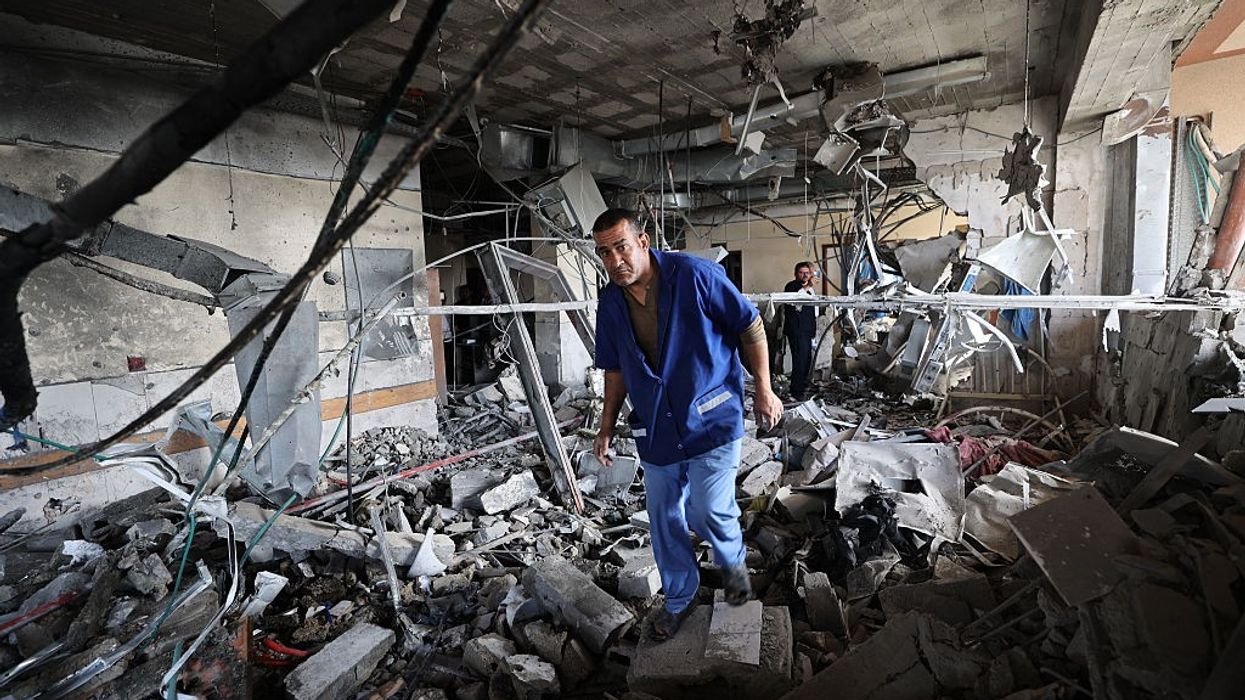
Palestine defenders are preparing for the latest—and largest—Freedom Flotilla Coalition mission to set sail for Gaza in an attempt to break Israel's US-backed genocidal siege on the embattled Palestinian territory.
Dozens of boats carrying hundreds of activists from as many as 44 nations are set to take part in the Global Sumud Flotilla—sumud means "perseverance" in Arabic—as it attempts to run Israel's naval blockade and deliver desperately needed humanitarian aid including food, medicines, and baby formula to the starving people of Gaza.
"We are a coalition of everyday people—organizers, humanitarians, doctors, artists, clergy, lawyers, and seafarers—who believe in human dignity and the power of nonviolent action," Global Sumud Flotilla's website explains.
In addition to "everyday people," flotilla participants include Swedish climate activist Greta Thunberg, American actress Susan Sarandon, Irish actor Liam Cunningham, leftist Portuguese parliamentarian Mariana Mortágua, former Barcelona Mayor Ada Colau, and Mandla Mandela, the grandson of former South African President Nelson Mandela.
Israel "is starving and killing the people of Gaza," Mandela—whose grandfather was not only a hero of his country's anti-apartheid struggle but also a staunch supporter of Palestinian liberation—said Friday on behalf of the South African flotilla delegation. "We are a diverse group of international activists calling for urgent global action to compel Israel to open Gaza's borders to aid and end its genocide of the Palestinian people."
"We ask that South Africans of conscience join us," he added. South Africa is leading an ongoing genocide case against Israel at the International Court of Justice (ICJ) in The Hague that is officially or informally supported by around two dozen nations.
Colau said earlier this week that "to end the genocide in Gaza is the duty of all of us, so we have to do what is in our power to do it if governments, including the government of Spain, do not do what they can to stop the criminal state of Israel."
Spain has joined the ICJ genocide case against Israel, has formally recognized Palestinian statehood and urged other nations to do so, and has taken significant steps toward an arms embargo on Israel.
"Although Spain has positioned itself more than other governments and recognized the Palestinian state, words are not enough when thousands of children are being killed," Colau said Friday in an interview with RTE.
At least 18,500 children are among the more than 63,000 Palestinians killed by Israeli forces in Gaza since October 2023—although the official Gaza Health Ministry figures are likely a vast undercount, according to peer-reviewed studies.
"This is my third attempt to try to sail with humanitarian aid to break Israel's illegal siege on Gaza and open up a humanitarian corridor," Thunberg, who is a member of the flotilla steering committee, told Middle East Eye Thursday.
"There have been 38 previous attempts just for the Freedom Flotilla Coalition (FFC) and now with the Global Sumud Flotilla," Thunberg continued. "This is unprecedented. We are mobilizing people from all over the world with dozens of boats sailing from Barcelona first, and then more boats joining us from other ports around the Mediterranean Sea."
"We are doing this because we are facing a genocide," she added. "We are seeing people being deliberately deprived of their basic means to sustain life. And this is a continuation of the suffocating oppression that Palestinians have been living under for decades, and we simply have no choice if we have any sense of humanity left, we cannot just sit by and watch this unfolding."
The Gaza Famine—officially declared last week by the authoritative Integrated Food Security Phase Classification—has claimed at least hundreds of Palestinian lives in what experts say is an engineered effort by Israel. The International Criminal Court arrest warrants issued last year for Israeli Prime Minister Benjamin Netanyahu and former Defense Minister Yoav Gallant, who ordered the "complete siege" on Gaza fueling the famine, list forced starvation, along with murder, as alleged crimes against humanity and war crimes committed by the pair.
Earlier this year, the FFC vessels Conscience, Madleen, and Handala each separately tried to break the blockade but were thwarted by Israeli forces in international waters, an apparent violation of maritime law. Flotilla activists were beaten, kidnapped, jailed, interrogated, and deported by Israel.
Fifteen years ago, Israeli forces raided one of the first FFC convoys carrying humanitarian aid to Gaza. The Israeli attackers killed nine volunteers aboard the MV Mavi Marmara, including Turkish-American teenager Furkan Doğan.
The Sumud Flotilla comes as Israeli forces ramp up Operation Gideon's Chariots 2, a campaign of conquest, occupation, and ethnic cleansing of Gaza backed by the administration of US President Donald Trump. On Thursday, Israeli Finance Minister Bezalel Smotrich proposed the systematic annexation of Gaza over the coming months if Hamas keeps fighting, as well as the implementation of Trump's plan to ethnically cleanse the Palestinian exclave and transform it into the "Riviera of the Middle East."
Israel's siege of Gaza has been in effect in varying degrees of severity since 2006 in response to Hamas' rise to power in the strip.
"The idea is to put the Palestinians on a diet, but not to make them die of hunger," a senior adviser to then-Israeli Prime Minister Ehud Olmert said at the time.
Now Palestinians are dying of hunger, and the world has increasingly had enough.
"Our boats carry more than aid," Global Sumud Flotilla said. "They carry a message—the siege must end. The greater danger lies not in confronting Israel at sea, but in allowing genocide to continue with impunity."
"Why is it that cinema, a breeding ground for socially committed works, seems to be so indifferent to the horror of reality and the oppression suffered by our sisters and brothers?"
On Monday, in the lead-up to the annual Cannes Film Festival in France, nearly 400 international actors, directors, and producers released an open letter condemning Israel's genocide in the Gaza Strip.
The letter—published by French newspaper Libération and U.S. magazine Variety—begins with Fatma Hassona a 25-year-old Palestinian freelance photojournalist killed in an Israeli military strike on April 16, 2025, just a day after it was announced that Sepideh Farsi's film Put Your Soul on Your Hand and Walk, in which she stars, was selected to premiere at a section of the festival.
Just weeks earlier, in March, "Palestinian filmmaker Hamdan Ballal, who won an Oscar for his film No Other Land, was brutally attacked by Israeli settlers and then kidnapped by the army, before being released under international pressure," the letter details, noting that the Academy of Motion Picture Arts and Sciences was pushed to apoloize for not adequately supporting him.
"We are ashamed of such passivity," asserted the signatories, including Pedro Almodóvar, Javier Bardem, Ralph and Sophie Fiennes, Richard Gere, Jonathan Glazer, Viggo Mortensen, Cynthia Nixon, Ruben Östlund, Guy Pearce, Laura Poitras, Mark Ruffalo, and Susan Sarandon.
"Let us collectively dare to look at it with the precision of our sensitive hearts, so that it can no longer be silenced and covered up."
"Why is it that cinema, a breeding ground for socially committed works, seems to be so indifferent to the horror of reality and the oppression suffered by our sisters and brothers?" they asked. "As artists and cultural players, we cannot remain silent while genocide is taking place in Gaza and this unspeakable news is hitting our communities hard."
In addition to condemning silence in the face of genocide, they argued that "far-right, fascism, colonialism, anti-trans and anti-LGBTQIA+, sexist, racist, islamophobic, and antisemitic movements are waging their battle on the battlefield of ideas, attacking publishing, cinema, and universities, and that's why we have a duty to fight."
"Let's refuse to let our art be an accomplice to the worst," the letter declares. "Let us rise up. Let us name reality. Let us collectively dare to look at it with the precision of our sensitive hearts, so that it can no longer be silenced and covered up. Let us reject the propaganda that constantly colonizes our imaginations and makes us lose our sense of humanity."

Farsi—who also signed the letter—welcomed the impact of her film featuring Hassona but also called on Cannes organizers to denounce Israel's ongoing assault on Gaza, which has killed over 52,900 Palestinians since October 2023 and left the enclave's more than 2 million survivors struggling to access essentials, due to an Israeli blockade on humanitarian aid.
"There needs to be a real statement," Farsi
told Agence France-Presse. "Saying 'the festival isn't political' makes no sense."
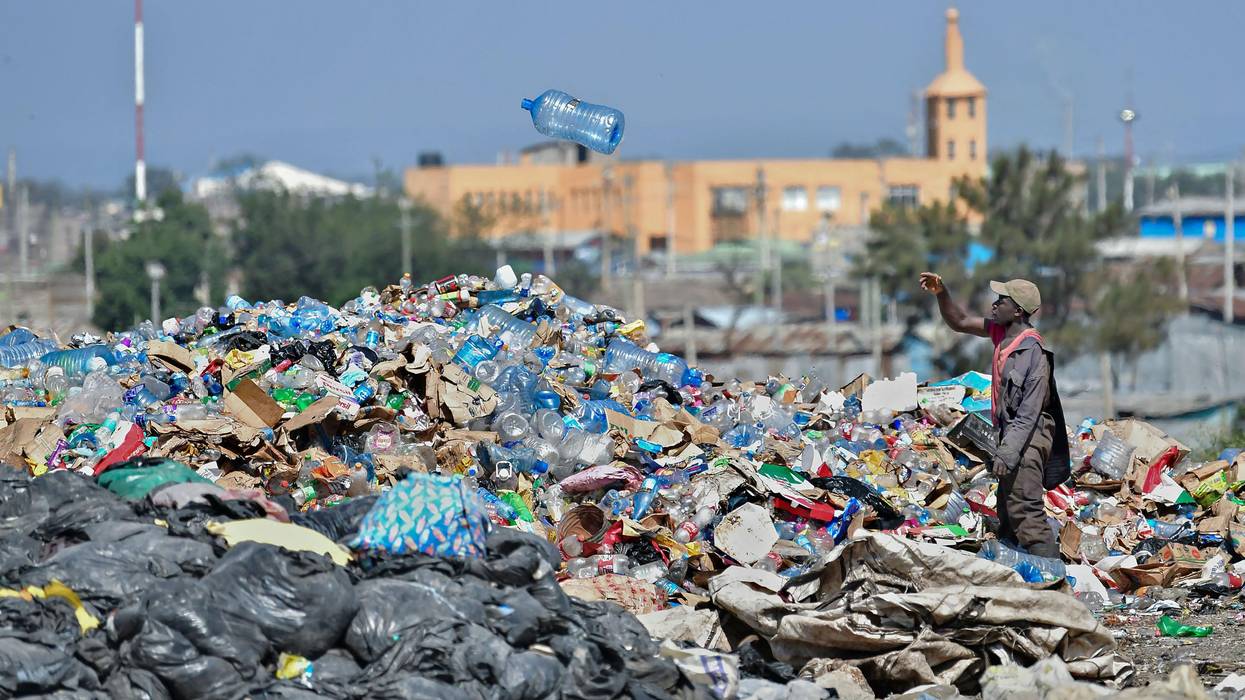
"Will you be the president who helped put an end to the plastic pollution crisis, or someone who let it spiral further out of control?"
Actors known for their environmental advocacy—including Jane Fonda, Jason Momoa, Joaquin Phoenix, Susan Sarandon, and Laura Dern—joined Greenpeace USA on Thursday in an open letter to U.S. President Joe Biden urging his administration to "protect the planet from plastic pollution" and slash carbon emissions "by supporting a strong global plastics treaty."
"We appreciate your leadership in securing a global oceans treaty that creates a path to protecting 30% of our oceans by 2030," the letter's signers told Biden. "Winning the treaty was truly a historic moment, one of the greatest environmental achievements in history."
"We're calling on President Biden to put aside fossil fuel and plastics industry interests and lead us on the path that prioritizes human health, biodiversity, and our communities."
"At the end of May, delegates from around the world will convene in Paris for the second round of negotiations on a global plastics treaty," the letter continues, referring to talks hosted by the United Nations Environment Program (UNEP).
"While you have signaled support for this treaty, the U.S. position is not yet strong enough," the letter argues. "Currently, the U.S. is not calling for a cap on plastic production—which is the only real way to stop plastic pollution. In 2021, the U.S. only recycled a mere 5% of plastics produced."
The letter continues:
Plastics are polluting and harmful at every stage of their life cycle—from extraction to disposal. Ninety-nine percent of plastics come from fossil fuels; cutting plastic production will make a significant dent in carbon emissions. There are communities living next to refineries and petrochemical facilities who are bearing the combined brunt of the climate and plastic crises. People living near these facilities—overwhelmingly people of color—face higher rates of cancer, asthma, and adverse birth outcomes.
"President Biden, you have a once-in-a-lifetime opportunity to help our climate, our oceans, and our communities this year by supporting a strong and ambitious global plastics treaty," the signers asserted. "The decision you make on this critical issue will help define your legacy—will you be the president who helped put an end to the plastic pollution crisis, or someone who let it spiral further out of control? We're calling on you to do the right thing."
Other actors who signed the letter include Rosana Arquette, Alec Baldwin, Ed Begley, Ted Danson, Piper Perabo, Kyra Sedgwick, William Shatner, and Shailene Woodley.
Greenpeace is proposing a seven-point plan for the global plastics treaty:
"Many environmental groups and frontline communities are disappointed with the U.S.' current position on the treaty, as it does not call for a cap on plastic production and instead focuses on recycling," Greenpeace USA senior plastics campaigner Lisa Ramsden said in a statement.
"Recycling will never solve the plastic waste problem," Ramsden added. "We must stop plastic waste at its source, and we're calling on President Biden to put aside fossil fuel and plastics industry interests and lead us on the path that prioritizes human health, biodiversity, and our communities."
On Tuesday, UNEP published a report contending that global plastic pollution can be reduced by 80% by 2040 if countries and corporations enact major changes using existing technologies. However, the report was criticized by some environmentalists for promoting the burning of plastic waste.
UNEP has also come under fire in recent days for issuing just one pass per organization attending the Global Plastics Treaty negotiations in Paris.
There is a school of thought which posits that a Bernie Sanders presidential nomination could undermine down-ballot Democratic candidates come Election Day. This notion was on full display over the weekend as Pete Buttigieg attacked Sanders after the Vermont senator won eight times as many delegates as he did in the Nevada caucuses, while cementing his position as the undisputed Democratic front-runner.
"I believe the only way to truly deliver any of the progressive changes we care about is to be a nominee who actually gives a damn about the effect you are having, from the top of the ticket, on those crucial, front-line House and Senate Democrats running to win, who we need to win, to make sure our agenda is more than just words on a page," Buttigieg said in his Nevada concession speech. The former South Bend, Indiana mayor then accused Sanders of "ignoring, dismissing, or even attacking the very Democrats we absolutely must send to Capitol Hill in order to keep Nancy Pelosi as speaker, in order to support judges who respect privacy and democracy, and in order to send Mitch McConnell into retirement."
One prominent Sanders supporter was quick to opine that there are some Democrats who should be sent packing, not back to Capitol Hill. Academy Award-winning actress and progressive firebrand Susan Sarandon hit back at Buttigieg, saying she would be glad to see House Speaker Nancy Pelosi forced into retirement. "We're not looking to keep Pelosi because there's a progressive running against her who supports Medicare for All and the Green New Deal among other things," she tweeted, urging her followers to check out Shahid Buttar's upstart campaign.
Sarandon had previously endorsed Buttar, tweeting last month that "he is the leader that we need right now to take on the influence of money in politics, the environment, criminal justice reform and labor rights, which will not survive or tolerate any more centrist inaction."
Buttar's recognition and support are growing in the San Francisco district he hopes to represent and beyond as Californians, who moved the date of their primary from June to Super Tuesday, mail in their ballots or prepare to head to the polls on March 3. However, he faces an uphill battle against Pelosi, who has represented California's 12th congressional district since 1987 and enjoys all the financial and other benefits that 33 years of incumbency and the house speakership confer. Buttar is nevertheless well-placed to make the November ballot due to California's unique system in which the two top candidates in the primary advance regardless of party affiliation. No other current candidates come close to Buttar's level of name recognition or support.
Much of that support comes from the usual corners. Buttar has been endorsed by SF Berniecrats, which is the local Our Revolution group, as well as by the local chapters of Democratic Socialists of America (DSA), Progressive Democrats of America (PDA) and others. Buttar also boasts endorsements from prominent national figures including Black Lives Matter activist Shaun King, Women's March co-chair Linda Sarsour and Harvard professors Cornel West and Lawrence Lessig.
Buttar, a Stanford law graduate and constitutional lawyer who in 2004 filed the first marriage equality lawsuit in the state of New York, was most recently director of grassroots advocacy for the San Francisco-based digital rights group Electronic Frontier Foundation (EFF). He launched his 2020 campaign by decrying the "essential threats" of corporate control and government surveillance.
"Watching Nancy Pelosi vote against proposed surveillance reforms made me want to quit my job and run against her," Buttar said. And he did. On the campaign trail, he takes every opportunity to paint himself in stark contrast to Pelosi. He repeatedly links the homelessness and health care crises, noting that the leading cause of the former is the crippling cost of the latter.
"How barbaric is it that in the country that is supposed to be the richest in the world there are people without shelter because they got sick?" he asked at his campaign launch, before asserting that Pelosi "is committed to the interests of for-profit health insurance companies before the health of patients."
Addressing what is arguably the greatest crisis facing humanity, Buttar, who backs the Green New Deal, lamented that "our species is in crisis because we are more committed to fossil fuel extraction than we our to the lives of your children and your grandkids."
"Climate change is not just a threat to future generations," he said. "People are dying today from the effects of climate change." Buttar then blasted Pelosi for "deriding the only visionary solution that's been proposed to the climate crisis as a dream."
Many in the political establishment have dismissed Buttar's lofty aspiration as a dream. However, Buttar and his growing group of supporters are confident that victory is possible through the strength of a people-powered campaign that lays out a stark choice between business as usual--the business of greed, violence and ecological destruction--and the better world that so many residents of a city of dreamers believe is possible.
On July 25, in a surprise announcement, U.S. Attorney General William Barr said that the federal government would be resuming executions, with five scheduled in the coming months. This overturns an effective moratorium on the federal death penalty that has lasted over 16 years.
"Punishment must be swift," Barr said.
Just a week later, President Donald Trump exploited the mass killings in El Paso, Texas, and Dayton, Ohio, by demanding not an assault weapons ban, but that capital punishment "be delivered quickly, decisively and without years of needless delay." Needless delay? Since 1973, over 160 wrongfully convicted people have been freed from death row.
Trump's death penalty dictate is a tragic step backward.
In fact, the death penalty is rapidly losing favor in the United States. Twenty-one states and the District of Columbia have banned executions, while four more states have formal moratoriums in place. Around the world, 106 countries have outlawed capital punishment, and another 28 either have moratoriums or don't carry out the death sentences. Trump's death penalty dictate is a tragic step backward.
"I'm not surprised that William Barr did this or the Trump administration wants to expedite federal executions," renowned anti-death penalty activist Sister Helen Prejean said on the "Democracy Now!" news hour. "It's their whole way of approaching everything: the way is through violence to try to solve social problems." Prejean is the Catholic nun who rose to global prominence in 1995 after her book "Dead Man Walking: An Eyewitness Account of the Death Penalty" was turned into an Oscar-winning film starring Susan Sarandon and Sean Penn.
In her new memoir, "River of Fire," Prejean eloquently describes the path that led her from a life as a semi-cloistered young nun in New Orleans in the 1960s to become one of the world's most celebrated and effective campaigners against capital punishment. In it, she writes, "From years on the road talking with people in every state of this nation I realized that most folks have never reflected deeply about capital punishment and have almost no information about how the penalty actually works--or doesn't work."
Prejean co-founded a group, Survive, that works with the families of murder victims. Bud Welch lost his daughter Julie in the Oklahoma City bombing in 1995, which killed 168 people. Timothy McVeigh was later executed for the crime. Welch said on "Democracy Now!": "One cannot go through the healing process at all when you're living with revenge. And that's all the death penalty is, revenge. It is not a deterrent. It doesn't, as the media says, bring closure to family members."
The Death Penalty Information Center presents clear and compelling statistics on the 2,500 people currently on death row in the U.S., and how unjustly the death penalty is implemented. The most significant factors in determining whether or not a person is given the death penalty are the location where they are tried, whether they are poor, and the race of the victim. For example, over half of all death sentences are handed down in just 2% of U.S. counties. Similarly, over 75% of capital punishment cases involve murders where the victim was white. According to the DPIC, "In Louisiana, the odds of a death sentence were 97% higher for those whose victim was white than for those whose victim was black. Jurors in Washington state are three times more likely to recommend a death sentence for a black defendant than for a white defendant in a similar case."
Not only is the death penalty administered in an unjust, biased way, but it is also irreversible. Death is final. Clifford Williams Jr. and Charles Ray Finch became the 165th and 166th death row prisoners to be exonerated. Each of these innocent African American men spent over 40 years on death row. With the expedited execution schedule fancied by Trump and Barr, they would have been long dead.
Helen Prejean believes Trump and Barr "seem to have no understanding about how the courts work. They can claim all they want that they're going to fast-track this and speed up these executions, but there is the Constitution, and there are the appeals." While her focus remains on grassroots organizing, she also points to the importance of dedicated death penalty defense attorneys.
One such lawyer is Bryan Stevenson, founder of the Equal Justice Initiative in Montgomery, Alabama. The group's Legacy Museum and the accompanying lynching memorial is deeply moving, documenting the 400-year history of African Americans, from enslavement to Jim Crow to the current crisis of mass incarceration.
Said Stevenson on "Democracy Now!," "The death penalty is lynching's stepson."
A recent CNN poll shows that among potential Democratic candidates in Iowa caucuses Senator Bernie Sanders has the highest approval rating from people of color. And the diversity of the Sanders-inspired left was on display at the Sanders Institute Gathering in Burlington Vermont earlier this month, which I covered on my podcast, The Katie Halper Show.
But empirical evidence has not stopped much of the corporate press--including many "liberal" or "progressive" outlets and commentators--from condemning the senator as having "a race problem."
Over the past week we saw Jonathan Martin of the New York Times (who happens to be white) claim that Sanders "has done little to broaden his political circle and has struggled to expand his appeal beyond his base of primarily white supporters." Meanwhile, Clara Jeffery, the editor-in-chief of Mother Jones (also white), recently presented not only Sanders' supporters but the left movement in general as white. Linking to a written exchange between two Splinter journalists about Sanders, she tweeted, "In which white lefties have a debate that somehow does not discuss the fact that Bernie has no real purchase among the POC base of the Democratic party. And that problem has not improved for him, if anything it seems larger..."
Even those who openly mock the concerns of the white working class, undermine their own alleged commitment to marginalized voices when they ignore the diversity of Sanders' supporters.
But despite evidence like the new CNN poll, in which Sanders had the highest approval among non-white voters, outlets reporting on the survey studiously avoided mentioning that key finding which undermines the media narrative about Sanders' struggle to appeal to minority voters. While it's only one poll, and his favorability among voters of color isn't far ahead of Joe Biden's, it's newsworthy and significant precisely because it undermines the media narrative about Sanders' alleged struggle to appeal to non-white voters. On social media people who happily call Sanders #FakeJews, and defend Hillary Clinton's use of prison slave labor, continue to vilify Sanders as somehow "racist."
Most politicians could "do better," when it comes to addressing and speaking about racial inequities, sexism, homophobia, transphobia and classism. But the claim that Sanders is exceptionally problematic is absurd, given, for example, that Biden opposed integrated busing in the 1970's; mistreated Anita Hill during the confirmation process of Clarence Thomas; called Obama "the first mainstream African-American who is articulate and bright and clean and a nice-looking guy"; and said "You cannot go to a 7-Eleven or a Dunkin' Donuts unless you have a slight Indian accent. I'm not joking."
Sanders' critics smear him as blinded by straight, white, male privilege. The mere mention of class gets Sanders and others condemned as class reductionists. The irony is that many of the most vocal critics attacking him for being insufficiently intersectional fail to address class altogether as an aspect of identity.
It's cruel, immoral and politically disastrous to dismiss the experience of working class people of all colors and backgrounds. But even those who openly mock the concerns of the white working class, undermine their own alleged commitment to marginalized voices when they ignore the diversity of Sanders' supporters. By ignoring the people of all ages, backgrounds, genders, sexuality, and ethnicity who support Sanders, they engage in the very erasure and marginalization of the women, people of color, LGBTQ people (and all the intersections thereof) that they claim to oppose.
The real story is very different, as I found at the Sanders Institute Gathering. Organized by Jane Sanders and David Driscoll, the 3-day event was more about the movement that Sanders helped spark than it was about the man. Though Sanders delivered the keynote and participated in several panels, the gathering focused on issues, bringing together leaders, thinkers, organizers and activists. Participants included physician and public health activist Abdul El-Sayed; San Juan Mayor Carmen Yulin Cruz; actor and activist Danny Glover; executive director of Good Jobs Nation, Joseph Geevarghese; Our Revolution director, Nina Turner; Presente.org's executive director Matt Nelson; and many others. Over the weekend, the panels and roundtables addressed healthcare, climate change, criminal "injustice," civil rights, immigration, Puerto Rico, the housing crisis, the international progressive movement, and other issues with attention to class, race, and gender.
The following are excerpts from my interviews, which you can hear in full here and here:
Bernie Sanders: Bringing people together
The first person I ran into at the gathering was, believe it or not, Bernie Sanders himself. I told the senator, "One of the things that's really frustrating to progressives who support you is this narrative about your not being a feminist or not being anti-racist." Then I asked, "How can we push back on that, given how much the corporate media seems to be interested in that narrative?"
"What we are fighting for is to bring people together--Black and White and Latino, Native American and Asian American--around an agenda that speaks to the needs of ordinary Americans and not just the one percent."
--Sen. Bernie SandersTo which he replied:
What we are fighting for is to bring people together--Black and White and Latino, Native American and Asian American--around an agenda that speaks to the needs of ordinary Americans and not just the one percent. We want Medicare for All, we want to raise the minimum wage to a living wage, we don't want our kids to be living in a planet ravaged by climate change. So we are making progress. We expect opposition to continue. And we're gonna do the best in this fight that we can.
When you look at corporate media, you're looking at media owned by large, often international corporate conglomerates, which are owned by some of the wealthiest people in this country or in the world. They will do anything and everything they can do to protect their own interest and they will say anything about anybody that they want.
During a panel discussion later that day, he went spoke further about the dangers of divide-and-conquer strategies deployed by the enemies of equality:
When people are pushed aside, when people are hurting, you have demagogues who step in and say "Our problem is that Mexican who is picking strawberries." So you take that anger and frustration and pain that people are feeling and you turn them against people who are in worse shape than [they] are. And our job is to bring people together and say, "No. It is not some Mexican who is picking strawberries who is our enemy. It is Wall Street, it is the fossil fuel industries, it is the drug companies, it's the insurance companies." Let's stand together and take those people on.
Mayor Michael Tubbs: We absolutely have to be intersectional
I also interviewed Stockton, California Mayor Michael Tubbs, who--as he put it during a panel at the Gathering in Burlington--grew up a "poor black child on the south side of Stockton with an incarcerated father and a mother who had me at sixteen as a teenager. The things we fight for like affordable healthcare, affordable childcare, entitlement programs like WIC and Head Start all paved the way for me to be here today."
After the round table he spoke to me about how Sanders' 2016 run pushed him to embrace bolder more progressive ideas:
Senator Sanders came and spoke in Stockton in a presidential campaign, which was unheard of--someone running for president to come to Stockton. And I was able to introduce him. And I was also impressed with the number of people who were at that rally in the middle of the day like five- or six-thousand people. And Stockton's not a super rabid political town and I was like, "Wow, this message is resonating." And I think that gave me the confidence to be a little more bold in my policy prescriptions or pilot programs that we're doing in the city because I saw the hunger and the want for a government that is actually responsive and works for regular everyday people.
The mayor sees such bold progressive policies as crucial to defeating the equally bold but opposingly reactionary policies of Trumpism. There is "no middle ground," Tubbs said, when you're battling fascism. "Some of Trump's supporters wanted to see--and I don't think that discounts racial resentment--something bold, shocking, say something that's different, that's not vanilla."
"We absolutely have to be intersectional in how we think about things. It's not just one thing, we have to be intersectional in our policies and programs."
--Mayor Michael TubbsThe president's rhetoric and policies are xenophobic, Tubbs continued, and his solutions are bad. "But some of the problems he articulated with trade deals and the way they impact regular people are clear problems that we have to address," he said. "So I think it's about how do we give people something bold that relates to their everyday life that says [to them]: 'I am seen. I am heard. This leader cares about what I'm dealing with.'"
Tubbs sees intersectionality and multiracial organizing as challenging but crucial.
"Historically since Bacon's Rebellion," Tubbs explained, "poor white folks have voted against their best interest and I don't think we've done enough work to actually show people why is it in your best interest to cast your lot with these folks that don't look like you. We absolutely have to be intersectional in how we think about things. It's not just one thing, we have to be intersectional in our policies and programs."
Mayor Gus Newport: Neoliberals are single-issue people
Right before speaking to the mayor of Stockton, I interviewed the former mayor of another California city. Eighty-three year old Eugene "Gus" Newport worked with Malcolm X, is the great grandson of a slave and was the mayor of Berkeley from 1979-1986. He and Sanders were mayors at the same time and Newport had stumped for Bernie earlier during Sanders' unsuccessful runs for governor of Vermont in 1972 and 1976.
Newport recalls that as the two campaigned in Burlington, a reporter asked Sanders, "Why does a Jew from Brooklyn, who's a Socialist, invite Gus Newport, a former black nationalist and a socialist from Berkeley to campaign for him in a state that is 97% white?" Bernie's answer was short: "Because we're gonna talk about the issues." After that, Newport explained, the reporters had no more questions. "I've loved him ever since," he said.
"Why does a Jew from Brooklyn, who's a Socialist, invite Gus Newport, a former black nationalist and a socialist from Berkeley to campaign for him in a state that is 97% white?" Bernie's answer was short: "Because we're gonna talk about the issues."
Sanders would later appoint Newport to the Democratic Unity Commission in 2017 in the wake of Hillary Clinton's loss to Trump. "I found out more than I ever wanted to know about the Democratic National Committee than I ever wanted to know," he said, but "nobody in the Democratic Party has ever spoken to all the issues in the depth that Bernie Sanders has."
When I asked him what he thought about the claim, often perpetuated by the media, that socialism is a white project, Newport responded:
The media--look who they work for, that's corporate America. You must remember Malcolm X was a socialist and Martin Luther kIng was moving towards socialism when he talked about the war against Vietnam. But a lot of Black leaders didn't go along. We've got to educate our own to become an integral part of this. And we're gonna do it. Danny Glover and I, we've gone down to Mississippi and South Carolina with Bernie. And the minute it appears that Bernie's going out there [to run in the 2020 primary], we're gonna go organize. I'm gonna be ready to campaign 9 to 10 months out of the year. I'm going to rehab now for this bad knee but as soon as I can--I'll do a lot of walking.
While some smear Sanders for being a "single issue" candidate, Newport believes it's the centrist "neoliberal" Democrats who deserve that label. "They are a single issue people," he declared. "They do not work around other issues [like class or poverty]. They're usually not a part of the working class. We're looking for real people."
Newport was thrilled that the Gathering--for which "Jane Sanders needs to be given all the credit in the world"--provided participants with "a challenge to pull ourselves together and make sure there's a worthwhile future for the next generation."
Though people often consider the intersection of race, gender and sexuality--class and age are often excluded. A popular narrative which pits people of different ages against each other is that of the spoiled, entitled and lazy millennial. Newport has sympathy, empathy and righteous outrage for the bleak economic reality that millennials face.
As he said at the Democratic Unity Commission, it is time to get "past our own egos and look at the issues." He added, "Too many of us who get into body politic eventually just focus on ourselves. We got retirement for life, we got healthcare for life. But what about the people? You gotta think of the reality: the millennials have had enough. Many of them know they won't be able to buy a house in their life times. They gotta pay student loans. So I'm proud. But we have a lot more work to do."
Naomi Klein: connecting the dots between all issues
In some ways climate change affects us all, as writer and journalist Naomi Klein told me: "Climate change impacts everything because we're all inside the climate so there's no prying anything apart from it."
"[The left has to] deepen its analysis of what racial capitalism means. Too often race is an add-on. Too often gender is an add-on. And we have to take that on board and do a better job."
-- Naomi KleinIn some ways, climate disasters don't discriminate: "As anyone who's lived through a hurricane knows, no matter how rich you are or how powerful you are those winds are absolutely terrifying; no matter how rich you are or how powerful you are if the flames are coming towards your house in Malibu, you're not safe." But, Klein added class perspectives to her analysis. "Climate change doesn't affect all of us equally." She explained:
It's tricky. [Climate change] isn't a leveler. In the short term what it does is exacerbate pre-existing inequalities. It's already here for people who are very precarious and who have no protections. And it is true that wealth can buy you protection for a couple of generations. And in the meantime there are enormous profit potentials. It's not very comforting that there's such a keen interest in Mars. Because that really does start to feel like a Plan B. Not that it's a realistic one.
Ultimately this is a system that will collapse on everyone's head... eventually. But in the short term there are definitely rooms that are going to collapse first.
I'm not making the argument that it has to be the issue to trump all other issues. I think we need to have an analysis that is all about connecting the dots between all of these issues.
Klein pointed to the distinctions among Democrats that the Sanders campaign exposed. There were liberal centrists who were liberal centrists "because they honestly didn't believe that more progressive, more redistributive policies were popular or possible. But when they saw that they might be, they got on board." And then there were liberal centrists who didn't shift to the left because, it turned out, they "just opposed those ideas."
"We've all have our eyes opened by that," Klein said. "And then you realize, we're not all on the same side."
Roseann DeMoro: The duplicitous Bernie Bro smear
Former executive director of National Nurses United and of the California Nurses Association/National Nurses Organizing Committee, Roseann DeMoro does not mince words when describing the dishonesty of the latter group.
"I was just talking to Susan Sarandon," she explains. "We were all accused of being Bernie Bros. It's to delegitimize us. It's a lie. It's a duplicitous, ugly, malicious, horrendous, calculated lie. It's a calculated lie by the DNC. It's a PR campaign masquerading as politics."
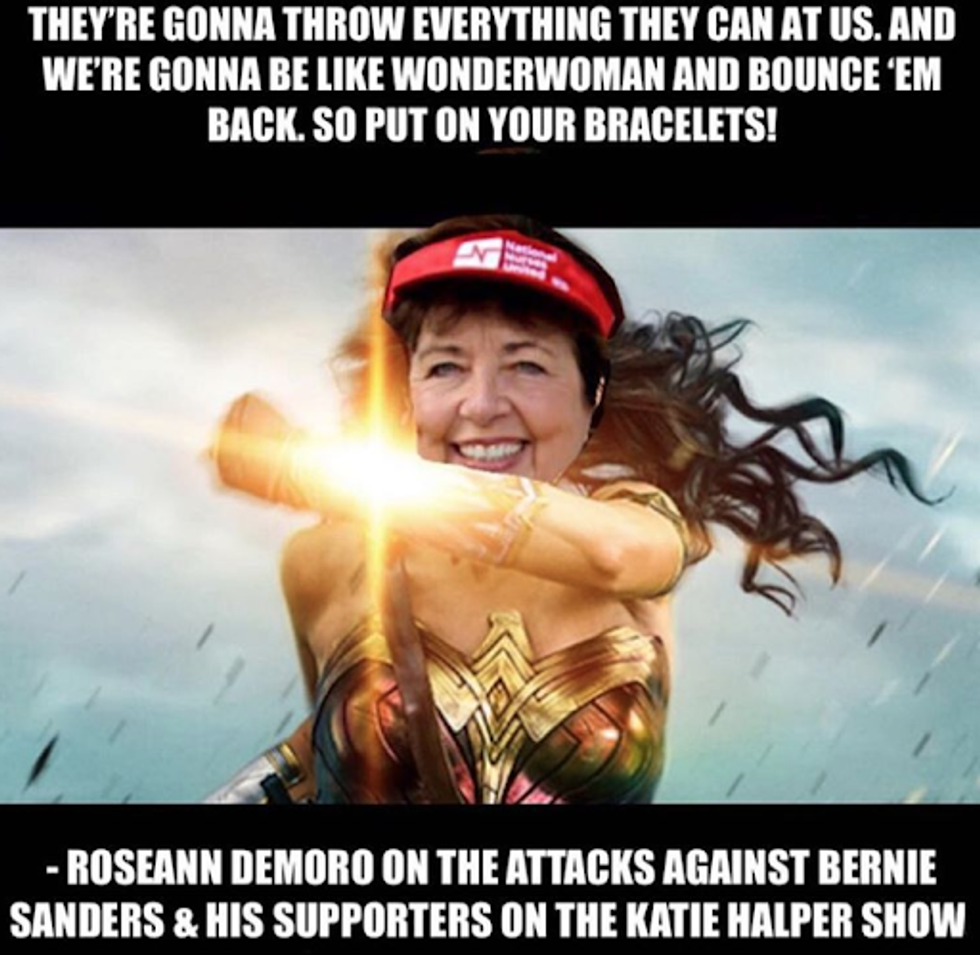
I agreed that many of the people who spread the Bernie Bro smear are, indeed, disingenuous and malicious. Others, however, are more misinformed by the coordinated propaganda campaign which portrays Sanders as "bad on race and gender" whose supporters are a monolith of white men or people who want to curry their favor.
DeMoro objected to prioritizing identity over policy and profits over people. "People are suffering across the spectrum," she said. "They can't take care of their families or of themselves. Their personal dignity is going down the drain. Ultimately, what we were supposed to do was to buy into a neoliberal paradigm to elect a neoliberal woman who didn't share our values because she was a woman. Well, Margaret Thatcher was a woman."
Of course, as DeMoro and I agreed, one of the differences between Clinton and Thatcher is that neither Thatcher, nor her fans, ever claimed the Iron Lady was a feminist.
An ardent supporter for Sanders to run again in 2020, DeMoro is prepared for more of the smears which started in 2016 and never really went away. "They're gonna throw everything at us, when it comes to Bernie, and we're gonna be like Wonder Woman and bounce 'em right back. So put on your bracelets."
Maria Svart: You can't understand class without understanding gender and race and vice versa
I also interviewed Maria Svart, the national director of the Democratic Socialists of America (DSA), for The Real News Network and my podcast. She also criticized the Bernie Bro narrative.
"Look at Bernie Sanders," Svart said, "the most popular politician in the country. And yet people that support Bernie are called Bernie Bros. You look at DSA. I am a Latina. I'm leading the organization. And there are many women of color in leadership, and yet we are characterized as a bunch of Bernie Bros."
Svartz went on to describe her own intersectional identity:
"You look at DSA. I am a Latina. I'm leading the organization. And there are many women of color in leadership, and yet we are characterized as a bunch of Bernie Bros."
--Maria Svart, Democratic Socialists of America
You can't understand class without understanding gender, and race--and vice versa. How can you possibly understand, for example, the life experience of my grandmother, who was an undocumented Mexican immigrant, without understanding the much bigger picture, the whole systems of our society, whether it's white supremacy or xenophobia or capitalism? They all intersect. And we need to talk about the complexity of that reality all the time, and we have to push back against lean-in feminism, mainstream feminism, all the time.
Whether or not Sanders decides to run for the 2020 Democratic presidential nomination (and in case you can't tell, I hope that he does), the movement he sparked is deepening its understanding and analyses of the intersectionality for the electoral and organizing work ahead in 2020 and beyond.
According to Klein, the left has to "deepen its analysis of what racial capitalism means. Too often race is an add-on. Too often gender is an add-on. And we have to take that on board and do a better job."
No matter what the landscape looks like in 2020, Klein continued, "we have to spend 2019 building as broad a coalition as possible, understanding as deeply as we possibly can that all these issues are so profoundly intertwined. To me what's clear is that if we fail, it is not because our ideas are unpopular. It is because we failed as organizers."
The 2018 Golden Globes is set to make prime time the demand for a world free from sexual harassment and abuse as leading gender and racial activists will hit the red carpet alongside actresses.
"Too much of the recent press attention has been focused on perpetrators and does not adequately address the role race, ethnicity and economic status play in sexual violence," the justice advocates, who include #MeToo founder Tarana Burke, National Domestic Workers Alliance director Ai-jen Poo, and National Farmworker Women's Alliance president Monica Ramirez, declared in a joint statement.
"Our goal in attending the Golden Globes is to shift the focus back to survivors and on systemic, lasting solutions. Each of us will be highlighting legislative, community-level, and interpersonal solutions that strengthen protections against sexual violence in our communities. It is our hope that in doing so, we will also help to broaden conversations about the connection to power, privilege, and other systemic inequalities."
As organizer and former vice presidential candidate Rosa Clemente posted to Instagram about the event she's joining: "This definitely will not be your normal Golden Globes!" Her post included a photo of the actresses taking part, including Laura Dern, Reese Witherspoon, Susan Sarandon, America Ferrera, and Meryl Streep.
The awards show, during which many of the stars will also be wearing black to make a statement about the pervasive exploitation, comes days after hundreds of Hollywood women launched the Times Up initiative, in which they issued a "unified call for change" to end the plague that exists "from movie sets to farm fields to boardrooms" nationwide.
The industry women are also taking to social media to encourage others to wear black as a sign of solidarity, as "the imbalance of power" exists "Not just in Hollywood, but every industry! "
" Selma" director Ava DuVernay says she'll be wearing the color "because balance and inclusion and diversity is not some kind of allowance to be made to accommodate people. No, sir. It is a correction of an error. It is a righting of a wrong. And it is going to be done. Now. #TimesUp"
While the advocates acknowledge that 2017 brought pivotal developments from the Women's March to the rise of #MeToo, "There is still much work to do, and many hands required to do it."
"The #TIMESUP initiative joins an ever growing collective of organizations, movements, and leaders working to end gender-based violence. We look forward to partnering with them and others to organize, support all survivors, and find solutions that ensure a future where all women and all people can live and work with dignity," the activists' statement concludes.
The Golden Globes airs 8pm ET Sunday on NBC.
Several polls combined with his growing support base have confirmed that Sen. Bernie Sanders is the most popular politician in the United States. His presidential candidacy sparked a progressive political revolution across the country.
Several polls combined with his growing support base have confirmed that Sen. Bernie Sanders is the most popular politician in the United States. His presidential candidacy sparked a progressive political revolution across the country. In response to its popularity, establishment figures have denigrated, belittled, and reduced the strength, tenacity, and legitimacy of this movement. On May 29, Politico published an article armed with that motive claiming Sanders' revolution has "hit a rough patch" and that his supporters "struggle to capture the actual levers of power."
David Siders, the article's author, cites several examples to corroborate the narrative purported by the title. "The losses are piling up," he wrote, mentioning the recent losses of Sanders endorsed candidates, including Heath Mello's mayoral bid in Omaha and the special congressional elections of Rob Quist in Montana and James Thompson in Kansas. When discussing the latter two, Siders fails to mention that the Democratic establishment failed to match the funds that the Republican Party provided to their candidates or the Republican-backed attack ads that portrayed Quist and Thompson as allies of House Minority Leader Nancy Pelosi. The context of these elections was also not discussed; grassroots campaigns substantially over performed in Republican strongholds. Instead, sweeping conclusions were drawn to connect these elections to a national trend.
Berniecrat Christine Pellegrino's recent victory of a traditional Republican New York Assembly district was reduced as low-profile. The beginning of a promising progressive's political career is the start of something larger--not a ceiling that Sanders' revolution is incapable of breaking.
Pellegrino's victory is a small victory foreshadowing more to come. Progressives intend to spark a political revolution to take on the Democratic establishment in addition to Republicans. Politico claimed Lucy Flores and Zephyr Teachout's losses in their November 2016 congressional races prove a shortfall in Sanders' movement, but Congresswoman Pramila Jayapal's victory was conveniently omitted. Flores lost in the Nevada Democratic primary race against Sen. Harry Reid's hand-picked candidate Ruben Kihuen, while Emily's List inexplicably endorsed a third candidate in the race after the organization had previously endorsed Flores for other races due to her strong record fighting for abortion rights. Though Teachout's loss was a disappointment, she was outspent and hurt by animosity toward Hillary Clinton. In a February 2017 interview, she said she regrets succumbing to the Democratic establishment's pressure to focus her campaign against Trump and Republicans over what she would have done for voters in her district. Another recent congressional race, in a Los Angeles congressional district, was included to reduce the momentum of Sanders' movement, but this race was mischaracterized as well. While two progressive candidates ran in the April 2017 primary, a race with 23 candidates, Our Revolution and Bernie Sanders did not get involved. One of those pro-Sanders candidates, Arturo Carmona, faced sexual harassment and sexism allegations in the days leading up to the race, though he led the race in a January 2017 poll.
Two other unfair criticisms included the claims that DNC chair candidate Congressman Keith Ellison and California Democratic Party chair candidate Kimberly Ellis' came up short. Both elections were decided by Democratic Party insiders--not voters. Ellis recently filed a formal challenge of the election results, and new DNC Chair Tom Perez was hand-picked by the Democratic establishment to prevent a pro-Sanders candidate from obtaining a party leadership position.
On Our Revolution's website, victories in elections and ballot initiatives outnumber losses, a fact overlooked in Politico's article. Victories include Ilhan Omar, the first Somali-American Muslim woman to win public office, Larry Krasner for Philadelphia's District Attorney, and 23 ballot initiatives.
While Sanders' political revolution has suffered losses, which is expected given the scope of the movement, the narrative propagated in the Politico article portrays it as a dysfunctional lost cause, which is far from the truth.
"It is unfortunate, but it is no surprise because as we continue to expose hypocrisy and the flaws within the political system, we can expect to be minimized, marginalized and maligned," prominent Bernie Sanders surrogate and former Ohio State Senator Nina Turner told the Observer. "However, the good news is that we signed up for the long term fight for health care for all, increasing the minimum wage, economic justice, environmental justice and racial justice. The vision began with Sen. Bernie Sanders. However, it will continue for generations to come."
Turner, a board member of Our Revolution, has helped lead the fight that Sanders started, but her strong leadership has incited opposition from forces that insist on preserving the status quo. This week, Turner has been attacked by the establishment and Clinton supporters for comments she made during an interview on CNN's State of the Union, during which she noted that the Democratic Party needs to focus on more visceral issues for voters rather than placing all its efforts on investigating Trump's ties to Russia. Her comments were conflated to casting shade on the Russia investigations and provoked the typical neo-McCarthyist allegation that she is aligned with Putin and Russia.
She noted the attacks ironically come from groups that have touted "Love Trumps Hate" signs and that these attacks prove that misogyny and racism are not exclusive to the Republican Party.
In spite of these attacks, Turner's rhetoric reflects the sentiment of a majority of progressives, who have recently pushed Democrats to support single payer health care in contrast to the Republicans' efforts to repeal Obamacare. For progressives, it's not enough to coast on attacks against Trump and Republicans; they push for progressive policies that will tangibly improve the lives of voters. Turner added, "As mentioned, it is more than resistance, it is about our resilience to plan, organize, and translate passion into votes that elect progressive public servants who will exert the people's power in public office in a way that pushes progressive policy that serves the people."
Prominent activists, lawmakers, artists, academics, and other leading voices in civil society, including Sen. Bernie Sanders (I-Vt.), are joining the campaign to get a pardon for National Security Agency (NSA) whistleblower Edward Snowden.
"The information disclosed by Edward Snowden has allowed Congress and the American people to understand the degree to which the NSA has abused its authority and violated our constitutional rights," Sanders wrote for the Guardian on Wednesday. "Now we must learn from the troubling revelations Mr. Snowden brought to light. Our intelligence and law enforcement agencies must be given the tools they need to protect us, but that can be done in a way that does not sacrifice our rights."
Pentagon Papers whistleblower Daniel Ellsberg, who co-founded the public interest journalism advocacy group Freedom of the Press Foundation, where Snowden is a board member, also wrote, "Ed Snowden should be freed of the legal burden hanging over him. They should remove the indictment, pardon him if that's the way to do it, so that he is no longer facing prison."
Snowden faces charges under the Espionage Act after he released classified NSA files to media outlets in 2013 exposing the U.S. government's global mass surveillance operations. He fled to Hong Kong, then Russia, where he has been living under political asylum for the past three years.
"The NSA and U.S. government have revealed no evidence that the information Ed Snowden released has caused any harm," Ellsberg continued. "Inconvenience, yes, embarrassment certainly, but what has truly been revealed is that the NSA itself was unquestionably committing international, domestic, and constitutional crimes."
"His revelations directly challenged the commonly held belief that media, phone and technology corporations must always give into state interests to target and harass the public."
--Malkia Cyril, Center for Media Justice
Black Lives Matter activist and Center for Media Justice co-founder Malkia Cyril wrote in the Guardian that Snowden must be pardoned "because the ability of black communities to organize for our collective liberation depends, in part, on whistleblowers like him. Black movements for peace and freedom demand that out of the darkness of empire, truth-tellers emerge to sound the alarm."
"His revelations directly challenged the commonly held belief that media, phone and technology corporations must always give into state interests to target and harass the public," she continued. "His bravery was a catalyst for the modern movement to defend democracy from both state and corporate overreach."
In a separate op-ed, Green Party presidential nominee Jill Stein wrote, "The American people have a right to privacy. My hope is that Obama uses his power to pardon Snowden now. The debate he began must be continued so we find a resolution that protects the freedom of press, association, religion and speech as well as the privacy of people in the United States and around the world."
Their words--as well as those of actress and Sanders supporter Susan Sarandon, renowned scholar and linguistics professor Noam Chomsky, civil rights activist Dr. Cornel West, Harvard Law School professor and former Democratic presidential candidate Lawrence Lessig, and technology lawyer Mishi Choudhary, among others--come as a coalition of human rights groups launch a last-ditch effort to convince President Barack Obama to pardon Snowden before he leaves office, as the chances for clemency will be much lower under a Hillary Clinton or Donald Trump administration.
"It is indisputable that our democracy is better off thanks to Snowden, and it's precisely for cases like his that the pardon power exists."
--Anthony D. Romero, ACLU
The Pardon Snowden campaign, supported by the American Civil Liberties Union (ACLU), Amnesty International, and Human Rights Watch (HRW), urges people around the world to write to Obama throughout his last four months in the White House.
"Thanks to Edward Snowden's act of conscience, we have made historic strides in our fight for surveillance reform and improved cybersecurity," said ACLU executive director Anthony D. Romero. "It is indisputable that our democracy is better off thanks to Snowden, and it's precisely for cases like his that the pardon power exists. President Obama should use this power for good instead of leaving an American whistleblower stranded in exile."
Snowden himself made the case for his pardon on Tuesday, telling the Guardian that the leaks "were necessary things, these were vital things."
It took months of fierce resistance, thousands camped out in protest, dozens of arrests, and a brutal encounter with attack dogs, but the tribal fight against the Dakota Access Pipeline (DAPL) has emerged as a national moment of truth for the political establishment, as well as the hundreds of thousands who have voiced support for the Standing Rock Sioux in this pivotal moment.
In anticipation of Friday's federal court ruling that could temporarily halt pipeline construction, North Dakota Gov. Jack Dalrymple officially activated the National Guard to increase the security presence around the peaceful prayer camps, which heightened tensions for many tribal members.
"To an average non-Native person, that might feel safe," Faith Spotted Eagle, an Ihanktowan elder, explained to Indian Country Today. "To us, it feels really familiar, and it personally takes me back to the Whitestone Massacre," she said, referring to the 1863 attack by the U.S. military on the very same land occupied by the prayer camp. "But we know how to handle these situations...We pray."
U.S. District Court Judge James Boasberg is expected to rule on the tribe's request (pdf) for a preliminary injunction against the pipeline permit. The Standing Rock Sioux want to halt construction of the 1,170-mile, $3.8 billion conduit until the court can determine whether the U.S. Army Corps of Engineers granted permission to Dakota Access in violation of numerous federal statutes, and without assessing the potential damage to the tribe's water supply.
Standing Rock Sioux chairman David Archambault II issued a statement on Thursday calling for peace regardless of the outcome.
"Thousands of people, from members of the Standing Rock Sioux Tribe, tribes across the nation and First Nations in Canada, to non-Native supporters in the United States and around the world, have stood in solidarity against the harm and destruction caused by the Dakota Access Pipeline," he said. "The pipeline threatens our sacred lands and the health of 17 million people who rely upon the Missouri River for water. There is a lot at stake with the court decision."
He continued: "We call upon all water protectors to greet any decision with peace and order. Even if the outcome of the court's ruling is not in our favor, we will continue to explore every lawful option and fight against the construction of the pipeline. Any act of violence hurts our cause and is not welcome here. We invite all supporters to join us in prayer that, ultimately, the right decision--the moral decision--is made to protect our people, our sacred places, our land and our resources."
With so much at stake and with so much attention thrust on the stretch of land at the convergence of the Missouri and Cannonball Rivers, the silence on the part of the country's leaders, particularly President Barack Obama and presidential hopeful Hillary Clinton, has been deafening.
When asked for her stance by The Hill on Thursday, the Democratic nominee declined to comment while her running mate, Tim Kaine, told an activist last week he needs more information on the matter.
Obama was questioned directly about the issue during an event in Laos this week by a Malayasian student who asked, "What can you do to ensure to protect indigenous land and make sure environmental justice prevails" in the case of the Standing Rock Sioux?
The president said he could not give any details "on this particular case, but what I can tell you is that we have restored more rights among native Americans to their ancestral lands, sacred sites, water, hunting grounds, we have done a lot more work on that in the last eight years than had in the previous 20 or 30 years, and it is something that I hope will continue as we go forward."
When asked about that response, Oliver Semans of the Native Organizers Alliance told Campaign for America's Future, "I am hoping that what he meant by that is that all of the work I've done for the past eight years will mean nothing if they let this pipeline go through."
And much like the pivotal--and ultimately victorious--campaign against the Keystone XL pipeline, as columnist Isaiah Poole wrote Friday, the confrontation over the pipeline "challenges" Obama, Clinton, and Congress, "to be clear whose side they are on--Native and non-Native Americans seeking to protect vital waterways and land from the risks of oil spills (and to stop global warming by leaving oil in the ground and using renewables instead) or the fossil fuel industry and its pursuit of profits at the expense of people and the planet."
On Friday, tribal women with the Brave Heart Society, White Buffalo Calf Woman Society, and Stone Boy Society issued an open letter to Obama calling on him to stop the pipeline and its related violence, in this particular case with the recent dog attack and desecration of burial sites, as well as the threats to women through the so-called "man camps" that come with pipeline construction.
Nearly 800,000 people have signed one of the multiple petitions circulating calling for the pipeline permit to be revoked, citing the threats to both clean water as well as tribal sovereignty. Solidarity events have been held in cities across the country with a day of national day of action planned for September 13. Meanwhile, numerous high profile activists, politicians, and celebrities--including Bernie Sanders, Susan Sarandon, Leonardo DiCaprio, Bill McKibben, and Shailene Woodley--have also joined the opposition.
On the ground, representatives from more than 185 Native American tribes from across the nation have joined the encampment in North Dakota, making it the biggest tribal gathering in modern history.
Clyde Bellecourt, one of the founders of the radical activist American Indian Movement, recently told BBC, "I am 80 years old...I've been jailed, I've been shot. This is the most beautiful thing I have ever seen. This is what I fought for."
"This is the biggest gathering of its kind in history," added Keith Lussier. "We will stand our ground if we have to."