

SUBSCRIBE TO OUR FREE NEWSLETTER
Daily news & progressive opinion—funded by the people, not the corporations—delivered straight to your inbox.
5
#000000
#FFFFFF
To donate by check, phone, or other method, see our More Ways to Give page.
Daily news & progressive opinion—funded by the people, not the corporations—delivered straight to your inbox.
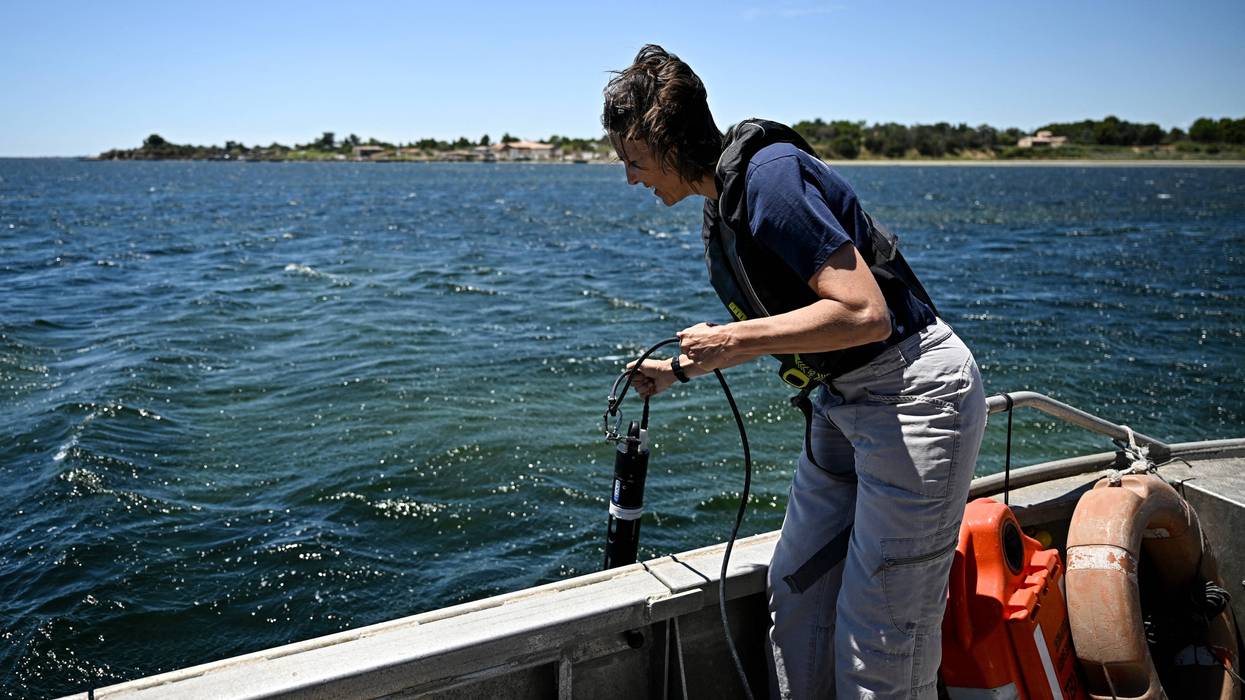
A climate scientists weighs in on what we can and can't expect from an El Niño supercharged by the climate crisis.
On Saturday August 22, the world’s ocean surface temperature was the hottest it’s ever been recorded—just a fraction under 70°F. As the ocean continues warming, I and Vicki Nichols Goldstein of the Inland Ocean Coalition interviewed weather and climate scientist Daniel Swain who is affiliated with the University of California’s California Institute for Water Resources and the National Science Foundation’s National Center for Atmospheric Research. We spoke with him on our Rising Tide Ocean Podcast. Here is an excerpted version of that conversation:
David Helvarg: Before we get into our rapidly heating ocean and its impacts onshore and off, give us some background.
Daniel Swain: I started out as a weather geek, even as a kid. When I went to UC Davis for an undergraduate degree in atmospheric science, I thought I might become a federal meteorologist with the National Weather Service. But at some point, I realized that some of the really big questions, both intellectually interesting and societally important, were at this weather-climate interface. We can predict the weather really well, but the climate is changing. What does that mean for the weather?
So, I came into climate from the weather side—day-to-day weather changes and operational forecasting. I still get to wear that weather-geek hat pretty regularly, even though today I would call myself a climate scientist. I exist at that boundary between weather and climate, which of course is not very distinct to begin with. It’s all the same fluid atmosphere and the same fluid ocean, just different densities.
If funding becomes dependent on whether a research topic aligns with the political priorities of whoever happens to be president, that fundamentally changes the scientific enterprise. It is difficult to overstate how destructive and dangerous that could be.
I’ve been known to call the ocean, “the atmosphere, but upside down and wet.” That comes from an Earth-system perspective. The atmosphere, ocean, biosphere, and cryosphere (frozen water) aren’t really distinct elements. That becomes more obvious with each passing decade as we try to predict and model these different Earth systems and discover we can’t do it very well unless we connect them. We can’t predict the atmosphere very well unless we connect it to the ocean, and vice versa.
Helvarg: So, let’s start at that large scale. People don’t necessarily think of the ocean as a driver of climate and weather, even though it covers more than 70% of the planet.
Swain: Exactly. We live on a water planet even though we don’t really think of it that way. Fundamentally, that is what Earth is. The fact that more than 70% of the planet is covered by water means that long-term variations in the atmosphere are largely driven by what’s happening in the ocean.
Climate change, as we think about it, is actually, to a first order, ocean warming. The majority of the accumulated heat is going into the oceans. Then it affects the atmosphere as some of that heat comes back out of the ocean and comes back to bite us on land. One way to think about global warming is that it is primarily a tremendous amount of extra energy accumulating in the oceans and then spilling over into the remaining third of the Earth that isn’t ocean covered.
Vicki Nichols Goldstein: We know that about 90% of the excess heat is being stored in the ocean. Why can the ocean absorb so much heat compared to land?
Swain: First, because most of the planet is ocean. If you’re warming the whole sphere, most of that warming is going to involve the ocean simply because that’s most of the planet. But there’s more to it. Water has an enormous specific heat capacity. It can absorb an incredible amount of energy compared to an equivalent mass of soil or rock. It can also absorb that energy over a very deep layer.
On land, we talk about geology over millions of years—mountains building and collapsing, continents colliding and diverging. But over a few decades, that’s not happening to a meaningful degree. The ocean moves much more rapidly. An individual water molecule at the surface can end up in the atmosphere through evaporation or thousands of feet down in the deep ocean within a couple of years. The ocean is therefore very good at transferring energy from the surface to the depths.
It’s not just that the ocean covers 70+% of the planet and absorbs a lot of the increased warmth at the surface. Through vertical circulation and currents, it transfers some of that heat downward and redistributes it across the planet—longitudinally, latitudinally, and vertically.
The atmosphere overturns very quickly. A cumulus cloud can go from your house up to 20,000 feet in 20 minutes during a thunderstorm. The ocean takes longer, but significant movement can still occur over weeks, months, and years. On land, comparable movement can take millennia to millions of years. That’s why the ocean and atmosphere are tightly coupled. They interact causally, bidirectionally, and continuously.
Helvarg: People also have a hard time grasping how rapidly this change has occurred. Since we began burning fossil fuels just a few centuries ago, we’ve been changing the physical nature of the ocean—its temperature, chemistry, circulation, even its color. What does increasing ocean heat mean in terms of marine heatwaves?
Swain: Marine heatwaves really just mean anomalously warm ocean temperatures. Usually, we’re talking about the surface ocean because that’s what we can observe most readily and where these heatwaves are often most pronounced. We’re seeing them emerge with much greater frequency, intensity, and spatial connectedness, year after year and decade after decade. Unfortunately, I don’t see that stopping.
We’re going to see continued acceleration in marine heatwaves for as long as planetary warming continues. And marine heatwaves can have a lot of staying power because the oceans evolve more slowly than the atmosphere. You get a blob of unusually warm water and, except under unusual circumstances, you can’t just blow it away with a strong wind the way you might end a heatwave over land. A large marine heatwave can take days, weeks, or months to dissipate because there’s so much thermal inertia in the ocean.
Ironically, that persistence is also part of why the ocean helps us predict the atmosphere. The ocean varies more slowly. It has more “memory,” and therefore its variations can exert a persistent influence on the atmosphere. At a fundamental level, as the air warms, the ocean beneath it is going to warm too—although it will warm more in some places than others because of ocean currents, circulation, and atmospheric conditions.
Goldstein: We hear a lot about La Niña and El Niño. What is actually happening during that transition?
Swain: El Niño and La Niña are parts of a broader pattern of natural ocean variability called the El Niño-Southern Oscillation, or ENSO.
El Niño is the warm phase. La Niña is the cool phase. Essentially, we’re talking about whether the eastern tropical Pacific, particularly the ocean off Peru and South America, is warmer or cooler than usual. That’s a region where there’s normally a lot of coastal upwelling, with cold water moving vertically upward from the deeper ocean. Despite being in the tropics, this keeps coastal temperatures relatively moderate.
During El Niño, that cold-water upwelling weakens as warm water from the western Pacific literally sloshes eastward, sometimes thousands of miles. The prevailing easterly winds that help drive the upwelling can also weaken or even reverse. When the eastern tropical Pacific warms substantially, that is fundamentally El Niño.
But the reason it matters globally is that ENSO performs something like a thermostat function in the global climate system. During La Niña, heat gets stored below the surface in the tropical Pacific. During El Niño, some of that accumulated heat is released from the ocean into the tropical atmosphere, where it spreads through the rest of the climate system.
Swain: Because El Niño unleashes stored energy from the tropical ocean, it increases the global average temperature. And in a warming world, when you put a big El Niño on top of long-term global warming, you increase the likelihood of new global temperature records. It also accelerates the hydrologic cycle.
The warmer the air, the greater the potential swings between extreme wet and extreme dry. Warmer air can hold more water vapor. It doesn’t necessarily do so everywhere, but it raises the ceiling on how much moisture can be present. That raises the ceiling on extreme precipitation events, but also on extreme drought and wildfire conditions in different places and at different times. Some parts of the world see increased flood risk during El Niño. Other places see increased drought risk. El Niño shifts weather patterns while global warming increases the potential magnitude of whatever those patterns produce.
Helvarg: Here on the West Coast, my experience with El Niño has generally meant more storminess. How strong is that relationship?
Swain: El Niño in general exerts a meaningful but sometimes hard-to-pinpoint influence on California because it’s just one of many relevant factors. But with a very strong El Niño, I think it’s a different story.
This is a message I’ve tried to communicate to people in emergency management and policy. Recent El Niño events haven’t always produced the canonical effects people expected. The 2015-16 El Niño, for example, was one of the strongest ever observed in the tropical Pacific, but we did not see extremely strong impacts in California. Some people took that to mean, “Well, what does El Niño really mean anyway?” My answer is: not much if it’s weak. But if it’s strong or very strong, it should significantly tilt the odds.
It can mean a significantly warmer California nearshore ocean. It can mean temporarily elevated local sea levels, increasing the risk of coastal flooding and marine heatwave impacts. And in winter it can significantly increase the odds of a wetter-than-average California winter, potentially even a very wet winter with increased flood risk.
But if you asked me for one single predictor in the global climate system that could provide three to six months’ advance notice of the potential for a very wet California winter, it would be a very strong El Niño.
Goldstein: What does that mean for mountain snowpack in California and across the West?
Swain: This is where things get tricky because precipitation means different things in a warming world. You can have a winter that isn’t particularly dry and still have very low snowpack because it’s simply too warm. Some places can actually be wetter than average and still have unusually low snowpack. So, a strong El Niño may increase precipitation in California, including the Sierra Nevada, and could bring needed water to parts of the Colorado River Basin.
But more precipitation doesn’t necessarily mean more snow (if it rains). We may see above-average precipitation in some mountainous regions while still seeing below-average snowpack. That can help alleviate drought, but it’s a very different picture from a cold, snowy winter.
Helvarg: Jumping from the Pacific to that other still-significant ocean, the Atlantic: Strong El Niño events are supposed to suppress Atlantic hurricanes. Is that right? And why?
Swain: This is a good example of global warming and El Niño pushing in different directions. El Niño usually decreases Atlantic hurricane activity, mainly because of its effect on vertical wind shear rather than temperature. Tropical cyclones don’t like strong winds at upper levels of the atmosphere because those winds can literally decapitate storms—shear them apart. El Niño tends to increase wind shear in the Atlantic hurricane development region, making it more difficult for hurricanes to form and strengthen.
But there’s a big asterisk. If you have record-warm waters in places like the Gulf of Mexico, and a storm manages to develop during a brief period when wind shear is low, you can still get an extremely strong hurricane. So, a strong El Niño may suppress the overall hurricane season, while exceptionally warm ocean water can supercharge a storm that does manage to develop.
That’s a good example of natural variability—El Niño and the Southern Oscillation—interacting with the decidedly unnatural long-term warming trend to produce outcomes we haven’t seen very often before. It’s also why, despite all our advances in prediction and historical data, science still has a lot to learn.
Goldstein: That brings us to science itself. The Trump administration is changing Office of Management and Budget rules in ways that could make federal research funding reflect presidential priorities. How does that affect climate research and communication?
Swain: This goes far beyond weather, climate, and oceans. It affects any domain requiring expert knowledge to make important decisions—from health to public policy to research funding. There has been a lot of focus on research funding, but it’s important to emphasize that this affects everything.
The degree of alarm in academic and research institutions is significant. Changes that politicize the federal grant system could make us vastly less able to understand how the world works and prepare for future contingencies—whether storms, floods, pandemics, or geopolitical disturbances. It also becomes much harder for people in science to remain nonpartisan and simply focus on their research.
If funding becomes dependent on whether a research topic aligns with the political priorities of whoever happens to be president, that fundamentally changes the scientific enterprise. It is difficult to overstate how destructive and dangerous that could be.
Goldstein: That’s why people have to follow these issues, raise their voices, and try to hold the line.
Helvarg: Democracy doesn’t guarantee that we’ll be good ocean stewards or base public policy on sound science. But without democratic means, it becomes far harder to move forward on existential challenges like climate change and ocean protection.
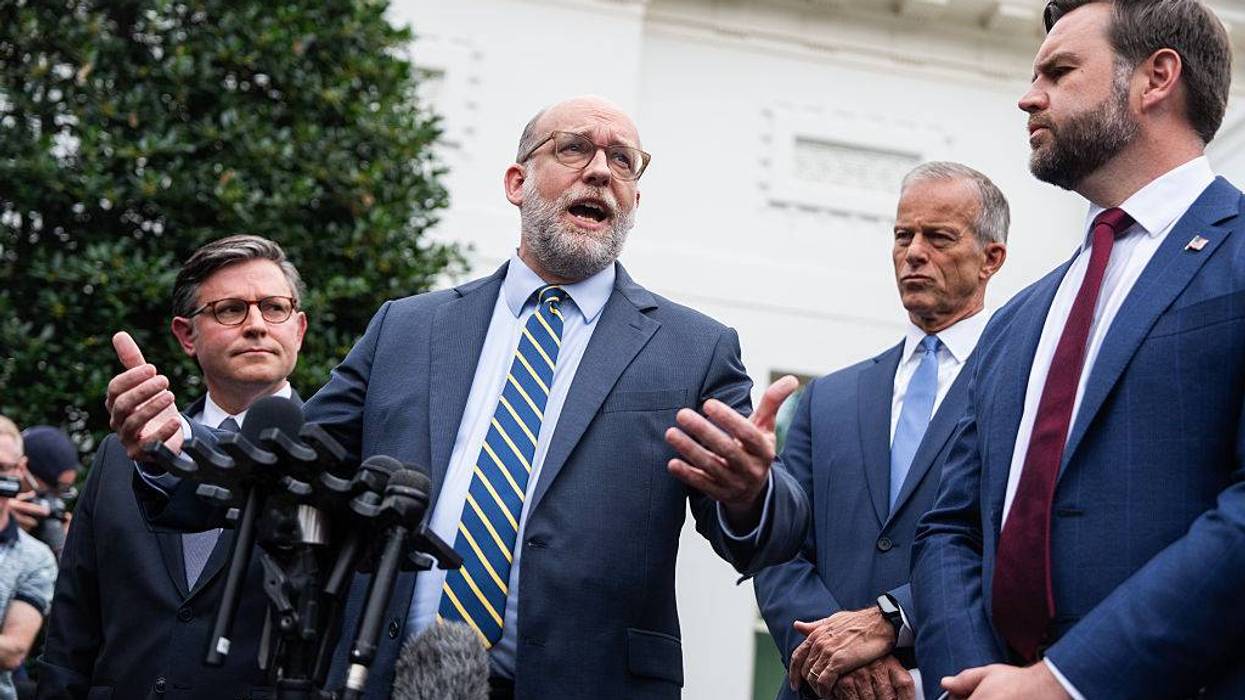
"The test will be a simple one: Are you sufficiently loyal to the president? If the answer is no, it will result in the denial of lifesaving disaster relief, funding for research into cures, the closure of Head Start offices, and more."
A Trump White House plan to give political appointees more power over federal grant money has sparked alarm among scientists, public health organizations, environmental groups, and others who fear that the proposal amounts to an attempt to subordinate critical funds to the whims of the president and his far-right allies.
More than 300 organizations signed a joint letter on Friday calling on White House budget director Russell Vought, the proposed rule's architect, to extend the public comment period that's set to end on July 13, warning that the "scope and impact of [the Office of Management and Budget's] rule is vast."
"The rule will impact the entirety of government grant-making across the United States," the groups warned. "OMB itself says the revisions suggested would relate to over $179 billion of funds to small entities."
Politico, which exclusively obtained the letter, noted that the "proposed rule has already garnered over 15,000 public comments, with many expressing alarm that the changes could undermine research across fields."
Under Vought's rule, federal agencies would be required to perform "pre-issuance reviews" of federal grants—funds appropriated by Congress—to ensure their distribution is consistent with "applicable law, federal agency priorities, and the national interest."
The rule lays out a number of standards that political appointees at federal agencies must screen for when deciding whether an organization can receive federal grant dollars. For instance, the rule would prohibit the distribution of federal grants to organizations that "promote anti-American values" or support "ideologies that deny the biological reality of sex or the sex binary in humans."
The New York Times reported that the consequences of Vought's rule "could fall hardest on health and science, a field in which [President Donald Trump] has pursued some of the steepest cuts in his second term."
"In exchange for federal assistance, researchers would face limits on the subjects that they can explore, the foreign labs with which they may collaborate and even the conferences at which they can appear," the Times noted. "Dr. Georges C. Benjamin, the chief executive of the American Public Health Association, a professional organization and advocacy group, said the policy could 'devastate innovation, science, and research' in the United States."
"This is an executive power grab that would hand presidential political appointees unchecked control over more than a trillion dollars that Congress appropriated in the interests of all Americans."
Earlier this month, Lawyers for Good Government and the Environmental Protection Network said that "if finalized, the rule would put senior political appointees in charge of approving and canceling individual grants, while stripping recipients of due process rights" while attaching "ideological conditions to nearly every federal dollar, raising First Amendment and equal-protection concerns."
The two organizations published a fact sheet warning that the proposed rule has the potential to halt billions of dollars in funding that communities across the US depend on for "health, public education, scientific research, public safety, and economic development projects."
“This is an executive power grab that would hand presidential political appointees unchecked control over more than a trillion dollars that Congress appropriated in the interests of all Americans,” said Jillian Blanchard, senior vice president for climate change and environmental justice at Lawyers for Good Government. “Conditioning funding for critical programs on ideology and viewpoint discrimination, while erasing basic due-process protections, violates freedoms of speech, equal protection, and eviscerates Congress’ power of the purse.”
Democratic lawmakers have also sounded the alarm about Vought's proposal. Rep. Rosa DeLauro (D-Conn.), the top Democrat on the House Appropriations Committee, said Thursday that she has given her Republican colleagues two opportunities to denounce Vought's rule—and they declined both times.
"Vought continues to attempt to steal from communities across the country. Now, he is trying to set a new political test on grants for a wide swath of the federal government," said DeLauro. "The test will be a simple one: Are you sufficiently loyal to the president? If the answer is no, it will result in the denial of lifesaving disaster relief, funding for research into cures, the closure of Head Start offices, and more. If you are not loyal enough, if you speak out against this administration, the president and his cronies will take away resources Congress provided."
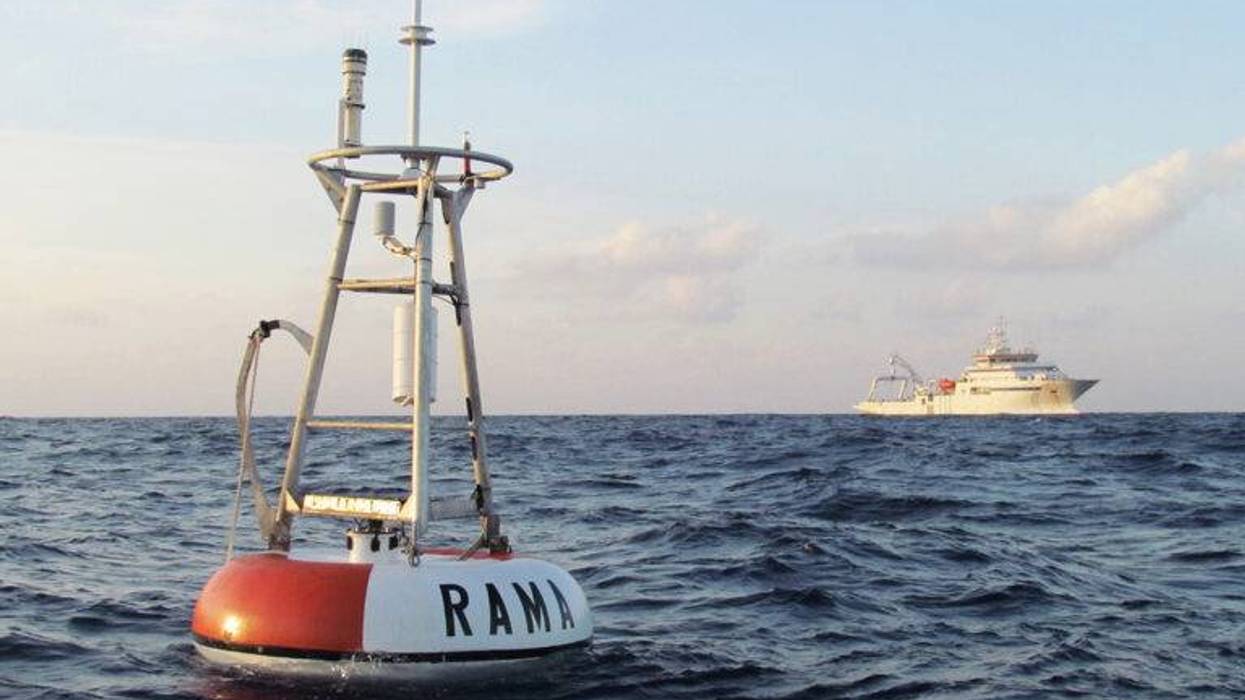
At a time when ocean heat, the slowing of the Gulf Stream, and other major changes are sending shock waves through scientific and decision-making circles, we need greater understanding of what we’re facing, not self-imposed blind spots.
It’s easy for us land dwellers to forget that we live on a water planet, more than 70% of it covered by a vast ocean. But we are entering an age—or more accurately, have created an age—when that fact will be impossible to ignore. With global climate change, the seas are rising, yes, but they are also warming, slowly but steadily, and that warmth is now reaching levels that can drive profound changes here on land. Many of those changes have begun, many are on display this year, and some will have seismic consequences going forward.
Almost as shocking as the scale of these changes are the Trump administration’s efforts to dismantle the very scientific instruments that enable us to understand them. We’ll get there. But first, a little immersion into our water planet to better understand what it means to overheat it and force the ocean to compensate.
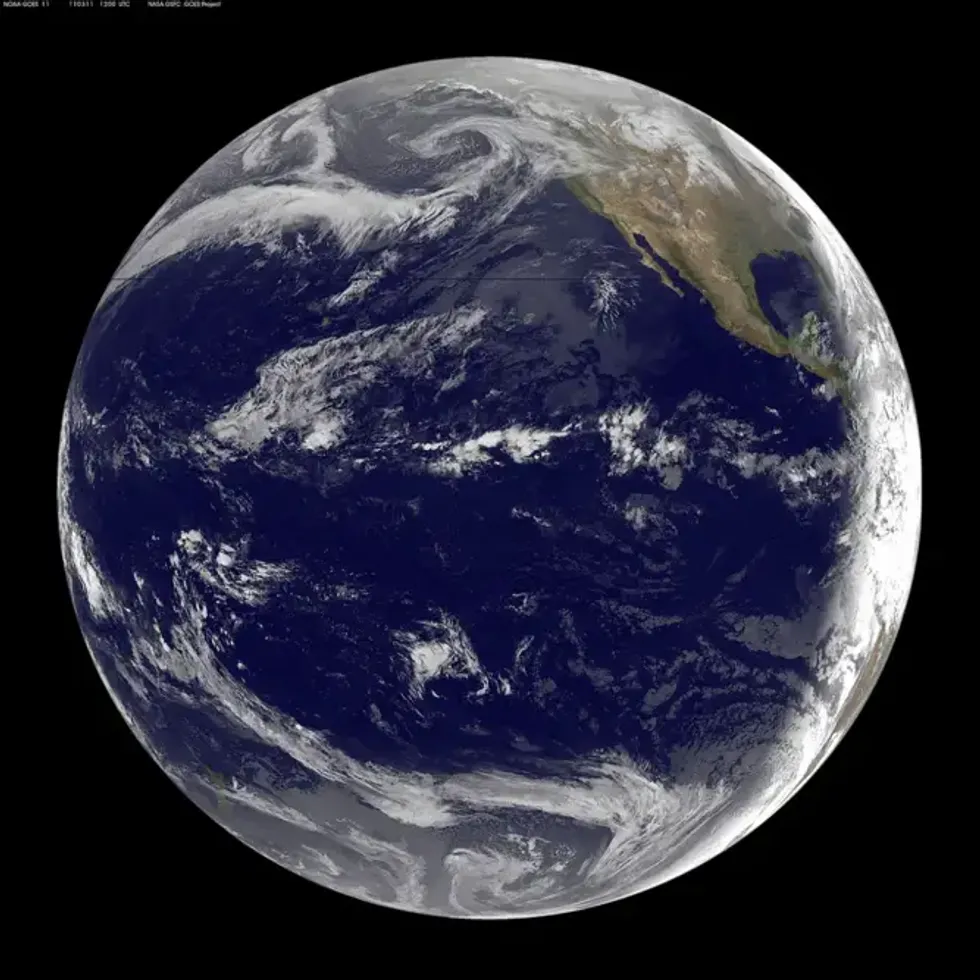 A more representative, less terra-centric view of our 70% water planet. (Photo by NOAA/NASA GOES via Smithsonian)
A quick refresher on Earth’s ocean. I mean, where did it even come from, all this water?
After Earth’s molten formation 4.6 billion years ago, the planet gradually cooled below the boiling point of water and, fueled by steam released from volcanoes, it rained for thousands of years, filling the low-lying surface of the planet. An era of bombardment by icy asteroids provided a huge additional volume of water. And voila, a water planet was born, almost entirely covered by one massive ocean. Tectonic activity eventually produced large land masses and, over time, both plate movement and global temperature fluctuations have greatly changed the shape of the ocean—and the land, our default perspective—e.g., tying more or less water up in ice. But with the exception of a couple of global ice ages, the liquid ocean has always dominated Earth’s surface. We’ve almost always been a “blue planet,” and always a water planet.
This water was the birthplace of life on Earth. Indeed, water is considered the birthplace of carbon-based life anywhere, which is why scientists search for it in other solar systems. It took at least 500 million years for the first life to form in the ocean (~4.1 billion years ago), and once it did, life remained simple and aquatic for the vast majority of Earth’s history. It took fungi, plants, and especially animals big evolutionary leaps to venture out of the ocean (and much of it did not; today, nearly 80% of Earth’s animal life, measured in biomass, lives in the oceans), first to the tidal zone, then the coasts, and even today, with terrestrial life spanning most dry land, the ocean continues to exert tremendous influence on that life. It does this through a range of mechanisms. Chief among them, our ocean plays the dominant role in managing the Earth’s heat and making large regions of the planet habitable.
The ocean has spared us land dwellers from the true ~36°C consequences of our fossil-fuel burning actions. And we can’t tackle 1.5°C?
A core way the ocean does this is by absorbing solar radiation at tropical latitudes and distributing that heat via vast ocean currents to cooler parts of the world. These currents then distribute water that has cooled at the poles back toward the equator. Without this mechanism, the heat that makes life possible even in the otherwise frigid latitudes would remain concentrated around an intolerably hot equator. In this sense, the oceans are a great regulator of the global climate, tamping down extremes and supporting Goldilocks-style just-right regional climates around the world.
The oceans are also the primary source of moisture and precipitation—basically, weather—to land. As the sun heats ocean surface water, it evaporates, creating humid air that is transported by forces like winds and the Earth’s rotation, delivering precipitation, the water that makes terrestrial life possible.
So, if the role of the ocean in managing Earth’s temperature is fundamental to life on Earth, what happens when we overheat it?
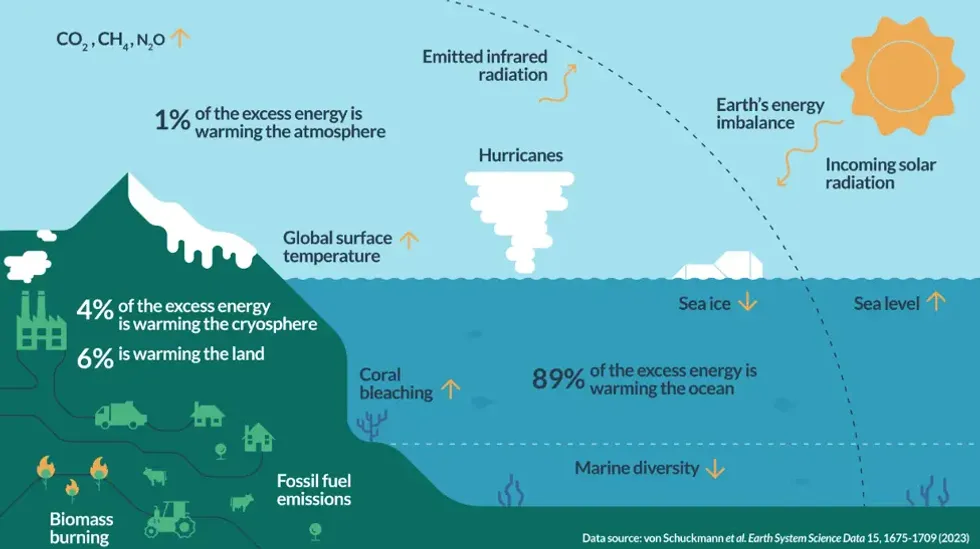 A depiction of how the Earth has dealt with the energy imbalance created mainly by burning fossil fuels and adding heat-trapping molecules to the atmosphere. The oceans have spared us the true brunt of global warming, storing 91% of excess heat, up from 89% when this visual was created three years ago.(Graphic by Copernicus)
The ocean is estimated to have absorbed 91% of the excess heat, caused mainly by the burning of fossil fuels, that has been trapped in the Earth’s atmosphere. This heat storage is possible because of the ocean’s specific heat capacity—i.e., water takes a lot more energy to warm than land or air. Direct absorption of sunlight, the main way the ocean absorbs heat, depends on the level of albedo present, where darker surfaces, like the ocean surface, absorb more of the sun’s energy than light surfaces, like polar ice caps, which reflect it back to space. But other mechanisms, like heat exchange with the atmosphere, warm the ocean, too.
Without that excess-heat absorption and storage in recent decades, life on land would have been thrown into chaos (at best) by skyrocketing temperatures by now. According to one study, the heat taken up by the upper layer of the ocean between 1955 and 2010 was enough to warm the atmosphere by a jaw-dropping 36°C. This massive, climate-mediating role of the ocean puts our thus-far unsuccessful human efforts to keep warming to 1.5 or 2°C in sharp relief. That is, the ocean has spared us land dwellers from the true ~36°C consequences of our fossil-fuel burning actions. And we can’t tackle 1.5°C?
The vastness of the ocean means it requires tremendous inputs to respond. But the excess heat that carbon emissions have trapped since the start of the Industrial Revolution is one such tremendous input. Major recent research captures the scale in this way, according to one of a new study’s 50 authors, John Abraham: the heat absorbed by the ocean in 2025 alone is “like 12 Hiroshima bombs being detonated each second, for every minute, hour, and day for the entire year.”
The absorption of that heat means that the average temperature of the oceans has been steadily rising, and now those temperatures are reaching levels that fuel impacts, including on land, that we will be unable to ignore.
Overall, the ocean has broken average temperature records every year for the past nine years. Temperatures have increased most at the surface, where sea surface temperatures have warmed roughly 0.8°C between 1901 and 2020, and recently broke new monthly high records for thirteen consecutive months, starting in mid-2023. But deeper layers are warming, too. The chart below shows ocean heat content at different depths. And while slow ocean circulation constrains the movement of heat to great depths, ~20% of total warming is occurring below 700 meters.
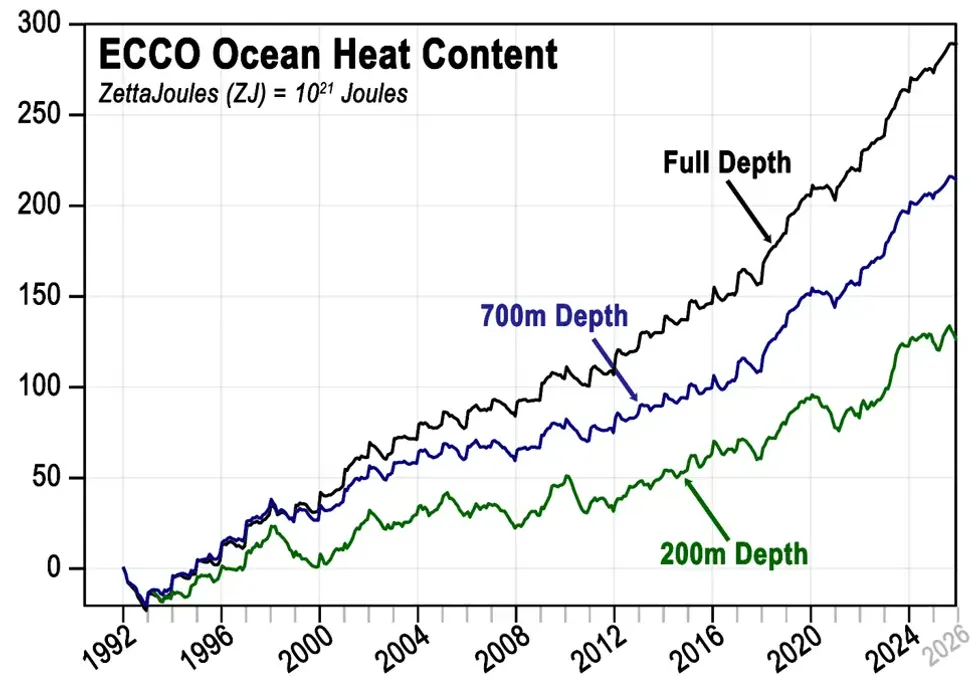 (Credit: ECCO https://ecco-group.org/ohc.htm)
The NOAA sea surface temperature (SST) data in the chart below shows 2026 SSTs rising to rival the record-breaking levels of 2024. This is influenced by the formation of a Super El Niño. Outlooks point toward new record high ocean temperatures this year, potentially creating the new hottest year on record for Earth in 2027.
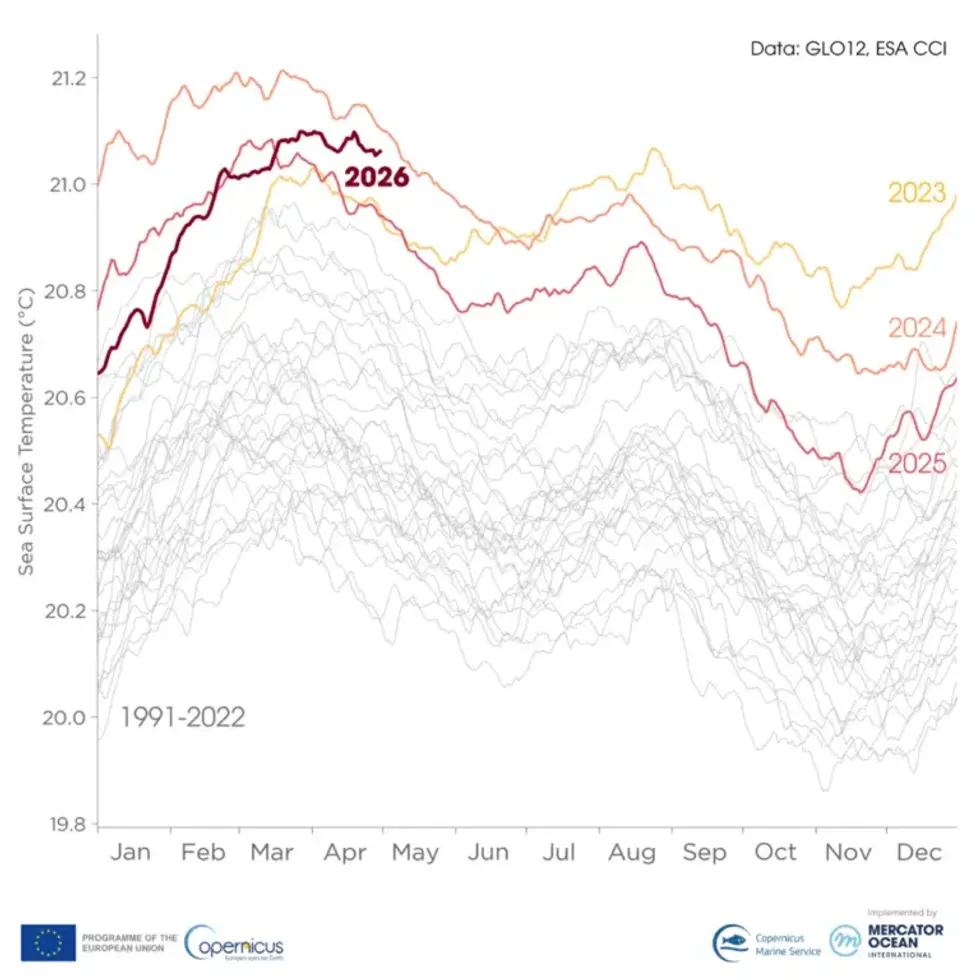 2026 sea surface temperatures are now rivaling those of 2024, the warmest year on record. (Graphic by Copernicus)
Climate change is the clear driver here. Thanks to tools like Climate Central’s Climate Shift Index (CSI), we can now see the role of climate change in daily sea surface temperatures, and thus in marine heatwaves and other anomalies. According to the CSI, this week, both the notable heat in the Indian Ocean and that in the Equatorial Pacific (where the El Niño is forming) are made substantially more likely due to climate change.
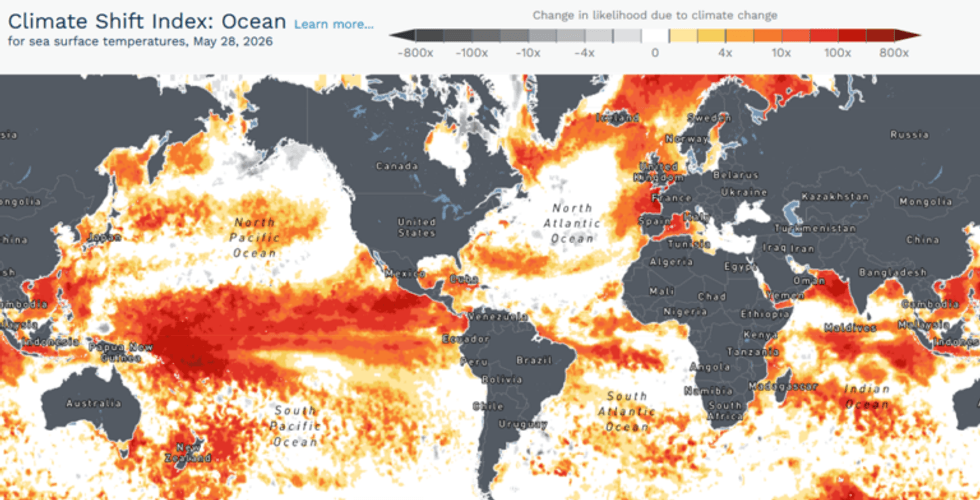 The role of climate change in driving warm ocean surface temperatures. (Graphic by Climate Central)
These temperatures are now manifesting in impacts around the world and pointing toward accelerating change. In follow up blogs, we will unpack these symptoms in some detail, but to name significant ones:
Warmer water hastens the melting of “ocean-terminating” ice sheets (i.e., land-based ice connected to the ocean), contributing to sea-level rise; creates a warming feedback loop by shrinking sea ice and increasing the ocean-warming albedo affect; enhances ocean stratification, where warmer surface and cooler deep waters fail to mix and redistribute heat; this in turn can drive hypoxic conditions, starving deeper waters of oxygen; can slow major ocean currents (thermohaline circulation), which are driven by changes in density, in turn driven by water temperature and salinity; and can super-charge storm systems, from tropical cyclones to Nor’easters, causing stronger and more rapidly accelerating storms.
We have created an era of ocean heat consequences and now we must figure out how to live in it, even as we work to correct it.
Then there is the acute heat that manifests in marine heatwaves, a condition that is now chronic and widespread in oceans around the world. In 2023, an estimated 96% of the ocean by area experienced a marine heatwave. The most significant heatwaves (all recent) have disrupted marine food webs and caused major ecological harm, resulting in widespread, prolonged coral reef bleaching, large-scale wildlife deaths, and damaged commercial fisheries.
Given the ocean’s significant role in driving or influencing vastly-consequential terrestrial climate patterns, like the Asian Monsoon, ocean overheating has implications for the human systems that are attuned to those patterns, from water supply, to agriculture and food security, energy production, and more. We’ll be tracking ocean temperatures, reporting on developments, and digging into these implications in subsequent blogs.
The tremendous capacity of the ocean to store away heat meant that the consequences of warming our planet were slower to be made visible. It now means that an enormous amount of excess heat energy now exists in the oceans, to be gradually released to other Earth systems in forms like direct heat to the atmosphere (as we see in El Nino years), melting of ice, and the supply of sea-surface heat that fuels tropical cyclones, to name a few.
It also means that releasing of that heat, slowing ocean warming, and eventually cooling the ocean cannot be accomplished on practical human timescales, but rather in hundreds to thousands of years. We have created an era of ocean heat consequences and now we must figure out how to live in it, even as we work to correct it.
An essential requirement for meeting the era of ocean heat is better understanding how our oceans and climate are changing, and for this, we have global ocean and climate monitoring infrastructure. Here in the US, the Trump administration is attempting—through staff cuts, budget cuts, eliminating data and information (e.g., datasets and websites taken down), and dismantling our monitoring infrastructure—to make ocean, land, and atmospheric change harder to see.
It’s hard to think of a more monumental failure than overheating an ocean planet and handing it off to younger generations.
Most recently, the administration ordered the “descoping” of the National Science Foundation’s Ocean Observing Infrastructure Project, a system of sensing and data gathering infrastructure distributed in the North Atlantic and Pacific. Information is still sparse about this dismantling; the process is not transparent. What’s clear is that, at a time when ocean heat, the slowing of the Gulf Stream, and other major changes are sending shock waves through scientific and decision-making circles, we need greater understanding of what we’re facing, not self-imposed blind spots. Sending taxpayer-funded ships on taxpayer-funded missions to essentially unplug functional taxpayer-funded ocean monitoring systems is baffling. Given the fossil fuel industry’s influence on the Trump agenda, it could look like a massive attempted cover up, except that the crime—warming the planet—is ongoing, and there’s really no covering up the changing climate, because we live here.
The ocean has become easy for the wealthier people of the world to ignore: a place to extract resources and dump waste. But this titan is now rumbling into a new kind of activation, more central character than backdrop. It’s hard to think of a more monumental failure than overheating an ocean planet and handing it off to younger generations. History won’t look kindly on the leaders of this time who ignore the science and the obvious signals. May it reflect that they were forced by their people, in time frames that made a difference, to phase out fossil fuels and invest in a safe and just climate future for all on this rare water planet.
"Blinding the public to climate change won’t make it go away. It will only accelerate its profound consequences."
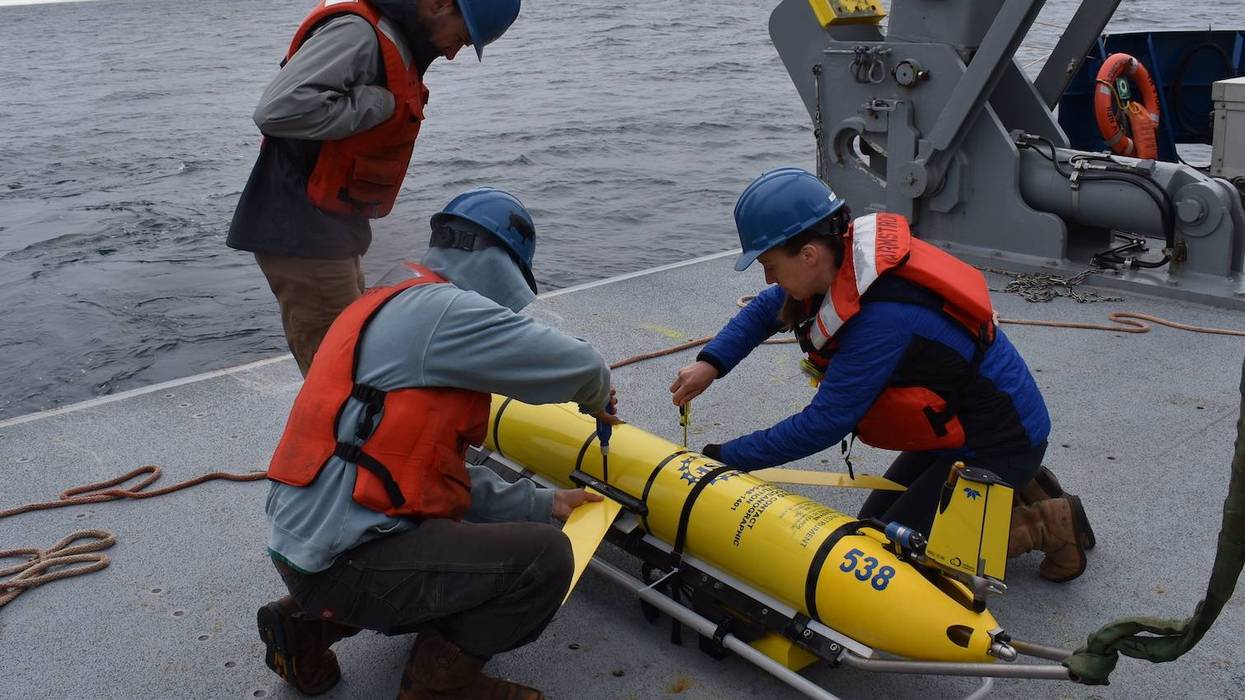
In what a number of scientists suggested was the Trump administration's latest effort to stop tracking the changing climate in hopes of convincing the public that the climate emergency isn't happening, the National Science Foundation announced Monday that it was dismantling a crucial deep-ocean monitoring system that for years has helped researchers understand the impacts of the crisis on the world's oceans.
The NSF said it plans to send ships this month to remove more than 900 instruments, part of a project called the Ocean Observatories Initiative. The project collects data on temperatures, currents, and the ocean's absorption of carbon dioxide off the coasts of Oregon, Alaska, Washington, and North Carolina, as well as in the Irminger Sea between Iceland and Greenland.
A spokesperson for NSF told The New York Times that the dismantling of the initiative will help the NSF in "prioritizing support for evolving scientific priorities and emerging technologies as well as a deliberate approach to smart life cycle management within its portfolio of research infrastructure.”
The reasoning given for the shuttering of the project, said Tara Blume, a journalist at Oklahoma City NBC affiliate KFOR, was "a master class in obfuscation and doublespeak."
Genevieve Guenther of the group End Climate Silence shared her own interpretation of why the $368 million ocean observation system is being discontinued, despite the fact that it had been set to collect data for 25 years.
"We need to track ocean currents to assess how close we are to climate tipping points that will essentially destroy the world as we know it," said Guenther. "The GOP doesn't want us to be able to do that. That's why they're dismantling ocean monitoring."
Scientists have used data gathered by moorings, robotic vehicles, and other instruments that transmit the information to research laboratories, to study changes in the Atlantic Meridional Overturning Current (AMOC), a current system that moves warm water northward and cools the Arctic and Northern Atlantic regions while absorbing carbon dioxide deep into the ocean and keeping it out of the atmosphere.
Data gathered at the observation station in the Irminger Sea has been key to understanding AMOC, which scientists fear is gradually weakening due to planetary heating and could ultimately collapse, likely causing major global weather changes.
"This is absolutely crazy," said David Doniger, a senior strategist and attorney at the Natural Resources Defense Council's climate and energy department. "Wouldn’t you want to know if the ocean currents are changing? Wouldn’t you want to know ocean temperatures? These things affect everything from fishing to hurricanes."
Following the announcement that the stations will be dismantled in the coming weeks, said Blume, "science gasps for breath."
President Donald Trump has attempted several times to shut down or drastically reduce the budget of the Ocean Observatories Initiative, which costs $48 million annually to run. Congress has restored the program's funding.
The dismantling of the program comes months after the Environmental Protection Agency repealed the "endangerment finding," which for years had underpinned the department's environmental regulations; after the administration closed down the National Center for Atmospheric Research, which had gathered data on hurricanes and extreme weather to help improve forecasts; and after the National Aeronautics and Space Administration released a statement on record-breaking temperatures in 2024 and 2025—without any mention of the climate crisis or climate change.
"Blinding the public to climate change won’t make it go away. It will only accelerate its profound consequences," said clinical researcher Iris Gorfinkel.
According to the Trump administration, said historian Nick Kapur, "apparently climate change doesn't exist if you prevent scientists from measuring it."
Can the rest of us organize a powerful, humane alternative to Donald Trump's politics of hatred and division that could transform this country and the world?
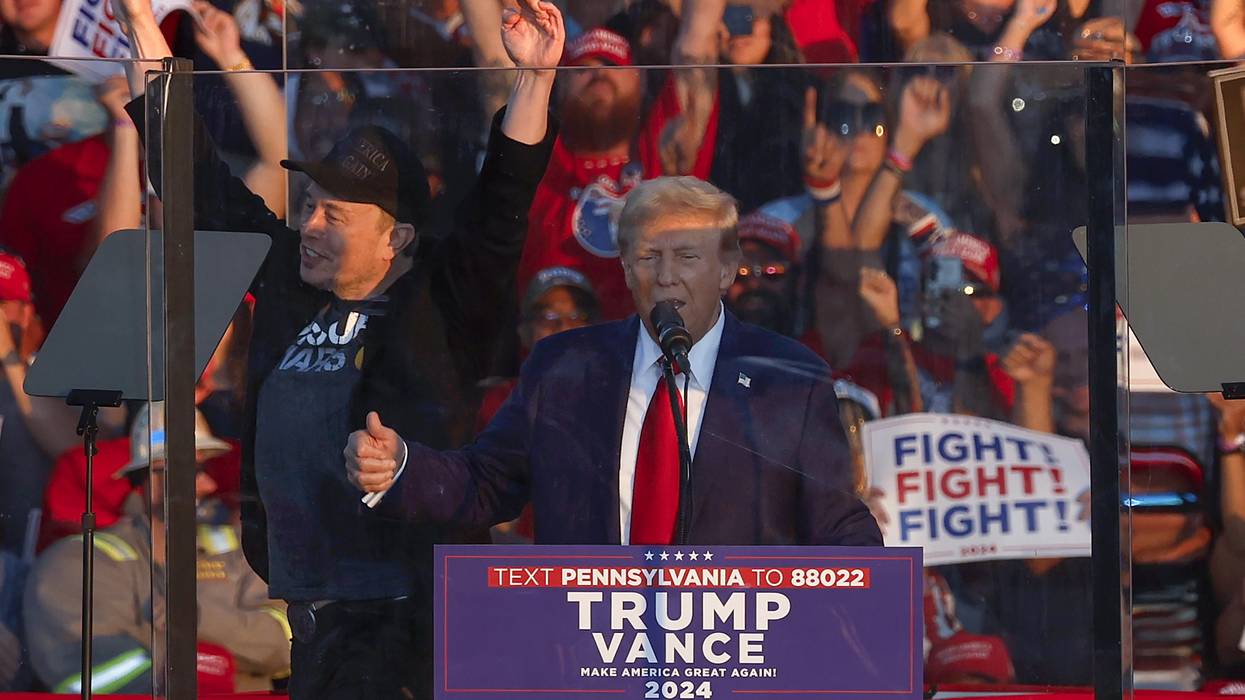
Donald Trump’s America is a scary place in significant part thanks to an unholy alliance of MAGA devotees who don’t believe in science and see intellectuals as public enemy number one, and a gaggle of Silicon Valley militarists who think that they’re the smartest people in the room, if not the universe. Add in white Christian nationalists who abuse religious precepts to sow hatred and division and you have the foundations of the political base that elected Donald Trump (twice!). And worse yet, those groupings are likely to be with us long after our current president has gone off to that great cheeseburger stand in the sky.
Still, it’s worth reflecting on whether such an odd coalition of allies can survive without Donald Trump, or even with a president whose policies have become so harmful and irrational that they’re doing severe human and economic damage even to his most loyal supporters (not to mention the rest of us). And it’s also worth considering whether the pillars of the MAGA movement can manage to stick together in the ever-grimmer Trumpian years to come, not to speak of the post-Trumpian ones, or whether the rest of us can organize a powerful, humane alternative to his politics of hatred and division that could transform this country and the world.
As a start, we have the latter-day “Know Nothings,” a term borrowed from a 19th century political movement. It’s not that members of that group literally know nothing. Some of them are quite skilled in their given professions and astute at assessing certain kinds of situations. Some are intelligent but woefully misguided. Trump supporter and former Secretary of Housing and Urban Development Ben Carson, for example, is a brain surgeon.
Members of the anti-science crowd are also often very good at communicating their messages, however wrongheaded or offensive they may be. The problem isn’t that they can’t take in information; it’s that they are distinctly anti-knowledge when it comes to, among other things, separating compelling conspiracy theories from well-documented facts.
Rather than DEI programs that stop at raising tough questions about America’s long history of systematic discrimination, what’s needed are programs that truly change people’s lives by creating better-paying jobs and affordable, quality healthcare for all.
The results of their ingrained antagonism toward basic knowledge are profound, making them a threat to public health and democratic practices. After all, we now live in a country where millions of people are against vaccinating their children to prevent potentially deadly diseases and don’t believe that perhaps the gravest threat to continuing life on this planet—climate change—is caused, or even influenced, by human activity or perhaps is even happening at all.
The dangerous delusions of Trump Secretary of Health Robert F. Kennedy, Jr., now have the stamp of government approval and the power of the US government behind them. There is no way to estimate how many people have already fallen sick or even died unnecessarily due to the implementation of his crackpot theories, but the numbers will undoubtedly be significant. The American Public Health Association captured the grim mood of our moment perfectly in an April 2025 press release entitled “Secretary Kennedy and His Policies Are a Danger to the Public Health.”
On a different spiritual plane, tens of millions of Americans believe in the rapture—the notion that they and their kind will be called up to heaven in the end days, while the rest of us will be left behind, presumably to burn in hell (but not a climate-change version of the same). A 2022 Pew poll found that 39% of Americans believe “we are in the end times.” Already! And such a belief, of course, has an impact on how or even whether one wants to devote time and energy to fixing problems here on Earth.
Such an amalgam of opponents of science and skeptics about basic reality bears a distinct resemblance to the “Know Nothing” movement of the 19th century that thrived on anti-immigrant sentiments and half-baked conspiracy theories.
The anti-intellectual faction on the right has been propagandized for decades to believe that the biggest obstacle to a better life for them and their families isn’t the predatory corporations hollowing out our economy and manipulating our democracy, but a group of liberal intellectuals clustered on both coasts who allegedly want to replace this country’s bedrock beliefs with a set of “politically correct” prescriptions about how they should live their lives, especially when it comes to DEI or diversity, equity, and inclusion. In such a rendering of reality, that “new class” is seen as sapping the country’s strength and undermining the basic values that would make America great (again!).
The use of that “new class” as a political epithet emerged from the neoconservative movement of the 1960s and 1970s, as Andrew Hartman has explained at his blog on American intellectual history:
Out of their political repositioning in the late 1960s and 1970s, neoconservatives developed a critical theory (co-opted from anti-Stalinist thinking) about a so-called "new class" of intellectuals, broadly defined to include all professionals tasked with manipulating language—although more narrowly applied to humanists and social scientists. Members of this "new class," so the theory went, had turned their backs on the society to which they owed their high-ranking status.
However, the current Trumpian war on DEI should be considered an extension of a longstanding conservative effort to distract Americans from the real sources of their problems by promoting a politics of division and hatred. Mainstream accounts of the drive to eradicate concerns about diversity, equity, and inclusion from public life rarely point out that fighting DEI can fairly be characterized as fighting to make racism, misogyny, and anti-gay and anti-trans discrimination ever more acceptable in the sort of open, unapologetic fashion that prevailed before the modern-day civil rights, women’s rights, and gay rights movements gained strength.
The crusade—and it’s nothing less than that—against DEI needs to be called out for what it is, not treated as some sort of skirmish over language. And rather than DEI programs that stop at raising tough questions about America’s long history of systematic discrimination, what’s needed are programs that truly change people’s lives by creating better-paying jobs and affordable, quality healthcare for all, regardless of race, gender, class status, or faith. Getting there will, however, require a flowering of faith of another kind—not religious faith, but faith that we can construct an accountable government that serves the public interest, rather than, as in the present age of Donald Trump, the interests of corporations and inhumane ideologues.
In contrast to the “know nothing” faction of the political right in America is the “know it all” faction—Silicon Valley billionaires like Peter Thiel, Alex Karp, Elon Musk, and Palmer Luckey. They view themselves not just as business executives cashing in on the latest trend, but as superior beings who should be running the planet. They promise better living through technology and, as new age militarists, see robotic weapons as the future of warfare. But the idea that such new technologies will inevitably change our lives for the better or protect us from the worst has, at best, a mixed record. It depends, of course, on just who is using such technologies and for what purpose.
In addition to owning companies that create new systems grounded in artificial intelligence and machine learning, the new age militarists are angling to shape our foreign policy, our federal budget, and the future of our democracy. They literally want to become masters of the universe by figuring out how to live forever and promote the colonization of space. They dream of video games in which, as Palmer Luckey put it, “If you die in the game, you die in real life.”
To say that Thiel, Musk, Palmer Luckey, Alex Karp, and their financiers like Marc Andreessen of the venture capital firm Andreessen Horowitz have a high opinion of themselves—and of the potential of the technology their companies produce—would distinctly be an understatement.
The political reach of the Silicon Valley crowd has grown dramatically in the age of Donald Trump. JD Vance, his vice president, was, of course, groomed and financed by Peter Thiel, the founder of the omnipresent firm Palantir, which provides technology to patrol the border, helps Immigration and Customs Enforcement identify suspects, and has provided software to Israel that its leaders have used to step up the pace of bombing in their genocidal war in Gaza. After a stint at one of Thiel’s venture capital firms, Vance won a Senate election in Ohio with major financial backing from him and his allies.
When Trump chose Vance as his running mate, champagne corks popped in Silicon Valley and the money started flowing to help Trump get elected, including up to a quarter of a billion dollars in dark money from Elon Musk. As a result, Silicon Valley now has its man in the executive branch.
Nor is Vance alone. Former employees of tech firms like SpaceX and Anduril are now embedded in key agencies of the federal government, and Secretary of—yes!—War Pete Hegseth has gone all in on integrating AI into US military planning and practice to the delight of the billionaire tech moguls and their hangers-on.
To say that Thiel, Musk, Palmer Luckey, Alex Karp, and their financiers like Marc Andreessen of the venture capital firm Andreessen Horowitz have a high opinion of themselves—and of the potential of the technology their companies produce—would distinctly be an understatement.
Kathryn Boyle of Andreessen Horowitz, a self-appointed chief ideologist and cheerleader for the Silicon Valley tech takeover of America, gave a speech to the conservative American Enterprise Institute in February 2025 that analyst Gil Duran described as an effort to “equate most government actions with communist dictatorships… while positioning tech bros as the ordained saviors of the traditional family.” Boyle’s bread and butter argument—call it a potentially fatal kind of narcissism—was that only the “founders” (yes, they call themselves that!) are serious enough, skilled enough, and endowed by their creator with enough persistence to solve and reverse America’s imperial decline. The rest of us should just get out of the way and let the new techno-gods do their work.
The Trump coalition is a strange kaleidoscope of confusing views and contradictory cover stories: the know-nothings; the know-it-alls; the false prophets of white Christian nationalism, the billionaires and millionaires, the people who (once upon a time) watched too many episodes of "The Apprentice" and think Trump is a good businessman; those who want yet another tax break; those men among us who want to control what women do with their bodies, and the (mostly) men who feel liberated because Trump openly and repeatedly makes racist, sexist, anti-gay, and anti-trans statements, legitimizing vocal expressions of prejudice in a way not seen in decades.
Yes, his is a motley crew, but so far they have rallied around the president, no matter the promises he breaks or the harmful policies he jams down all of our throats (policies that could ultimately hit many die-hard Trump supporters who aren’t billionaires as hard or harder than they will hit his opponents). Fortunately, there are at least signs that his ability to thrive politically (even as his policies drive America into a ditch) may be fading. His brutal, illogical, illegal, ill-defined war on Iran—complete with genocidal rhetoric about ending an entire civilization—may be the beginning of the end of his grasp of our politics and our psyche.
Unfortunately, he may be as much a symptom of what’s wrong with America as he is a producer of deep damage to the future prospects of democratic governance and human cooperation in this country and on this planet.
Any resistance to such know-nothingism and incipient technofascism must start on a human scale. If we are ever going to build a tolerant, welcoming nation that meets the basic needs of its residents, while leaving ample room for scientific inquiry and creative endeavors of all sorts, we need to get off our machines and start talking to—and crucially, listening to—each other.
This is already happening more widely than you might imagine if you’re a prisoner of your news feed. And it’s happening not just in large gatherings like the No Kings rallies, but in local organizing around schools and housing, voter registration and education efforts, and attempts to help communities survive the double-injury of runaway capitalism and the shredding of the social safety net thanks, at least in part, to Donald Trump’s “Big Beautiful Bill” (which is the ugliest, most inhumane piece of legislation in living memory).
There are no guarantees in life, but in this disastrous Trumpian universe of ours, fighting the power should feel far more fulfilling than bending the knee.
We need to fight on at least three fronts—economically, politically, and culturally. Sen. Bernie Sanders (I-Vt.) has shown just how a truly populist economic program could draw support even among diehard MAGA backers, and such a program is a necessity if we are ever to dig our way out of our current predicament.
But economics is hardly the only problem we have. There’s also the reality of racism to contend with, not to speak of a thriving anti-immigrant sensibility, and misogyny, as well as anti-gay and anti-trans discrimination—all deeply embedded in a nation that was founded as a colonial enterprise fueled by slavery and genocide. Such a history has to be transcended by embracing the values and elevating the leadership of the people most impacted by the legacy of America’s repressive past, while building a new culture based on tolerance, respect, and (yes!) love for our fellow human beings.
To be clear (as President Barack Obama would often say), by “transcend” I don’t mean ignore. We must fully acknowledge and seriously commit our society to repairing the crimes embedded in our development as a nation, not to speak of those being committed right now in Donald Trump’s America against so many of us and our planet as well.
And sadly, it’s all too obvious that coming together to save this planet and retain our basic humanity will not be easy. People are messy and, frankly, can be a pain to deal with (yours truly included). We are, however, all we have, and making the effort will matter.
I believe in the saying, attributed to leaders of the Wobblies (the radical union founded in 1905 and known formally as the Industrial Workers of the World), that we must sow the seeds of any new society in the shell of the old one. The way we treat each other in our homes, workplaces, schools, sites of worship, and other public and private spaces will determine whether we can build a better world or are fated to live in a never-endingly Trumpian one. In that context, it’s important not just to speak truth to power, but to begin trying to create alternative sources of power and good ideas aren’t enough for that. (If they were, we would already be living in a far better world.)
Building alternative power and charting a path to such a world will be a distinctly collective undertaking. A handful of charismatic leaders or courageous organizers can’t do it for us. We all need to be leaders since we are all experts (in the sense of knowing our communities and our bits of the world).
There are no guarantees in life, but in this disastrous Trumpian universe of ours, fighting the power should feel far more fulfilling than bending the knee, and if enough of us join that fight, we at least have a shot at building a society and a world worth sustaining for generations to come.
What are we waiting for?
"This is the latest stupid move made by a president who continues to harm science and American innovation."
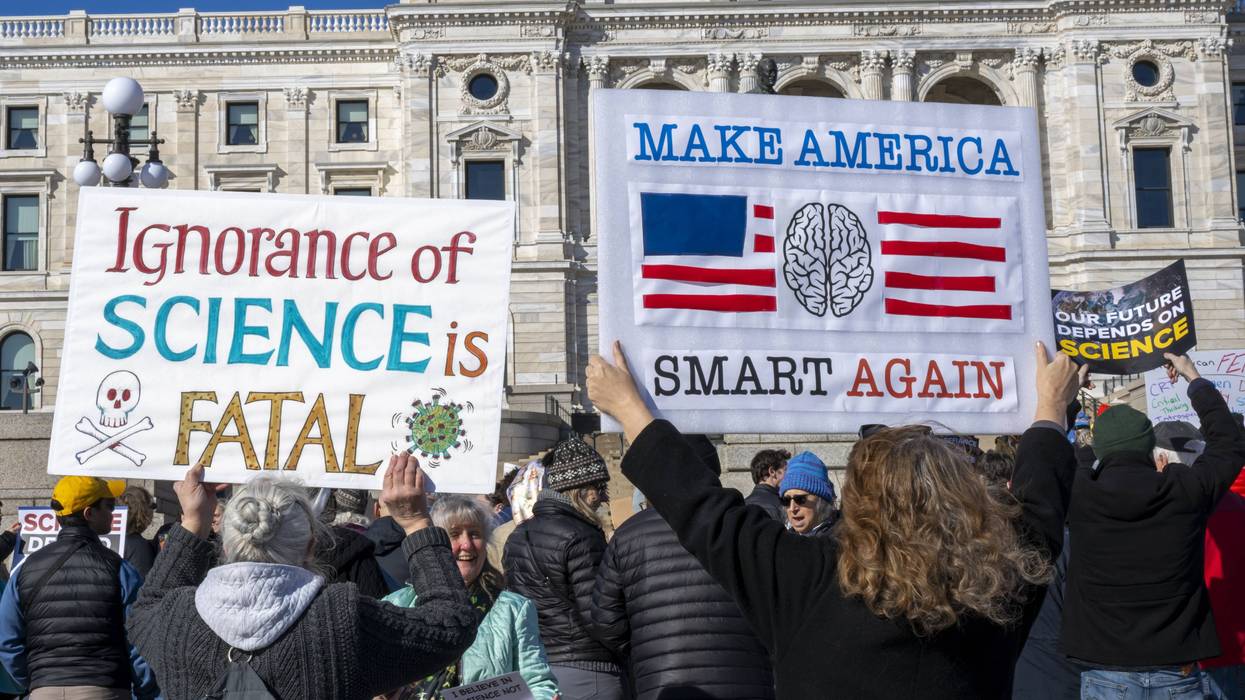
US President Donald Trump on Friday quietly fired every member of the independent board that governs the National Science Foundation, a move seen as an escalation of the administration's destructive war on science.
Members of the National Science Board (NSB) were notified in a brief email "on behalf of President Donald J. Trump" that their "position as a member of the National Science Board is terminated, effective immediately." One fired board member, chemist Willie May, told The New York Times that he was "disappointed" but not "entirely surprised," adding, "I have watched the systematic dismantling of the scientific advisory infrastructure of this government with growing alarm, and the National Science Board is simply the latest casualty."
The NSB sets the policies of the US National Science Foundation (NSF), approves major funding decisions for NSF, and advises Congress and the president on "policy matters related to science and engineering."
Rep. Zoe Lofgren (D-Calif.), the ranking member of the House Committee on Science, Space, and Technology, said in a statement Saturday that "this is the latest stupid move made by a president who continues to harm science and American innovation."
“The NSB is apolitical," said Lofgren. "It advises the president on the future of NSF. It unfortunately is no surprise a president who has attacked NSF from day one would seek to destroy the board that helps guide the foundation. Will the president fill the NSB with MAGA loyalists who won't stand up to him as he hands over our leadership in science to our adversaries? A real bozo the clown move."
Alondra Nelson, an academic who resigned from the NSB last May over concerns of political interference, wrote on social media that "history will not look kindly on this administration for many reasons, but the systematic silencing of independent expertise is particularly troubling."
Since the start of his second term, Trump and his deputies have assailed science across the federal government, including by eliminating the Environmental Protection Agency's scientific research arm and firing experts en masse.
In the coming fiscal year, Trump has proposed cutting NSF's budget by nearly 55%. Additionally, the president's budget would "eliminate funding for the National Oceanic and Atmospheric Administration’s Office of Oceanic and Atmospheric Research," Scientific American reported. The White House plan, if approved by Congress, would also slash NASA's budget by nearly 25%.
"This is how the US loses its scientific leadership—with a reckless budget line," Leigh Stearns, a glaciologist at the University of Pennsylvania, told Scientific American.
Entire careers and livelihoods have been destroyed by this dictator using the White House to vastly enrich himself and his cronies.
On my radio show-podcast—the Ralph Nader Radio Hour—interviews of knowledgeable people have detailed the ravages by the cruel, serial law violator, Tyrant Trump, inflicted on millions of Americans. Still, the report from the V-Dem Institute at Sweden’s University of Gothenburg produced a jolting Common Dreams headline: 'Trump is Dismantling US Democracy at a Speed ‘Unprecedented in Modern History.’"
The report described the first year of President Donald Trump’s second term as achieving in one year what budding autocracies take a decade to accomplish, adding that “the speed of decline is comparable to some coups d’état.”
To wreck, weaken, and endanger our country, Trump disrupts the lives of millions of civil servants, contractors, small businesses, and their families. He fired or forced out hundreds of thousands of federal civil servants staffing programs that protect the health, safety, and economic well-being of tens of millions of Americans, relying on food supplements, Medicaid, government-backed loans, and innumerable other social safety nets.
Trump has especially targeted law enforcement programs directed at enforcing worker and consumer safety, financial protections, and environmental health against toxic corporations. He is taking federal cops off the corporate crime beat.
Multiply this story of undeserved misery and fragility hundreds of thousands of times.
Here are some specifics. Qualified foreign doctors have had their visas rejected. The US has a doctor shortage, especially in rural areas. These physicians were blocked by Trump from extending care in areas with no doctors.
Huge, arbitrary cuts for scientific research have closed or curtailed labs, left individual scientists pursuing crucial discoveries to save lives without the government grants funding vital promising projects. He has also accelerated a brain drain from the US to Europe and China, and reduced the number of scientists, engineers, and nurses coming to the US to work, where they are seriously needed.
Entire careers and livelihoods have been destroyed by this dictator using the White House to vastly enrich himself and his cronies.
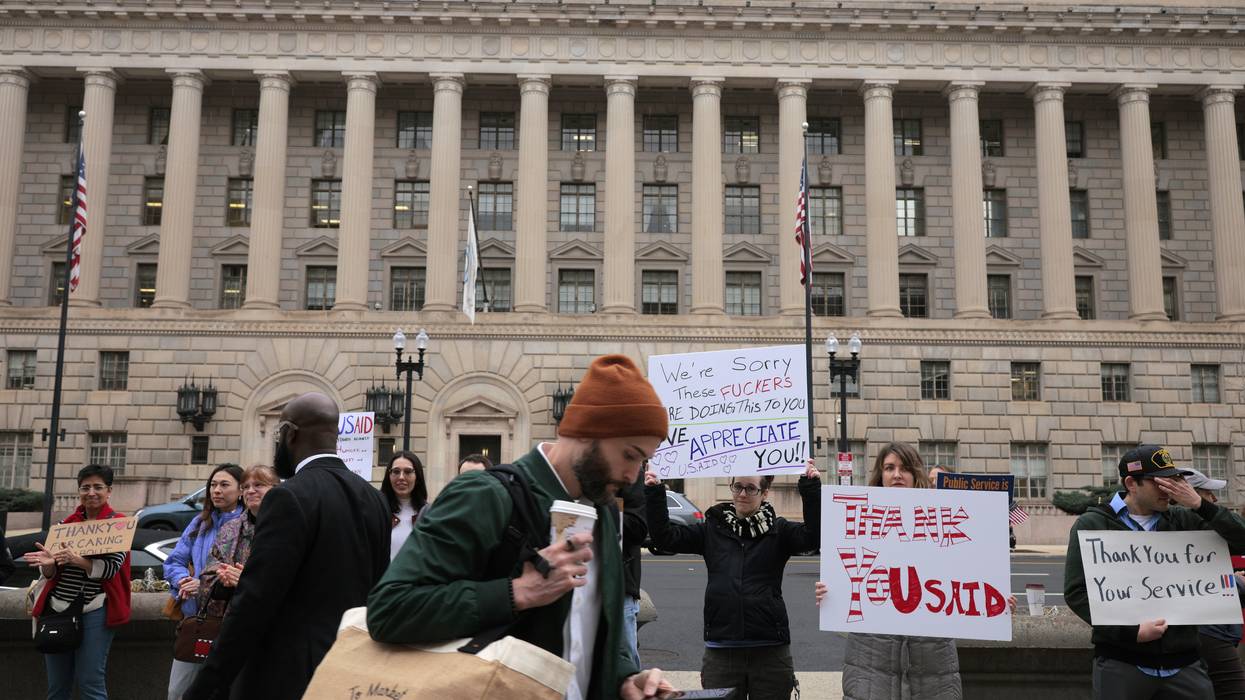
Let’s be more specific. The New York Times published a front-page story about what is happening to employees of the US Agency for International Development (USAID), illegally closed down in the first week of Trump’s regime. This reckless action jeopardizes millions of impoverished lives abroad. The article opened with: “She was fired by email while on maternity leave, given 24 hours to clear out her desk, and left with three days of health insurance and no severance.” Her husband, also working with funding from USAID, lost his job. They are now relying on food stamps, Medicaid, and a supplemental nutrition program—long-standing programs being cravenly slashed by the Trumpsters, while giving huge tax escapes to the super rich and large corporations like Apple.
Multiply this story of undeserved misery and fragility hundreds of thousands of times. Through Elon Musk’s criminal enterprise, the Department of Government Efficiency (DOGE), whole agencies were being illegally shattered, and virtually shut down, e.g., the Department of Education, the Consumer Financial Protection Bureau, and the US Institute of Peace. Others were being strip-mined like the Department of Health and Human Services, the Environmental Protection Agency, and the Department of Agriculture.
Trump tore up civil service union contracts. The unions are suing Trump for this breach of contract. Such lawsuits drag on interminably and are hardly covered by the media. What the union leaders and members should be doing is peaceably encircling the White House for round-the-clock vigils and featuring large signs calling Trump out in vivid language. After all, the headquarters of the AFL-CIO is less than a block from the White House for easy logistics.
What are the pretexts coming out of Trump’s snarling mouth to justify such devastation of America? One is that he accuses these agencies of being “woke,” an ill-defined word for “leftists” that he has turned into another of his four-letter epithets for his ever-true believers.
A more frequent declaration issued without substantiation is that his decisions are based on “a grave threat to national security.” His lies don’t pass the laugh test.
This pretext is always applied to Trump’s blockage of offshore wind turbines, which he strangely has long called “ugly.” Trump recently exempted oil and gas drilling in the Gulf of Mexico from measures to protect endangered species. Self-described warrior of God and Jesus Christ, Defense Secretary Pete Hegseth, stated that such exemptions would bolster national security by increasing domestic oil production.
Trumpian effrontery gets worse. He issued an executive order removing collective bargaining rights from hundreds of thousands of federal employees employed by a dozen agencies on national security grounds. The 1978 law he falsely invoked applied to “intelligence officers,” not to cleaners, guards, clerks, etc., in federal buildings. Again, the expected lawsuits were filed. Amid judicial delays, Trump gets his way.
When pressed by reporters to explain these pretexts, Trump’s flaks come up with ridiculous assertions promptly rebutted by specialists in each area. (See The New York Times, April 19, 2026—“Trump Has a Go-To Justification for His Contentious Decisions: National Security.”)
Who elected Trump? The Democratic Party’s feeble, cowardly, and uninspiring performance in 2024—repressing through its corporate-conflicted consultants’ decisive input from its progressive wing and civic and labor leaders—was a big factor. (See the August 27, 2024, letter to Liz Shuler).
Who unleashed this runaway felonious politician violating daily innumerable federal laws, regulations, international treaties, and constitutional provisions, constituting serious impeachable offenses? (See H.Res.1155).
First, the congressional Republicans have abjectly surrendered their oath of office to constitutionally lead the congressional branch of government. In addition, the cowardly Democrats, who could have conducted scores of “shadow hearings” to inform the media and citizenry are largely MIA.
It is time for citizens to press their Senators and Representatives to stop this Trump rampage—before it is too late. The Congressional Switchboard number is 202-224-3121.
Both truth and lies serve overarching social purposes. The better we understand those purposes and the choices entailed in pursuing them, the better we’ll understand ourselves, each other, and the society around us.
Sorting fact from fiction in statements by President Donald Trump and members of his administration can be demoralizing and cringe inducing. The ratio of untruths to truths is astonishing—and many of the lies seem almost pointlessly cruel.
Trump lies at a pace that’s puzzling. What conceivable purpose could this behavior serve? And why are his most transparent lies so enthusiastically parroted by his underlings?
My aim in this article is not to engage in partisan lie shaming, but rather to better understand human nature. Why do people—and especially large groups of people—spew and cling to falsehoods?
As we’ll see, the distinction between truth and untruth is fuzzy at the edges, and discussions about the nature of truth can quickly spiral into rarefied philosophizing. In this article, we’ll entertain the centuries-old philosophical question, “What is truth?” only to the degree that’s useful in helping clarify my main thesis—which is that both truth and lies serve overarching social purposes. The better we understand those purposes and the choices entailed in pursuing them, the better we’ll understand ourselves, each other, and the society around us—and the better we will navigate the Great Unraveling which lies before us.
Lies told by individuals typically serve some immediate need—often to avoid blame or to improve one’s status in the eyes of others. However, lies also serve a larger social function arising from human social evolution.
Kaivan Shroff hinted at that function in a recent article about Department of Homeland Security spokesperson Tricia McLaughlin, whose untruthful statements to the press are widely documented. What’s interesting is Shroff’s speculation on why McLaughlin lies so much:
The reason McLaughlin and other people who speak on behalf of the administration say things on television that are demonstrably false is not to try to convince ambivalent people of the merits of Trump’s policy decisions. Persuasion is not their objective. Their objective is instead to offer a demonstration of loyalty to the president and his political project—costly loyalty: The price is their own credibility. The more indefensible a claim, the clearer the signal.
Shroff is saying that, for McLaughlin, status within her social group—i.e., the Trump administration—outweighs accuracy or veracity.
Shroff’s explanation dovetails nicely with the discussion of social evolution in my book Power: Limits and Prospects for Human Survival. As humans developed prodigious linguistic ability, we evolved to become an ultra-social species. There are many other social species (ants, bees, chimps, chickens, crows, and more), but symbolic language greatly amplifies sociality, heightening both its advantages and costs.
Lacking language, many other species still engage in deception (like the mimic octopus, which impersonates toxic sea creatures to discourage its potential predators). But language opens the door to fiction, exaggeration, and just plain fibbing on a scale that no other creature can begin to match. Also, our main targets for deception aren’t other species, but members of our own kind who use the same language.
The biggest advantage of sociality is that greater cohesion among individuals makes any given group more powerful vis-à-vis other groups of similar size. While increased cohesion yields a payoff for the group, there is also a payoff for individual members: Acceptance by a cohort confers a sense of security. Alone, life is dangerous and hard. But if you’re with a tribe, there’s the sense that others have your back. Indeed, we all tend to feel strong psychological pressures to align with any social group in which we want to maintain membership.
Lying is not the only possible demonstration of group loyalty. In “big god” religions, tithing, self-flagellation, and long pilgrimages emerged long ago as signs of sincere dedication to the faith. The key factor in such signs was their costliness: The more costly the demonstration, the greater the payoff in proof of group loyalty and therefore status in the group.
A price of entry for at least for some religious and political groups is belief in absurdities. Examples range from Christianity’s doctrine of the virgin birth to Stalin’s requirement that his followers give credence to his personal infallibility (George Orwell famously satirized such political gullibility mandates in his 1948 novel, 1984, wherein the sole function of the government’s “Ministry of Truth” was to create false historical records and news to align with the Party’s ever-changing narrative).
Absurdities are an affront to common sense, so believers must expend constant effort to justify them. This need for justification creates an employment niche for apologists. Theologians’ justifications for absurdities and contradictions in sacred texts have ranged from simple literalism (“the Bible tells me so”) to earnest hunts for allegorical and metaphorical meaning. For example, Episcopal Bishop John Shelby Spong says the virgin birth isn’t so much a fact as a teaching story meant to symbolize a new beginning for humanity. Such metaphorical interpretations relieve the anxiety that results from too much effort spent justifying an absurdity; in effect, they offer membership in the group at a discounted rate. Nevertheless, the absurdity still stands as a gateway test of group membership.
The problem with lies is that, if you believe them, you can bump into things. If you believe a lie that there is no wall in front of you when there is in fact a wall, a few forward steps can induce severe cognitive dissonance. And if the collision occurs at a brisk gait, you might get a bloody nose or worse.
Here’s a familiar real-world example. In 2002 and 2003, members of the George W. Bush administration repeatedly made the case that Iraq was developing weapons of mass destruction and that the United States must therefore attack the country and overthrow its government. Bombers flew, troops invaded, hundreds of thousands died, and Saddam Hussein’s regime fell. But the war is now generally regarded as having been a grave mistake and a strategic failure due to the ensuing destabilization of the region. The supposed Iraqi weapons of mass destruction were never found, and Americans’ trust in government never recovered.
Individually and collectively, we need an accurate understanding of reality if we are to survive and thrive. Sometimes that’s easy: Facts can be plain to see and agreed upon by nearly everyone. Other times they can require hard work, math, and instrumentation to ascertain—and they may still remain controversial.
While factual truths are fragile and evolving, they are essential to a free society, serving as a necessary anchor for public opinion.
As important as microscopes, telescopes, and other sensory augmentations of the modern era are to grasping reality, certain mental habits and methodologies are even more essential. Those habits and methodologies have a history. Indigenous peoples used logic routinely, and the basic functions of reason have been observed in many nonhuman species. Aristotle (4th century BCE) has long been credited with the invention of formal (i.e., written) logic, but thinkers in India and China made independent similar contributions that were arguably as early. Later, Middle Eastern philosophers added mathematical rigor to the process of disciplined thinking. In the 17th and 18th centuries, the founders of modern science applied logic to the assessment of evidence from the natural world using a method that rigorously tests hypotheses—the scientific method. This method differs profoundly from the usual procedure of political or legal debaters, who gather and present evidence that supports their thesis. Scientists instead continually look for evidence to disprove their hypotheses, so they can improve or replace them.
Science has produced immense amounts of reliable information about the world and about us. However, scientists are still human and still susceptible to political and social influences. As Thomas Kuhn explained in his groundbreaking book The Structure of Scientific Revolutions (1962), major breakthroughs in science occur as the result of a long accumulation of anomalies that cannot be explained by existing theories. However, despite the existence of these anomalies, until a clearly better theory comes along scientists often tend to close ranks around the existing theory.
This happened, for example, in the field of geology, which in the 19th century was confronted by evidence of vast changes to rocks and ecosystems throughout hundreds of millions of years of Earth history. Wishing to distance themselves from theologians who saw such evidence as confirming the biblical story of Noah’s Flood, geologists developed the doctrine of uniformitarianism, which held that all geological evidence should be explained by slow processes (mostly erosion and deposition) that can be observed at work today. A few geologists protested, saying that the evidence also suggested occasional catastrophic events of which there are no ongoing examples, but until the 1970s these catastrophists were largely prevented from publishing prominently. Anomalies kept accumulating until it became clear that events like mass extinctions could only be explained in catastrophist terms. Today it’s fair to say that all geologists are part-time catastrophists.
French philosopher-anthropologist Bruno Latour (1947-2022) argued that all scientific knowledge is socially constructed. In his book Laboratory Life: The Social Construction of Scientific Facts (1979), he described facts not as objective truths waiting to be discovered, but as descriptions of the world that are generated within social networks of scientists. The exact extent to which commercial and social interests shape science is a question that echoes through today’s vaccine controversies.
Science is always changing. One year, drinking red wine is proclaimed to be good for you. A couple of years later, the same authorities say drinking any alcohol is bad. Science’s tendency to evolve is its virtue, but also its vulnerability: Many people assume that, because scientific understandings change, scientists are therefore often wrong and really don’t know much. Why bother learning what scientists think now when the consensus is bound to shift later? Hence the persistence of flat Earth believers.
Further, there are important questions science can’t answer. What existed before the Big Bang? Is there a creative principle behind the universe that could be equated with God? What is a good life? Methodically probing physical evidence won’t tell you.
Nevertheless, science has proven to be a useful tool in clarifying most day-to-day issues. If you’re a bridge builder and you want to know the tensile strength of a particular kind of steel, you can consult the outcomes of repeated experiments and have confidence in the numbers. Even though scientists can sometimes be swayed by social motives, that’s not a reason for abandoning science altogether, just for doing it better.
“Facts” are simply the current numbers, descriptions, and interpretations agreed upon by experts, based on the best current evidence. Yes, facts can be socially influenced and can change as new data emerges. But fact-checkers still have value. They’re usually right. They’re good at exposing lies. And, as we’ve seen, lies have consequences.
Social evolution theory isn’t the final word on why groups of people create false representations of reality. Two 20th century thinkers had some relevant insights on knowledge, truth, and lies that I need to touch upon here before we proceed.
French historian Michel Foucault (1926-1984) claimed that knowledge is constructed through systems of power and discourse. His concept of “power-knowledge” (pouvoir-savoir) asserts that power and knowledge are inextricable, and fundamental to the organization of societies. While power can operate through simple coercion, it also achieves its ends through discourse, defining “truths” that categorize, regulate, and control individual actions, making knowledge a force that shapes reality.
Foucault argued that knowledge is never neutral; it is always linked to power. Conversely, power is exercised through the creation and application of knowledge. Power isn’t merely repressive (saying “no”) but also productive, as it generates knowledge, discourse, and new ways of understanding the self and the world. Institutions (like medicine, psychiatry, and prisons) produce “truths” that determine what is “normal” or “abnormal.” These, in turn, regulate behavior and justify power structures.
Hannah Arendt (1906-1975) was a historian and philosopher who lived through the rise of Nazism in Germany before emigrating to the US. She argued that authoritarian power thrives not just by forcing people to believe lies, but by destroying their capacity to distinguish truth from falsehood, thereby inducing cynicism. By constantly changing fabricated narratives, totalitarian regimes destroy the factual basis of society, leaving citizens unable to think, judge, or act. The aim is to create a world where nothing is believed, resulting in a population that can no longer distinguish right from wrong, truth from lies. When people stop believing anything, they become “ideal subjects” for totalitarian rule because they stop caring about what’s true.
Arendt noted that totalitarian leaders try to replace factual truth with a fabricated, consistent narrative that feels more appealing than reality. While factual truths are fragile and evolving, they are essential to a free society, serving as a necessary anchor for public opinion.
There’s a significant difference between a social reality in which experts and the public alike value truth but are often deceived via the influences of financial and political power (i.e., the situation described by Foucault), and a social reality in which elites pursue power at any cost, routinely asserting patent lies and deliberately undermining society’s commitment to reason as ways to exert and extend their advantages (the situation described by Arendt). Foucault was describing the social production of knowledge in most modern industrial societies; Arendt focused specifically on authoritarian, totalitarian states. With Trump in charge, the US is careening toward the latter condition.
Confirming this, Adam Serwer argues in a recent article that “gullicism” (a portmanteau of “gullibility” and “cynicism”) is the tenor of present-day America:
Gullicists see everyone’s hidden motives—except when they don’t. They are able to reject any claim rooted in actual evidence—whether in science, politics, or history—while embracing the most breathtakingly absurd assertions on the same topics. Indeed, documentation is often taken as further evidence of conspiracy, while assertion (that this or that will "detoxify" your blood or that COVID deaths were exaggerated) is taken as gospel.
Unsurprisingly, as gullicism spreads, we’re increasingly bumping into things, including:
In some ways the ascent of Trumpism represents a contest between followers of the 18th century European Enlightenment, who still value reason and democracy, and those who say the Enlightenment was a mistake. In place of reason and democracy, Peter Thiel and other MAGA intellectual leaders promote an authoritarian “dark enlightenment.” But it’s a simple truism: In the dark, you’re more likely to bump into things.
If we don’t want to bump into more things, we must hold to logic and evidence. But we can’t do so in isolation. We’re all consumers of information, and now more than ever it’s essential to make a habit of evaluating our information sources for trustworthiness—based not on what “feels right” or what our social group thinks, but on a demonstrated consistency in testing statements.
Because we’re an ultra-social species with language, the tendency toward loyal lying will always be with us. We’ll never eliminate all lies, either personal or collective. But at this moment in history, as we face climate change and a Great Unraveling, we have a rough ride ahead of us one way or another, and the last thing we need is a sudden proliferation of fake road maps.
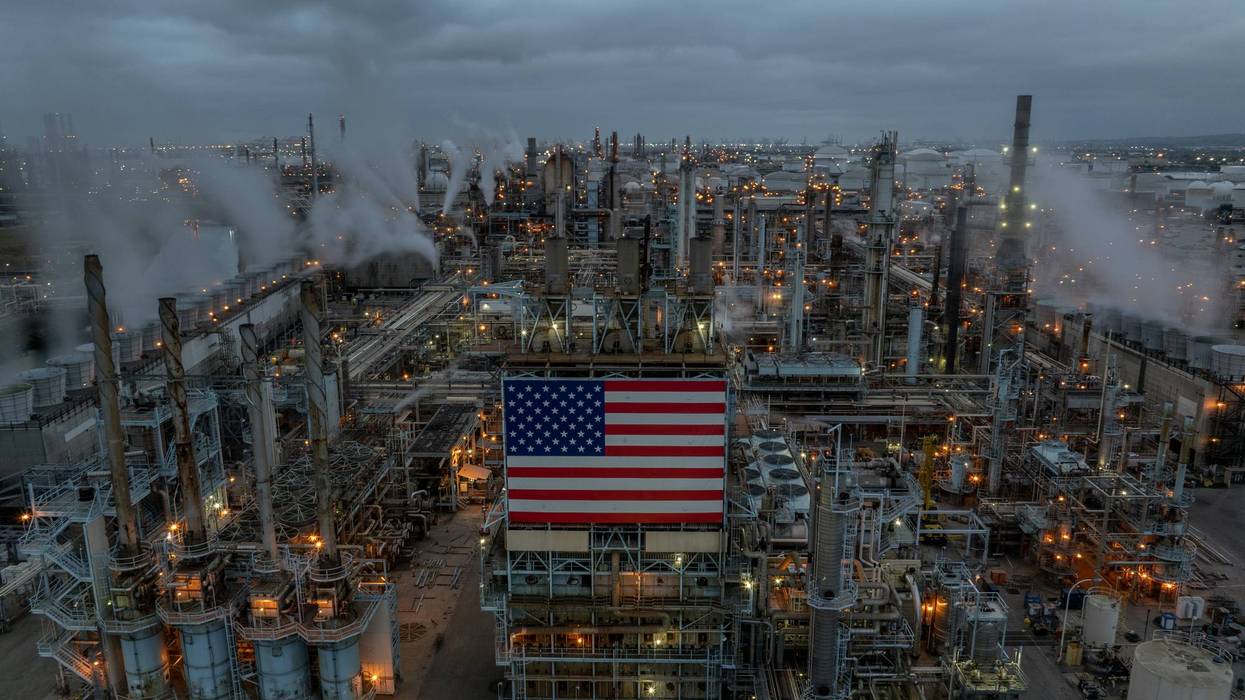
US President Donald Trump continued his "war on science" on Friday with his budget request for the 2027 fiscal year, which critics have denounced as "grossly irresponsible" for its proposed $1.5 trillion in military spending and "a moral obscenity" because of its cuts to social and scientific programs.
In the lead-up to Trump's request to the Republican-controlled Congress, as he and Israel waged war on Iran, Sean Manning, a Herbert Scoville Jr. Peace Fellow in the Union of Concerned Scientists' Global Security Program, wrote that "if this Bloody New Deal actually passes, it could give unparalleled increases in financial power to defense contractors and support for the political work they already do to influence Congress."
"Sane voices need to act now, building opposition to this unprecedented plan," Manning argued. "Progressives should be unflinching in defining this proposal as a blank check for the same contractors who cannot deliver ships on time, munitions at scale, or clean audits. Pouring funds into a defense sector that has repeatedly failed basic tests of accountability will not miraculously produce innovation."
In addition to railing against the budget for the Pentagon—the world's largest institutional climate polluter—after it was officially released on Friday, progressive voices directed attention to some particular proposed cuts and their consequences.
To fund the Pentagon's massive war-making budget, "the Trump administration is requesting the cancellation of billions of dollars in funds for renewable energy, environmental justice, carbon removal, space science, and climate change education," Emily Gardner reported Friday for Eos, the American Geophysical Union's news magazine.
As Katherine Tsantiris, Ocean Conservancy's director of government relations, pointed out, among the targeted federal agencies is the National Oceanic and Atmospheric Administration (NOAA). The proposed cuts, she said, "fly directly in the face of the clear bipartisan support Congress showed earlier this year by protecting funding for this critical agency."
"Slashing NOAA's budget would weaken weather forecasting, disrupt fisheries management, and stall ocean research—putting American lives, livelihoods, and global scientific leadership at risk," Tsantiris continued. "Congress should once again reject these cuts to ensure NOAA has the resources it needs to support our economy, protect our ocean, and keep Americans safe."
Quentin Scott, federal policy director at the Chesapeake Climate Action Network Action Fund, argued that "this proposed budget is exactly what America does NOT need when facing rising energy bills, more frequent extreme weather, and rising insurance rates."
"By gutting funds for climate science and innovation, the budget jeopardizes our ability to understand and respond to the accelerating climate crisis," Scott said. "Defunding climate research at NOAA doesn't make the problem go away—it makes those hazards more dangerous and more expensive. Families across the country are already paying the price through higher utility bills, flooding, and storm damage. This budget would only make those burdens worse."
Big Oil-backed Trump's budget proposal came on the heels of devastating flooding in Hawaii and as high temperatures hit the Western United States. It also followed an annual World Meteorological Organization report on the fossil fuel-driven climate emergency, which last month led UN Secretary-General António Guterres to declare that "every key climate indicator is flashing red."
Devastating.
[image or embed]
— Scott Kardel aka Palomar Skies (@palomarskies.bsky.social) April 3, 2026 at 12:29 PM
Trump also proposed slashing the Environmental Protection Agency's budget—amid calls to oust Administrator Lee Zeldin for "so brazenly" betraying the EPA's core mission to "protect human health and the environment." Trump also proposed cutting the agency's budget. Noting that attack, Climate Action Campaign director Margie Alt described the president's plan as "anything but a serious" one and "a declaration of who this administration is willing to let suffer."
In a nod to some of the rich executives whose campaign cash helped Trump return to power after promising to scrap his predecessor's climate policies and to enact a "drill, baby, drill" agenda, Alt also called it "a reiteration of this president's devotion to fossil fuel interests."
"This budget would slash the EPA budget by 52%, gutting the agency's ability to protect the air our children breathe, the water our families drink, and the communities that already bear the worst of extreme weather and climate change," she said. "It is a deliberately callous choice to remove the protections that keep families safe, healthy, and shielded from the impacts of pollution and climate change."
According to Alt:
This is not just a continuation of last year's rollbacks. It is an escalation of the Trump administration's Polluters First Agenda and their assault on public health safeguards. Since January 2025, among other abuses, this administration has fired 600 National Weather Service staff, proposed eliminating critical climate research institutions, waived mercury pollution standards for 60 dirty power plants, and gutted the Clean Air Act. This budget is the Trump administration's payback for their big oil, coal, and gas friends and contributors. It slashes resources for clean energy, it zeroes out environmental justice, and pushes oil, gas, and coal, at a time when prices for these energy sources are skyrocketing.
Never before have we had an administration that so blatantly treats American lives as expendable, as proven by this budget. Congress must reject this inhumane budget in full. The American people deserve a federal government that protects them, not one that trades their health, their safety, and their futures for big oil, coal, and gas profits.
As Gardner reported, Trump's budget also "proposes consolidating the Endangered Species Act and Marine Mammal Protection Act, but did not provide details outside noting the program would be housed at the Department of the Interior," among other changes and cuts.
Chris Westfall, senior government relations legislative counsel at Defenders of Wildlife, said that "the administration is yet again demanding that an overworked and grossly understaffed federal workforce do more with less. The proposed budget recklessly consolidates US Fish and Wildlife Service and National Marine Fisheries without the needed resources to preserve scientific expertise, opens our lands and waters to extractive industries, and hollows out the already strained workforce that provides crucial conservation work."
"This proposed budget pushes us further in the wrong direction—potentially triggering even more staff layoffs and providing less resources for wildlife conservation, which are pivotal to recovering America's imperiled species," Westfall warned. "Our nation's lands and the wildlife that depend on them for habitat deserve better than to be ignored by agencies that are shells of their former selves."
The president's proposed attack on endangered species came just days after the administration's so-called "God Squad" voted unanimously for an exemption allowing fossil fuel operations in the Gulf of Mexico to ignore policies intended to protect them. In response, Andrew Bowman, president and CEO of Defenders of Wildlife, said that "I cannot stress enough how unprecedented and unlawful this action is."

Three recent stories about measles have implications that are far more consequential for the fate of humanity than Trump’s racist memes or his destabilizing antics on the world stage.
Not until President Donald Trump is long gone will Americans feel the full impact of his most destructive policies and his administration’s incompetence. Today’s topic: Measles.
“For children, the risks of measles are especially grave. Complications, which occur in 1 in 5 people who have the disease, can include pneumonia, blindness, permanent neurologic injury, and death. These outcomes are well-documented, particularly among young children and those with delayed access to medical care.” (Theresa Cheng, MD, JD, assistant clinical professor in the Department of Emergency Medicine at UCSF-Zuckerberg San Francisco General Hospital and a lawyer.)
Measles is preventable, but community immunity requires a 92-94% vaccination rate. Since the introduction of the measles vaccine in 1963, the incidence of the disease has decreased by over 99%, thanks to the combination of immunity through prior exposure and vaccination rates above the required threshold.
Secretary of Health and Human Services Secretary Robert F. Kennedy Jr. is reversing that remarkable public health achievement.
Someone who does not get vaccinated puts others—mostly children who have no voice in the critical decision to protect or jeopardize their health—at serious risk of injury or death.
Three recent stories about measles have implications that are far more consequential for the fate of humanity than Trump’s racist memes or his destabilizing antics on the world stage.
Between 1991 and 2024, South Carolina had a total of only 8 measles cases—6 of which occurred within a single household in 2018.
In October 2025, the state reported the first three cases in the current outbreak.
As of February 17, South Carolina had 962 confirmed measles cases; 253 involve children under 5, 615 are ages 5 to 17, 85 are adults, and nine ages are unknown.
Since the outbreak, 20 individuals have been hospitalized with complications related to the disease.
Ninety-five percent of the infected individuals were not vaccinated.
The area of the state experiencing the greatest number of cases (95% of them) also led the state in the decline in vaccination rate: Spartanburg County’s rate dropped from 93.9% in 2021-2022 to 88.9% the current school year—well below the critical threshold required for community immunity.
Kennedy has gutted the Department of Health and Human Services. He has replaced scientific and medical experts with hacks who adhere here to his willful ignorance.
One of those appointees is the leader of the federal panel that recommends vaccines for Americans, Dr. Kirk Milhorn, chair of the Advisory Committee on Immunization Practices. On January 22, Milhorn said that vaccines protecting children from polio and measles, and perhaps all diseases, should be optional.
“What we are doing is returning individual autonomy to the first order—not public health but individual autonomy to the first order.”
What he and his colleagues are actually doing is killing us. Kennedy has already dropped six vaccines from the childhood immunization schedule.
Only individual states, which have ultimate responsibility for vaccine schedules, have saved the country from the full destructive force of Kennedy’s anti-science, anti-vaxxer crusade. But his ascension as head of the nation’s federal public health policy has empowered his allies to target state childhood vaccination mandates.
The Medical Freedom Act Coalition includes the Children’s Health Defense—a nonprofit group that Kennedy co-founded. It is pushing legislation that would end state laws that codify vaccination schedules. Such legislation is pending in several states.
Asked about the effort, Kennedy said he was not involved, but added, “I believe in freedom of choice.”
As the impact of his attack on science intensifies, the overall public health costs will be staggering.
Earlier this month, Chris Anders, a Republican state lawmaker in West Virginia, introduced a bill that would eliminate his state’s school vaccination mandates, including the requirement that county health departments offer free shots to low-income children.
“If people decide not to be vaccinated, that is their choice,” he argued. “Just like if they decide not to wear a seatbelt or a motorcycle helmet or anything else. If they decide that, they suffer the consequences.”
Kennedy, Milhorn, Anders, and their like-minded anti-vaxxers march under the “freedom of choice” banner. It’s a red herring that omits a crucial element of the equation: Someone who does not get vaccinated puts others—mostly children who have no voice in the critical decision to protect or jeopardize their health—at serious risk of injury or death.
For a long time to come, everyone else’s kids will bear those consequences.
The measles vaccine is the small tip of an enormous public health iceberg. Kennedy and his anti-vaxxers in charge of public health have “sent a chill through the entire [vaccine] industry,” according to Dr. John Coller of Johns Hopkins University, a member of the executive committee of the Alliance for mRNA Medicines.
As Kennedy creates unwarranted fears about the safety and efficacy of lifesaving vaccines, some Americans will continue to believe him and vaccine sales will suffer. As he cuts research funding for new vaccine development, America will be unprepared for the next pandemic. As the impact of his attack on science intensifies, the overall public health costs will be staggering.
Future historians will scratch their heads in disbelief at what we are doing to ourselves and our children.