

SUBSCRIBE TO OUR FREE NEWSLETTER
Daily news & progressive opinion—funded by the people, not the corporations—delivered straight to your inbox.
5
#000000
#FFFFFF
To donate by check, phone, or other method, see our More Ways to Give page.
Daily news & progressive opinion—funded by the people, not the corporations—delivered straight to your inbox.

A recent lawsuit where parents at Palo Alto Unified School District sued over a field trip to a mosque is one of the latest manifestations of the policing of California public schools over how Palestine is or is not taught.
As Jewish-Arab American, I feel the responsibility to work to overturn the dominating narratives that divide my people. I can see clearly the manufactured ill will that has fueled ignorance and the murder of ten of thousands of Palestinians and stripping of the survivors’ dignity. Misinformation about Islam and the silencing of Arab voices are shadows on the wall, distracting us from a deeper truth: that we share a common humanity, and that the best of our cultures and faiths calls us toward kindness, forgiveness, and humility, even as public attention so often fixates on separation.
California has seen a sustained campaign by pro-Israel advocacy organizations to reshape how Palestine is taught—or not taught—in public schools through a plethora of bills aimed to censor ethnic studies, and a recent lawsuit where parents at Palo Alto Unified School District sued over a field trip to a mosque is one of the latest manifestations of the policing of public schools. The lawsuit sparked serious debate on the discretion afforded to public educators in developing course content.
Claims made include that students were encouraged to wear hijabs, that other houses of worship were not included in the class plans, and that students were exposed to a speaker they deemed controversial, Zahra Billoo.
Whatever one’s personal views are on these topics, let’s ground back to facts: A field trip to a mosque isn’t illegal. Lawsuits are often made even in cases where the plaintiff is aware the law wasn’t broken, but the lawsuit itself can be used as a tactic of intimidation and to mobilize negative press attention toward the defendants, as is the case here.
This lawsuit is motivated by a desire to intimidate schools away from exposing students to Islam and speakers who represent the opposite of Israeli propaganda.
Starting with the claim regarding hijabs: Is it illegal to encourage a student to wear the proper attire to enter a space of worship that is optional to enter in the first place? I don’t think so.
Next, a main claim was that “the mosque was the only house of worship included in the program, according to the lawsuit,” as Jweekly put it. This one caused me to pause.
Should you be allowed to take students to a house of worship? If so, then where would we be able to draw the line?
There are hundreds of religions out there. Classes would be going to houses of worship everyday in order to meet the proposed standards. Does it have to be all or nothing? Surely students could be allowed to visit one or two houses of worship without visiting them all, as it would be impossible to determine a reasonable legal standard for this.
I think defining the purpose of the class in question is also very important here. If the purpose of the class is to expose students to minorities, which would be characteristic of a class called “Social Justice Pathway,” it is true that Muslims are minorities in this country. Islamophobia is ironically being triggered online in the responses to this incident.
The Council on American-Islamic Relations is a legal advocacy organization for Muslims. CAIR supports Muslims whose civil rights are directly targeted. It is appropriate to have a representative of that organization address a class focused on social justice. Muslims are materially being denied access and rights based on their religion and identity in the United States. With the other Abrahamic religions being dominant and widely represented, I would assert that Islam is the least represented of the Abrahamic religions in the US and is deserving of students getting a chance to experience it firsthand.
Recent national polling suggests that Muslim Americans experience religious discrimination at higher rates than any other faith group surveyed, including in consequential areas such as employment, housing, banking, healthcare, travel, education, immigration, and interactions with law enforcement.
Another thing that bothered me (but didn’t shock me) about this lawsuit is that it assumes students shouldn’t be exposed to “controversial” speakers. It is hardly illegal for students to hear controversial speakers in school. In fact, a balanced education relies on freedom of ideas and information rather than censorship. Even if a parent finds some of Billoo's statements deeply objectionable, does that mean high school students cannot hear her speak?
Zahra is a staunch supporter of Palestinian rights, and it is convenient for Zionist groups to label her as antisemitic. Articles portraying her as antisemitic rely on the conflation of Judaism and Zionism. Zahra is a supporter of Jewish Voice for Peace and If Not Now, which are composed of Jewish people who refuse to allow Israeli nationalist propaganda to define what it means to be Jewish.
If the plaintiffs are arguing that any discussion of and exposure to Muslims must be accompanied by a discussion of other religious groups—where does that requirement end? Such a rule would be impractical and inappropriate in many educational contexts.
Educators require the agency to make reasonable judgments about which communities and perspectives are relevant to a particular lesson. This lawsuit is motivated by a desire to intimidate schools away from exposing students to Islam and speakers who represent the opposite of Israeli propaganda.
Ultimately, all of this is to say: I reject the premise that protecting Jewish students requires shielding them from Palestinian advocacy or Muslim voices. My Jewishness does not require that.

Yair Lapid, the opposition leader some Democrats believe will rescue Israel from extremism, said the nation should expand its territory to match "the Bible's borders" earlier this year.
Faced with mounting pressure from constituents to stop providing military support to Israel's genocidal wars, some Democrats in Congress who've long expressed unwavering support for the country are hoping that its elections this fall could provide a reset.
On Wednesday, a clique of Democrats met with former Israeli Prime Minister Yair Lapid, a leader of the opposition coalition aiming to oust Prime Minister Benjamin Netanyahu, whose far-right government's unapologetic pursuit of ethnic cleansing against Palestinians and push toward indefinite occupation of southern Lebanon have made support among liberals increasingly untenable.
Lapid has described the ascendancy of his coalition as an opportunity for Democrats who'd recently voted against measures to provide Israel with weapons aid to wipe the slate clean and restore the status quo of ironclad bipartisan support that Israel had enjoyed for decades.
At the meeting, arranged by the staunch Israel supporter Sen. Jacky Rosen (D-Nev.), Lapid said he urged the Democrats in the room, which included Sens. Michael Bennet (Colo.), Richard Blumenthal (Conn.), Maggie Hassan (NH), Cory Booker (NJ), Brian Schatz (Hawaii), Alex Padilla (Calif.), John Hickenlooper (Colo.) and Catherine Cortez Masto (Nev.), according to The Jerusalem Post, "not to give up on Israel and to show solidarity in the face of its challenges."
Lapid is often portrayed in the Western press as a more "moderate" alternative to Netanyahu and his coalition of religious nationalist and ultra-Orthodox parties. Lapid is comparatively secular and has criticized Netanyahu's assaults on institutions like the courts, while showing himself more open to aligning with Israel's marginalized Arab parties.
But on the questions that have led Israel to lose favor with American voters—those of Israel's aggressive warmaking—Lapid has expressed views that seem hardly less extreme than those of the current government, including the idea that Israel should continue to expand its borders across the Middle East in accordance with biblical texts.
The idea that Israel should wage wars of conquest against its neighbors was once confined to the fringes, but has become mainstream in recent years with the support of far-right figures in Netanyahu's government, like Finance Minister Bezalel Smotrich and Security Minister Itamar Ben-Gvir, who've pushed for Israel to expand its illegal settlements in the West Bank and begin moving settlers into Gaza and Lebanon after they're depopulated of their inhabitants.
In February, Lapid was asked during a press conference if he agreed with a statement by US Ambassador to Israel Mike Huckabee that the state had a religious right to seize all the land between the Nile and the Euphrates Rivers.
Per Middle East Eye, he responded as follows:
"I support anything that will allow the Jews a large, broad, strong land and a safe haven for us, our children and our children's children. That I support," he told a Kipa News reporter.
When asked "How broad?" Lapid responded: "As broad as possible."
He added that there were practical "considerations of security and policy and time," but said Israeli territory could expand as far as Iraq.
"Zionism is based on the Bible, our mandate over the land of Israel is biblical, the biblical borders of Israel are very clear," he said. "I believe our ownership deed over the land of Israel is the Bible, therefore the borders are the Bible's borders."
Rania Khalek, a journalist and commentator at BreakThrough News, warned that by viewing Lapid as a palatable alternative to Netanyahu, Democrats were aligning themselves with "violent colonial religious fanaticism... despite the fact that their base overwhelmingly despises this Greater Israel settler project."
Remarking on his comments endorsing the idea of Israeli expansion into Iraq, she marveled that "Yair Lapid is supposedly the liberal opposition to Netanyahu. Yet he sounds just like Ben-Gvir here."
Lapid has been nominally critical of Netanyahu's policy toward Gaza, but largely only from a tactical perspective rather than a humanitarian one.
He defended Israel against criticism as it imposed a "complete siege" that cut off food, water, and electricity from the strip in October 2023, and claimed most killed in Gaza were "terrorists"; supported legislation aimed at crippling the main United Nations aid agency for Palestinians, and endorsed President Donald Trump's idea of permanently removing the residents of Gaza.
Lapid has also been a strong proponent of war with Iran, praising Trump and Netanyahu's strikes in late February as a "just war against evil" and calling for the nation's leadership to be "obliterated." During a speech earlier this week, he endorsed the idea of striking Iran's energy infrastructure, calling it "the right thing to do in the long term."
While serving as prime minister in 2022, Lapid signaled rhetorical support for a two-state solution with the Palestinians, a marked difference from Netanyahu, who has long been adamantly against it. However, the man likely to become prime minister if Lapid's coalition wins, former premier Naftali Bennett, has long opposed a Palestinian state, recently calling it a "huge mistake."

With Jewish identity focused on its ethnic nation-state rather than a worldwide people gifted Torah and obligations, its majoritarianism and contempt for others shows our vulnerability—as all other groups—to vice.
Separating the meaning of Jewish identity and learning, distinct from the Israeli state and its underlying doctrine, is worthwhile work.
It's also urgent work, overdue. This is a maniacal, genocidal post from Israel's Minister of National Security Itamar Ben-Gvir:
For every tear of an Israeli mother, a thousand Lebanese mothers must weep. All of Lebanon must burn!
Repulsion from Israel's actions naturally affects how Jews are seen in the world, how we walk among others in the world—and ironically, for Zionists, validates their conception of the gentile world as forever hostile to Jews.
The existence of the State of Israel, the merger of Judaism with Jewish nationalism, has unavoidably changed what being a Jew is.
Identifying with a state perpetually in conflict, we retreat to the protection of our litany of noble sufferings, protecting from facts, from seeing ourselves as cruel or hurtful. Or—even—silly, annoying, not so significant.
Zionist theoretician Ze’ev Jabotinsky wrote in 1923 of the way that the Jewish state would have to be constructed, that “it is utterly impossible to obtain the voluntary consent of the Palestine Arabs for converting ‘Palestine’ from an Arab country into a country with a Jewish majority.”
Colonization would have to continue “only under the protection of a power that is independent of the native population—behind an iron wall, which the native population cannot breach.”
When Jabotinsky wrote this, Jews were immigrating to Palestine under British protection to fulfill the League of Nations Mandate promise of a yet-to-be defined “Jewish homeland” there.
Population "transfer" to create a Jewish majority state was envisioned by Zionist leadership, from founder Theodor Herzl onwards.
The United Nations Palestine partition plan of 1947 and resulting civil conflict provided the opportunity for Jewish militias and then the Israeli army to target and empty communities—to become sites for Jewish settlements with Hebrew names.
Israeli statehood on May 14, 1948 was accomplished by dispossession of most of the Arabs of Palestine—the expulsion of 750,000 Arabs from what would become Israel. This is called the Nakba (catastrophe) in Arabic.
Those Palestinians remain exiled despite a pledge from Israel to the United Nations in 1949 to accept returning refugees, as part of their admission as a member state.
The “restoration” of our sovereignty inflicted a catastrophe on Palestinians which will be part of Jewish history forever.
The creation of the State of Israel is presented as necessary Jewish self-assertion.
In September 1948, Israeli diplomat Abba Eban wrote that in a “just world” consultation and agreement would have been preferred. “But the world is more realistic than just. The doctrine of ‘accomplished fact’ has been entirely vindicated against that of ‘prior consent.’”
That doctrine forces for Jews a necessity of either identifying with Israel, or maintaining the identity of “Jewish-not Zionist,” an awkward thing to maintain while well-provisioned Jewish organizations present Zionism as Judaism.
That doctrine also destroyed Jewish communities across the Middle East and North Africa, and as far as India. Exercising naked power to force Arabs from their homes to privilege Jews in Palestine poisoned the place of Jews who lived for many centuries as citizens in neighboring societies.
Thinking of the vulnerability and degradation of Jews in the past, I struggle to reconcile those moments with this moment of Jews as a menace—and Jewish nationalism as a personal imprisonment.
The Zionist movement which descended on Palestine to “ingather the exiles” is now a state dedicated to a philosophy of Jewish redemption by violence, “an admixture of ultranationalism, religious mysticism, and racial superiority,” as described by Albert Einstein, Hannah Arendt, and others in a 1948 letter to The New York Times, of the faction that is now in control of Israel’s psyche.
Israel operates with a logic in which opponents to the Jewish state intend a Holocaust—mindless, causeless enemies as in the Passover or Purim or Hanukkah stories.
While most Jews in the diaspora live in accommodation and cooperation with gentile co-nationals, Israel has sacralized and militarized the “they always turn on us” belief.
We live in two models of Jewishness—the Jew living in civil cooperation with gentiles, and the militant Jewish supremacist in Palestine.
The contradiction of those two models of Jewishness makes us a problem to ourselves and others, with no clarity.
Complicating this is our belief in the grandeur of our own culture and learning.
As a child, I was buoyed by stories of Jewish learning and achievement—unlikely persistence through the ages—uniqueness.
I felt I was one of a fine, special group.
I also absorbed the other, paired, narrative of Jewish history. In the ritual reading of the Haggadah text each Pesach, I was reminded that we were enslaved in Egypt, and that in every generation They rise up to destroy us. And we survive, achieve, and show our high quality.
The theme of Jewish life is that we were chosen for a great mission, and have been persecuted since.
In these narratives, living a Jewish life is fulfilling the endowment of Torah and generations of scholarship, earnest and humane— targeted by malice, by jealousy from peoples less… fortunate? Not Jewish.
It may be that feelings Jews have about gentiles are as problematic as prejudices gentiles have against Jews. We suffer from not only how gentiles may see us, but limitations on how we see non-Jews.
Mitch Abidor, in the magazine Jewish Currents, describes a passage in Philip Roth’s novel Portnoy’s Complaint about a non-Jewish girl who tosses a flaming baton and catches it, and and its significance to the “nice Jewish boys in the stands." Portnoy observes that:
there was still a certain comic detachment exhibited on our side of the field, grounded in the belief that this was precisely the kind of talent that only a goy would think to develop in the first place.
Legendary Forverts newspaper editor Abraham Cahan wrote in his novel, The Rise of David Levinsky, of Talmudic education (an experience Cahan had shared with his character during his youth in Lithuania). The process of extended reasoning and disputation in religious study seemed the acme of human ratiocination:
"Can you fathom the sea? Neither can you fathom the depths of the Talmud," as we would put it. We were sure that the highest mathematics taught in the Gentile universities were child's play as compared to the Talmud.
This feeling of higher thought as a specifically Jewish achievement is useful to surface in discussion of how we see our not-Jewish fellows.
Torah study may be mostly a treasure of the observant now, but the habits and outlook of study and productive disputation persist. Might the assumption of superlative Jewish quality also?
To accept the World-Against-the-Jew construct, one must accept the idea that there is a unique quality to Jews.
Our religion revolves around identity, descent from tribes in a substantive relationship with the true God. When we pray, we are praying to a god that particularly cares that we are Jews doing the praying.
The central prayer of Judaism is the Shema:
Hear O Israel, the Lord our God, the Lord is One.
The Yiddish phrase "pintele yid," Jewish spark or kernel, expresses the belief that there is an irreducible, distinct core of Jewishness that is in a born Jew, observant or secular or ignorant.
The story told about converts is that their nefesh (soul, spirit) was there at Sinai to hear Moses tell God’s covenant with his people..
This resolves Judaism as an embrace of Torah—fudges the membership story, in truth.
Is “Jew” a coherent national category, as we include Indians, Ethiopians, Yemenis, Poles, and Romanians?
When devotion to Torah is the center of this identity, it does not require ruling from imagined supremacy.
The poison brewed when mixed with a colonial enterprise designed at a time Britain could design a plan “natives” had to accept.
The Israeli government recognizes Israeli citizenship for Jews, Arabs, and others, but then records the “nationality” of the citizen separately, so that I, an American citizen, in their system share the same “nationality”—“Jewish”—as an Israeli Jew.
Ultimately the identity is based on magic, superstition, folkways, and spiritual truth. Am I required to believe in the existence of "The Jewish Nation" as the term is meant in the Zionist state?
The Zionist proposition for the world’s relationship with Jews is, “Love us, love our land.” This is articulated in their claim, “Anti-Zionism is antisemitism.”
In 1906, Jewish educator Solomon Schechter said that he feared assimilation of Jews, loss of identity, “even more than pogroms.” He wrote that in the Jewish “exile,” the Zionist project could form “the great bulwark against assimilation… an opposing force.”
As we Jews "fight for our existence," is it because diminishment of our self-held special place in the world feels like death?
American Jewish organizations promote connection with the State of Israel to nurture Jewish identity of the young.
Identifying with a state perpetually in conflict, we retreat to the protection of our litany of noble sufferings, protecting from facts, from seeing ourselves as cruel or hurtful. Or—even—silly, annoying, not so significant.
A popular 1970s Israeli song had the refrain, "The Whole World is Against Us.” It concluded,
The whole world is against us...
This song was taught to us
By our old fathers,
And we too shall sing it,
And after us—the sons.
And great-grandchildren of great-grandchildren will sing
Here in the Land of Israel,
And anyone who is against us
Can go to hell!
The whole world is against us…
It’s not clear how we wish to be regarded.
At the Enlightenment and revolutionary emancipation of Jews, converting from toleration to equal citizenship, there was a loss of community autonomy, statutory difference—the loss of definition as members of a nation within the nation.
Even stigmatized, community autonomy had its advantages. Jewish communities had their own recognized governance, internal taxation, regulation of their own personal affairs, and laws, courts.
That concept of modern citizenship as individual equality conflicts with Jews residing as their own self-governing polity with representatives to the larger society, as was often the practice. This is sacrificed with equal citizenship, where all live under the same law.
Max Nordau, speaking to the First Zionist Congress in 1897, made interesting comments that when Jews lived isolated in ghettos, they had society of their own. He says that while Emancipation had its intoxication, it left Jews in Western Europe in “misery” because they could not thrive as Jews among Jews.
We are people; people do evil.
Acceptance becomes a stressor; the more we become like our fellow nationals, the more desperate to maintain a difference.
By the logic of Nordau, the most salutary circumstance for Jewish happiness is isolation from the larger society—or living as the majority the Jewish state achieved in 1948.
UK Rabbi Jonathan Sacks, in a 2016 address on antisemitism, presents the existence of Israel as a Jewish human right. “Antisemitism means denying the right of Jews to exist collectively as Jews with the same rights as everyone else.” (Emphasis added.)
Now, we've acquired the belief we're only meant to be happy if we rule our own “Jewish” land? Or only be safe if we do? The rationale toggles between the two, that Israel represents Jewish safety or Jewish fulfillment.
Jewish history treasures—curates—narratives of persecution. The meaning of that must be considered. If we have grievance, contempt, or pity for those outside our circle, are we healthy?
For me, there has been not just a feeling of kinship but a higher expectation of Jews, expecting less of gentiles as a rule. Prejudice absorbed growing up is painful to examine.
The origin story of our people—chosen by God to a special mission of glorifying Him and his laws—may instill confidence, a sense of identity, but I think is “worth another think” as a problem when, as Peter Beinart points out, it is empowered as a state.
He writes, “In most of the Jewish world today, rejecting Jewish statehood is a greater heresy than rejecting Judaism itself.”
Beinart's comment suggests that many Jews now have Zionism as their faith—and faiths are based on taking certain premises as fact. It may be a creator of a particular sort, or in this case a belief in the Jewish people as a reconstituted modern nation-state. In any case, faiths can't be debated.
Beinart, religiously observant and well-grounded in Jewish study, called his book Being Jewish After the Destruction of Gaza, and gave it the subtitle, A Reckoning. The necessary reckoning he forecasts for Jews I think will be ugly and with false starts and detours, and will necessitate re-evaluations of how we prejudge gentiles.
We number perhaps 16 million worldwide, and we Jews are at the pivot point of the USA’s wars on Iran, Iraq, and all sorts of involvement in bolstering Israel’s impunity in its neighborhood. Things at pivot points can get caught and mangled.
Dr. Michael A. Meyer wrote of American Jews: “For them the state is the flagship of the people to which they belong. Their Jewish identity is as much ethnic as religious, and their religious expression of that identity as much as affirmation of their peoplehood and the importance they attribute to preserving it…”
Polling shows this identification with Israel is less true than when written in 1994.
The American Council for Judaism, an anti-Zionist organization founded in 1943, is reviving the struggle within the Jewish community for Jewish life "free from the Zionist idea of Judaism as a nationality or the elevation of one nation above others…grounded in justice, solidarity, and humility."
We maybe are preserving ourselves without attention to what we become. An organized project to dispossess Arabs from their homes leaves us as what sort of people, declaring populations "human animals," and promising a “Nakba that will overshadow the Nakba of 48”?
Israel is now again attempting a land grab of south Lebanon, methodically blowing up evacuated villages so that Lebanese have no homes to return to.
Israel has no declared borders, only armistice lines after various wars since 1948. It has claimed and settled part of Syria, and in a de facto manner acquired all of mandate Palestine, settled it with Jews, but without recognizing citizenship of non-Jews living there. Gaza, populated in majority by refugees from the 1948 Nakba, it tried to settle, and strangled it at the best of times.
Israel has, since 1948, and especially since the 1967 occupation, arbitrarily detained 1 million Palestinians, and subjected them to routine beatings, humiliation, and abuse, reaching new depths since October 7, 2023.
This abuse is enabled by indifference to the humanity of a classification of people—in this case non-Jews.
Having known abuse from both pogromists and cruel soldiers, we—we?—unleash them on Arab civilians.
Israel is a significant producer in the international arms trade, especially in mechanisms of surveillance and control of civilian populations.
One thing is taboo: anything other than seeing innocence in the actions of Jews in the world.
Cruelty, persecution, crimes against humanity are in a blind spot when it's “our own people” as perpetrators. Exceptions to a virtuous rule.
There is anger at Israel's blockade, bombing, and occupation of Gaza, and West Bank state terrorism, and the reaction of Israel defenders is often that the charged offenses match historic antisemitic canards—thus are invalid.
The problem with enumerating the package of common antisemitic slurs is that they always seem to create a kind of immunity: If something has been falsely charged of Jews, one needn't avoid the crime charged?
Is it a matter of seeing ourselves as others see us? Is it a matter of the struggle for some objectivity? Is every ethnic or tribal identity a devaluing of those outside it?
For me to see the Jewish story with objectivity is as impractical as performing a non-trivial surgical operation on myself.
Do I touch on something unmentionable, “feed antisemitism,” by separating our human value from our outsize mythologizing?
I defend myself: It cannot be betrayal to think of Hillel's teaching, the universal "What is hateful to you, do not do to another," with an eye to truths we thought established in the Nuremberg trials, not to mention learned from the object lesson of the Nuremberg rallies.
Zionist Israel is Chelm. The legendary town of Chelm (not the real Polish city) in Yiddish stories is inhabited by remarkably foolish people who begin from foolish premises and build on them to ridiculous solutions.
The first stupid premise—that “Israel” can be taken from “Palestine”—is compounded by more and more technological excellence in killing and surveillance.
For believers that the Jewish story must include a modern nation-state in Palestine, it’s a certainty that I am “betraying my people” by writing out these thoughts. Or, naive to the innate antisemitism of the world.
In the Passover ritual meal, the “wicked son” asks, “What does this mean to you?” By not asking what the Exodus story means to “us,” he separates himself from The Jewish People, showing his wickedness.
I think the only irredeemable sin, among Jews, is faithlessness to “Our People”—aligning with gentiles. As a comment posted on a Zionist website stated, “True Jewish morality begins with loyalty to our own people.”
If all Jews compose a Jewish nation in a literal rather than spiritual, figurative sense, the weight of treason comes into play for faithlessness.
Danish expatriate Israeli Jonathan Ofir wrote in an online essay titled “I Am Freed from Zionism”:
It's hard to define the line where people sense you're not loyal. But it is a kind of social control with cult characteristics. It’s like people have the understanding that you’ve gone too far and now you’re not with "us" but against "us."
Ofir's provocative suggestion that Zionism is cultish makes me ask if there is some vulnerability that Zionism exploits in Jewish hyper-fixation on identity. Are we prone to the cultish division of the world into members and outsider "enemies" that installs an inner policeman to monitor for betrayal?
Certainly there is the cult characteristic of devaluing views from outside of the cult as worthless, ill-intentioned.
Intrinsic to Zionist belief is that Jews are historically vulnerable and non-Jews are unreliable, and that Israeli security is achieved by "realism”—relying on military superiority, "teaching" non-Jews lessons by massive retaliation and iron control.
Zionism began as a secular movement. The secular seamlessly slid to the sanctified, as the words of the Zionist anthem “Hatikvah,” with no mention of the deity, evoke the “Jewish soul,” necessarily implicating a God that made Jewish souls.
Considered with a step back, it has impressive gravity, being a selected people of God. Add the patina of antiquity and who can match the distinction?
The Zionist solution is to be strong and a majority—jettisoning the aspiration of making a better world where the weak and less numerous can be safe.
When arms and sovereignty are grafted to this identity, we have Jewish identity transmogrified to something new—Jewish religious-nationalist power.
With Jews’ role of noble victim is the gentiles’ role of ignoble victimizers. In practice, we may view non-Jews as defective, lacking, having morally-vacant animality.
There is a witticism of uncertain origin, “Jews are like everyone else, only moreso.” I’d leave off the last part, and just say we’re human, with all the human prides and failings.
We are people; people do evil.
Israeli-born genocide scholar Omer Bartov has concluded that Zionism “became the ideology of the state. And it became not only militaristic and expansionist but also racist, extremely violent, and ultimately an ideology that deeply harms both the individual and the collective.”
Bartov continues that in Israel there was “a radical transformation of Judaism itself into a political religion, intertwined with a certain translation of Zionism... In Israel the specific version has, in effect, produced divine or rabbinic legitimation for genocide.”
Zionism becomes revenge, for correction of every humbled moment of Jews in history, and glorification of the god that selected us—to wreak on Palestinians reversal of centuries of obstruction of God’s promise of Jews being mighty and numerous in our land.
Fatally, omitted in the fury is remembering the promise of the land is conditioned on faithful following of God's mitzvot.
The “eternal Jewish vulnerability” narrative is available in Jewish learning to be turned to Zionist purposes. In February, Israeli PM Benjamin Netanyahu laid out concisely the mental landscape of Zionism grafted to Judaism—eternal world antisemitism:
If you look at the course of Jewish history, then what you see is this was a fairly constant phenomenon:
I mean, once we lost our land, once we were scattered among the Nations, we were ready prey. We were ready prey. And eventually, when there was societal change the Jews always were blamed… And these attacks on the Jews were always preceded by vilification. Horrible vilifications that even so-called civilized and educated people adhered to: “The Jews poisoned the wells. The Jews spread vermin. The Jews slaughtered Christian children to use their blood for baking matzos.”
And this goes into modern times. The Nazis basically said the same thing. And all these vituperations, all these slanders were always accompanied, eventually, by exile or pogroms or mass murder.
That's what happened to the Jews one country after another into modern times.
PM Netanyahu then defines the rationale for whatever violence is necessary to preserve the Jewish state in Palestine:
The great change in Jewish history which [Theodor] Herzl saw very clearly is that when the Jews have their own independent state they will have the independent power to roll back the physical attacks against us.
Functionally, it is the strategy of a paranoid person holed up with weapons. As in any religion’s foundational literature, justifications can be found. In the Talmud is the imperative, “If someone comes to kill you, rise up and kill him first.”
In territories under Israeli control, it has fostered land stealing and ongoing terrorizing of Arab residents by Jewish “settlers” drunk on ethnic self-assertion, protected by the army of the Israeli state.
When we live among others, the paradox of this outlook on Jewish history, and its "solution" by territorial Zionism, is the abandonment of Jews' right to be French, American, Indian, Syrian, Irani. In harmony with the Nazi legislation that German Jews were not German.
Zionist founding father, secular Theodor Herzl, in Der Judenstaat, summarized the basis of Zionism—that Jews carry antisemitism with them. He said we go where there is no antisemitism and there generate antisemitism:
The Jewish question exists wherever Jews live in perceptible numbers. Where it does not exist, it is carried by Jews in the course of their migrations. We naturally move to those places where we are not persecuted, and there our presence produces persecution.
Herzl describes an irredeemable gentile world: “In the world as it now is and for an indefinite period will probably remain, might precedes right. It is useless, therefore, for us to be loyal patriots, as were the [French] Huguenots who were forced to emigrate. If we could only be left in peace... But I think we shall not be left in peace.”
Herzl's and Netanyahu's formulation is degrading of gentiles—that Jews cannot live among others. That there is something profoundly wrong with everyone but Jews.
This approach disregards the success story of a tribal cult from Judea maintaining and building culture over millennia, integrating converts wherever they’ve settled, up to our present.
Jewish pride can be consciousness of heritage, or be a sort of implicit contempt of gentiles.
The Zionist outlook, expressed by Maurice Samuel in 1924—talking of Jews' "wretched fate"—has Jews living in a trap which alienates us from humanity. One may be proud or lament the identity, but with no escaping it:
A century of partial tolerance gave us Jews access to your world. In that period the great attempt was made, by advance guards of reconciliation, to bring our two worlds together. It was a century of failure. Our Jewish radicals are beginning to understand it dimly...
The wretched fate which scattered us through your midst has thrust this unwelcome rôle upon us.
Do we demand safety, protection, because we share common humanity with rights to be respected, or because of our rare qualities—making us a special case?
Whether we think of ourselves as “ready prey” (Netanyahu) or precious unicorns of advanced civilization—or both—the point is we may think of ourselves as a different ilk than run-of-the-mill-humanity.
In America, the claim of being an extraordinary case makes a sisterly blend with Christians Zionist eschatology and “American exceptionalism” in Israel advocacy.
We are whatever we think we are. It isn’t a lament but a boast, that we are “a people that dwells apart.”
The Zionist solution is to be strong and a majority—jettisoning the aspiration of making a better world where the weak and less numerous can be safe.
In 1938, a Polish leader of the anti-Zionist socialist Bund forecast:
Zionism has always regarded the law of force, of nationalistic action, as the normal law of history and on this law has based its perspective on Jewish life…
If a Jewish state should arise in Palestine, its spiritual climate will be: eternal fear of the external enemy (Arabs); eternal struggle for every bit of ground with the internal enemy (Arabs)…
With Jewish identity focused on its ethnic nation-state rather than a worldwide people gifted Torah and obligations, its majoritarianism and contempt for others shows our vulnerability— as all other groups—to vice. Trauma has not ennobled us.
The whole of Torah revolves around the proposition of singular essential Jewish peoplehood.
Herzl’s proposition that we have “our right to exist as a separate people, according us our rightful place among the nations of the world” is built on it.
The inner policeman tries to stop critical examination of the identity—Disloyalty to faithful ancestors! Betrayal of my people!—to question Zionist corollaries of the statement, “I am a Jew.”
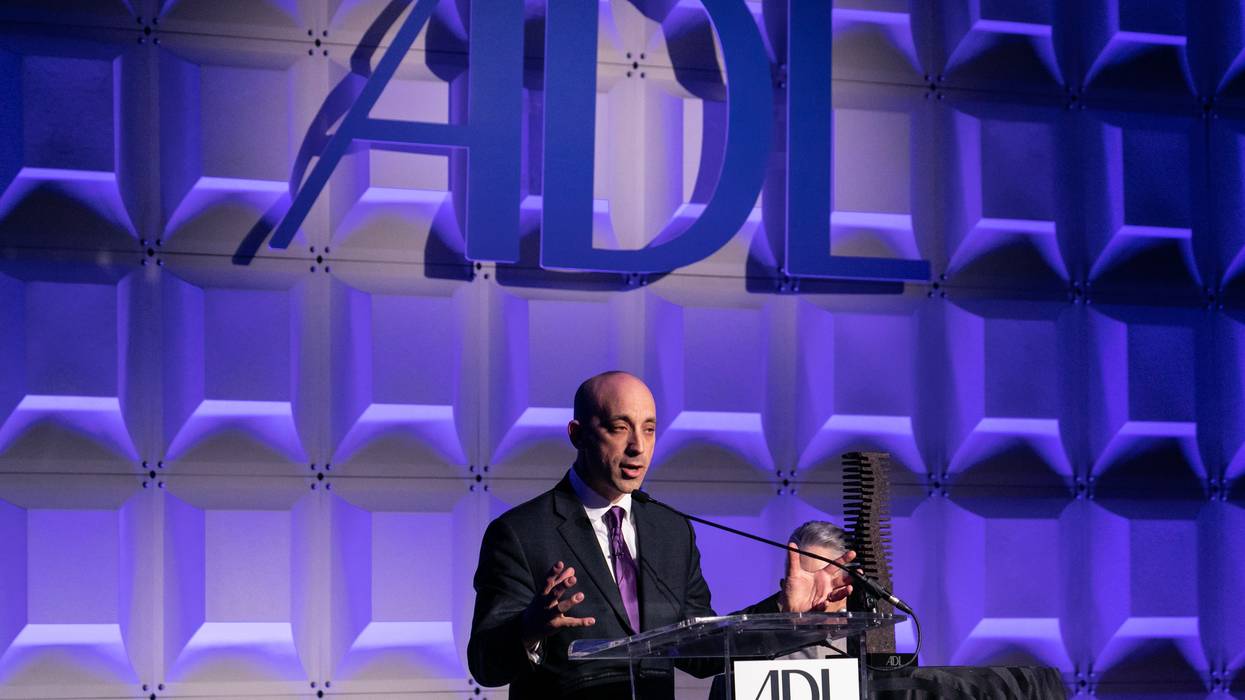
The group uses dubious reporting methods and tends to conflate right-wing racial extremism with pro-Palestine speech and activity.
More than a decade ago, a video (Mondoweiss, 8/7/14) showed Jodi Rudoren, then The New York Times‘ Jerusalem bureau chief, having a casual and friendly meeting with Abe Foxman, head of the Anti-Defamation League. The cozy relationship in the video was telling enough, but when the video captured Foxman complaining that the “Arabs” had taken over a famous New York City hotel, and Rudoren shrugging it off, many skeptics viewed this as a window into the Times’ pro-Israel bias.
The recently deceased Foxman (Jewish Telegraphic Agency, 5/12/26), famous for promoting the pro-Israel viewpoint and insinuating that critics of Israel were antisemitic, wasn’t Rudoren’s source in this video; they were pals.
Emmaia Gelman’s new book, The Anti-Defamation League and the Racial State, is a history of the group, framing it not as a racial justice organization but as a deputy sheriff for the US empire. Gelman shows how the ADL crafts a narrative for the public that pushes Western imperialism rather than equality. In recent years, the ADL’s main focus has been smearing criticism of Israel or support for Palestinian human rights as Jew hatred. As the group (4/4/23) says, “anti-Zionism is indeed antisemitism.”
The book is loosely part of the #DropTheADL campaign, which encourages both progressives and schools to stop citing the group as a source on political extremism, because of its “racist and right-wing” track record. The movement has had limited success: The delegates of the nation’s largest teachers union, the National Education Association, voted to sever ties with the ADL, a move that was overruled by the union’s governing board (Jewish Telegraphic Agency, 7/21/25).
Over the decades the ADL has established itself as a one-stop research depot for media when it comes to antisemitism.
When major newspapers write about the definition or prevalence of antisemitism, they frequently look to the ADL (New York Times, 2/27/28, 12/10/23, 10/6/24; Washington Post, 10/27/21; Wall Street Journal, 5/6/26; USA Today, 4/22/25, 5/6/26). In the Times obituary for Foxman (5/10/26), the paper wrote:
One reason Mr. Foxman was consulted by journalists and academics was that he made sure his organization could back up its claims with facts and statistics.
Gelman’s research challenges that record, arguing that ADL documentation of antisemitic incidents lacks context, allowing the group to “conflate small ambiguous acts like some kid writing a swastika on their desk with burning a synagogue,” Gelman told FAIR. That’s where their research “got fudgy” and “showed spikes” in antisemitism, leading to reporting filled with “stark terms without context.”
Why is the ADL so influential? In Gelman’s telling, the ADL worked hard in the early days of the Cold War as a news source for Washington, DC officials. It blanketed congressional offices and newsrooms with briefings, newsletters, and press releases, making it a go-to source for civil rights information. Its stances neatly aligned with pro-US Cold War policy, unlike other other civil rights organizations, which anti-communists tended to view with political suspicion.
The book documents much of this history, including how the ADL produced influential media of its own:
One measure of the ADL’s reach into political culture was the ADL Bulletin, a glossy, often chatty magazine of news features and insider tidbits on domestic and international civil rights issues. The Bulletin started the decade with a paid circulation of 150,000—already a major publication, matching about 11% of the concurrent circulation of the New York Times. By 1967 it had grown to nearly 169,000 subscribers.
In particular, she cites the organization’s role in changing US perception of Israel after the 1967 war, establishing the Israeli side as the West’s bulwark against a Soviet-aligned Arab alliance. The group’s
reporting heralded a new project of blanketing US media with articles about Israelis as salt-of-the-earth Westerners, mixing human interest with political argument, and flatly denying Palestinian dispossession.
In the 1970s, the ADL created the radio series Dateline Israel, which “was distributed at no cost to thousands of radio stations and reportedly aired on 500 stations,” where “episodes presented Israel as bustling, hopeful, modern.” Gelman adds:
Dozens of 15-minute radio segments highlighted Jewish ingenuity, character, and desire for peace. They highlighted an ostensible pluralism alongside grateful and supportive Arabs who welcomed colonization.
Gelman wants to see news organizations stop using the ADL as a go-to source, not just because of what she sees as dubious reporting methods, but because the group tends to conflate right-wing racial extremism with pro-Palestine speech and activity.
It’s a long road ahead, she said. “We have progressive media moving away from the ADL,” she said. “What’s left is the legacy media and the big-reach media. The only way I can see that shifting is if journalists themselves begin to revolt.”
Part of the problem is that over the decades the ADL has established itself as a one-stop research depot for media when it comes to antisemitism. Last year, for example, when FAIR asked the Southern Poverty Law Center about a rise in antisemitic and white supremacist content on social media networks like Facebook, a media handler suggested FAIR send its request to the ADL.
There are small signs of change. In a long interview with ADL head Jonathan Greenblatt, New York Times writer Lulu Garcia-Navarro (8/9/25) asked the leader about “young Jews who might self-describe as anti-Zionist or have problems with the state of Israel at the moment.” Greenblatt dismissed them, comparing them to “Hispanic people who support President Trump’s policies at the border.” “There are Blacks for Trump,” he added.
When the writer continued to press this issue, he bit back:
What polls are you seeing? I understand anecdotally you may have heard it from some people. I believe there may be a bit of a selection bias there. Have you gone to any of the mainstream synagogues in New York City, the ones with the largest membership, and asked them? I would encourage you to go to 92nd Street Y. Go to the West Side JCC. Go to Central, Park Avenue, Rodeph Sholom, go to KJ. Go to all these large Jewish synagogues and ask where their young people are.
Later that year, the Forward (11/21/25) reported that “younger Jews are more than twice as likely to identify as anti-Zionist than the overall population.” A Washington Post poll (10/6/25) taken in September 2025 found only 36% of Jewish Americans aged 18 to 34 saying they were emotionally attached to Israel, while 50% of Jews in that age group said that Israel has committed genocide.
A 2026 poll by the Jewish Voter Resource Center found 44% of Jewish Americans under 35 supported a democratic, binational government in Israel-Palestine elected by both Jews and Palestinians—”even as most major Jewish organizations classify calls for a single state as an expression of antisemitism,” the Forward (5/27/26) reported.
But in his interview with the Times, Greenblatt redefined which Jewish opinions mattered to him: not just pro-Israel opinions, but those of monied religious congregations in upper Manhattan, an elite that towers above Jewish communities elsewhere. The exchange makes the leader seem woefully out of touch.
He and his group still enjoy a kind of media access the rest of society can only dream about. But the pushback from the Times reporter is a small signal that some outlets are beginning to look at this group more critically.
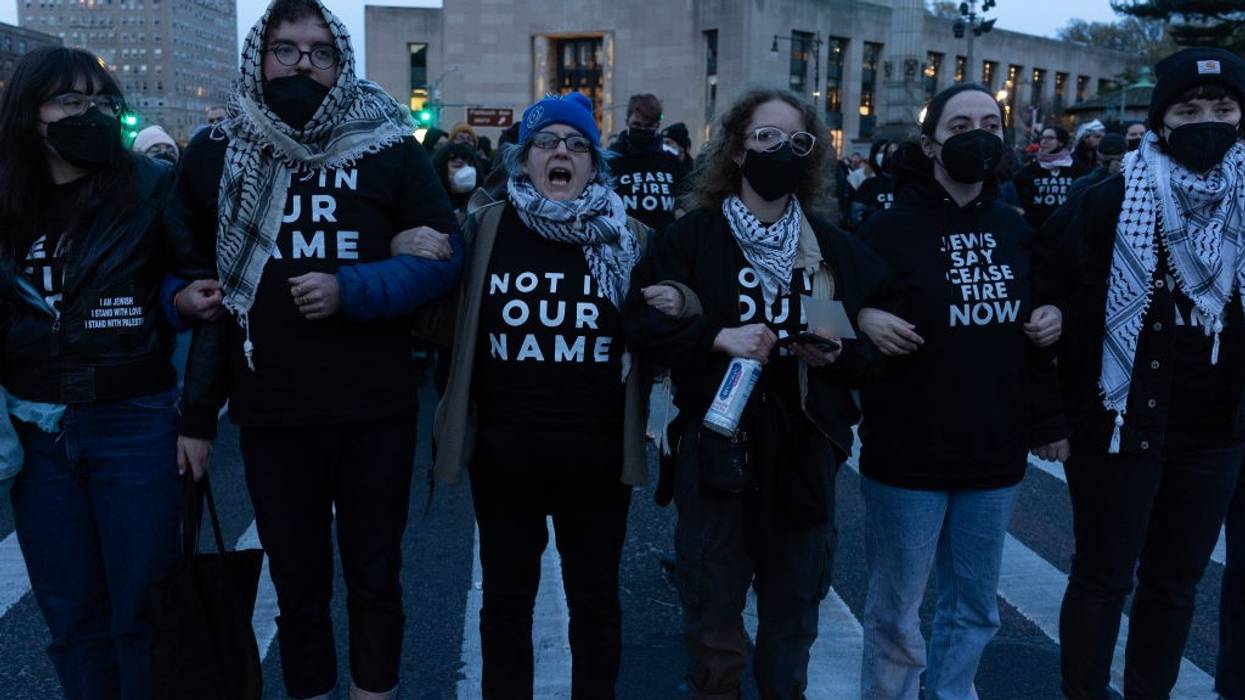
In a historical moment where Jewish identity is facing political and moral division, the inquisitive nature of the Four Children can inspire a new generation of Jewish families to question what we have been told about Palestinians in Gaza.
During the Passover seder, Jewish families recall our cultural yearning for freedom and liberation through storytelling and asking questions. This week, families across the Jewish world will gather to retell an ancient story, connecting with ancestors who passed on to us a generations-old struggle for justice and peace.
But what makes this night different from all other nights? This Passover, Jewish communities will continue to witness a rupture over Israel’s actions in Gaza, while Israel’s attacks on Iran and Lebanon will surely generate new questions. But, unlike the Four Children, or the child reciting, “Mah Nishtana,” many Jewish children will have their questions left unanswered.
By exploring what the Four Children might ask in this moment, and offering answers aligned to our Jewish values, we honor rather than shy away from the Jewish tradition of asking questions.
The wise one, what does he say? “What are the testimonies, the statutes, and the laws which the LORD, our God, has commanded you?” And you shall tell him the laws of Pesach.
If we truly want to honor our traditions and values, we must not shy away from difficult questions.
The wise child asks, “What are the testimonies of Palestinians in Gaza? What are the international laws that nations follow? What are the Jewish ethics which our ancestors have passed to us?”
When the wise child asks for testimony, you must share the countless firsthand accounts of Palestinians in Gaza who have endured deteriorating conditions and cruelty at the hands of the Israeli military.
When the child asks for statutes, you must guide them to United Nations reports, International Court of Justice cases, and International Criminal Court investigations that provide evidence of war crimes and genocide.
When the wise child asks for laws, you must show how our Jewish texts instruct us to value all life, command us against standing “idly by the blood of another,” and teach us to honor each soul as a universe.
The wicked one, what does he say? “What is this service to you?” He says, “to you,” but not to him. By thus excluding himself from the community he has denied that which is fundamental.
The wicked child asks, “Why do they deserve this?” “They,” the child says, and not Palestinians, not families, not human beings. When the child excludes others from humanity, they exclude themself. You must call them in and say, “we must stand with Palestinians facing genocide in Gaza.” “We,” and not, “I,” for our safety is intertwined.
The simple one, what does he say? “What is this?”
The simple child asks, “What is this?” What is the truth about Gaza?” He hears opposing narratives in the news, on his phone, and in his Jewish community. He hears Zionists describe the people who live in Gaza as terrorists, animals, and other dehumanizing labels justifying collective punishment. He sees another reality, a mosaic of humanity–children, doctors, journalists, and families– experiencing profound grief and suffering.
The simple child is confused, and we must direct him to seek truth and act in alignment with his Jewish values: Never again means never again for anyone.
As for the one who does not know how to ask, you must open [the story] for him [...]
And for the child who doesn’t know how to ask, you must open a path for them to question the narratives that Zionists tell of Palestinians in Gaza, just as Jewish culture teaches us to question, challenge, and debate our traditions and worldviews.
Passover is a testament to the power of retelling stories that resonate across generations. The Four Children, a key part of the Passover haggadah, have always acted as archetypes of Jewish engagement. In a historical moment where Jewish identity is facing political and moral division, the inquisitive nature of the Four Children can inspire a new generation of Jewish families to question what we have been told about Palestinians in Gaza.
If we truly want to honor our traditions and values, we must not shy away from difficult questions. Nor should our answers ignore the parts of our tradition that teach us to prioritize life, to love the stranger, and to challenge our worldviews. Our children deserve nothing less.
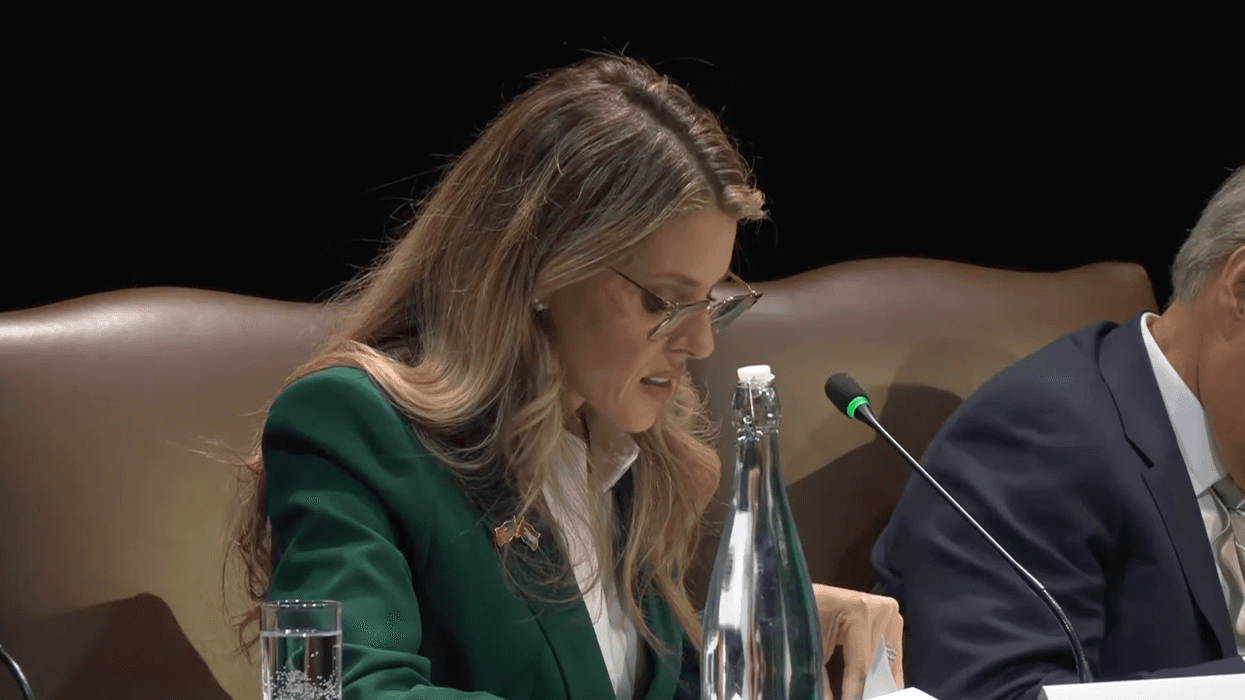
"I will not be bullied," said Carrie Prejean Boller. "I have the religious freedom to refuse support for a government that is bombing civilians and starving families in Gaza, and that does not make me an antisemite."
A conservative Catholic was expelled from President Donald Trump's so-called Religious Liberty Commission this week over remarks at a hearing on antisemitism in which she pushed back against those who conflate criticism of Israel and its genocidal war on Gaza with hatred of Jewish people.
Religious Liberty Commission Chair Dan Patrick, who is also Texas' Republican lieutenant governor, announced Wednesday that Carrie Prejean Boller had been ousted from the panel, writing on X that "no member... has the right to hijack a hearing for their own personal and political agenda on any issue."
"This is clearly, without question, what happened Monday in our hearing on antisemitism in America," he claimed. "This was my decision."
Patrick added that Trump "respects all faiths"—even though at least 13 of the commission's remaining 15 members are Christian, only one is Jewish, and none are Muslim, Hindu, Buddhist, or other religions to which millions of Americans adhere. A coalition of faith groups this week filed a federal lawsuit over what one critic described as the commission's rejection of "our nation’s religious diversity and prioritizing one narrow set of conservative ‘Judeo-Christian’ beliefs."
Noting that Israeli forces have killed "tens of thousands of civilians in Gaza," Prejean Boller asked panel participant and University of California Los Angeles law student Yitzchok Frankel, who is Jewish, "In a country built on religious liberty and the First Amendment, do you believe someone can stand firmly against antisemitism... and at the same time, condemn the mass killing of Palestinians in Gaza, or reject political Zionism, or not support the political state of Israel?"
"Or do you believe that speaking out about what many Americans view as genocide in Gaza should be treated as antisemitic?" added Prejean Boller, who also took aim at the International Holocaust Remembrance Alliance (IHRA) Working Definition of Antisemitism, which has been widely condemned for conflating criticism of Israel with anti-Jewish bigotry.
Frankel replied "yes" to the assertion that anti-Zionism is antisemitic.
Prejean Boller also came under fire for wearing pins of US and Palestinian flags during Monday's hearing.
"I wore an American flag pin next to a Palestinian flag as a moral statement of solidarity with civilians who are being bombed, displaced, and deliberately starved in Gaza," Prejean Boller said Tuesday on X in response to calls for her resignation from the commission.
"I did this after watching many participants ignore, minimize, or outright deny what is plainly visible: a campaign of mass killing and starvation of a trapped population," she continued. "Silence in the face of that is not religious liberty, it is moral complicity. My Christian faith calls on me to stand for those who are suffering [and] in need."
"Forcing people to affirm Zionism as a condition of participation is not only wrong, it is directly contrary to religious freedom, especially on a body created to protect conscience," Prejean Boller stressed. "As a Catholic, I have both a constitutional right and a God-given freedom of religion and conscience not to endorse a political ideology or a government that is carrying out mass civilian killing and starvation."
Zionism is the movement for a homeland for the Jewish people in Palestine—their ancestral birthplace—under the belief that God gave them the land. It has also been criticized as a settler-colonial and racist ideology, as in order to secure a Jewish homeland, Zionists have engaged in ethnic cleansing, occupation, invasions, and genocide against Palestinian Arabs.
Prejean Boller was Miss California in 2009 and Miss USA runner-up that same year. She launched her career as a Christian activist during the latter pageant after she answered a question about same-sex marriage by saying she opposed it. Then-businessman Trump owned most of Miss USA at the time and publicly supported Prejean Boller, saying "it wasn't a bad answer."
Since then, Prejean Boller has been known for her anti-LGBTQ+ statements and for paying parents and children for going without masks during the Covid-19 pandemic.
The Council on American-Islamic Relations (CAIR) commended Prejean Boller Wednesday "for using her position to oppose conflating criticism of Israel with antisemitism and encourage solidarity between Muslims, Christians, and Jews," calling her "one of a growing number of Americans, including political conservatives, who recognize that corrupted politicians have been trying to silence and smear Americans critical of the Israeli government under the guise of countering antisemitism."
"We also condemn Texas Lt. Gov. Patrick’s baseless and predictable decision to remove her from the commission for refusing to conflate antisemitism with criticism of the Israel apartheid government," CAIR added.
In her statement Tuesday, Prejean Boller said, "I will not be bullied."
"I have the religious freedom to refuse support for a government that is bombing civilians and starving families in Gaza, and that does not make me an antisemite," she insisted. "It makes me a pro-life Catholic and a free American who will not surrender religious liberty to political pressure."
"Zionist supremacy has no place on an American religious liberty commission," Prejean Boller added.
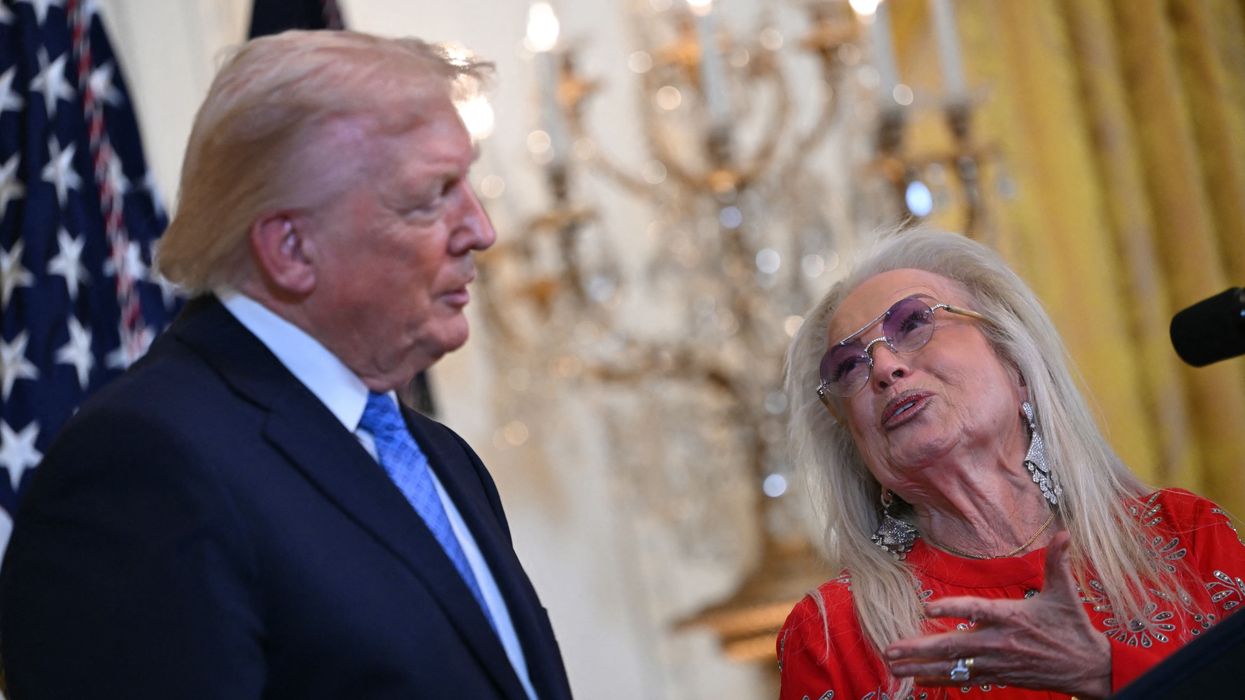
"I will give," said the Republican mega-donor with a smile.
Billionaire Miram Adelson on Tuesday night suggested the legal obstacles for President Donald Trump to serve an additional term in office after 2028 are not insurmountable as the far-right Republican megadonor vowed another $250 million to bolster a run that experts say would be unlawful and unconstitutional on its face.
Adelson, a hardline Zionist who, along with her now deceased husband, Sheldon Adelson, has given hundreds of millions to US lawmakers who back a strong relationship between the US and Israeli governments, was sharing the podium with Trump during a Hanukkah candlelighting event at the White House when she made the remarks.
With a reference to Harvard law professor Alan Dershowitz, Adelson said they had discussed "the legal thing of four more years"—something Trump has repeatedly gestured toward and many of his backers have called for—and told Trump, “So, we can do it, think about it.”
A chant in the crowd then broke out for "For four more years!" as Adelson whispered something in Trump's ear.
“She said, ‘Think about it, I’ll give you another $250 million,’” Trump then said into the microphone. "I will give," Adelson said with a smile.
Watch the exchange:
Adelson: I met Alan Dershowitz.. he said.. four more years. We can do it. Think about it.
Crowd: *chants four more years*
Trump: She said think about it, I’ll give you another 250 million pic.twitter.com/eOc7Zazyns
— Acyn (@Acyn) December 17, 2025
For Trump's 2024 presidential campaign alone, Adelson gave at least $100 million to support the Republican candidate with Super PAC she established, according to federal filings.
In his remarks on Tuesday, Trump credited Adelson with providing him $250 million overall—"directly and indirectly"—during his 2024 bid.
"When someone can you $250 million, I think that we should give her the opportunity to say hello," Trump said, when introducing her. "And Miriam, make it quick, because $250 million is not what it used to be."
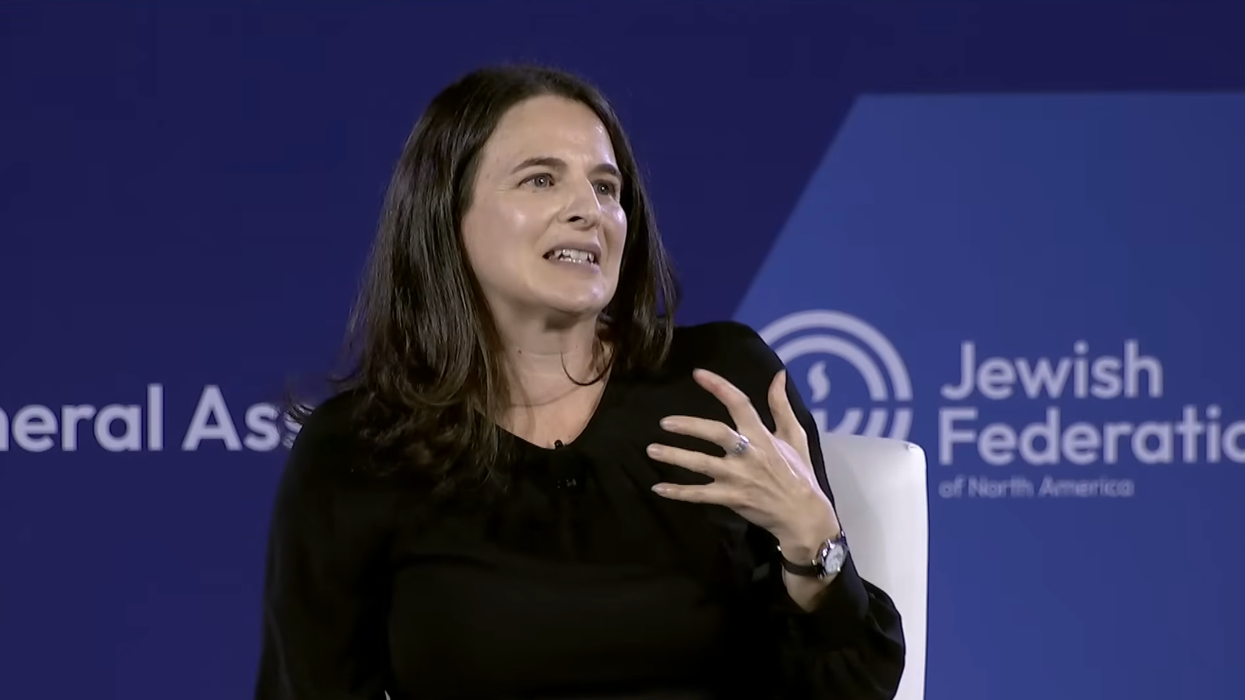
"Holocaust education is too successful, it made the kids anti-holocaust while Israel is trying to do one," quipped one prominent critic.
A speechwriter for prominent Democrats including former President Barack Obama and presidential candidates Hillary Clinton and John Kerry faced widespread outrage this week after video emerged of her blaming Holocaust education for young Jews' empathy for Palestinians in Gaza and revulsion at Israel's genocidal war there.
Earlier this week, Sarah Hurwitz—who was also a senior speechwriter for former First Lady Michelle Obama and other Democrats—spoke at the opening plenary of this year's Jewish Federations of North America general assembly in Washington, DC. The event featured speakers including Free Press staff writer Olivia Reingold, who implicitly attempted to absolve Israel from blame for the Gaza famine by noting that 12 of the at least 463 Palestinians who starved to death had preexisting health conditions.
"There have been huge shifts in America on how people think about Jews and Israel, and I think that is especially true of young people," Hurwitz said during the panel discussion, noting the rise of social media as a primary source of news and information.
"Today, we have social media," she added "Its algorithms are shaped by billions of people worldwide who don't really love Jews."
Hurwitz continued:
It's also this increasingly post-literate media. Less and less text, more and more videos, so you have TikTok just smashing our young peoples' brains all day long with video of carnage in Gaza. And this is why so many of us can't have a sane conversation with younger Jews, because anything we try to say to them, they are hearing it through this wall of carnage. So I wanna give data and information and facts and arguments and they are just seeing in their minds carnage, and I sound obscene.
"I think, unfortunately, the very smart... bet we made on Holocaust education to serve as antisemitism education, in this new media environment, I think that is beginning to break down a little bit, because Holocaust education is absolutely essential," Hurwitz asserted.
"But I think it may be confusing some of our young people about antisemitism, because they learn about big, strong Nazis hurting weak, emaciated Jews," she added, "...so when on TikTok all day long they see powerful Israelis hurting weak, skinny Palestinians, it's not surprising that they think, 'Oh, I know, the lesson of the Holocaust is you fight Israel, you fight the big powerful people hurting the weak people.'"
Reaction to Hurwitz' remarks ranged from incredulity to anger.
"I am almost literally speechless," American-Arab Anti-Discrimination Committee nation legal director Jenin Younes said on X. "She's decrying the fact that kids' takeaway from Holocaust education has been that we must protect helpless people from powerful people killing them. The real lesson from the Holocaust, it seems, is that Israel must be able to commit genocide if it wants to."
Argentinian economist Maia Mindel also took to X, writing that it is "extremely grim that a substantial number of very influential people seem to think that the lesson from the Holocaust isn't 'mass murder of civilians based on their ancestry so your nation can take their land is wrong' but rather, 'Fuck you, got mine.'"
Jewish Currents editor-at-large Peter Beinart wrote on X that "the level of condescension" in Hurwitz's commentary "is quite remarkable."
Writer Bryce Greene lamented: "We're at the point where Israels supporters are now claiming that the Holocaust was not bad because it was the powerful attacking the weak."
"No, that would be the wrong lesson from the Holocaust," he added. "According to them it was only bad because Jews were the victims. Real sick shit."
Independent journalist Ahmed Eldin said on X that "Zionism is so morally bankrupt it sees empathy as a design flaw."
Eldin wrote Wednesday on his Substack that "Hurwitz didn’t slip up—she said the quiet part out loud and exposed the Zionist project for exactly what it is."
"She even admitted that, amidst the carnage, she sounds 'obscene,'" he noted. "That admission, said almost accidentally, is the closest thing to honesty her worldview will allow: The problem is not the violence of Zionism itself, but the visibility of it. Zionism, as she inadvertently revealed, depends not on morality but on opacity. The ideology requires not less brutality, but simply fewer witnesses."
Moving on to Holocaust education, Eldin wrote:
According to Hurwitz, Holocaust curricula have “backfired” because they taught young people that “you fight the big powerful people hurting the weak people.” In her telling, this universal ethical principle—this most basic moral intuition—is the problem.
The implication is staggering: the “correct” lesson of the Holocaust, she seems to believe, is not “never again for anyone,” but “never question Israel.” What outrages her is not the suffering of Palestinians but the possibility that young people are recognizing it as suffering.
"A world that is witnessing and seeing Palestinians as human is a world in which Zionism cannot function," Eldin concluded. "A world that sees the violence cannot romanticize the ideology producing it. Once people witness the truth, the mythology cannot be resuscitated and the propaganda cannot be rehabilitated."
"Israel may be able to flatten Gaza’s buildings, but it cannot rebuild the ignorance it once relied upon," he added. "The truth is already out, the narrative collapse well underway, the mask irretrievably gone."
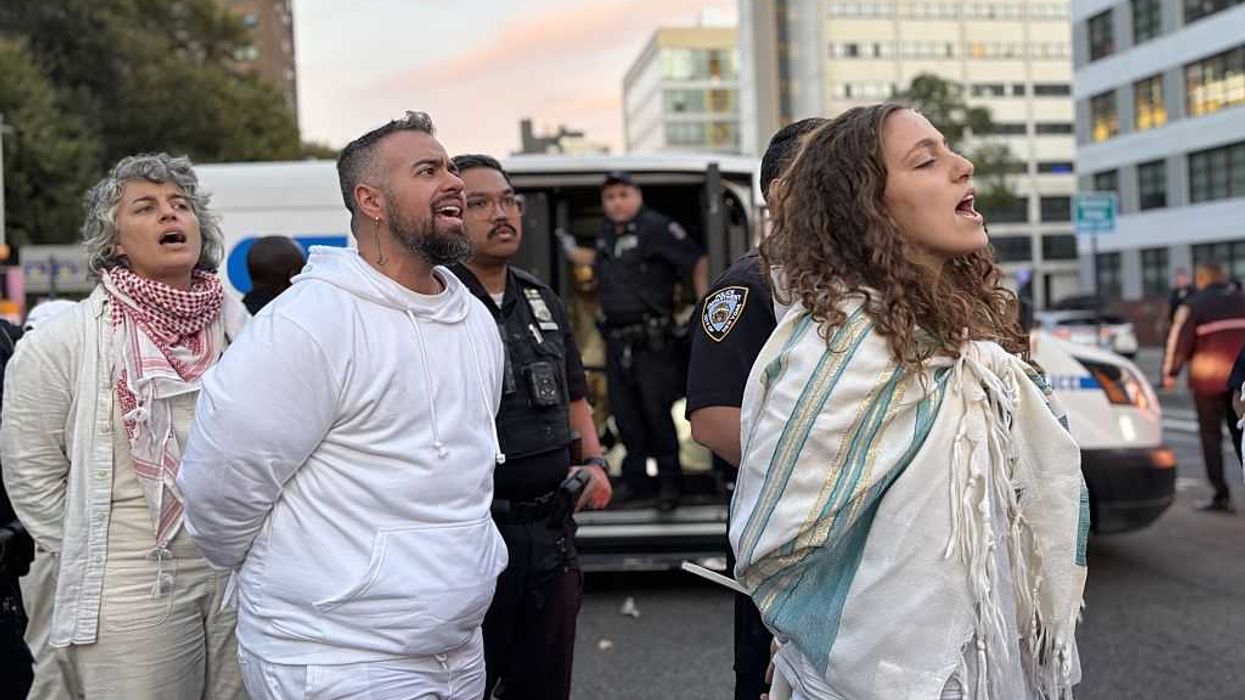
Protesters blocked traffic to the Brooklyn Bridge, embodying the ancient Jewish tenets of justice, righteousness, and saving life.
Dozens of people were arrested in New York City on Thursday during a protest led by rabbis on Yom Kippur—the holiest day of the Jewish calendar—demanding a permanent ceasefire in Gaza and an end to US complicity in Israel's genocide.
More than 1,000 Jews plus allies turned out for the demonstration, which was led by the group Rabbis for Ceasefire. The protest started around 3:30 pm local time at Brooklyn Borough Hall, where rabbis led a Yizkor, a memorial prayer of mourning recited just four times per year, including on Yom Kippur, the Jewish day of atonement and repentance.
Some protesters carried a banner reading, "Not Another Bomb," written in Hebrew and English.
"Our heart is broken for every single person who has been murdered, and we want to convey the fact that this has to end," Rabbi Elliot Kukla told CBS New York.
Protesters then marched to the Brooklyn Bridge, where some sat down, locked their arms together, and sang while blocking traffic to the span. New York Police Department (NYPD) officers subsequently arrested at least 56 people, according to the New York Post.
Many of the arrested protesters chanted, "Let Gaza Live!" as their hands were zip-tied and they were hauled off to an awaiting NYPD bus.
Asked why she was arrested, one keffiyeh-clad woman said, "Because I’m using this sacred holiday of Yom Kippur, as a Jewish person whose ancestors perished during the Holocaust, to protest against the genocide of the Palestinian people in my name."
"And I say, not in my name," she added.
- YouTube
Speakers at the protest included New York City Comptroller Brad Lander—an ally of Democratic mayoral candidate and staunch Palestine defender Zohran Mamdani—who told the crowd that "we must today take collective responsibility for what the Israeli government has been doing, is doing today, on Yom Kippur," with "over 65,000 Palestinians killed, mostly women and children, whole families wiped out, food used as a weapon."
Earlier this week, President Donald Trump welcomed Israeli Prime Minister Benjamin Netanyahu at the White House. The right-wing Israeli leader is a fugitive from the International Criminal Court in The Hague, which last year ordered his arrest for alleged crimes against humanity and war crimes, including murder and forced starvation.
Like former President Joe Biden before him, Trump has approved billions of dollars in US armed aid to Israel, even while senior Trump administration officials acknowledge that children and others are starving to death in Gaza.
Lander took aim at US complicity in the genocide, decrying "the bombs funded by our taxpayer dollars in the name of the Jewish state," as well as the "desecration of Judaism."
Grateful to Rabbis for Ceasefire, @jfrejnyc.bsky.social and the other organizers of yesterday's mass mourning and collective atonement at Brooklyn Borough Hall. Let us steady and care for one another, and persevere together. #YomKippur
[image or embed]
— Office of NYC Comptroller Brad Lander (@nyccomptroller.bsky.social) October 3, 2025 at 8:01 AM
The Jewish religion emphasizes the ancient tenets of tzedek, mishpat, and din—righteousness, justice, and law—as well as pikuach nefesh, or saving life, which overrides nearly every other religious law including kosher dietary restrictions and keeping the Sabbath.
Just 2.4% of the US population, Jews have had an outsize presence at pro-Palestine demonstrations since October 2023, with groups like Jewish Voice for Peace, IfNotNow, and Rabbis for Ceasefire often leading large protests against Israel's war and US complicity under both Trump and Biden.
Jews have opposed Zionism—the mainly European settler-colonial movement to reestablish a Jewish homeland in Palestine—since the earliest days of the experiment. Even some early Zionists foresaw the genesis of events like the Hamas-led October 7, 2023 attack on Israel, with Ahad Ha'am, father of cultural Zionism, writing after an 1891 trip to Palestine that "if the time comes when [Jews are] encroaching upon the native population, they will not easily yield their place."
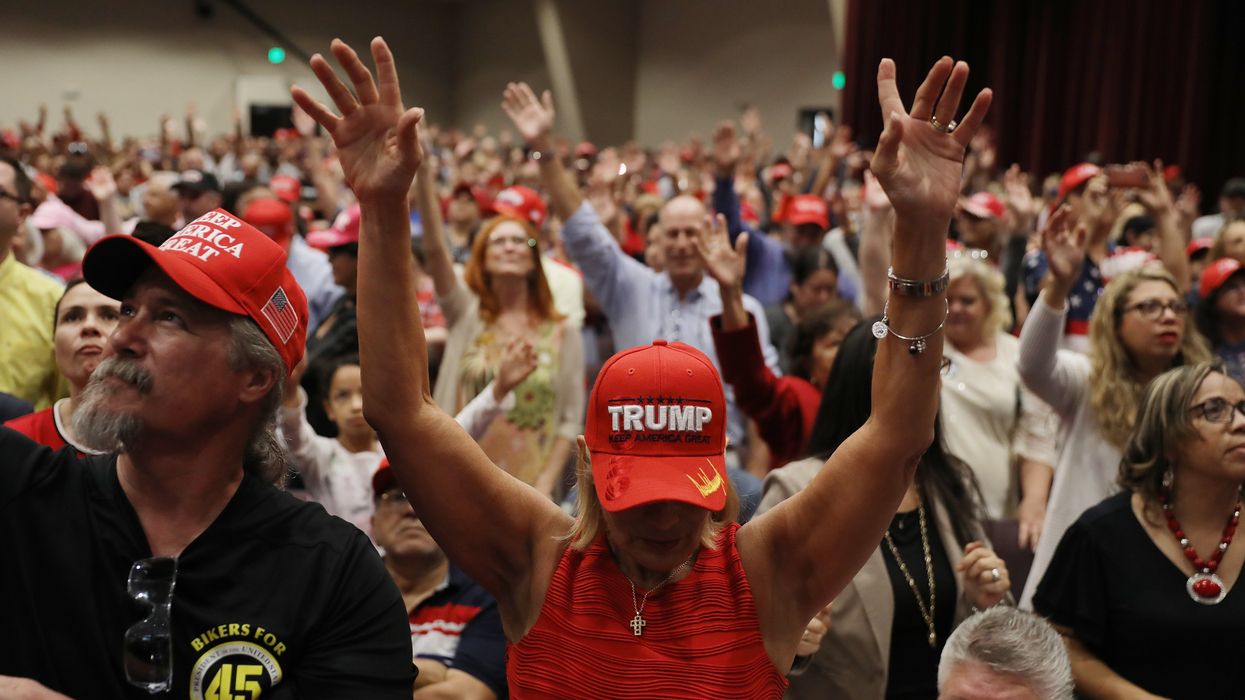
We condemn extremism abroad while ignoring the holy mandates shaping law, policy, and life right here at home.
I was a political science student in college when 9-11 happened. Almost overnight, the air in our classrooms thickened with talk of the Middle East—of regimes and sects, of the supposed sickness in other people’s faith. At the same time, I sat in lectures on American government, absorbing lessons on freedom, the separation of church and state, and the principles that anchor a democracy. The story was tidy: Extremism existed “over there,” and here was civility, rationality, liberty.
But even then, I felt the story was too neat. We were trained to see extremism as foreign, an affliction of others. No one asked us to look for it in our own pulpits, in our own chambers of power, where faith is wielded not only as belief but as authority.
For decades, we were told that extremism abroad is born of poverty, oppression, and lack of democracy. That dignity and fair governance could inoculate against violence. Yet here at home, the extremists are not poor. They are not desperate. They are wealthy, white, and privileged, carrying Bibles in one hand and power in the other. These are the people shaping foreign policy, writing the rules of engagement, and insisting that God Himself is on their side.
It is easy to sneer at fundamentalism when it wears a beard and prays to a different God. We do this without noticing how our own leaders claim the same divine sanction. Take Sen. Ted Cruz (R-Texas), who recently said, “Those who bless Israel will be blessed, and those who curse Israel will be cursed,” a statement guiding policy on the basis of religious prophecy. As a result, borders are drawn and redrawn, not by maps or treaties, but by the conviction that scripture demands it. Tanks move forward because some believe the end times will be hastened by the blood spilled today. I have heard lawmakers speak of Israel not as a nation among nations, but as a ticket for their own salvation—a stage for the rapture. Lives are traded away for a promise written in ancient ink. Too often, it is prophecy, not policy, that carries the weight of law.
The divine is always invoked to conquer, to exclude, to strip away the humanity of others.
Charlie Kirk was another voice in this chorus. His platform rested on the claim that his words bore the imprint of Jesus Himself. And that is the mark of fundamentalism: not just to speak, but to declare speech holy. Not just to pass laws, but to claim the laws come from God. When movements convince their followers that every act of war, every border drawn, every vote cast is sanctified, fundamentalism is no longer a fringe—it is the system itself.
This is America’s problem. We imagine fundamentalism as the product of religion alone, but in truth it is about power. It thrives in systems that punish dissent and demand obedience. It flourishes where inequality is already deep, where racism already wounds. Whether it calls itself Christian nationalism or Zionism, the fruit is the same: oppression disguised as divine order.
Christian nationalism, in particular, is theater. Fear of the stranger is the script. The Gospels are props—quoted when convenient, discarded when not. The gun becomes holy; violence is celebrated as sacrament; scripture appears only to bless white entitlement and empire. And somehow, the divine is always invoked to conquer, to exclude, to strip away the humanity of others.
“Love the stranger as yourself” has been rewritten into “expel the immigrant.” “Turn the other cheek” has become “press his cheek into the ground.” The inversion is so stark you can only call it blasphemy.
It is time to see the truth we’ve trained ourselves to ignore: that the politics of faith are not a distant problem but a domestic one. That prophecy and scripture are invoked to shape our laws, and our laws shape our lives. That the moral high ground, so often claimed, is little more than a thin veneer of power and entitlement.
We are not exempt from the damage. We are participants in it. And we cannot keep pretending that America’s fundamentalists are not pulling the strings.