Rick Santorum started the 2012 presidential race as an asterisk seemingly destined for footnote status.
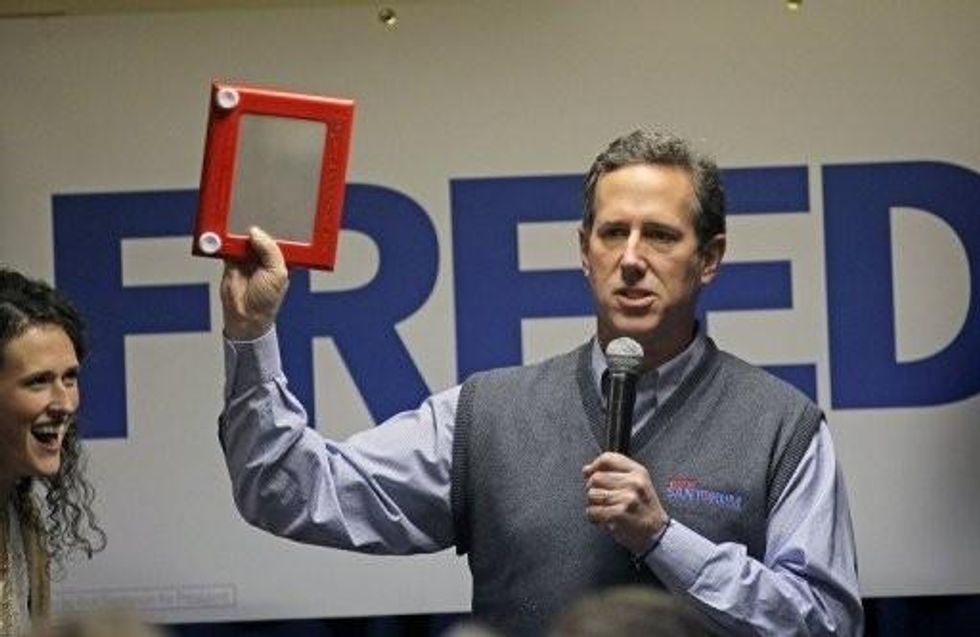
But Mitt Romney made Santorum a contender--so much so that, if the now all-but-certain Republican nominee loses to Democrat Barack Obama in November--Santorum may merit a chapter of his own in the "Making of the President" books.
That's because, though Santorum is now out of the running, the campaign that he ended on Tuesday (appropriately enough at Gettysburg) will continue to define Romney.
Santorum improbable rise from bit player to potentially definitional figure in the 2012 contest was entirely the result of Anybody-But-Romney sentiment within a fractured Republican Party.
No one has been running for the 2012 Republican presidential nomination for longer than Romney. He began campaigning back in the middle of George Bush's second term, stumbled through a 2008 bid and then kept on running.
Romney was almost always the frontrunner.
But he was never loved, or even liked all that much, by Republican voters. Even to the last--in the Wisconsin and Maryland primaries of April 3--Romney could not get 50 percent of the vote. Republican voters in thirteen primary and caucus states gave wins to someone other than Romney. Four states put Romney in third place. Where Romney did win, if was more often than not by narrow margins--as in battleground states such as Michigan, Ohio and Wisconsin. And though the former governor of Massachusetts built and maintained a steady delegate lead, most Republicans vted for someone else--as of April 3, only 41 percent of GOP primary and caucus voters had backed Romney. The combined vote for other Republicans was roughly 6.6 million to around 4.5 million for Mr. Mitt.
The story of the 2012 Republican presidential race was not of Romney's growing popularity. To the end, the candidate and his Super PAC had to spend dramatically in order to scrape out victories against the always under-funded and often-bumbling Santorum campaign.
No, the story of the 2012 Republican presidential race was of a desperate search by most Republicans for Anyone But Romney. They never trusted the independent who gave money to Democrats turned liberal Republican turned moderate Republican turned sort-of conservative turned right-wing ranter.
The great mass of Republican tried as hard as they could to find an alternative: Michele Bachmann, Herman Cain, Newt Gingrich, Ron Paul, New Gingrich again and, at last, Santorum.
The defeated former senator from Pennsylvania, who was never even all that big a deal when he served in Congress and whose theocratic stances disqualified him even in the eyes of serious GOP strategists, never really got a break.
He won the Iowa caucuses, but only had the victory confirmed weeks after the headline gave the starting state to Romney.
Then he bumbled his way through New Hampshire, South Carolina and Florida, fighting with Gingrich for anti-Romney status.
Only when the race moved to caucus states such as Minnesota and Iowa, where his extreme religious-right base could sustain him, did Santorum start to get real traction. But when Santorum's moment finally came, enough of party's Christian conservative establishment fell behind him to give Romney a real problem.
As Santorum finally emerged as the anti-Romney, for a series of March contests in midwestern and western caucus states, southern contests and Great Lakes state primaries, his rhetorical extremism pulled the race further and further to the right. To remain in contention, Romney had to divert from his comfort zone: drab managerial discussions about the economy. A frontrunner who had wanted to present himself as a CEO contender instead was forced to defend assualts on reproductive rights and basic protections for women, to explore the far reaches of Islamophobiic foreign policy and to engage in rants about Obama's "secularism" that seemed to try and out-do Santorum when it came to blurring the lines of church-state separation.
Now, polling suggests that Romney is struggling to overcome a gaping gender gap.
It won't be easy for Romney to close that gap. He said and did things during the 2012 primary campaign that will provide fodder for Democrats throughout the fall race.
Romney enters that competition now--with the suspension of the campaign of his last serious Republican rival--as a far weaker contender than the man who began the 2012 race as the GOP frontrunner. His approval ratings are lower, his poll numbers are worse and his record is far more vulnerable to attack.
The latest Washington Post-ABC News poll give the president a 51-44 lead over Romney--a far wider lead than Obama or his aides imagined he would have at this point. And women favor Obama over Romney by 19 points.
Romney tried very hard at the start of the 2012 race to avoid saying and doing things that would define him as an unacceptable contender for swing voters, moderates and women.
But Rick Santorum--and to a lesser extent Newt Gingrich and Ron Paul--forced Romney to go where the candidate and his handlers did not want to go.
That diversion has defined the man who will now carry the GOP banner into the fall competition.
To be sure, Romney was always a weak prospect with many flaws. But the long contest, and especially the last month or so of wrangling with the persistent Santorum, exposed all of those flaws.
Rick Santorum started the 2012 presidential race as an asterisk seemingly destined for footnote status.
But Mitt Romney made Santorum a contender--so much so that, if the now all-but-certain Republican nominee loses to Democrat Barack Obama in November--Santorum may merit a chapter of his own in the "Making of the President" books.
That's because, though Santorum is now out of the running, the campaign that he ended on Tuesday (appropriately enough at Gettysburg) will continue to define Romney.
Santorum improbable rise from bit player to potentially definitional figure in the 2012 contest was entirely the result of Anybody-But-Romney sentiment within a fractured Republican Party.
No one has been running for the 2012 Republican presidential nomination for longer than Romney. He began campaigning back in the middle of George Bush's second term, stumbled through a 2008 bid and then kept on running.
Romney was almost always the frontrunner.
But he was never loved, or even liked all that much, by Republican voters. Even to the last--in the Wisconsin and Maryland primaries of April 3--Romney could not get 50 percent of the vote. Republican voters in thirteen primary and caucus states gave wins to someone other than Romney. Four states put Romney in third place. Where Romney did win, if was more often than not by narrow margins--as in battleground states such as Michigan, Ohio and Wisconsin. And though the former governor of Massachusetts built and maintained a steady delegate lead, most Republicans vted for someone else--as of April 3, only 41 percent of GOP primary and caucus voters had backed Romney. The combined vote for other Republicans was roughly 6.6 million to around 4.5 million for Mr. Mitt.
The story of the 2012 Republican presidential race was not of Romney's growing popularity. To the end, the candidate and his Super PAC had to spend dramatically in order to scrape out victories against the always under-funded and often-bumbling Santorum campaign.
No, the story of the 2012 Republican presidential race was of a desperate search by most Republicans for Anyone But Romney. They never trusted the independent who gave money to Democrats turned liberal Republican turned moderate Republican turned sort-of conservative turned right-wing ranter.
The great mass of Republican tried as hard as they could to find an alternative: Michele Bachmann, Herman Cain, Newt Gingrich, Ron Paul, New Gingrich again and, at last, Santorum.
The defeated former senator from Pennsylvania, who was never even all that big a deal when he served in Congress and whose theocratic stances disqualified him even in the eyes of serious GOP strategists, never really got a break.
He won the Iowa caucuses, but only had the victory confirmed weeks after the headline gave the starting state to Romney.
Then he bumbled his way through New Hampshire, South Carolina and Florida, fighting with Gingrich for anti-Romney status.
Only when the race moved to caucus states such as Minnesota and Iowa, where his extreme religious-right base could sustain him, did Santorum start to get real traction. But when Santorum's moment finally came, enough of party's Christian conservative establishment fell behind him to give Romney a real problem.
As Santorum finally emerged as the anti-Romney, for a series of March contests in midwestern and western caucus states, southern contests and Great Lakes state primaries, his rhetorical extremism pulled the race further and further to the right. To remain in contention, Romney had to divert from his comfort zone: drab managerial discussions about the economy. A frontrunner who had wanted to present himself as a CEO contender instead was forced to defend assualts on reproductive rights and basic protections for women, to explore the far reaches of Islamophobiic foreign policy and to engage in rants about Obama's "secularism" that seemed to try and out-do Santorum when it came to blurring the lines of church-state separation.
Now, polling suggests that Romney is struggling to overcome a gaping gender gap.
It won't be easy for Romney to close that gap. He said and did things during the 2012 primary campaign that will provide fodder for Democrats throughout the fall race.
Romney enters that competition now--with the suspension of the campaign of his last serious Republican rival--as a far weaker contender than the man who began the 2012 race as the GOP frontrunner. His approval ratings are lower, his poll numbers are worse and his record is far more vulnerable to attack.
The latest Washington Post-ABC News poll give the president a 51-44 lead over Romney--a far wider lead than Obama or his aides imagined he would have at this point. And women favor Obama over Romney by 19 points.
Romney tried very hard at the start of the 2012 race to avoid saying and doing things that would define him as an unacceptable contender for swing voters, moderates and women.
But Rick Santorum--and to a lesser extent Newt Gingrich and Ron Paul--forced Romney to go where the candidate and his handlers did not want to go.
That diversion has defined the man who will now carry the GOP banner into the fall competition.
To be sure, Romney was always a weak prospect with many flaws. But the long contest, and especially the last month or so of wrangling with the persistent Santorum, exposed all of those flaws.
Rick Santorum started the 2012 presidential race as an asterisk seemingly destined for footnote status.
But Mitt Romney made Santorum a contender--so much so that, if the now all-but-certain Republican nominee loses to Democrat Barack Obama in November--Santorum may merit a chapter of his own in the "Making of the President" books.
That's because, though Santorum is now out of the running, the campaign that he ended on Tuesday (appropriately enough at Gettysburg) will continue to define Romney.
Santorum improbable rise from bit player to potentially definitional figure in the 2012 contest was entirely the result of Anybody-But-Romney sentiment within a fractured Republican Party.
No one has been running for the 2012 Republican presidential nomination for longer than Romney. He began campaigning back in the middle of George Bush's second term, stumbled through a 2008 bid and then kept on running.
Romney was almost always the frontrunner.
But he was never loved, or even liked all that much, by Republican voters. Even to the last--in the Wisconsin and Maryland primaries of April 3--Romney could not get 50 percent of the vote. Republican voters in thirteen primary and caucus states gave wins to someone other than Romney. Four states put Romney in third place. Where Romney did win, if was more often than not by narrow margins--as in battleground states such as Michigan, Ohio and Wisconsin. And though the former governor of Massachusetts built and maintained a steady delegate lead, most Republicans vted for someone else--as of April 3, only 41 percent of GOP primary and caucus voters had backed Romney. The combined vote for other Republicans was roughly 6.6 million to around 4.5 million for Mr. Mitt.
The story of the 2012 Republican presidential race was not of Romney's growing popularity. To the end, the candidate and his Super PAC had to spend dramatically in order to scrape out victories against the always under-funded and often-bumbling Santorum campaign.
No, the story of the 2012 Republican presidential race was of a desperate search by most Republicans for Anyone But Romney. They never trusted the independent who gave money to Democrats turned liberal Republican turned moderate Republican turned sort-of conservative turned right-wing ranter.
The great mass of Republican tried as hard as they could to find an alternative: Michele Bachmann, Herman Cain, Newt Gingrich, Ron Paul, New Gingrich again and, at last, Santorum.
The defeated former senator from Pennsylvania, who was never even all that big a deal when he served in Congress and whose theocratic stances disqualified him even in the eyes of serious GOP strategists, never really got a break.
He won the Iowa caucuses, but only had the victory confirmed weeks after the headline gave the starting state to Romney.
Then he bumbled his way through New Hampshire, South Carolina and Florida, fighting with Gingrich for anti-Romney status.
Only when the race moved to caucus states such as Minnesota and Iowa, where his extreme religious-right base could sustain him, did Santorum start to get real traction. But when Santorum's moment finally came, enough of party's Christian conservative establishment fell behind him to give Romney a real problem.
As Santorum finally emerged as the anti-Romney, for a series of March contests in midwestern and western caucus states, southern contests and Great Lakes state primaries, his rhetorical extremism pulled the race further and further to the right. To remain in contention, Romney had to divert from his comfort zone: drab managerial discussions about the economy. A frontrunner who had wanted to present himself as a CEO contender instead was forced to defend assualts on reproductive rights and basic protections for women, to explore the far reaches of Islamophobiic foreign policy and to engage in rants about Obama's "secularism" that seemed to try and out-do Santorum when it came to blurring the lines of church-state separation.
Now, polling suggests that Romney is struggling to overcome a gaping gender gap.
It won't be easy for Romney to close that gap. He said and did things during the 2012 primary campaign that will provide fodder for Democrats throughout the fall race.
Romney enters that competition now--with the suspension of the campaign of his last serious Republican rival--as a far weaker contender than the man who began the 2012 race as the GOP frontrunner. His approval ratings are lower, his poll numbers are worse and his record is far more vulnerable to attack.
The latest Washington Post-ABC News poll give the president a 51-44 lead over Romney--a far wider lead than Obama or his aides imagined he would have at this point. And women favor Obama over Romney by 19 points.
Romney tried very hard at the start of the 2012 race to avoid saying and doing things that would define him as an unacceptable contender for swing voters, moderates and women.
But Rick Santorum--and to a lesser extent Newt Gingrich and Ron Paul--forced Romney to go where the candidate and his handlers did not want to go.
That diversion has defined the man who will now carry the GOP banner into the fall competition.
To be sure, Romney was always a weak prospect with many flaws. But the long contest, and especially the last month or so of wrangling with the persistent Santorum, exposed all of those flaws.