

SUBSCRIBE TO OUR FREE NEWSLETTER
Daily news & progressive opinion—funded by the people, not the corporations—delivered straight to your inbox.
5
#000000
#FFFFFF
To donate by check, phone, or other method, see our More Ways to Give page.
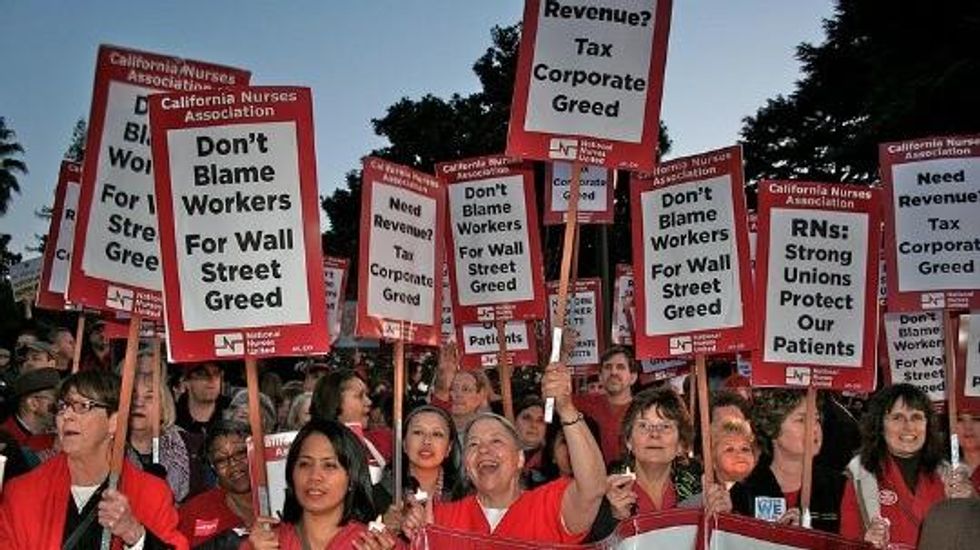
In healthcare the implications are especially insidious. It is a clear assault on the ability of nurses to act collectively to improve safety standards and public protections for patients. If nurses are unable to speak out for patients and act together to safeguard conditions, all patients are threatened in an era in which most hospital employers place their bottom line above patient safety.
When the board is not dominated by corporate-oriented appointees, as it has been most of the past four decades, the game plan of the anti-union crowd is to bar it from operating, either by refusing to confirm appointees, defunding or other destabilization tactics. That was what prompted these recess appointments, made by President Obama only after the Senate minority blocked confirmation of his nominees needed to restore a quorum on the board to enable it to function.
Without a quorum, the effect of the court ruling and the goal of those who brought it, workers experience delays that can drag on for years if they object to unfair discipline, intimidation or harassment by employers, or attempt to form a union to represent them.
In 2007, for example, the California Nurses Association filed labor board charges in response to retaliation by a rural Northern California hospital against RNs for legally protected union activity and other violations of federal law.
After initial board delays, an NLRB administrative law judge ruled in 2009 that the hospital had acted illegally. But when the hospital employer appealed to Washington, the NLRB was unable to act for years because of the lack of a quorum on the NLRB.
Only after the recess appointments were made was the NLRB able to act on this case along with a large backlog of other delayed decisions.
A final decision on the 2007 charge was issued just days ago affirming the 2009 law judge ruling. Now that decision, too, is in jeopardy, further delaying justice for the nurses. Once again justice delayed is justice denied.
That, of course, is the real intent of this court challenge, the obstruction of the Senate in confirming Presidential appointees, and blatant attempts by the U.S. Chamber of Chamber and the politicians they heavily influence. They want to gut any semblance of federal protection for workers who need a collective voice to counter multi-million dollar employers who profit off denying workplace rights, consumer rights, and reducing worker living standards.
Labor law was enacted in the 1930s precisely to provide some balance in the workplace and fairer treatment for workers. It helped sustain the growth of unions which led to dramatic improvements in living standards for all Americans in the 1950s and 1960s.
Since then, the neo-liberal agenda has been to overturn any labor law rights for workers which has contributed to the growing decline of union membership and the concurrent stagnation in wages and economic security for all U.S. workers, while more wealth is transferred to corporate board rooms and private jet owners.
This decision is a further reminder that the labor movement, and all those who believe in workplace and democratic rights, need to step up our efforts to challenge Wall Street, the Chamber and those on its strings. We need to get back in the streets, forcefully challenge those who would deny our rights, and unite a broad movement to press for participatory democracy and social change.
In healthcare the implications are especially insidious. It is a clear assault on the ability of nurses to act collectively to improve safety standards and public protections for patients. If nurses are unable to speak out for patients and act together to safeguard conditions, all patients are threatened in an era in which most hospital employers place their bottom line above patient safety.
When the board is not dominated by corporate-oriented appointees, as it has been most of the past four decades, the game plan of the anti-union crowd is to bar it from operating, either by refusing to confirm appointees, defunding or other destabilization tactics. That was what prompted these recess appointments, made by President Obama only after the Senate minority blocked confirmation of his nominees needed to restore a quorum on the board to enable it to function.
Without a quorum, the effect of the court ruling and the goal of those who brought it, workers experience delays that can drag on for years if they object to unfair discipline, intimidation or harassment by employers, or attempt to form a union to represent them.
In 2007, for example, the California Nurses Association filed labor board charges in response to retaliation by a rural Northern California hospital against RNs for legally protected union activity and other violations of federal law.
After initial board delays, an NLRB administrative law judge ruled in 2009 that the hospital had acted illegally. But when the hospital employer appealed to Washington, the NLRB was unable to act for years because of the lack of a quorum on the NLRB.
Only after the recess appointments were made was the NLRB able to act on this case along with a large backlog of other delayed decisions.
A final decision on the 2007 charge was issued just days ago affirming the 2009 law judge ruling. Now that decision, too, is in jeopardy, further delaying justice for the nurses. Once again justice delayed is justice denied.
That, of course, is the real intent of this court challenge, the obstruction of the Senate in confirming Presidential appointees, and blatant attempts by the U.S. Chamber of Chamber and the politicians they heavily influence. They want to gut any semblance of federal protection for workers who need a collective voice to counter multi-million dollar employers who profit off denying workplace rights, consumer rights, and reducing worker living standards.
Labor law was enacted in the 1930s precisely to provide some balance in the workplace and fairer treatment for workers. It helped sustain the growth of unions which led to dramatic improvements in living standards for all Americans in the 1950s and 1960s.
Since then, the neo-liberal agenda has been to overturn any labor law rights for workers which has contributed to the growing decline of union membership and the concurrent stagnation in wages and economic security for all U.S. workers, while more wealth is transferred to corporate board rooms and private jet owners.
This decision is a further reminder that the labor movement, and all those who believe in workplace and democratic rights, need to step up our efforts to challenge Wall Street, the Chamber and those on its strings. We need to get back in the streets, forcefully challenge those who would deny our rights, and unite a broad movement to press for participatory democracy and social change.
In healthcare the implications are especially insidious. It is a clear assault on the ability of nurses to act collectively to improve safety standards and public protections for patients. If nurses are unable to speak out for patients and act together to safeguard conditions, all patients are threatened in an era in which most hospital employers place their bottom line above patient safety.
When the board is not dominated by corporate-oriented appointees, as it has been most of the past four decades, the game plan of the anti-union crowd is to bar it from operating, either by refusing to confirm appointees, defunding or other destabilization tactics. That was what prompted these recess appointments, made by President Obama only after the Senate minority blocked confirmation of his nominees needed to restore a quorum on the board to enable it to function.
Without a quorum, the effect of the court ruling and the goal of those who brought it, workers experience delays that can drag on for years if they object to unfair discipline, intimidation or harassment by employers, or attempt to form a union to represent them.
In 2007, for example, the California Nurses Association filed labor board charges in response to retaliation by a rural Northern California hospital against RNs for legally protected union activity and other violations of federal law.
After initial board delays, an NLRB administrative law judge ruled in 2009 that the hospital had acted illegally. But when the hospital employer appealed to Washington, the NLRB was unable to act for years because of the lack of a quorum on the NLRB.
Only after the recess appointments were made was the NLRB able to act on this case along with a large backlog of other delayed decisions.
A final decision on the 2007 charge was issued just days ago affirming the 2009 law judge ruling. Now that decision, too, is in jeopardy, further delaying justice for the nurses. Once again justice delayed is justice denied.
That, of course, is the real intent of this court challenge, the obstruction of the Senate in confirming Presidential appointees, and blatant attempts by the U.S. Chamber of Chamber and the politicians they heavily influence. They want to gut any semblance of federal protection for workers who need a collective voice to counter multi-million dollar employers who profit off denying workplace rights, consumer rights, and reducing worker living standards.
Labor law was enacted in the 1930s precisely to provide some balance in the workplace and fairer treatment for workers. It helped sustain the growth of unions which led to dramatic improvements in living standards for all Americans in the 1950s and 1960s.
Since then, the neo-liberal agenda has been to overturn any labor law rights for workers which has contributed to the growing decline of union membership and the concurrent stagnation in wages and economic security for all U.S. workers, while more wealth is transferred to corporate board rooms and private jet owners.
This decision is a further reminder that the labor movement, and all those who believe in workplace and democratic rights, need to step up our efforts to challenge Wall Street, the Chamber and those on its strings. We need to get back in the streets, forcefully challenge those who would deny our rights, and unite a broad movement to press for participatory democracy and social change.

