

One cyberactivist's federal case wrapped up this week, and another's is set to begin. Although these two young men, Jeremy Hammond and Bradley Manning, are the two who were charged, it is the growing menace of government and corporate secrecy that should be on trial.
Hammond was facing more than 30 years in prison, charged with hacking into the computers of a private security and intelligence firm called Strategic Forecasting, or Stratfor, when he agreed to a plea agreement of one count of computer hacking. Stratfor traffics in "geopolitical intelligence, economic, political and military forecasting," according to its website. Yet, after Hammond and others released 5m emails from Stratfor's servers to WikiLeaks, it became clear that the firm engages in widespread spying on activists on behalf of corporations. Coca-Cola hired Stratfor to spy on the group PETA (People for the Ethical Treatment of Animals). Dow Chemical hired Stratfor to spy on the activists who were exposing Dow's role in the cyanide chemical disaster in Bhopal, India, in 1984 that killed an estimated 8,000 and injured thousands more.
Hammond is scheduled to be sentenced 6 September. His lawyers have asked for time served - 15 months, some of which was in solitary confinement. He faces 10 years.
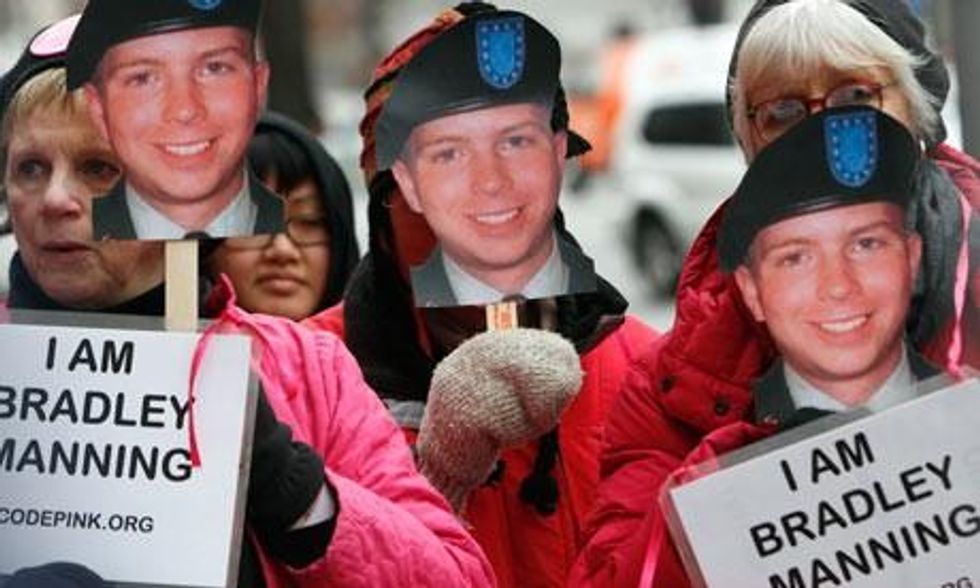
Bradley Manning, meanwhile, will finally have his day in military court at Fort Meade, Maryland. He faces a slew of charges related to the largest leak of classified information in US history. Manning pled guilty to mishandling the information, and acknowledged uploading hundreds of thousands of documents to the WikiLeaks website. But he denies the most serious charge, still pending, of "aiding the enemy." Prosecutors are seeking life in prison; however, if Manning is found guilty, the judge could still impose the death penalty.
Bradley Manning and Jeremy Hammond are among the highest profile in a series of cases that the Obama administration has been pursuing against whistle-blowers and journalists. Attorney Michael Ratner, president emeritus of the Center for Constitutional Rights, and an attorney for WikiLeaks and its founder, Julian Assange, said in front of the courthouse after Hammond's court appearance:
"This is part of the sledgehammer of what the government is doing to people who expose corporate secrets, government secrets, and really the secrets of an empire."
Manning explained his actions and his motivation in a detailed statement in his pretrial proceedings. He said, "I believed that if the general public, especially the American public, had access to the information ... it could spark a domestic debate on the role of the military and our foreign policy in general." The first public release by WikiLeaks of the material provided by Manning was the video (titled by WikiLeaks) Collateral Murder. The grainy video, taken from an attack helicopter, shows the cold killing of a dozen men on the ground in Baghdad on 12 July 2007. Two of those killed by the US Apache helicopter gunship were employees of the Reuters news agency, cameraman Namir Noor-Eldeen, 22, and his driver, Saeed Chmagh, a father of four.
After their violent, senseless deaths, Reuters sought answers and filed Freedom of Information requests for material relating to the attack, which were denied. Manning saw the video when stationed in Iraq, and researched the background of the attack. He saved the video file. He explained in court, "I planned on providing this to the Reuters office in London to assist them in preventing events such as this in the future."
Hammond and Manning, facing years in prison, have in common their connection to WikiLeaks and its founder, Assange. Assange is wanted for questioning in Sweden about allegations of sexual misconduct - he has not been charged. After losing a fight against extradition in Britain, he was granted political asylum by the government of Ecuador, and has remained in Ecuador's embassy in London since last June. It was a leaked Stratfor email that referenced a US indictment against Assange, reading: "Not for Pub - We have a sealed indictment on Assange. Pls protect."
This all happens amidst recent revelations about the Obama administration's extraordinary invasion of journalists' privacy and the right to protect sources. The Associated Press revealed that the Justice Department had secretly obtained two months of telephone records of its reporters and editors in an effort to discover the source of a leak about a foiled bomb plot. Fox News' chief Washington correspondent, James Rosen, may actually be charged in a criminal conspiracy for allegedly receiving classified information from a source about North Korea.
President Barack Obama and Attorney General Eric Holder have used the Espionage Act six times to prosecute whistle-blowers - more than all previous presidents combined. Obama's assault on journalism and his relentless war on whistle-blowers are serious threats to fundamental democratic principles on which this nation was founded.
The job of journalists is to hold those in power accountable. Our job is to be the fourth estate, not "for the state." Let us be.
Denis Moynihan contributed research to this column
One cyberactivist's federal case wrapped up this week, and another's is set to begin. Although these two young men, Jeremy Hammond and Bradley Manning, are the two who were charged, it is the growing menace of government and corporate secrecy that should be on trial.
Hammond was facing more than 30 years in prison, charged with hacking into the computers of a private security and intelligence firm called Strategic Forecasting, or Stratfor, when he agreed to a plea agreement of one count of computer hacking. Stratfor traffics in "geopolitical intelligence, economic, political and military forecasting," according to its website. Yet, after Hammond and others released 5m emails from Stratfor's servers to WikiLeaks, it became clear that the firm engages in widespread spying on activists on behalf of corporations. Coca-Cola hired Stratfor to spy on the group PETA (People for the Ethical Treatment of Animals). Dow Chemical hired Stratfor to spy on the activists who were exposing Dow's role in the cyanide chemical disaster in Bhopal, India, in 1984 that killed an estimated 8,000 and injured thousands more.
Hammond is scheduled to be sentenced 6 September. His lawyers have asked for time served - 15 months, some of which was in solitary confinement. He faces 10 years.
Bradley Manning, meanwhile, will finally have his day in military court at Fort Meade, Maryland. He faces a slew of charges related to the largest leak of classified information in US history. Manning pled guilty to mishandling the information, and acknowledged uploading hundreds of thousands of documents to the WikiLeaks website. But he denies the most serious charge, still pending, of "aiding the enemy." Prosecutors are seeking life in prison; however, if Manning is found guilty, the judge could still impose the death penalty.
Bradley Manning and Jeremy Hammond are among the highest profile in a series of cases that the Obama administration has been pursuing against whistle-blowers and journalists. Attorney Michael Ratner, president emeritus of the Center for Constitutional Rights, and an attorney for WikiLeaks and its founder, Julian Assange, said in front of the courthouse after Hammond's court appearance:
"This is part of the sledgehammer of what the government is doing to people who expose corporate secrets, government secrets, and really the secrets of an empire."
Manning explained his actions and his motivation in a detailed statement in his pretrial proceedings. He said, "I believed that if the general public, especially the American public, had access to the information ... it could spark a domestic debate on the role of the military and our foreign policy in general." The first public release by WikiLeaks of the material provided by Manning was the video (titled by WikiLeaks) Collateral Murder. The grainy video, taken from an attack helicopter, shows the cold killing of a dozen men on the ground in Baghdad on 12 July 2007. Two of those killed by the US Apache helicopter gunship were employees of the Reuters news agency, cameraman Namir Noor-Eldeen, 22, and his driver, Saeed Chmagh, a father of four.
After their violent, senseless deaths, Reuters sought answers and filed Freedom of Information requests for material relating to the attack, which were denied. Manning saw the video when stationed in Iraq, and researched the background of the attack. He saved the video file. He explained in court, "I planned on providing this to the Reuters office in London to assist them in preventing events such as this in the future."
Hammond and Manning, facing years in prison, have in common their connection to WikiLeaks and its founder, Assange. Assange is wanted for questioning in Sweden about allegations of sexual misconduct - he has not been charged. After losing a fight against extradition in Britain, he was granted political asylum by the government of Ecuador, and has remained in Ecuador's embassy in London since last June. It was a leaked Stratfor email that referenced a US indictment against Assange, reading: "Not for Pub - We have a sealed indictment on Assange. Pls protect."
This all happens amidst recent revelations about the Obama administration's extraordinary invasion of journalists' privacy and the right to protect sources. The Associated Press revealed that the Justice Department had secretly obtained two months of telephone records of its reporters and editors in an effort to discover the source of a leak about a foiled bomb plot. Fox News' chief Washington correspondent, James Rosen, may actually be charged in a criminal conspiracy for allegedly receiving classified information from a source about North Korea.
President Barack Obama and Attorney General Eric Holder have used the Espionage Act six times to prosecute whistle-blowers - more than all previous presidents combined. Obama's assault on journalism and his relentless war on whistle-blowers are serious threats to fundamental democratic principles on which this nation was founded.
The job of journalists is to hold those in power accountable. Our job is to be the fourth estate, not "for the state." Let us be.
Denis Moynihan contributed research to this column
One cyberactivist's federal case wrapped up this week, and another's is set to begin. Although these two young men, Jeremy Hammond and Bradley Manning, are the two who were charged, it is the growing menace of government and corporate secrecy that should be on trial.
Hammond was facing more than 30 years in prison, charged with hacking into the computers of a private security and intelligence firm called Strategic Forecasting, or Stratfor, when he agreed to a plea agreement of one count of computer hacking. Stratfor traffics in "geopolitical intelligence, economic, political and military forecasting," according to its website. Yet, after Hammond and others released 5m emails from Stratfor's servers to WikiLeaks, it became clear that the firm engages in widespread spying on activists on behalf of corporations. Coca-Cola hired Stratfor to spy on the group PETA (People for the Ethical Treatment of Animals). Dow Chemical hired Stratfor to spy on the activists who were exposing Dow's role in the cyanide chemical disaster in Bhopal, India, in 1984 that killed an estimated 8,000 and injured thousands more.
Hammond is scheduled to be sentenced 6 September. His lawyers have asked for time served - 15 months, some of which was in solitary confinement. He faces 10 years.
Bradley Manning, meanwhile, will finally have his day in military court at Fort Meade, Maryland. He faces a slew of charges related to the largest leak of classified information in US history. Manning pled guilty to mishandling the information, and acknowledged uploading hundreds of thousands of documents to the WikiLeaks website. But he denies the most serious charge, still pending, of "aiding the enemy." Prosecutors are seeking life in prison; however, if Manning is found guilty, the judge could still impose the death penalty.
Bradley Manning and Jeremy Hammond are among the highest profile in a series of cases that the Obama administration has been pursuing against whistle-blowers and journalists. Attorney Michael Ratner, president emeritus of the Center for Constitutional Rights, and an attorney for WikiLeaks and its founder, Julian Assange, said in front of the courthouse after Hammond's court appearance:
"This is part of the sledgehammer of what the government is doing to people who expose corporate secrets, government secrets, and really the secrets of an empire."
Manning explained his actions and his motivation in a detailed statement in his pretrial proceedings. He said, "I believed that if the general public, especially the American public, had access to the information ... it could spark a domestic debate on the role of the military and our foreign policy in general." The first public release by WikiLeaks of the material provided by Manning was the video (titled by WikiLeaks) Collateral Murder. The grainy video, taken from an attack helicopter, shows the cold killing of a dozen men on the ground in Baghdad on 12 July 2007. Two of those killed by the US Apache helicopter gunship were employees of the Reuters news agency, cameraman Namir Noor-Eldeen, 22, and his driver, Saeed Chmagh, a father of four.
After their violent, senseless deaths, Reuters sought answers and filed Freedom of Information requests for material relating to the attack, which were denied. Manning saw the video when stationed in Iraq, and researched the background of the attack. He saved the video file. He explained in court, "I planned on providing this to the Reuters office in London to assist them in preventing events such as this in the future."
Hammond and Manning, facing years in prison, have in common their connection to WikiLeaks and its founder, Assange. Assange is wanted for questioning in Sweden about allegations of sexual misconduct - he has not been charged. After losing a fight against extradition in Britain, he was granted political asylum by the government of Ecuador, and has remained in Ecuador's embassy in London since last June. It was a leaked Stratfor email that referenced a US indictment against Assange, reading: "Not for Pub - We have a sealed indictment on Assange. Pls protect."
This all happens amidst recent revelations about the Obama administration's extraordinary invasion of journalists' privacy and the right to protect sources. The Associated Press revealed that the Justice Department had secretly obtained two months of telephone records of its reporters and editors in an effort to discover the source of a leak about a foiled bomb plot. Fox News' chief Washington correspondent, James Rosen, may actually be charged in a criminal conspiracy for allegedly receiving classified information from a source about North Korea.
President Barack Obama and Attorney General Eric Holder have used the Espionage Act six times to prosecute whistle-blowers - more than all previous presidents combined. Obama's assault on journalism and his relentless war on whistle-blowers are serious threats to fundamental democratic principles on which this nation was founded.
The job of journalists is to hold those in power accountable. Our job is to be the fourth estate, not "for the state." Let us be.
Denis Moynihan contributed research to this column