SUBSCRIBE TO OUR FREE NEWSLETTER
Daily news & progressive opinion—funded by the people, not the corporations—delivered straight to your inbox.
5
#000000
#FFFFFF
To donate by check, phone, or other method, see our More Ways to Give page.
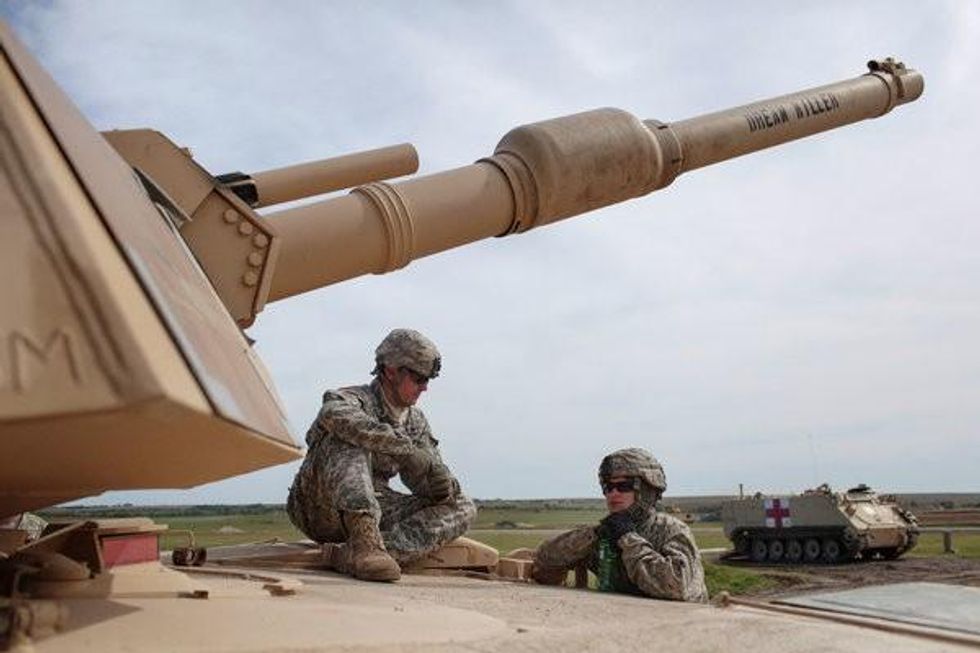
In the view of our leaders these days, having extra troops on hand and keeping them in cold storage in this country is like having extra money around and stuffing it under your mattress or parking it in a local bank at next to no interest. Why would you do that when you could go out and play the market -- or, in the case of the U.S. military, pivot toward Africa? So many "partnerships" to forge as you lend a helping hand to the counterterrorism struggle on -- and the destabilization of -- that continent using that brigade in Kansas, Special Operations forces like the ones recently sent on raids into Libya and Somalia, and the drones whose bases are spreading in the region.
In Washington, war and preparations for war remain the options of choice, no matter the traffic jam of U.S. military disasters in this century. Despite all the recent talk about pivoting to Asia, preparations of every sort, not just at Ft. Riley, suggest that Africa may prove the actual pivot point for this country's endless war policies in the coming decade, as TomDispatch has been reporting now for the last year or more. In the meantime, Andrew Bacevich, author most recently of Breach of Trust: How Americans Failed Their Soldiers and Their Country, offers a little primer on just how to cut any critics of the relentless American global mission impossible off at the knees. Just call them "isolationists" and go right on with your next operation. It works like a dream.
In the view of our leaders these days, having extra troops on hand and keeping them in cold storage in this country is like having extra money around and stuffing it under your mattress or parking it in a local bank at next to no interest. Why would you do that when you could go out and play the market -- or, in the case of the U.S. military, pivot toward Africa? So many "partnerships" to forge as you lend a helping hand to the counterterrorism struggle on -- and the destabilization of -- that continent using that brigade in Kansas, Special Operations forces like the ones recently sent on raids into Libya and Somalia, and the drones whose bases are spreading in the region.
In Washington, war and preparations for war remain the options of choice, no matter the traffic jam of U.S. military disasters in this century. Despite all the recent talk about pivoting to Asia, preparations of every sort, not just at Ft. Riley, suggest that Africa may prove the actual pivot point for this country's endless war policies in the coming decade, as TomDispatch has been reporting now for the last year or more. In the meantime, Andrew Bacevich, author most recently of Breach of Trust: How Americans Failed Their Soldiers and Their Country, offers a little primer on just how to cut any critics of the relentless American global mission impossible off at the knees. Just call them "isolationists" and go right on with your next operation. It works like a dream.
In the view of our leaders these days, having extra troops on hand and keeping them in cold storage in this country is like having extra money around and stuffing it under your mattress or parking it in a local bank at next to no interest. Why would you do that when you could go out and play the market -- or, in the case of the U.S. military, pivot toward Africa? So many "partnerships" to forge as you lend a helping hand to the counterterrorism struggle on -- and the destabilization of -- that continent using that brigade in Kansas, Special Operations forces like the ones recently sent on raids into Libya and Somalia, and the drones whose bases are spreading in the region.
In Washington, war and preparations for war remain the options of choice, no matter the traffic jam of U.S. military disasters in this century. Despite all the recent talk about pivoting to Asia, preparations of every sort, not just at Ft. Riley, suggest that Africa may prove the actual pivot point for this country's endless war policies in the coming decade, as TomDispatch has been reporting now for the last year or more. In the meantime, Andrew Bacevich, author most recently of Breach of Trust: How Americans Failed Their Soldiers and Their Country, offers a little primer on just how to cut any critics of the relentless American global mission impossible off at the knees. Just call them "isolationists" and go right on with your next operation. It works like a dream.