SUBSCRIBE TO OUR FREE NEWSLETTER
Daily news & progressive opinion—funded by the people, not the corporations—delivered straight to your inbox.
5
#000000
#FFFFFF
To donate by check, phone, or other method, see our More Ways to Give page.
Daily news & progressive opinion—funded by the people, not the corporations—delivered straight to your inbox.
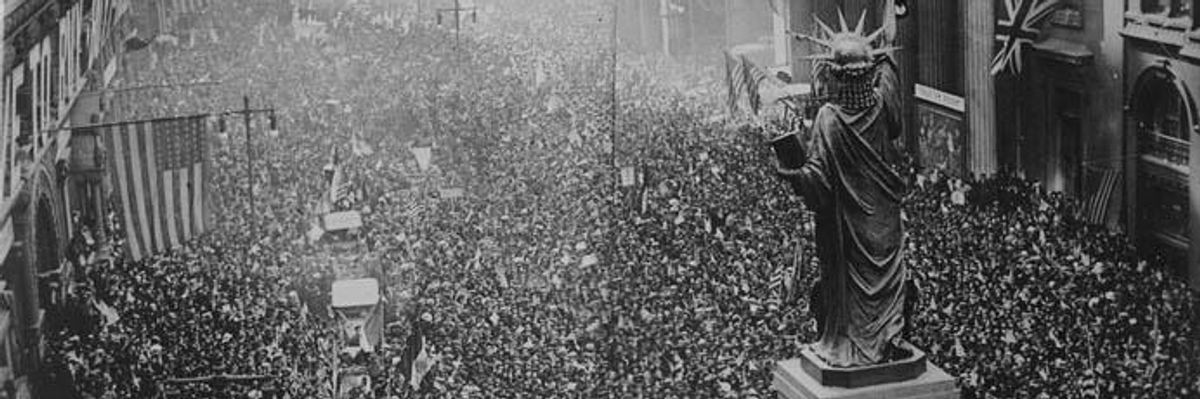
Thousands massed on all sides of the replica of the Statue of Liberty on Broad Street in Philadelphia, cheered unceasingly, upon the announcement of the armistice on November 11, 1918. (Photo: U.S. National Archives)
Wilfred Owen, an English poet who was killed in action exactly one week before the Armistice that finally ended World War I was signed, wrote about the horrors of living in trenches and enduring gas warfare.
In "The Parable of the Old Man and the Young," he revises the Biblical narrative about Abraham's willingness to sacrifice his son, Isaac. Believing God willed the slaughter, Abraham prepared to bind Isaac and slay him. Owen transforms Abraham into the European powers who were willing to slaughter youthful generations in the trenches of World War I.
Only in this telling, Abraham refuses to heed the angel who urges that the son be spared. The old man "slew the son, and half the seed of Europe, one by one."
Thirty million soldiers were killed or wounded and another seven million taken captive during World War I. Some 50 to 100 million perished from a flu epidemic created by the war. "Never before," writes author and activist David Swanson, "had people witnessed such industrialized slaughter, with tens of thousands falling in a day to machine guns and poison gas."
A stunned and exhausted West greeted November 11, 1918, the day the war came to an end, as its delivery from horror.
In 1938, Congress declared Armistice Day a legal holiday dedicated to the cause of world peace. In 1954, the holiday was renamed Veterans Day and morphed into an occasion for flag waving and military parades.
Now, members of the group Veterans for Peace are working across the U.S. to recover the original purpose of Armistice Day. They are using it to call for adequate psychological and material support for veterans, to help them cope with the terrors they have been forced to endure. Above all, they work to abolish wars.
This year on November 11, at 11 a.m., Veterans for Peace chapters across the United States will ring bells, recalling that minute in 1918 when, as Kurt Vonnegut wrote, "millions upon millions of human beings stopped butchering one another."
"This event is more than just a historical remembrance," says Ed Flaherty, a member of the Iowa City Chapter of Veterans for Peace. "It is about today, about our pressing need to reverse the war-momentum and to take up the sweet burden of creating lasting peace."
Writing on behalf of the group's Tom Paine chapter in Albany, New York, John Amidon explains that the veterans will be "purposefully walking" in the local Veterans day parade because "we ain't marching anymore."
The tragically stubborn "old man" in Owen's poem rejected the angel's intervention urging him to choose life over death. We do not have to keep making that same mistake.
Armistice Day gives us an opportunity to acknowledge the brutal futility of armed conflict, the wastefulness of our military spending, and the responsibility we share to abolish all wars.
Dear Common Dreams reader, It’s been nearly 30 years since I co-founded Common Dreams with my late wife, Lina Newhouser. We had the radical notion that journalism should serve the public good, not corporate profits. It was clear to us from the outset what it would take to build such a project. No paid advertisements. No corporate sponsors. No millionaire publisher telling us what to think or do. Many people said we wouldn't last a year, but we proved those doubters wrong. Together with a tremendous team of journalists and dedicated staff, we built an independent media outlet free from the constraints of profits and corporate control. Our mission has always been simple: To inform. To inspire. To ignite change for the common good. Building Common Dreams was not easy. Our survival was never guaranteed. When you take on the most powerful forces—Wall Street greed, fossil fuel industry destruction, Big Tech lobbyists, and uber-rich oligarchs who have spent billions upon billions rigging the economy and democracy in their favor—the only bulwark you have is supporters who believe in your work. But here’s the urgent message from me today. It's never been this bad out there. And it's never been this hard to keep us going. At the very moment Common Dreams is most needed, the threats we face are intensifying. We need your support now more than ever. We don't accept corporate advertising and never will. We don't have a paywall because we don't think people should be blocked from critical news based on their ability to pay. Everything we do is funded by the donations of readers like you. When everyone does the little they can afford, we are strong. But if that support retreats or dries up, so do we. Will you donate now to make sure Common Dreams not only survives but thrives? —Craig Brown, Co-founder |
Wilfred Owen, an English poet who was killed in action exactly one week before the Armistice that finally ended World War I was signed, wrote about the horrors of living in trenches and enduring gas warfare.
In "The Parable of the Old Man and the Young," he revises the Biblical narrative about Abraham's willingness to sacrifice his son, Isaac. Believing God willed the slaughter, Abraham prepared to bind Isaac and slay him. Owen transforms Abraham into the European powers who were willing to slaughter youthful generations in the trenches of World War I.
Only in this telling, Abraham refuses to heed the angel who urges that the son be spared. The old man "slew the son, and half the seed of Europe, one by one."
Thirty million soldiers were killed or wounded and another seven million taken captive during World War I. Some 50 to 100 million perished from a flu epidemic created by the war. "Never before," writes author and activist David Swanson, "had people witnessed such industrialized slaughter, with tens of thousands falling in a day to machine guns and poison gas."
A stunned and exhausted West greeted November 11, 1918, the day the war came to an end, as its delivery from horror.
In 1938, Congress declared Armistice Day a legal holiday dedicated to the cause of world peace. In 1954, the holiday was renamed Veterans Day and morphed into an occasion for flag waving and military parades.
Now, members of the group Veterans for Peace are working across the U.S. to recover the original purpose of Armistice Day. They are using it to call for adequate psychological and material support for veterans, to help them cope with the terrors they have been forced to endure. Above all, they work to abolish wars.
This year on November 11, at 11 a.m., Veterans for Peace chapters across the United States will ring bells, recalling that minute in 1918 when, as Kurt Vonnegut wrote, "millions upon millions of human beings stopped butchering one another."
"This event is more than just a historical remembrance," says Ed Flaherty, a member of the Iowa City Chapter of Veterans for Peace. "It is about today, about our pressing need to reverse the war-momentum and to take up the sweet burden of creating lasting peace."
Writing on behalf of the group's Tom Paine chapter in Albany, New York, John Amidon explains that the veterans will be "purposefully walking" in the local Veterans day parade because "we ain't marching anymore."
The tragically stubborn "old man" in Owen's poem rejected the angel's intervention urging him to choose life over death. We do not have to keep making that same mistake.
Armistice Day gives us an opportunity to acknowledge the brutal futility of armed conflict, the wastefulness of our military spending, and the responsibility we share to abolish all wars.
Wilfred Owen, an English poet who was killed in action exactly one week before the Armistice that finally ended World War I was signed, wrote about the horrors of living in trenches and enduring gas warfare.
In "The Parable of the Old Man and the Young," he revises the Biblical narrative about Abraham's willingness to sacrifice his son, Isaac. Believing God willed the slaughter, Abraham prepared to bind Isaac and slay him. Owen transforms Abraham into the European powers who were willing to slaughter youthful generations in the trenches of World War I.
Only in this telling, Abraham refuses to heed the angel who urges that the son be spared. The old man "slew the son, and half the seed of Europe, one by one."
Thirty million soldiers were killed or wounded and another seven million taken captive during World War I. Some 50 to 100 million perished from a flu epidemic created by the war. "Never before," writes author and activist David Swanson, "had people witnessed such industrialized slaughter, with tens of thousands falling in a day to machine guns and poison gas."
A stunned and exhausted West greeted November 11, 1918, the day the war came to an end, as its delivery from horror.
In 1938, Congress declared Armistice Day a legal holiday dedicated to the cause of world peace. In 1954, the holiday was renamed Veterans Day and morphed into an occasion for flag waving and military parades.
Now, members of the group Veterans for Peace are working across the U.S. to recover the original purpose of Armistice Day. They are using it to call for adequate psychological and material support for veterans, to help them cope with the terrors they have been forced to endure. Above all, they work to abolish wars.
This year on November 11, at 11 a.m., Veterans for Peace chapters across the United States will ring bells, recalling that minute in 1918 when, as Kurt Vonnegut wrote, "millions upon millions of human beings stopped butchering one another."
"This event is more than just a historical remembrance," says Ed Flaherty, a member of the Iowa City Chapter of Veterans for Peace. "It is about today, about our pressing need to reverse the war-momentum and to take up the sweet burden of creating lasting peace."
Writing on behalf of the group's Tom Paine chapter in Albany, New York, John Amidon explains that the veterans will be "purposefully walking" in the local Veterans day parade because "we ain't marching anymore."
The tragically stubborn "old man" in Owen's poem rejected the angel's intervention urging him to choose life over death. We do not have to keep making that same mistake.
Armistice Day gives us an opportunity to acknowledge the brutal futility of armed conflict, the wastefulness of our military spending, and the responsibility we share to abolish all wars.