SUBSCRIBE TO OUR FREE NEWSLETTER
Daily news & progressive opinion—funded by the people, not the corporations—delivered straight to your inbox.
5
#000000
#FFFFFF
To donate by check, phone, or other method, see our More Ways to Give page.
The public discourse in the US about transgender athletes focuses primarily on the competitiveness of transgender females. Our original survey data asks whether the public views transgender male athletes more favorably.
For every group under analysis, transgender male athletes received greater support, with a double-digit gap for all groups except Blacks, Republicans, and those with children in a public K-12 school.
While a majority of Americans according to a 2022 Pew poll support transgender anti-discrimination laws regarding housing and employment, most, but polls show majorities opposed to transgender athletes competing under their gender identity. In a 2021 Gallup poll, 62% stated transgender athletes should compete under their birth gender, including 86% of Republicans and 41% of Democrats. An IPSOS 2022 poll found similar rates (63%) opposed transgender females competing on female teams, with slightly lower rates in a Washington Post/UMD poll in 2022, comprised mostly of sports fans and parents. Nor is this debate limited to "elite sports" like the Olympics or national championships, with 18 states now with laws that prohibit trans children in K-12 school systems from competing in gender affirming sports.
Opponents of transgender athletes competing under their gender identity typically frame this in terms of fairness in competition, often citing evidence such as transgender female advantages in fitness test results, while experts state hormone therapy diminishes any potential initial advantage usually in one to two years. Broader claims about inherent biological advantages of transgender athletes across sports remain unsubstantiated, including a lack of data showing testosterone levels corresponding with performance. Concerns have led to questions on also regulating cisgender female athletes with abnormally high levels of testosterone, even at the detriment of their mental and physical health. Meanwhile, legal scholars argue that restrictive "fair play" policies risk infringing on the Equal Protection Clause of the 14th Amendment.
This competition narrative consistently focuses on transgender female athletes and questions of the fairness of their inclusion against cisgender women, citing such examples as MMA fighter Fallon Fox, college swimmer Lia Thomas and U.S. track and field competitor Cece Telfer. Many of the state-level bills proposed since 2021 focus specifically on transgender females, despite legislators often unable to identify any transgender female athletes in their state.
However, claims of unfair competition rarely focus on transgender male athletes. The president of FINA (the International Swimming Federation) said that FINA must protect the rights and competitive fairness for all of their athletes, but added, "especially in the women's category." Coverage often frames transgender male athletes as at a competitive disadvantage, not on where they win, or where competition is a result of state laws that require these athletes to compete under their birth gender, such as wrestler Mack Beggs, rather than a concern about competition with cisgender males.
Whether out of deliberate perceptual differences or simply more familiarity with transgender female cases, the assumption is that the public differentiates in support. However, existing survey data does not compare the two groups.
We conducted an original national web survey in the US June 29-July 11 via Qualtrics with quota sampling for age, gender, and geographic region. We randomly assigned 1,728 Americans to one of two questions about trans athletes:
Should transgender women (those assigned as male at birth) be allowed to compete in women's sports?
Should transgender men (those assigned as female at birth) be allowed to compete in men's sports?
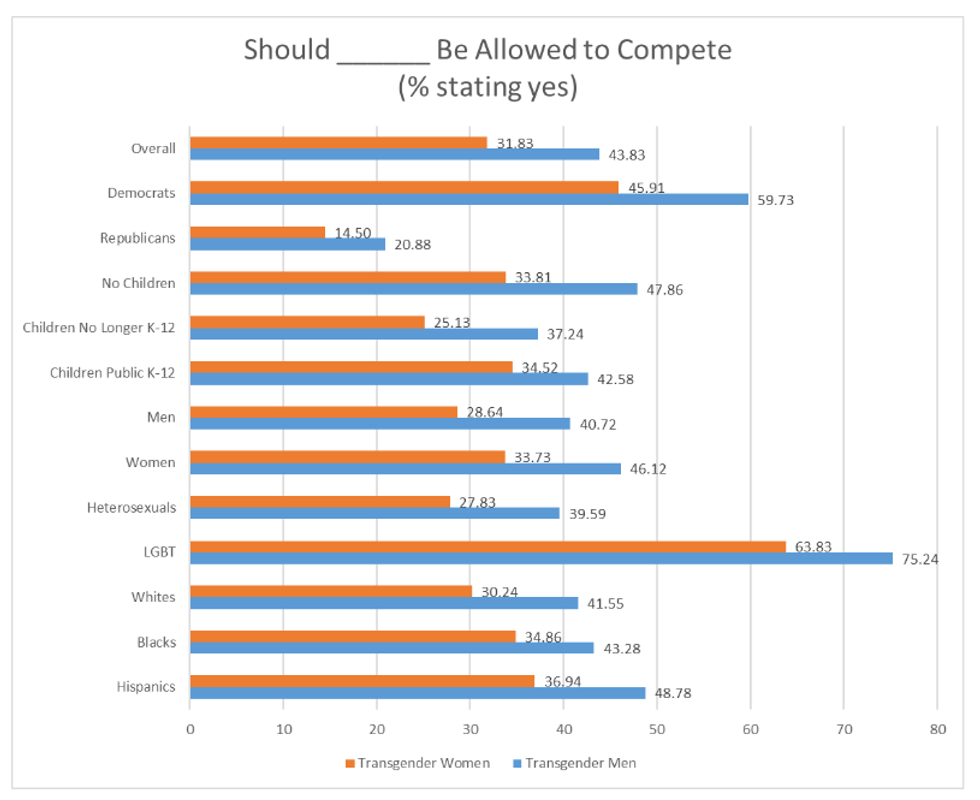
Overall, only 31.83% of respondents supported transgender women competing in women's sports, compared to 43.83% for transgender men. As expected, Democrats were about three times as likely to say either should compete compared to Republicans, yet across both groups respondents registered greater support for transgender men.
We also broke down the data by whether respondents said they had no children, no children still in the K-12 educational system, or had children in a public K-12 school (our survey had too few respondents among other educational options, such as homeschools, for analysis). Again, transgender male athletes received greater support. Of note, those without children and those with children in the public school system exhibited similar rates of approval, with those no longer having children in school lower, although this latter finding may simply be a function of older respondents in general being less supportive of transgender athletes.
In fact, for every group under analysis, transgender male athletes received greater support, with a double-digit gap for all groups except Blacks, Republicans, and those with children in a public K-12 school.
Even after controlling for demographic and party variables, the public is still more likely to state transgender men can compete in men's sports. We also find women more supportive of transgender athletes in general, consistent with previous research, while age negatively corresponds with support. Unsurprisingly, those who do not identify as heterosexual were also more supportive.
One factor not assessed is if respondents know a transgender person directly. Contact theory research typically found more tolerant views among those who knew an LGBT+ person. However, the effect of contact with transgender people may be more mixed. The same 2021 Gallup poll referenced above found only 31% stating they knew a transgender person, with age being a contributing factor to knowing a transgender person.
The results show a consistent pattern of higher support for transgender men, but does not give a clear answer as to why. However, the findings here and elsewhere suggest a rapidly changing public dialogue, one where many have likely not thought about the complexities of poorly fitting policies or the possibility of changing existing binary categorizations for competition.
The public discourse in the US about transgender athletes focuses primarily on the competitiveness of transgender females. Our original survey data asks whether the public views transgender male athletes more favorably.
For every group under analysis, transgender male athletes received greater support, with a double-digit gap for all groups except Blacks, Republicans, and those with children in a public K-12 school.
While a majority of Americans according to a 2022 Pew poll support transgender anti-discrimination laws regarding housing and employment, most, but polls show majorities opposed to transgender athletes competing under their gender identity. In a 2021 Gallup poll, 62% stated transgender athletes should compete under their birth gender, including 86% of Republicans and 41% of Democrats. An IPSOS 2022 poll found similar rates (63%) opposed transgender females competing on female teams, with slightly lower rates in a Washington Post/UMD poll in 2022, comprised mostly of sports fans and parents. Nor is this debate limited to "elite sports" like the Olympics or national championships, with 18 states now with laws that prohibit trans children in K-12 school systems from competing in gender affirming sports.
Opponents of transgender athletes competing under their gender identity typically frame this in terms of fairness in competition, often citing evidence such as transgender female advantages in fitness test results, while experts state hormone therapy diminishes any potential initial advantage usually in one to two years. Broader claims about inherent biological advantages of transgender athletes across sports remain unsubstantiated, including a lack of data showing testosterone levels corresponding with performance. Concerns have led to questions on also regulating cisgender female athletes with abnormally high levels of testosterone, even at the detriment of their mental and physical health. Meanwhile, legal scholars argue that restrictive "fair play" policies risk infringing on the Equal Protection Clause of the 14th Amendment.
This competition narrative consistently focuses on transgender female athletes and questions of the fairness of their inclusion against cisgender women, citing such examples as MMA fighter Fallon Fox, college swimmer Lia Thomas and U.S. track and field competitor Cece Telfer. Many of the state-level bills proposed since 2021 focus specifically on transgender females, despite legislators often unable to identify any transgender female athletes in their state.
However, claims of unfair competition rarely focus on transgender male athletes. The president of FINA (the International Swimming Federation) said that FINA must protect the rights and competitive fairness for all of their athletes, but added, "especially in the women's category." Coverage often frames transgender male athletes as at a competitive disadvantage, not on where they win, or where competition is a result of state laws that require these athletes to compete under their birth gender, such as wrestler Mack Beggs, rather than a concern about competition with cisgender males.
Whether out of deliberate perceptual differences or simply more familiarity with transgender female cases, the assumption is that the public differentiates in support. However, existing survey data does not compare the two groups.
We conducted an original national web survey in the US June 29-July 11 via Qualtrics with quota sampling for age, gender, and geographic region. We randomly assigned 1,728 Americans to one of two questions about trans athletes:
Should transgender women (those assigned as male at birth) be allowed to compete in women's sports?
Should transgender men (those assigned as female at birth) be allowed to compete in men's sports?
Overall, only 31.83% of respondents supported transgender women competing in women's sports, compared to 43.83% for transgender men. As expected, Democrats were about three times as likely to say either should compete compared to Republicans, yet across both groups respondents registered greater support for transgender men.
We also broke down the data by whether respondents said they had no children, no children still in the K-12 educational system, or had children in a public K-12 school (our survey had too few respondents among other educational options, such as homeschools, for analysis). Again, transgender male athletes received greater support. Of note, those without children and those with children in the public school system exhibited similar rates of approval, with those no longer having children in school lower, although this latter finding may simply be a function of older respondents in general being less supportive of transgender athletes.
In fact, for every group under analysis, transgender male athletes received greater support, with a double-digit gap for all groups except Blacks, Republicans, and those with children in a public K-12 school.
Even after controlling for demographic and party variables, the public is still more likely to state transgender men can compete in men's sports. We also find women more supportive of transgender athletes in general, consistent with previous research, while age negatively corresponds with support. Unsurprisingly, those who do not identify as heterosexual were also more supportive.
One factor not assessed is if respondents know a transgender person directly. Contact theory research typically found more tolerant views among those who knew an LGBT+ person. However, the effect of contact with transgender people may be more mixed. The same 2021 Gallup poll referenced above found only 31% stating they knew a transgender person, with age being a contributing factor to knowing a transgender person.
The results show a consistent pattern of higher support for transgender men, but does not give a clear answer as to why. However, the findings here and elsewhere suggest a rapidly changing public dialogue, one where many have likely not thought about the complexities of poorly fitting policies or the possibility of changing existing binary categorizations for competition.
The public discourse in the US about transgender athletes focuses primarily on the competitiveness of transgender females. Our original survey data asks whether the public views transgender male athletes more favorably.
For every group under analysis, transgender male athletes received greater support, with a double-digit gap for all groups except Blacks, Republicans, and those with children in a public K-12 school.
While a majority of Americans according to a 2022 Pew poll support transgender anti-discrimination laws regarding housing and employment, most, but polls show majorities opposed to transgender athletes competing under their gender identity. In a 2021 Gallup poll, 62% stated transgender athletes should compete under their birth gender, including 86% of Republicans and 41% of Democrats. An IPSOS 2022 poll found similar rates (63%) opposed transgender females competing on female teams, with slightly lower rates in a Washington Post/UMD poll in 2022, comprised mostly of sports fans and parents. Nor is this debate limited to "elite sports" like the Olympics or national championships, with 18 states now with laws that prohibit trans children in K-12 school systems from competing in gender affirming sports.
Opponents of transgender athletes competing under their gender identity typically frame this in terms of fairness in competition, often citing evidence such as transgender female advantages in fitness test results, while experts state hormone therapy diminishes any potential initial advantage usually in one to two years. Broader claims about inherent biological advantages of transgender athletes across sports remain unsubstantiated, including a lack of data showing testosterone levels corresponding with performance. Concerns have led to questions on also regulating cisgender female athletes with abnormally high levels of testosterone, even at the detriment of their mental and physical health. Meanwhile, legal scholars argue that restrictive "fair play" policies risk infringing on the Equal Protection Clause of the 14th Amendment.
This competition narrative consistently focuses on transgender female athletes and questions of the fairness of their inclusion against cisgender women, citing such examples as MMA fighter Fallon Fox, college swimmer Lia Thomas and U.S. track and field competitor Cece Telfer. Many of the state-level bills proposed since 2021 focus specifically on transgender females, despite legislators often unable to identify any transgender female athletes in their state.
However, claims of unfair competition rarely focus on transgender male athletes. The president of FINA (the International Swimming Federation) said that FINA must protect the rights and competitive fairness for all of their athletes, but added, "especially in the women's category." Coverage often frames transgender male athletes as at a competitive disadvantage, not on where they win, or where competition is a result of state laws that require these athletes to compete under their birth gender, such as wrestler Mack Beggs, rather than a concern about competition with cisgender males.
Whether out of deliberate perceptual differences or simply more familiarity with transgender female cases, the assumption is that the public differentiates in support. However, existing survey data does not compare the two groups.
We conducted an original national web survey in the US June 29-July 11 via Qualtrics with quota sampling for age, gender, and geographic region. We randomly assigned 1,728 Americans to one of two questions about trans athletes:
Should transgender women (those assigned as male at birth) be allowed to compete in women's sports?
Should transgender men (those assigned as female at birth) be allowed to compete in men's sports?
Overall, only 31.83% of respondents supported transgender women competing in women's sports, compared to 43.83% for transgender men. As expected, Democrats were about three times as likely to say either should compete compared to Republicans, yet across both groups respondents registered greater support for transgender men.
We also broke down the data by whether respondents said they had no children, no children still in the K-12 educational system, or had children in a public K-12 school (our survey had too few respondents among other educational options, such as homeschools, for analysis). Again, transgender male athletes received greater support. Of note, those without children and those with children in the public school system exhibited similar rates of approval, with those no longer having children in school lower, although this latter finding may simply be a function of older respondents in general being less supportive of transgender athletes.
In fact, for every group under analysis, transgender male athletes received greater support, with a double-digit gap for all groups except Blacks, Republicans, and those with children in a public K-12 school.
Even after controlling for demographic and party variables, the public is still more likely to state transgender men can compete in men's sports. We also find women more supportive of transgender athletes in general, consistent with previous research, while age negatively corresponds with support. Unsurprisingly, those who do not identify as heterosexual were also more supportive.
One factor not assessed is if respondents know a transgender person directly. Contact theory research typically found more tolerant views among those who knew an LGBT+ person. However, the effect of contact with transgender people may be more mixed. The same 2021 Gallup poll referenced above found only 31% stating they knew a transgender person, with age being a contributing factor to knowing a transgender person.
The results show a consistent pattern of higher support for transgender men, but does not give a clear answer as to why. However, the findings here and elsewhere suggest a rapidly changing public dialogue, one where many have likely not thought about the complexities of poorly fitting policies or the possibility of changing existing binary categorizations for competition.