SUBSCRIBE TO OUR FREE NEWSLETTER
Daily news & progressive opinion—funded by the people, not the corporations—delivered straight to your inbox.
5
#000000
#FFFFFF
To donate by check, phone, or other method, see our More Ways to Give page.
Daily news & progressive opinion—funded by the people, not the corporations—delivered straight to your inbox.
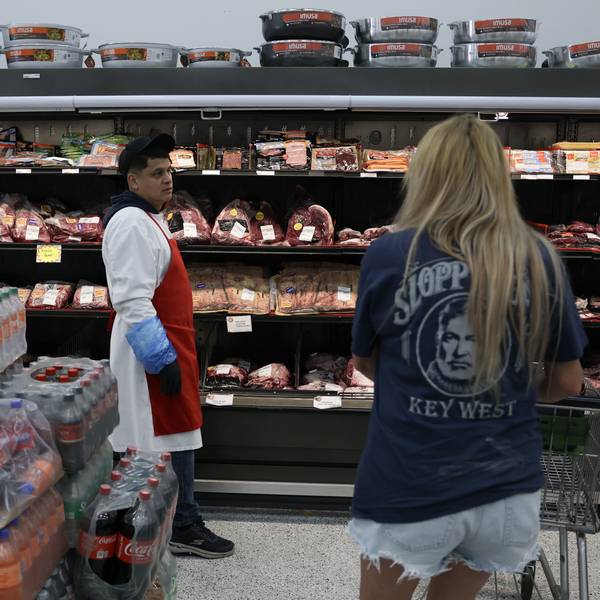
Prime Minister Dmitri Medvedev on Thursday officially announced Russia's one year ban on a wide array of food imports--including beef, pork, fruit, vegetables and dairy products--from western nations as a response to economic sanctions imposed against it by the United States, the European Union, Canada, Australia, and Norway.
According to the Russian news agency ITAR-TASS:
The list of the banned products includes cattle meat (fresh, chilled and refrigerated), pork (fresh, chilled and refrigerated), poultry meat and all poultry edible by-products, salted meat, pickled meat, dried meat, smoked meat, fish and shell fish, clams and other water invertebrates, milk and dairy products, vegetables, edible roots and tuber crops, fruits and nuts, sausage and analogous meat products, meat by-products or blood, as well as products made of them, ready-to-eat products including cheeses and cottage-cheese based on vegetable fats.
The import restrictions--which Medvedev said are effective immediately--come as a clear response to continued and escalated economic sanctions levied by these western countries against Russia over the ongoing conflict in Ukraine. The Obama administration and Congress have repeatedly called for tougher measures against Moscow for what they term as Russian "interference" in Ukraine where rebels in eastern regions remain in a protracted and increasingly deadly battle against the Ukraine Army. Though with more hesitancy, the EU countries have steadily increased their sanctions against Russia, which have closed down its access to financial markets and manufactured products.
The rebels in the east--who maintain control of areas in and around the cities of Donetsk and Luhansk--see the government in Kiev, which came to power in a coup earlier this year, as illegitimate and a threat to their Russian identities and regional autonomy. While the Kiev government has received steady support and financial backing from the U.S. and the EU, Moscow has attempted to broker a political settlement that acknowledges and protects the interests of those living in the east, closer to its border.
According to Reuters:
Russia bought $43 billion worth of food last year. It has become by far the biggest consumer of EU fruit and vegetables, the second biggest buyer of U.S. poultry and a major global consumer of fish, meat and dairy. [...]
He had promised to ensure that the measures would not hurt Russian consumers, which suggested he might exclude some popular products. But in the end, the bans announced by his prime minister, Dmitry Medvedev, mentioned no exceptions. [...]
Agriculture Minister Nikolai Fyodorov acknowledged that the measures would cause a short-term spike in inflation, but said he did not see a danger in the medium or long term. He said Russia would compensate with more imports of products from other suppliers such as Brazilian meat and New Zealand cheese.
The United Nations warned this week that the humanitarian crisis in eastern Ukraine is becoming increasingly dire.
On Thursday, the Ukraine Army shelled a hospital in the city of Donetsk, killing at least one person and injuring others. Separate shelling claimed other lives overnight. According to the Associated Press:
"There was a sudden explosion, a mortar round flew through the window, all the equipment was destroyed," said Anna Kravtsova, a doctor at the Vishnevskiy Hospital. "They killed one person, and one person was injured and taken away."
Only the dentistry unit suffered damage, witnesses said, but it is one of Donetsk's larger hospitals, only 4 kilometers (less than 3 miles) from the city's main square, and has also provided treatment to civilian victims of the conflict.
Kravtsova said that the person who was killed was a patient of the hospital. Donetsk city council spokesman Maxim Rovensky confirmed to the AP that one person had been killed, and said five were wounded.
The incident follows a night of shelling in another central neighborhood. The city council said in a statement posted on its website that three people had been killed and five wounded, and several residential buildings destroyed.
Dear Common Dreams reader, It’s been nearly 30 years since I co-founded Common Dreams with my late wife, Lina Newhouser. We had the radical notion that journalism should serve the public good, not corporate profits. It was clear to us from the outset what it would take to build such a project. No paid advertisements. No corporate sponsors. No millionaire publisher telling us what to think or do. Many people said we wouldn't last a year, but we proved those doubters wrong. Together with a tremendous team of journalists and dedicated staff, we built an independent media outlet free from the constraints of profits and corporate control. Our mission has always been simple: To inform. To inspire. To ignite change for the common good. Building Common Dreams was not easy. Our survival was never guaranteed. When you take on the most powerful forces—Wall Street greed, fossil fuel industry destruction, Big Tech lobbyists, and uber-rich oligarchs who have spent billions upon billions rigging the economy and democracy in their favor—the only bulwark you have is supporters who believe in your work. But here’s the urgent message from me today. It's never been this bad out there. And it's never been this hard to keep us going. At the very moment Common Dreams is most needed, the threats we face are intensifying. We need your support now more than ever. We don't accept corporate advertising and never will. We don't have a paywall because we don't think people should be blocked from critical news based on their ability to pay. Everything we do is funded by the donations of readers like you. When everyone does the little they can afford, we are strong. But if that support retreats or dries up, so do we. Will you donate now to make sure Common Dreams not only survives but thrives? —Craig Brown, Co-founder |
Prime Minister Dmitri Medvedev on Thursday officially announced Russia's one year ban on a wide array of food imports--including beef, pork, fruit, vegetables and dairy products--from western nations as a response to economic sanctions imposed against it by the United States, the European Union, Canada, Australia, and Norway.
According to the Russian news agency ITAR-TASS:
The list of the banned products includes cattle meat (fresh, chilled and refrigerated), pork (fresh, chilled and refrigerated), poultry meat and all poultry edible by-products, salted meat, pickled meat, dried meat, smoked meat, fish and shell fish, clams and other water invertebrates, milk and dairy products, vegetables, edible roots and tuber crops, fruits and nuts, sausage and analogous meat products, meat by-products or blood, as well as products made of them, ready-to-eat products including cheeses and cottage-cheese based on vegetable fats.
The import restrictions--which Medvedev said are effective immediately--come as a clear response to continued and escalated economic sanctions levied by these western countries against Russia over the ongoing conflict in Ukraine. The Obama administration and Congress have repeatedly called for tougher measures against Moscow for what they term as Russian "interference" in Ukraine where rebels in eastern regions remain in a protracted and increasingly deadly battle against the Ukraine Army. Though with more hesitancy, the EU countries have steadily increased their sanctions against Russia, which have closed down its access to financial markets and manufactured products.
The rebels in the east--who maintain control of areas in and around the cities of Donetsk and Luhansk--see the government in Kiev, which came to power in a coup earlier this year, as illegitimate and a threat to their Russian identities and regional autonomy. While the Kiev government has received steady support and financial backing from the U.S. and the EU, Moscow has attempted to broker a political settlement that acknowledges and protects the interests of those living in the east, closer to its border.
According to Reuters:
Russia bought $43 billion worth of food last year. It has become by far the biggest consumer of EU fruit and vegetables, the second biggest buyer of U.S. poultry and a major global consumer of fish, meat and dairy. [...]
He had promised to ensure that the measures would not hurt Russian consumers, which suggested he might exclude some popular products. But in the end, the bans announced by his prime minister, Dmitry Medvedev, mentioned no exceptions. [...]
Agriculture Minister Nikolai Fyodorov acknowledged that the measures would cause a short-term spike in inflation, but said he did not see a danger in the medium or long term. He said Russia would compensate with more imports of products from other suppliers such as Brazilian meat and New Zealand cheese.
The United Nations warned this week that the humanitarian crisis in eastern Ukraine is becoming increasingly dire.
On Thursday, the Ukraine Army shelled a hospital in the city of Donetsk, killing at least one person and injuring others. Separate shelling claimed other lives overnight. According to the Associated Press:
"There was a sudden explosion, a mortar round flew through the window, all the equipment was destroyed," said Anna Kravtsova, a doctor at the Vishnevskiy Hospital. "They killed one person, and one person was injured and taken away."
Only the dentistry unit suffered damage, witnesses said, but it is one of Donetsk's larger hospitals, only 4 kilometers (less than 3 miles) from the city's main square, and has also provided treatment to civilian victims of the conflict.
Kravtsova said that the person who was killed was a patient of the hospital. Donetsk city council spokesman Maxim Rovensky confirmed to the AP that one person had been killed, and said five were wounded.
The incident follows a night of shelling in another central neighborhood. The city council said in a statement posted on its website that three people had been killed and five wounded, and several residential buildings destroyed.
Prime Minister Dmitri Medvedev on Thursday officially announced Russia's one year ban on a wide array of food imports--including beef, pork, fruit, vegetables and dairy products--from western nations as a response to economic sanctions imposed against it by the United States, the European Union, Canada, Australia, and Norway.
According to the Russian news agency ITAR-TASS:
The list of the banned products includes cattle meat (fresh, chilled and refrigerated), pork (fresh, chilled and refrigerated), poultry meat and all poultry edible by-products, salted meat, pickled meat, dried meat, smoked meat, fish and shell fish, clams and other water invertebrates, milk and dairy products, vegetables, edible roots and tuber crops, fruits and nuts, sausage and analogous meat products, meat by-products or blood, as well as products made of them, ready-to-eat products including cheeses and cottage-cheese based on vegetable fats.
The import restrictions--which Medvedev said are effective immediately--come as a clear response to continued and escalated economic sanctions levied by these western countries against Russia over the ongoing conflict in Ukraine. The Obama administration and Congress have repeatedly called for tougher measures against Moscow for what they term as Russian "interference" in Ukraine where rebels in eastern regions remain in a protracted and increasingly deadly battle against the Ukraine Army. Though with more hesitancy, the EU countries have steadily increased their sanctions against Russia, which have closed down its access to financial markets and manufactured products.
The rebels in the east--who maintain control of areas in and around the cities of Donetsk and Luhansk--see the government in Kiev, which came to power in a coup earlier this year, as illegitimate and a threat to their Russian identities and regional autonomy. While the Kiev government has received steady support and financial backing from the U.S. and the EU, Moscow has attempted to broker a political settlement that acknowledges and protects the interests of those living in the east, closer to its border.
According to Reuters:
Russia bought $43 billion worth of food last year. It has become by far the biggest consumer of EU fruit and vegetables, the second biggest buyer of U.S. poultry and a major global consumer of fish, meat and dairy. [...]
He had promised to ensure that the measures would not hurt Russian consumers, which suggested he might exclude some popular products. But in the end, the bans announced by his prime minister, Dmitry Medvedev, mentioned no exceptions. [...]
Agriculture Minister Nikolai Fyodorov acknowledged that the measures would cause a short-term spike in inflation, but said he did not see a danger in the medium or long term. He said Russia would compensate with more imports of products from other suppliers such as Brazilian meat and New Zealand cheese.
The United Nations warned this week that the humanitarian crisis in eastern Ukraine is becoming increasingly dire.
On Thursday, the Ukraine Army shelled a hospital in the city of Donetsk, killing at least one person and injuring others. Separate shelling claimed other lives overnight. According to the Associated Press:
"There was a sudden explosion, a mortar round flew through the window, all the equipment was destroyed," said Anna Kravtsova, a doctor at the Vishnevskiy Hospital. "They killed one person, and one person was injured and taken away."
Only the dentistry unit suffered damage, witnesses said, but it is one of Donetsk's larger hospitals, only 4 kilometers (less than 3 miles) from the city's main square, and has also provided treatment to civilian victims of the conflict.
Kravtsova said that the person who was killed was a patient of the hospital. Donetsk city council spokesman Maxim Rovensky confirmed to the AP that one person had been killed, and said five were wounded.
The incident follows a night of shelling in another central neighborhood. The city council said in a statement posted on its website that three people had been killed and five wounded, and several residential buildings destroyed.