

SUBSCRIBE TO OUR FREE NEWSLETTER
Daily news & progressive opinion—funded by the people, not the corporations—delivered straight to your inbox.
5
#000000
#FFFFFF
To donate by check, phone, or other method, see our More Ways to Give page.
Daily news & progressive opinion—funded by the people, not the corporations—delivered straight to your inbox.
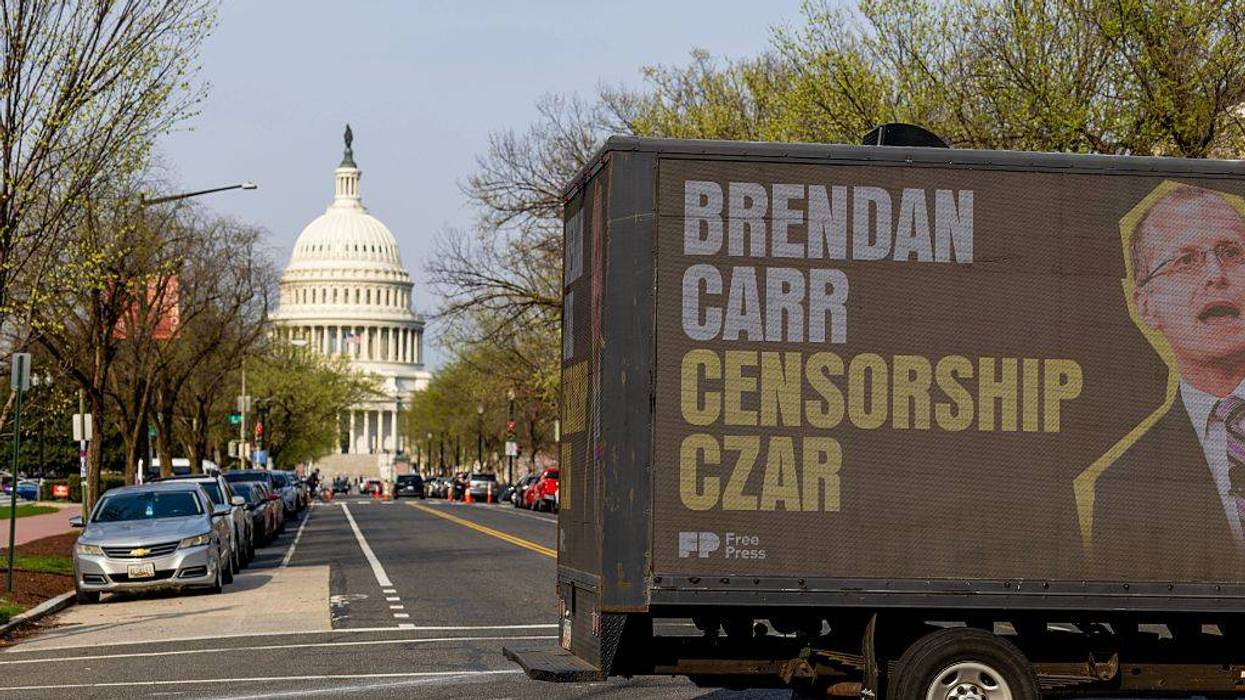
"ABC has finally learned that bullies don’t stop when companies cower in a corner," said one free press advocate.
ABC News earned plaudits on Friday after it came out swinging against the Trump administration's investigation into its daytime talk show "The View."
In a filing with the Federal Communications Commission (FCC), first reported by The New York Times, ABC said the Trump administration's actions "threaten to upend decades of settled law and practice and chill critical protected speech, both with respect to 'The View' and more broadly."
The FCC launched an investigation into "The View" over its interview with Democratic US Senate candidate James Talarico of Texas earlier this year, as the agency questioned whether the program should be exempt from Section 315 of the Communications Act, which requires networks to provide equal access to candidates' political opponents.
Disney-owned ABC noted that "'The View' has been broadcasting under a bona fide news exemption granted to it more than 20 years ago," and argued that forcing the show to abide by equal-time rules "would risk restricting political discourse exactly when it is needed most."
The network's aggressive posture against the FCC inquiry earned it praise from press freedom watchdogs who have long criticized mainstream media outlets for timidity in the face of the Trump administration's authoritarianism.
Seth Stern, chief of advocacy for the Freedom of the Press Foundation, said ABC deserved kudos for "for standing up for itself and the First Amendment" amid attacks from President Donald Trump and FCC Chairman Brendan Carr, who has repeatedly threatened to pull broadcasters' licenses over unfavorable news coverage.
"It’s about time news outlets start telling Carr and his Donald Trump lapel pin to kick rocks," said Stern. "Otherwise, he’ll continue manufacturing bogus pretexts to harass and jawbone licensees that air content his boss doesn’t like."
Jessica J. González, co-CEO of Free Press, said she was "pleased that ABC has finally learned that bullies don’t stop when companies cower in a corner," referring to past settlements ABC and other networks made with Trump after his 2024 election victory.
"The FCC chairman has blatantly and repeatedly abused his power to silence speech that displeases Trump," said González. "This doesn’t just violate the First Amendment rights of broadcasters on the receiving end of Brendan Carr's tactics; it also harms the broadcasters’ audiences."
Mark Jacobs, former editor at the Chicago Tribune and the Chicago Sun-Times, similarly pointed to ABC's past capitulations to Trump, while expressing hope that the network had learned its lesson.
"Remember when ABC folded to Trump's shakedown scheme with a $15 million settlement?" he wrote in a social media post. "Maybe they thought it would buy peace with the dictator. It didn't. The regime demanded Jimmy Kimmel's firing and harassed 'The View.' Now ABC is fighting back after learning that fascists always come back for more."

One expert warned that removing works on activism and social movements erodes the ability of marginalized communities "to take action amid rising authoritarian tactics by our government and attacks on free speech."
As President Donald Trump returned to the White House in the middle of the 2024-25 academic year and swiftly pursued increasingly authoritarian policies, there was "an embrace of anti-intellectualism" within the book-banning movement targeting US public schools and classrooms.
That embrace is detailed in "Facts & Fiction: Stories Stripped Away By Book Bans," an annual report released Thursday by PEN America, a nonprofit that promotes the protection of free expression through the advancement of human rights and literature.
The group found that from July 2024 to last June, 3,743 unique titles were removed from school libraries and classrooms nationwide—and 1,102 of them were "educational or informational books for young people—textbooks or reference texts on a wide range of subjects, history books, biographies, and autobiographies."
Although the majority of banned titles were still fiction, such as Fahrenheit 451 by Ray Bradbury and The Hunger Games by Suzanne Collins, the share of "fiction titles dropped from 85% to 69% of all banned titles, while nonfiction rose from 14% to a startling 29% of all banned titles," according to the analysis.
"This marked impact on books anchored in scientific and historic facts, real events, and real people represents something new and distinctive about the trajectory of book bans in public schools," the report states. "As nonfiction titles are not always the targets of efforts to remove books, that books on ancient Egypt, the digestive system, and self-help for teens, to name a few examples, are impacted by censorship signals an alarming spread of book bans that ignore the educational value of texts and books."
Targeted "nonfiction titles are wide-ranging," the report notes, "from memoirs such as Night by Elie Wiesel to biographies such as RuPaul by Maria Isabel Sánchez Vegara, alongside historical and educational or informational books such as Aztec, Inca & Maya by Elizabeth Baquedano and Challenges for LGBTQ Teens by Martha Lundin."
Flagging this "embrace of anti-intellectualism" in a statement about the new report, Kasey Meehan, director of PEN America's Freedom to Read program, said that "it is another example of how censorship sweeps broadly, leading to removals of all kinds of books, in its efforts to sow fear and distrust in our public education system."
Like the previous academic year, "realistic/contemporary and dystopia/sci-fi/fantasy remain the dominant genres banned," the publication highlights. "But of note, educational/informational titles grew from 5% of all titles in 2023-24 to 13% of total titles banned in 2024-25, or nearly 500 unique titles."
Among the nonfiction titles banned, "52% contained themes of activism and social movements, the most commonly banned topic within nonfiction titles," the report says. "Whether #WomensMarch: Insisting on Equality by Rebecca Felix or IntersectionAllies: We Make Room for All by Chelsea Johnson, LaToya Council, and Carolyn Choi, and illustrated by Ashley Seil Smith, this literature is crucial in the education of young people. These books can encourage readers to challenge the status quo and resist injustice."
Freedom to Read program assistant and report co-author Yuliana Tamayo Latorre said that removing books on these topics "silences the voices of marginalized communities and erode[s] their ability to take action amid rising authoritarian tactics by our government and attacks on free speech."
The most common theme across all banned books was nonsexual violence. This was a theme in 57% of the targeted titles, and they addressed topics including "war, gun violence, natural disasters, domestic violence, human trafficking, slavery and genocide, physical fighting, and more."
Other key themes included death and grief (48%), empowerment and self-esteem (39%), LGBTQ+ topics and metaphors (36%), consensual sexual experiences (34%), mental health disorders (29%), verbal or emotional abuse (28%), and substance use and/or abuse (27%).
There was an increase in banned titles with themes of empowerment and self-esteem, up from 31% in 2023-24.
"Fictional titles with themes of empowerment include Flor Fights Back: A Stonewall Riots Survival Story by Joy Michael Ellison and illustrated by Francesca Ficorilli, and The Moon Within by Aida Salazar," the report says. "To remove these books from classroom and library shelves means revoking access to books that students may rely on for personal and emotional development."
There is an entire section of the report about "erasing people" that examines trends in the identities of characters in banned books. Of all the targeted titles, 44% featured people of color, 39% had LGBTQ+ characters, 19% included transgender or genderqueer individuals, and 10% involved those who are neurodivergent or disabled.
Trump and other leading Republicans have embraced and advanced campaigns against diversity, equity, and inclusion (DEI). PEN America acknowledged that such efforts "have contributed to restrictions and removals on books with people of color and mirror efforts to suppress curriculum on Indigenous history, Black history, Asian American and Pacific Islander stories, and Latine and Hispanic contributions."
Another section of the report addresses a major "discrepancy between the titles impacted by book bans and the justifications made to ban books. Book banners have long cited 'pornography' and 'sexually explicit' material in literature to justify book challenges. Claims that these books contain 'explicit' or 'obscene' content grossly misrepresent the materials."
That section points out that 19% of last year's banned titles contained sexual violence—and "according to RAINN, 1 in 9 girls and 1 in 20 boys under 18 experience sexual abuse or assault. With so many of these titles banned since 2021, it is possible that some young people who have experienced sexual violence no longer have access to books that could help them."
"Books containing experiences of sexual violence include The Nickel Boys by Colson Whitehead, winner of the 2020 Pulitzer Prize for Fiction, set in a 1960s Southern juvenile reform school, and Laurie Halse Anderson's memoir Shout, a call to action for sexual abuse and trauma survivors in the wake of the #MeToo movement," according to PEN America.
The group's report came just a few weeks after a similar annual publication from the American Library Association, which details challenges to at least 4,235 unique titles in 2025, resulting in bans on at least 5,668 books and restrictions on another 920 works.
"In 2025, book bans were not sparked by concerned parents, and they were not the result of local grassroots efforts," noted Sarah Lamdan, executive director of the association's Office for Intellectual Freedom. “They were part of a well-funded, politically driven campaign to suppress the stories and lived experiences of LGBTQIA+ and BIPOC individuals and communities."

"You are deliberately trying to silence the voices of a community," said one Democratic Tennessee state senator. "You cannot call it anything but racism.”
Voting rights defenders in Tennessee on Wednesday condemned a racially rigged congressional map proposed by Republican state lawmakers in the wake of last week's US Supreme Court decision limiting challenges to discriminatory redistricting.
Tennessee Republicans unveiled a US House map that breaks Memphis—one of the nation's largest majority-Black cities—into three districts in a bid to make it likely for GOP candidates to flip the 9th Congressional District, which has been represented by Democrats for half a century.
"These maps have just been released that look like some coloring book from the Republican Party, without any clarity at a precinct level, of where these new districts are gonna be," state Rep. Justin Pearson (D-86) said Wednesday. Pearson—who is running to unseat incumbent Democratic Congressman Steve Cohen in the 9th District—drew national attention in 2023 when Republican legislators expelled him and Rep. Justin Jones (D-52) following their protest for tighter gun laws after the deadly Covenant School shooting in Nashville.
Tennessee Republicans just unveiled their post-VRA congressional gerrymander.It would eliminate the one majority-Black and solidly Democratic district by splitting Memphis 3 ways to install a 9-0 Republican majority.It also splits Nashville several ways to protect scandal-tarred Rep. Andy Ogles
[image or embed]
— Stephen Wolf (@stephenwolf.bsky.social) May 6, 2026 at 8:34 AM
"This whole process has been a sham," Pearson added. "It's been done in secrecy, behind closed doors, with backroom deals. This is just wrong. And everyone knows why this is happening. This is an attack on our Black majority district, this is an attack on our democracy."
US House Minority Leader Hakeem Jeffries (D-NY) weighed in Wednesday on the proposed gerrymander, writing on X, "MAGA Republicans are taking a blowtorch to Black representation in the American South."
Jeffries said that President Donald Trump "and Supreme Court extremists are responsible for this carnage," vowing to "crush them at the ballot box in November" during midterm elections.
John Bisognano, president of the National Democratic Redistricting Committee (NDRC), said in a statement, “This proposal takes an already egregious gerrymander to an even greater extreme by carving up Memphis into three districts, connecting it to rural areas hundreds of miles away, stretching as far as middle Tennessee—communities with needs far different from those of Memphians."
Bisognano added that the GOP proposal "robs Black voters of the ability to elect a congressional candidate of their choice—reversing a right that Black Memphians fought for with blood, sweat, and tears."
Democratic state lawmakers, civil rights leaders, and concerned citizens rallied outside the Tennessee State Capitol in Nashville Tuesday to protest the proposal as a two-day special legislative session on the issue began.
HAPPENING NOW… marching on the Capitol…. #NewJimCrow @GovBillLee
[image or embed]
— The Tennessee Holler (@thetnholler.bsky.social) May 5, 2026 at 12:33 PM
Republican Tennessee Gov. Bill Lee called the special session just two days after the US Supreme Court's Louisiana v. Callais decision ordering the state to redraw its 2024 congressional map, which created a second majority-Black district to mitigate persistent barriers to equal representation.
Lee's move came a day after a phone call from Trump, who has urged him and other Republican governors to follow the lead of Texas, the first salvo fired in a redistricting war prompted by Republican fears of a midterm loss of one or both houses of Congress. Democrat-controlled California followed Texas' move, with other blue states including Virginia, Maryland, and Washington in various stages of enacting or considering redraws.
Republican Louisiana Gov. Jeff Landry subsequently suspended his state’s scheduled May 16 US House primary election, a move that drew rebuke from liberal Supreme Court Justice Ketanji Brown Jackson and legal challenges from Louisianans who already cast ballots in the contest.
The Louisiana v. Callais decision, which the court's 6-3 right-wing majority framed as limiting the role of race in redistricting, is now being used to defend maps where race still plays a decisive role, not only in Tennessee but also in other states that are moving to redraw their congressional maps to dilute Black voting power. Republican Florida Gov. Ron DeSantis last week signed a rigged congressional map into law.
“The ink was barely dry on the Supreme Court’s disastrous decision to gut the Voting Rights Act before Tennessee Republicans rushed to be the first to shamelessly capitalize on it by proposing a gerrymander that systematically targets Black voters in Memphis... and ensures all of the state’s congressional districts are majority-white," Bisognano said.
Bold, blatant f*cking racism. They're gleeful about it.
[image or embed]
— catnan.bsky.social (@catnan.bsky.social) May 5, 2026 at 7:58 PM
Tennessee House Speaker Cameron Sexton (R-25) said in a statement that “the Supreme Court has opined that redistricting, like the judicial system, should be colorblind—the decision indicated states like Tennessee can redistrict based on partisan politics."
“Tennessee’s redistricting will reduce the risk of future legal challenges while promoting sound and strategic conservatism," Sexton added.
Black Memphians weren't having it. Protesters interrupted the second day of hearings Wednesday as a House committee discussed the proposal, chanting, "Memphis is Black, there's no denying that!" and "Hands off our vote!"
“Memphis is Black! There’s no denying that!”House committee disrupted after Speaker sexton presents the racist Republican maps and claims race has nothing to do with how they carved up the city to dilute black representation with white power 🤔(From @gabbysalinas)
[image or embed]
— The Tennessee Holler (@thetnholler.bsky.social) May 6, 2026 at 3:06 PM
"Voters pick our leaders, not the other way around,” Memphis resident Amber Sherman told WREG. "Slicing up Memphis’ congressional districts across a state map will make it impossible for us to get fair representation in Congress because we know that adding a chunk of rural voters to urban cities will never give us fair representation.”
Nashville students confronted Sen. Joey Hensley (R-28) inside the Capitol on Wednesday about how the proposal will disenfranchise voters affected by the redistricting. Hensley's attempt to gaslight the students was caught on camera by The Tennessee Holler, which has provided extensive coverage of the gerrymandering effort.
HENSLEY: “Their vote will still count the same.”STUDENTS: “Then why not leave it the way it was before?”🤔🔥Sen. Joey Hensley (R-Hohenwald) tries to gaslight NASHVILLE students about the Republican push to strip representation from MEMPHIS… and gets immediately owned.
[image or embed]
— The Tennessee Holler (@thetnholler.bsky.social) May 6, 2026 at 7:09 AM
During Tuesday's session, numerous Democratic lawmakers objected to the proposal, with some invoking the deadly struggle of the Civil Rights era.
"I never thought in my lifetime as the youngest African American to ever serve in this body, in the history of this state, that I’d be standing in a body surrounded by my colleagues who are going to erase the vote of my city and Black people in Memphis,” state Sen. London Lamar (D-33) said, according to Democracy Docket.
“This will be one of the most racist actions taken in the modern history of this Legislature that you are participating in this week," she continued. "Intentionally breaking state law to take my community’s vote is downright disgusting and offensive.”
“This is an opportunity for you to have some courage, show some courage. Y’all know this is wrong,” Lamar added. “You don’t have to do it.”
State Sen. Raumesh Akbari (D-29) said: “There’s no way to sugarcoat eliminating a district that is 61% Black and breaking it up into three different districts. You are deliberately trying to silence the voices of a community. You cannot call it anything but racism.”
“History will not look back kindly on you when you had an opportunity to do what was right and you chose to do something else,” she added.
MEMPHIS SENATOR @raumeshakbari : “This is an act of hate. You cannot call it anything but racism. You cannot sugarcoat this.”Tennessee Republicans are diluting Black representation with white power, stripping their seat in Congress. #JimCrow @GovBillLee @MarshaBlackburn
[image or embed]
— The Tennessee Holler (@thetnholler.bsky.social) May 5, 2026 at 4:31 PM
As Democracy Docket reported: "The debate repeatedly returned to personal history. Black lawmakers invoked ancestors who had fought in wars, lived through segregation, and struggled for the right to vote, placing the proposed map squarely in the lineage of those battles."
The fight for civil rights in Memphis spans centuries, from the Reconstruction-era Memphis Massacre to the Ida B. Wells-led anti-lynching campaign to the assassination of Martin Luther King, Jr. to ongoing struggles over police violence, inequality, and economic justice.
Martin Luther King III warned in a letter to legislative leaders that the redistricting would "dismantle the only congressional district that provides Black voters in Memphis a fair opportunity to have a voice in our democracy."
“Do not take this nation back to the days of Jim Crow," he implored, adding that the “resulting disenfranchisement of Black voters would run contrary to everything that my father, Dr. Martin Luther King Jr. fought for.”
Bisognano vowed to fight the GOP rigging attempt, saying that "Republicans are doing this because they think they can get away with it without consequence."
"But they are wrong," he added. "Tennesseans from across the state are already rising up against this un-American attempt to deny Black voters their voice at the ballot box, and, if enacted, this map will be challenged in court.”
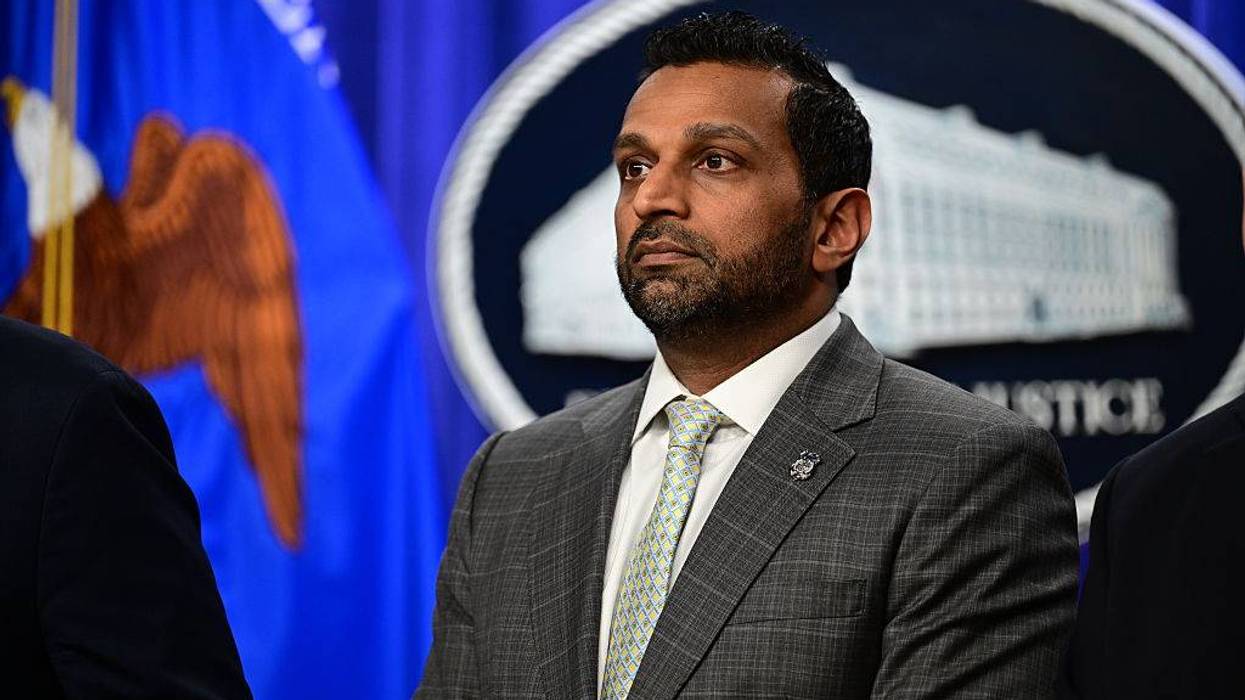
One press freedom advocate said the reported FBI investigation "would be outrageous even if The Atlantic reported classified information, which it didn’t."
The Federal Bureau of Investigation on Wednesday denied that it launched a reported probe into The Atlantic, which recently published a damning account of FBI Director Kash Patel’s alleged drunkenness, though magazine leadership and press freedom advocates remain alarmed.
As reported by MS NOW on Wednesday, the FBI is conducting a criminal leak investigation into The Atlantic's Sarah Fitzpatrick, whose reporting on Patel cited two dozen anonymous sources to document concerns about the FBI director's behavior.
MS NOW noted that the investigation into Fitzpatrick's reporting is "highly unusual because it did not stem from a disclosure of classified information" on the part of government insiders.
One source told MS NOW that the FBI agents assigned to the case have expressed serious reservations about its scope and purpose.
"They know they are not supposed to do this," the source said. "But if they don’t go forward, they could lose their jobs. You’re damned if you do and damned if you don't."
FBI spokesperson Ben Williamson denied to MS NOW that the agency had launched an investigation into Fitzpatrick, saying that "every time there’s a publication of false claims by anonymous sources that gets called out, the media plays the victim via investigations that do not exist."
Jeffrey Goldberg, editor-in-chief of The Atlantic, said the magazine was working to learn more about the alleged investigation, but "if true, this would be an outrageous, illegal, and dangerous attack on the free press and the First Amendment."
"We will defend Sarah and all of our reporters who are subjected to government harassment simply for pursuing the truth," Goldberg added.
Seth Stern, chief of advocacy at the Freedom of the Press Foundation, also condemned the reported investigation, which he said "would be outrageous even if The Atlantic reported classified information, which it didn’t."
"The FBI is reportedly conducting an invasive leak investigation merely to settle a personal vendetta," added Stern. "Separately, it doesn’t make much sense for Patel’s FBI to investigate leaks from what Patel’s lawsuit over the same reporting called ‘sham sources.’ Fake sources can’t leak."
Patel last month filed a $250 million defamation suit against The Atlantic for its report on his behavior, which the magazine said included "episodes of excessive drinking and unexplained absences."
The Atlantic vowed to fight the lawsuit, saying it stood by its reporting while describing Patel's complaint as "meritless."