SUBSCRIBE TO OUR FREE NEWSLETTER
Daily news & progressive opinion—funded by the people, not the corporations—delivered straight to your inbox.
5
#000000
#FFFFFF
To donate by check, phone, or other method, see our More Ways to Give page.
Daily news & progressive opinion—funded by the people, not the corporations—delivered straight to your inbox.
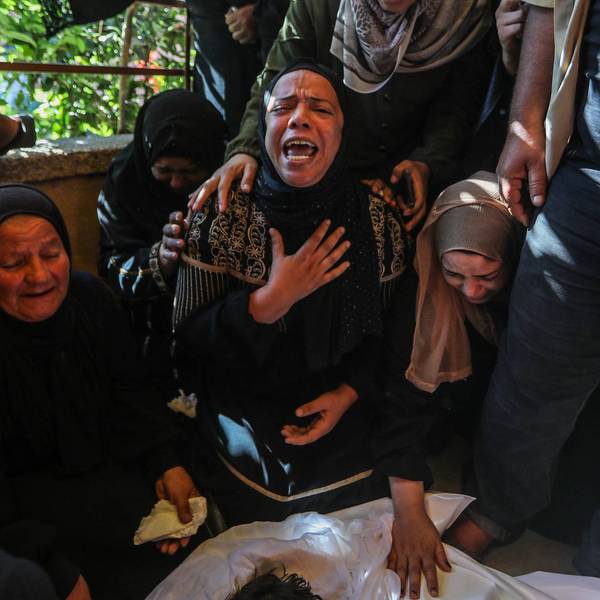
A four-year-old Israeli child was reportedly killed by mortar fire in southern Israel near the Gaza border on Friday afternoon, the latest casualty of renewed violence between Israel and Hamas that has disproportionately claimed Palestinian lives.
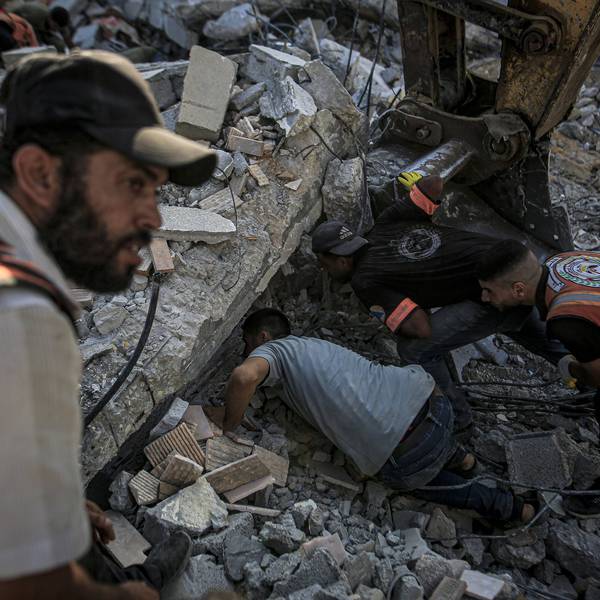
Since hostilities resumed Tuesday, 76 Palestinians have been killed, according to Ashraf el-Qedra, spokesman for the Ministry of Health in Gaza, bringing the total death toll since the conflict began in early July to 2,092 Palestinians--about 75 percent of them civilians and more than 450 of them children--and 68 Israelis, all but four of them soldiers.
Also Friday, Reuters reported that Hamas-led gunmen in Gaza executed 18 Palestinians accused of collaborating with Israel, "accelerating a crackdown on suspected informers after Israeli forces tracked down and killed three senior Hamas commanders" on Thursday.
In response to the child's death, Israeli Prime Minister Benjamin Netanyahu said "Hamas will pay a heavy price for this attack." He vowed that the Israeli Defense Forces (IDF) and the Shin Bet security service will "intensify" operations against Hamas "until the goal of Protective Edge is achieved."
Meanwhile, the Guardian reports that Gaza's economy will take years to recover from the devastating impact of the war:
Almost 10 percent of Gaza's factories have been put out of action, said the Palestinian Federation of Industries. Most other industrial plants have halted production during the conflict, causing losses estimated at more than $70m, said the union of Palestinian industries. The UN's food and agriculture organisation (FAO) said about 42,000 acres of croplands had sustained substantial direct damage and half of Gaza's poultry stock has been lost due to direct hits or lack of care as access to farmlands along the border with Israel became impossible.
"The initial indications are that economic damage caused by the war is three times that of the 2008-9 conflict," said Gaza-based economist Omar Shaban, referring to the Israeli military operation, code-named Cast Lead. "It's huge."
Dear Common Dreams reader, It’s been nearly 30 years since I co-founded Common Dreams with my late wife, Lina Newhouser. We had the radical notion that journalism should serve the public good, not corporate profits. It was clear to us from the outset what it would take to build such a project. No paid advertisements. No corporate sponsors. No millionaire publisher telling us what to think or do. Many people said we wouldn't last a year, but we proved those doubters wrong. Together with a tremendous team of journalists and dedicated staff, we built an independent media outlet free from the constraints of profits and corporate control. Our mission has always been simple: To inform. To inspire. To ignite change for the common good. Building Common Dreams was not easy. Our survival was never guaranteed. When you take on the most powerful forces—Wall Street greed, fossil fuel industry destruction, Big Tech lobbyists, and uber-rich oligarchs who have spent billions upon billions rigging the economy and democracy in their favor—the only bulwark you have is supporters who believe in your work. But here’s the urgent message from me today. It's never been this bad out there. And it's never been this hard to keep us going. At the very moment Common Dreams is most needed, the threats we face are intensifying. We need your support now more than ever. We don't accept corporate advertising and never will. We don't have a paywall because we don't think people should be blocked from critical news based on their ability to pay. Everything we do is funded by the donations of readers like you. When everyone does the little they can afford, we are strong. But if that support retreats or dries up, so do we. Will you donate now to make sure Common Dreams not only survives but thrives? —Craig Brown, Co-founder |
A four-year-old Israeli child was reportedly killed by mortar fire in southern Israel near the Gaza border on Friday afternoon, the latest casualty of renewed violence between Israel and Hamas that has disproportionately claimed Palestinian lives.
Since hostilities resumed Tuesday, 76 Palestinians have been killed, according to Ashraf el-Qedra, spokesman for the Ministry of Health in Gaza, bringing the total death toll since the conflict began in early July to 2,092 Palestinians--about 75 percent of them civilians and more than 450 of them children--and 68 Israelis, all but four of them soldiers.
Also Friday, Reuters reported that Hamas-led gunmen in Gaza executed 18 Palestinians accused of collaborating with Israel, "accelerating a crackdown on suspected informers after Israeli forces tracked down and killed three senior Hamas commanders" on Thursday.
In response to the child's death, Israeli Prime Minister Benjamin Netanyahu said "Hamas will pay a heavy price for this attack." He vowed that the Israeli Defense Forces (IDF) and the Shin Bet security service will "intensify" operations against Hamas "until the goal of Protective Edge is achieved."
Meanwhile, the Guardian reports that Gaza's economy will take years to recover from the devastating impact of the war:
Almost 10 percent of Gaza's factories have been put out of action, said the Palestinian Federation of Industries. Most other industrial plants have halted production during the conflict, causing losses estimated at more than $70m, said the union of Palestinian industries. The UN's food and agriculture organisation (FAO) said about 42,000 acres of croplands had sustained substantial direct damage and half of Gaza's poultry stock has been lost due to direct hits or lack of care as access to farmlands along the border with Israel became impossible.
"The initial indications are that economic damage caused by the war is three times that of the 2008-9 conflict," said Gaza-based economist Omar Shaban, referring to the Israeli military operation, code-named Cast Lead. "It's huge."
A four-year-old Israeli child was reportedly killed by mortar fire in southern Israel near the Gaza border on Friday afternoon, the latest casualty of renewed violence between Israel and Hamas that has disproportionately claimed Palestinian lives.
Since hostilities resumed Tuesday, 76 Palestinians have been killed, according to Ashraf el-Qedra, spokesman for the Ministry of Health in Gaza, bringing the total death toll since the conflict began in early July to 2,092 Palestinians--about 75 percent of them civilians and more than 450 of them children--and 68 Israelis, all but four of them soldiers.
Also Friday, Reuters reported that Hamas-led gunmen in Gaza executed 18 Palestinians accused of collaborating with Israel, "accelerating a crackdown on suspected informers after Israeli forces tracked down and killed three senior Hamas commanders" on Thursday.
In response to the child's death, Israeli Prime Minister Benjamin Netanyahu said "Hamas will pay a heavy price for this attack." He vowed that the Israeli Defense Forces (IDF) and the Shin Bet security service will "intensify" operations against Hamas "until the goal of Protective Edge is achieved."
Meanwhile, the Guardian reports that Gaza's economy will take years to recover from the devastating impact of the war:
Almost 10 percent of Gaza's factories have been put out of action, said the Palestinian Federation of Industries. Most other industrial plants have halted production during the conflict, causing losses estimated at more than $70m, said the union of Palestinian industries. The UN's food and agriculture organisation (FAO) said about 42,000 acres of croplands had sustained substantial direct damage and half of Gaza's poultry stock has been lost due to direct hits or lack of care as access to farmlands along the border with Israel became impossible.
"The initial indications are that economic damage caused by the war is three times that of the 2008-9 conflict," said Gaza-based economist Omar Shaban, referring to the Israeli military operation, code-named Cast Lead. "It's huge."