SUBSCRIBE TO OUR FREE NEWSLETTER
Daily news & progressive opinion—funded by the people, not the corporations—delivered straight to your inbox.
5
#000000
#FFFFFF
To donate by check, phone, or other method, see our More Ways to Give page.
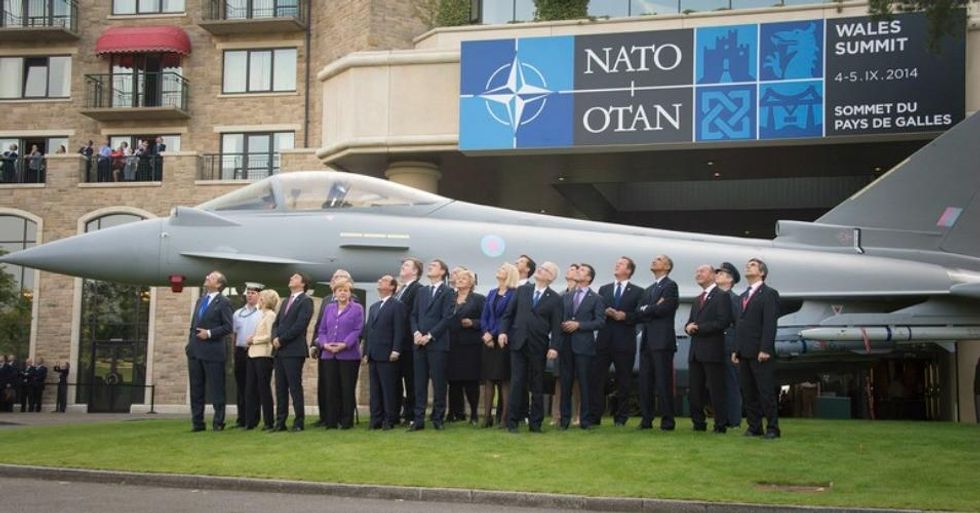
"This is a demonstration of our solidarity and resolve," said NATO Secretary General Anders Fogh Rasmussen as he announced the move by the western military alliance. "This spearhead will include several thousand land troops ready to deploy within a few days with air, sea and Special Forces support."
Part of a larger "Readiness Action Plan" meant to bolster NATO's military footprint in Poland and the Baltic states of Estonia, Lithuania, and Latvia--Russian leaders have repeatedly said that such a NATO expansion along the former Iron Curtain would be seen as a threat to its security and have angrily asserted that such moves by the west, led by the U.S. and the U.K., are a betrayal of key agreements long ago reached.
In addition to repeated pledges that NATO would not seek to expand eastward following the end of the Cold War, other treaties between Europe and Russia have now been brought back into question as the U.S. and Europe have imposed repeated economic sanctions against Russia for its move to re-incorporate Crimea earlier this year and the active support it has shown rebels in eastern Ukraine.
As the Russian news agency ITAR-TASS reports:
The NATO-Russia Founding Act on Mutual Relations, Cooperation and Security signed in 1997 still remains in force, the alliance's Secretary General Anders Fogh Rasmussen said Friday after NATO's first working session at the top level in Wales.
Rasmussen said NATO had not made any decisions to deviate from the act. He accused Russia of violating its principles.
The NATO-Russia Founding Act is the fundamental document in the relations between the Russian Federation and the alliance. It in particular states the principle of non-use of military force in foreign policy, as well as a joint declaration that Russia and NATO no longer see each other as adversaries.
NATO halted practical cooperation with Moscow after Russia incorporated Crimea in mid-March.
Friday's decision by NATO to approve new military forces for eastern Europe comes at the exact moment that representatives from Russia, the Ukraine government in Kiev, rebel factions from eastern Ukraine, and the Organization for Security and Cooperation in Europe (OSCE) are meeting in Minsk, Belarus on Friday in an attempt to finalize a negotiated settlement to the ongoing military conflict and political crisis in Ukraine.
Critics of NATO have accused it of repeatedly undermining efforts for a political solution in Ukraine and charging that high-level hypocrisy has been repeatedly evidenced regarding outside influence when it comes to overt western backing of the Kiev government while calling Russia support for those in eastern Ukraine "illegal" interference.
As leaders of NATO member states have repeatedly demanded that Russia move its troops further away from its border with Ukraine, those same voices have continued to push for re-positioning their own forces closer to Russia while stepping up their efforts to back the Kiev government financially, diplomatically, and militarily.
As noted--if subtly--in a piece in the New York Times on Friday, the other piece of the puzzle regarding NATO expansion in eastern Europe is the question of military spending itself. In addition to offering the eastern members a more robust NATO presence along their borders with Russia, the larger and more powerful states (ie. U.S., U.K., Germany, and France) are specifically pushing for those countries to increase their level of annual military spending. The Times reports:
NATO asks member states to spend 2 percent of their gross domestic product on their armed forces, yet only a handful of them actually do. Estonia, the small Baltic state at the alliance's far eastern edge, is one of them, and Poland, by far the largest and richest country on that flank, is at 1.95 percent.
"This is one of the reasons that when President Obama comes to the region, he visits Estonia and Poland," said Karlis Bukovskis, deputy director of the Latvian Institute of International Affairs.
But even the most vulnerable nations, including some with sizable Russian ethnic minorities that might tempt a repeat of Russia's incursion into Ukraine, are spending far less than the 2 percent benchmark. Latvia and Lithuania are spending less than 1 percent, though both have indicated they intend to ratchet up to 2 percent by 2020. Hungary and Slovakia are at about 1 percent and Romania, which recently announced that it would bolster military spending, is at about 1.5 percent.
The unease has moved to Scandinavia as well: Sweden recently announced an increase in military spending.
"It is looking like, as a result of Russia's actions in Ukraine, that military spending is likely to start increasing in those countries that are nearest to Russia, the frontline and the Nordic countries," said Sam Perlo-Freeman, head of the military expenditure project at the Stockholm International Peace Research Institute.
"This is a demonstration of our solidarity and resolve," said NATO Secretary General Anders Fogh Rasmussen as he announced the move by the western military alliance. "This spearhead will include several thousand land troops ready to deploy within a few days with air, sea and Special Forces support."
Part of a larger "Readiness Action Plan" meant to bolster NATO's military footprint in Poland and the Baltic states of Estonia, Lithuania, and Latvia--Russian leaders have repeatedly said that such a NATO expansion along the former Iron Curtain would be seen as a threat to its security and have angrily asserted that such moves by the west, led by the U.S. and the U.K., are a betrayal of key agreements long ago reached.
In addition to repeated pledges that NATO would not seek to expand eastward following the end of the Cold War, other treaties between Europe and Russia have now been brought back into question as the U.S. and Europe have imposed repeated economic sanctions against Russia for its move to re-incorporate Crimea earlier this year and the active support it has shown rebels in eastern Ukraine.
As the Russian news agency ITAR-TASS reports:
The NATO-Russia Founding Act on Mutual Relations, Cooperation and Security signed in 1997 still remains in force, the alliance's Secretary General Anders Fogh Rasmussen said Friday after NATO's first working session at the top level in Wales.
Rasmussen said NATO had not made any decisions to deviate from the act. He accused Russia of violating its principles.
The NATO-Russia Founding Act is the fundamental document in the relations between the Russian Federation and the alliance. It in particular states the principle of non-use of military force in foreign policy, as well as a joint declaration that Russia and NATO no longer see each other as adversaries.
NATO halted practical cooperation with Moscow after Russia incorporated Crimea in mid-March.
Friday's decision by NATO to approve new military forces for eastern Europe comes at the exact moment that representatives from Russia, the Ukraine government in Kiev, rebel factions from eastern Ukraine, and the Organization for Security and Cooperation in Europe (OSCE) are meeting in Minsk, Belarus on Friday in an attempt to finalize a negotiated settlement to the ongoing military conflict and political crisis in Ukraine.
Critics of NATO have accused it of repeatedly undermining efforts for a political solution in Ukraine and charging that high-level hypocrisy has been repeatedly evidenced regarding outside influence when it comes to overt western backing of the Kiev government while calling Russia support for those in eastern Ukraine "illegal" interference.
As leaders of NATO member states have repeatedly demanded that Russia move its troops further away from its border with Ukraine, those same voices have continued to push for re-positioning their own forces closer to Russia while stepping up their efforts to back the Kiev government financially, diplomatically, and militarily.
As noted--if subtly--in a piece in the New York Times on Friday, the other piece of the puzzle regarding NATO expansion in eastern Europe is the question of military spending itself. In addition to offering the eastern members a more robust NATO presence along their borders with Russia, the larger and more powerful states (ie. U.S., U.K., Germany, and France) are specifically pushing for those countries to increase their level of annual military spending. The Times reports:
NATO asks member states to spend 2 percent of their gross domestic product on their armed forces, yet only a handful of them actually do. Estonia, the small Baltic state at the alliance's far eastern edge, is one of them, and Poland, by far the largest and richest country on that flank, is at 1.95 percent.
"This is one of the reasons that when President Obama comes to the region, he visits Estonia and Poland," said Karlis Bukovskis, deputy director of the Latvian Institute of International Affairs.
But even the most vulnerable nations, including some with sizable Russian ethnic minorities that might tempt a repeat of Russia's incursion into Ukraine, are spending far less than the 2 percent benchmark. Latvia and Lithuania are spending less than 1 percent, though both have indicated they intend to ratchet up to 2 percent by 2020. Hungary and Slovakia are at about 1 percent and Romania, which recently announced that it would bolster military spending, is at about 1.5 percent.
The unease has moved to Scandinavia as well: Sweden recently announced an increase in military spending.
"It is looking like, as a result of Russia's actions in Ukraine, that military spending is likely to start increasing in those countries that are nearest to Russia, the frontline and the Nordic countries," said Sam Perlo-Freeman, head of the military expenditure project at the Stockholm International Peace Research Institute.
"This is a demonstration of our solidarity and resolve," said NATO Secretary General Anders Fogh Rasmussen as he announced the move by the western military alliance. "This spearhead will include several thousand land troops ready to deploy within a few days with air, sea and Special Forces support."
Part of a larger "Readiness Action Plan" meant to bolster NATO's military footprint in Poland and the Baltic states of Estonia, Lithuania, and Latvia--Russian leaders have repeatedly said that such a NATO expansion along the former Iron Curtain would be seen as a threat to its security and have angrily asserted that such moves by the west, led by the U.S. and the U.K., are a betrayal of key agreements long ago reached.
In addition to repeated pledges that NATO would not seek to expand eastward following the end of the Cold War, other treaties between Europe and Russia have now been brought back into question as the U.S. and Europe have imposed repeated economic sanctions against Russia for its move to re-incorporate Crimea earlier this year and the active support it has shown rebels in eastern Ukraine.
As the Russian news agency ITAR-TASS reports:
The NATO-Russia Founding Act on Mutual Relations, Cooperation and Security signed in 1997 still remains in force, the alliance's Secretary General Anders Fogh Rasmussen said Friday after NATO's first working session at the top level in Wales.
Rasmussen said NATO had not made any decisions to deviate from the act. He accused Russia of violating its principles.
The NATO-Russia Founding Act is the fundamental document in the relations between the Russian Federation and the alliance. It in particular states the principle of non-use of military force in foreign policy, as well as a joint declaration that Russia and NATO no longer see each other as adversaries.
NATO halted practical cooperation with Moscow after Russia incorporated Crimea in mid-March.
Friday's decision by NATO to approve new military forces for eastern Europe comes at the exact moment that representatives from Russia, the Ukraine government in Kiev, rebel factions from eastern Ukraine, and the Organization for Security and Cooperation in Europe (OSCE) are meeting in Minsk, Belarus on Friday in an attempt to finalize a negotiated settlement to the ongoing military conflict and political crisis in Ukraine.
Critics of NATO have accused it of repeatedly undermining efforts for a political solution in Ukraine and charging that high-level hypocrisy has been repeatedly evidenced regarding outside influence when it comes to overt western backing of the Kiev government while calling Russia support for those in eastern Ukraine "illegal" interference.
As leaders of NATO member states have repeatedly demanded that Russia move its troops further away from its border with Ukraine, those same voices have continued to push for re-positioning their own forces closer to Russia while stepping up their efforts to back the Kiev government financially, diplomatically, and militarily.
As noted--if subtly--in a piece in the New York Times on Friday, the other piece of the puzzle regarding NATO expansion in eastern Europe is the question of military spending itself. In addition to offering the eastern members a more robust NATO presence along their borders with Russia, the larger and more powerful states (ie. U.S., U.K., Germany, and France) are specifically pushing for those countries to increase their level of annual military spending. The Times reports:
NATO asks member states to spend 2 percent of their gross domestic product on their armed forces, yet only a handful of them actually do. Estonia, the small Baltic state at the alliance's far eastern edge, is one of them, and Poland, by far the largest and richest country on that flank, is at 1.95 percent.
"This is one of the reasons that when President Obama comes to the region, he visits Estonia and Poland," said Karlis Bukovskis, deputy director of the Latvian Institute of International Affairs.
But even the most vulnerable nations, including some with sizable Russian ethnic minorities that might tempt a repeat of Russia's incursion into Ukraine, are spending far less than the 2 percent benchmark. Latvia and Lithuania are spending less than 1 percent, though both have indicated they intend to ratchet up to 2 percent by 2020. Hungary and Slovakia are at about 1 percent and Romania, which recently announced that it would bolster military spending, is at about 1.5 percent.
The unease has moved to Scandinavia as well: Sweden recently announced an increase in military spending.
"It is looking like, as a result of Russia's actions in Ukraine, that military spending is likely to start increasing in those countries that are nearest to Russia, the frontline and the Nordic countries," said Sam Perlo-Freeman, head of the military expenditure project at the Stockholm International Peace Research Institute.