SUBSCRIBE TO OUR FREE NEWSLETTER
Daily news & progressive opinion—funded by the people, not the corporations—delivered straight to your inbox.
5
#000000
#FFFFFF
To donate by check, phone, or other method, see our More Ways to Give page.
Daily news & progressive opinion—funded by the people, not the corporations—delivered straight to your inbox.
One of the biggest stories of 2015 was the sharp decline of oil prices, which fell this year to levels not seen in more than a decade.
"After plunging from more than $100 a barrel to nearly $50 a barrel last year, U.S. oil prices fell 30 percent in 2015 to $37.04 a barrel," the Wall Street Journal reported Thursday.
"Renewables have turned a corner in a fundamental way."
-- Dan Reicher, Stanford University's Steyer-Taylor Center for Energy Policy and Finance
"A repeat in early 2016 could well push crude oil to fresh closing lows not seen since the early 2000s," the Fiscal Times added this week.
It was good news for fuel consumers--drivers who flocked to SUVs and pickup trucks in 2015, for instance--as well as for governments that import crude oil.
But this trend could easily translate into bad news for stemming climate change, a goal that depends on keeping the vast majority of fossil fuels in the ground.
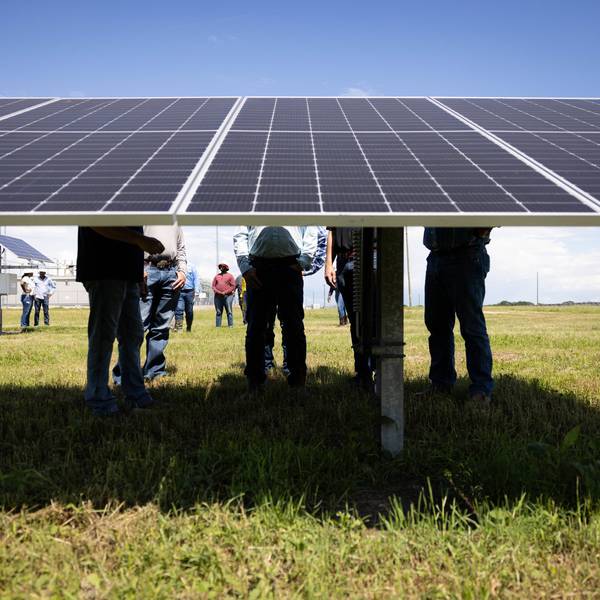
Yet surprisingly, even "amid a worldwide glut of cheap fossil fuels," the Washington Post's Joby Warrick reported on Friday, "business is blowing strong" for the renewable energy industry as well.
Indeed, Warrick writes, 2015 saw "a global surge for wind and solar energy, which occurred despite oil, coal and natural gas selling at bargain rates." He points to "massive new projects" under construction from China and India to Texas, as well as growing capacity in the U.S., which recently "crossed the 70-gigawatt threshold in wind-generated electricity, with 50,000 spinning turbines producing enough power to light up 19 million homes."
Common Dreams outlined several other global renewable energy "bright spots" in November.
Improved technology, combined with "new government policies here and abroad that favor investment in renewables" and "a growing willingness by Wall Street to pour billions of dollars into projects once considered financially risky," are all contributing to the boom, according to the Post.
"Renewables have turned a corner in a fundamental way," Dan Reicher, a former Energy Department assistant secretary who is now executive director of Stanford University's Steyer-Taylor Center for Energy Policy and Finance, told the paper.
Warrick credits the Paris Agreement hammered out at last month's COP21 climate talks in part for spurring this momentum. As Common Dreams reported at the time, fossil fuel stocks tumbled while renewable energy soared on the first day of trading after global leaders cemented the landmark pact in Paris.
Interestingly, at least one wind-energy company says the effect of cheap fossil fuels has been counter-intuitive. Warrick reports:
At Vestas Wind Systems, which is based in Denmark, [CEO Anders] Runevad said the recent drop in prices for traditional fuels has prompted some of his customers to actually increase their spending on wind farms, especially in countries that are heavy importers of petroleum.
"Some countries are having a budget surplus now because of low oil prices, and they're using that money to invest in new infrastructure," he said. "For importing countries, it's a net-positive. Because of the uncertainty with gas prices, we haven't seen any of our wind customers say, 'Let's build a gas-fired plant instead.'"
Still, major hurdles lay ahead if a complete transition to clean energy is to be achieved. Wind and solar power still account for minuscule pieces of the energy pie, in the U.S. and elsewhere.
The Associated Press reported Thursday that, for reasons ranging from technical to regulatory, while "[c]onverting the wind and sun into electricity is increasingly affordable...it can be difficult to get that electricity from distant plains and deserts to the places where it's needed."
But surmounting such obstacles is critical, as bidding farewell to fossil fuels could have enormous implications not just for the global climate, but for the world's population. "[E]specially for the people of Beijing--and Delhi and Tehran, among other cities currently choking on dirty emissions--that final goodbye can't come soon enough," the Huffington Post's Lynne Peeples wrote this week.
Indeed, as renewables boom, Harvard University environmental health expert and pediatrician Aaron Bernstein said at a December panel on climate change and health, "we actually stand at an entry point to perhaps the greatest public health intervention ever."
Dear Common Dreams reader, It’s been nearly 30 years since I co-founded Common Dreams with my late wife, Lina Newhouser. We had the radical notion that journalism should serve the public good, not corporate profits. It was clear to us from the outset what it would take to build such a project. No paid advertisements. No corporate sponsors. No millionaire publisher telling us what to think or do. Many people said we wouldn't last a year, but we proved those doubters wrong. Together with a tremendous team of journalists and dedicated staff, we built an independent media outlet free from the constraints of profits and corporate control. Our mission has always been simple: To inform. To inspire. To ignite change for the common good. Building Common Dreams was not easy. Our survival was never guaranteed. When you take on the most powerful forces—Wall Street greed, fossil fuel industry destruction, Big Tech lobbyists, and uber-rich oligarchs who have spent billions upon billions rigging the economy and democracy in their favor—the only bulwark you have is supporters who believe in your work. But here’s the urgent message from me today. It's never been this bad out there. And it's never been this hard to keep us going. At the very moment Common Dreams is most needed, the threats we face are intensifying. We need your support now more than ever. We don't accept corporate advertising and never will. We don't have a paywall because we don't think people should be blocked from critical news based on their ability to pay. Everything we do is funded by the donations of readers like you. When everyone does the little they can afford, we are strong. But if that support retreats or dries up, so do we. Will you donate now to make sure Common Dreams not only survives but thrives? —Craig Brown, Co-founder |
One of the biggest stories of 2015 was the sharp decline of oil prices, which fell this year to levels not seen in more than a decade.
"After plunging from more than $100 a barrel to nearly $50 a barrel last year, U.S. oil prices fell 30 percent in 2015 to $37.04 a barrel," the Wall Street Journal reported Thursday.
"Renewables have turned a corner in a fundamental way."
-- Dan Reicher, Stanford University's Steyer-Taylor Center for Energy Policy and Finance
"A repeat in early 2016 could well push crude oil to fresh closing lows not seen since the early 2000s," the Fiscal Times added this week.
It was good news for fuel consumers--drivers who flocked to SUVs and pickup trucks in 2015, for instance--as well as for governments that import crude oil.
But this trend could easily translate into bad news for stemming climate change, a goal that depends on keeping the vast majority of fossil fuels in the ground.
Yet surprisingly, even "amid a worldwide glut of cheap fossil fuels," the Washington Post's Joby Warrick reported on Friday, "business is blowing strong" for the renewable energy industry as well.
Indeed, Warrick writes, 2015 saw "a global surge for wind and solar energy, which occurred despite oil, coal and natural gas selling at bargain rates." He points to "massive new projects" under construction from China and India to Texas, as well as growing capacity in the U.S., which recently "crossed the 70-gigawatt threshold in wind-generated electricity, with 50,000 spinning turbines producing enough power to light up 19 million homes."
Common Dreams outlined several other global renewable energy "bright spots" in November.
Improved technology, combined with "new government policies here and abroad that favor investment in renewables" and "a growing willingness by Wall Street to pour billions of dollars into projects once considered financially risky," are all contributing to the boom, according to the Post.
"Renewables have turned a corner in a fundamental way," Dan Reicher, a former Energy Department assistant secretary who is now executive director of Stanford University's Steyer-Taylor Center for Energy Policy and Finance, told the paper.
Warrick credits the Paris Agreement hammered out at last month's COP21 climate talks in part for spurring this momentum. As Common Dreams reported at the time, fossil fuel stocks tumbled while renewable energy soared on the first day of trading after global leaders cemented the landmark pact in Paris.
Interestingly, at least one wind-energy company says the effect of cheap fossil fuels has been counter-intuitive. Warrick reports:
At Vestas Wind Systems, which is based in Denmark, [CEO Anders] Runevad said the recent drop in prices for traditional fuels has prompted some of his customers to actually increase their spending on wind farms, especially in countries that are heavy importers of petroleum.
"Some countries are having a budget surplus now because of low oil prices, and they're using that money to invest in new infrastructure," he said. "For importing countries, it's a net-positive. Because of the uncertainty with gas prices, we haven't seen any of our wind customers say, 'Let's build a gas-fired plant instead.'"
Still, major hurdles lay ahead if a complete transition to clean energy is to be achieved. Wind and solar power still account for minuscule pieces of the energy pie, in the U.S. and elsewhere.
The Associated Press reported Thursday that, for reasons ranging from technical to regulatory, while "[c]onverting the wind and sun into electricity is increasingly affordable...it can be difficult to get that electricity from distant plains and deserts to the places where it's needed."
But surmounting such obstacles is critical, as bidding farewell to fossil fuels could have enormous implications not just for the global climate, but for the world's population. "[E]specially for the people of Beijing--and Delhi and Tehran, among other cities currently choking on dirty emissions--that final goodbye can't come soon enough," the Huffington Post's Lynne Peeples wrote this week.
Indeed, as renewables boom, Harvard University environmental health expert and pediatrician Aaron Bernstein said at a December panel on climate change and health, "we actually stand at an entry point to perhaps the greatest public health intervention ever."
One of the biggest stories of 2015 was the sharp decline of oil prices, which fell this year to levels not seen in more than a decade.
"After plunging from more than $100 a barrel to nearly $50 a barrel last year, U.S. oil prices fell 30 percent in 2015 to $37.04 a barrel," the Wall Street Journal reported Thursday.
"Renewables have turned a corner in a fundamental way."
-- Dan Reicher, Stanford University's Steyer-Taylor Center for Energy Policy and Finance
"A repeat in early 2016 could well push crude oil to fresh closing lows not seen since the early 2000s," the Fiscal Times added this week.
It was good news for fuel consumers--drivers who flocked to SUVs and pickup trucks in 2015, for instance--as well as for governments that import crude oil.
But this trend could easily translate into bad news for stemming climate change, a goal that depends on keeping the vast majority of fossil fuels in the ground.
Yet surprisingly, even "amid a worldwide glut of cheap fossil fuels," the Washington Post's Joby Warrick reported on Friday, "business is blowing strong" for the renewable energy industry as well.
Indeed, Warrick writes, 2015 saw "a global surge for wind and solar energy, which occurred despite oil, coal and natural gas selling at bargain rates." He points to "massive new projects" under construction from China and India to Texas, as well as growing capacity in the U.S., which recently "crossed the 70-gigawatt threshold in wind-generated electricity, with 50,000 spinning turbines producing enough power to light up 19 million homes."
Common Dreams outlined several other global renewable energy "bright spots" in November.
Improved technology, combined with "new government policies here and abroad that favor investment in renewables" and "a growing willingness by Wall Street to pour billions of dollars into projects once considered financially risky," are all contributing to the boom, according to the Post.
"Renewables have turned a corner in a fundamental way," Dan Reicher, a former Energy Department assistant secretary who is now executive director of Stanford University's Steyer-Taylor Center for Energy Policy and Finance, told the paper.
Warrick credits the Paris Agreement hammered out at last month's COP21 climate talks in part for spurring this momentum. As Common Dreams reported at the time, fossil fuel stocks tumbled while renewable energy soared on the first day of trading after global leaders cemented the landmark pact in Paris.
Interestingly, at least one wind-energy company says the effect of cheap fossil fuels has been counter-intuitive. Warrick reports:
At Vestas Wind Systems, which is based in Denmark, [CEO Anders] Runevad said the recent drop in prices for traditional fuels has prompted some of his customers to actually increase their spending on wind farms, especially in countries that are heavy importers of petroleum.
"Some countries are having a budget surplus now because of low oil prices, and they're using that money to invest in new infrastructure," he said. "For importing countries, it's a net-positive. Because of the uncertainty with gas prices, we haven't seen any of our wind customers say, 'Let's build a gas-fired plant instead.'"
Still, major hurdles lay ahead if a complete transition to clean energy is to be achieved. Wind and solar power still account for minuscule pieces of the energy pie, in the U.S. and elsewhere.
The Associated Press reported Thursday that, for reasons ranging from technical to regulatory, while "[c]onverting the wind and sun into electricity is increasingly affordable...it can be difficult to get that electricity from distant plains and deserts to the places where it's needed."
But surmounting such obstacles is critical, as bidding farewell to fossil fuels could have enormous implications not just for the global climate, but for the world's population. "[E]specially for the people of Beijing--and Delhi and Tehran, among other cities currently choking on dirty emissions--that final goodbye can't come soon enough," the Huffington Post's Lynne Peeples wrote this week.
Indeed, as renewables boom, Harvard University environmental health expert and pediatrician Aaron Bernstein said at a December panel on climate change and health, "we actually stand at an entry point to perhaps the greatest public health intervention ever."