SUBSCRIBE TO OUR FREE NEWSLETTER
Daily news & progressive opinion—funded by the people, not the corporations—delivered straight to your inbox.
5
#000000
#FFFFFF
To donate by check, phone, or other method, see our More Ways to Give page.
Daily news & progressive opinion—funded by the people, not the corporations—delivered straight to your inbox.
Just before Sunday's Democratic primary debate in South Carolina, Bernie Sanders released the details of his Medicare-for-All universal healthcare proposal, saying it is "time for our country to join every other major industrialized nation on Earth and guarantee health care to all citizens as a right, not a privilege."
The plan (pdf), also known as single-payer healthcare, builds on the successes of both Medicare and the Affordable Care Act (ACA), "eliminating expensive and wasteful private health insurance," and saving taxpayers money by "dramatically reducing overall health care costs and bringing down skyrocketing prescription drug prices which are far greater in the United States than in any other country."
According to the Sanders campaign:
The shift to universal health care would be paid for with a 2.2 percent health care premium (calculated under the rules for federal income taxes); a 6.2 percent health care payroll tax paid by employers; an estate tax on the wealthiest Americans and changes in the tax code to make federal income tax rates more progressive.
Under the plan, individuals making $250,000 to $500,000 a year would be taxed at a rate of 37 percent. The top rate, 52 percent, would apply to those earning $10 million or more a year, a category that in 2013 included only the 13,000 wealthiest households in the United States.
An academic analysis (pdf) released alongside the proposal shows that it would save $6 trillion over the next 10 years compared to the current system.
"Instead of being held hostage to a corporate system based on profits and price gouging, with Sanders' Medicare-for-All plan we can finally have a system based on patient need."
-- RoseAnn DeMoro, National Nurses United
"The net savings from single payer come from reduced spending on administrative activities, in both private insurers and providers' offices, reduced spending on monopoly prices for pharmaceuticals and medical devices, and a slowdown in the growth of spending because of controls on administrative costs and drug prices," University of Massachusetts Amherst economics professor Gerald Friedman states in the analysis.
Friedman's calculations show that the typical family earning $50,000 a year would save nearly $6,000 annually in health care costs. "The average working family now pays $4,955 in premiums for private insurance and spends another $1,318 on deductibles for care that isn't covered," the campaign said in a statement. "Under Sanders' plan, a family of four earning $50,000 would pay just $466 per year to the Medicare-for-all program."
Heralding his plan during Sunday's debate, Sanders "spoke to Democratic heroes and liberal values," Paul Waldman wrote at the Washington Post.
"What a Medicare-for-all program does is finally provide in this country health care for every man, woman and child as a right," Sanders said. "Now, the truth is, that Frank Delano Roosevelt, Harry Truman, do you know what they believed in? They believed that health care should be available to all of our people."
He continued:
Do you know why we can't do what every other...major country on Earth is doing? It's because we have a campaign finance system that is corrupt, we have super PACs, we have the pharmaceutical industry pouring hundreds of millions of dollars into campaign contributions and lobbying, and the private insurance companies as well. What this is really about is not the rational way to go forward -- it's Medicare for all -- it is whether we have the guts to stand up to the private insurance companies and all of their money, and the pharmaceutical industry. That's what this debate should be about.
Sanders' chief rival Hillary Clinton, who has gone on the attack regarding single-payer in recent weeks, has taken a more narrow view, focused on defending the ACA and "making it work." But Sanders notes that even under the ACA, 29 million are still uninsured and millions more are "underinsured"--unable to afford high co-pays or deductibles.
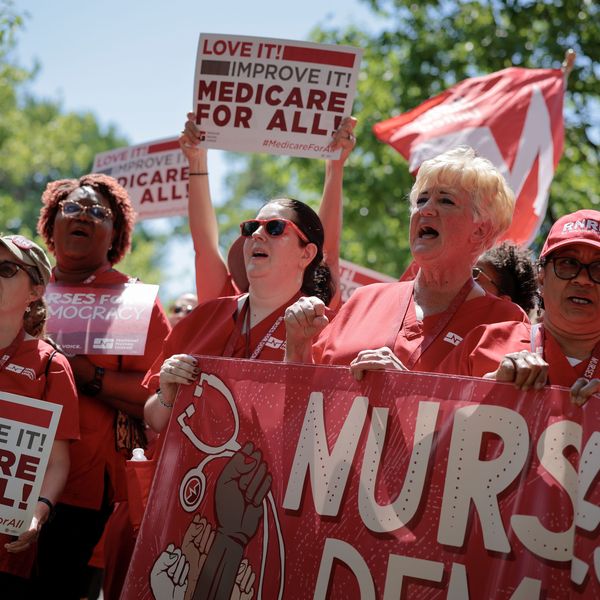
"Instead of being held hostage to a corporate system based on profits and price gouging, with Sanders' Medicare-for-All plan we can finally have a system based on patient need, with a single standard of quality care for all, regardless of ability to pay, race, gender, age, or where you live," said National Nurses United executive director RoseAnn DeMoro in a statement on Monday. "That's a beautiful thing."
Watch Sanders and Clinton debate healthcare below:
Dear Common Dreams reader, It’s been nearly 30 years since I co-founded Common Dreams with my late wife, Lina Newhouser. We had the radical notion that journalism should serve the public good, not corporate profits. It was clear to us from the outset what it would take to build such a project. No paid advertisements. No corporate sponsors. No millionaire publisher telling us what to think or do. Many people said we wouldn't last a year, but we proved those doubters wrong. Together with a tremendous team of journalists and dedicated staff, we built an independent media outlet free from the constraints of profits and corporate control. Our mission has always been simple: To inform. To inspire. To ignite change for the common good. Building Common Dreams was not easy. Our survival was never guaranteed. When you take on the most powerful forces—Wall Street greed, fossil fuel industry destruction, Big Tech lobbyists, and uber-rich oligarchs who have spent billions upon billions rigging the economy and democracy in their favor—the only bulwark you have is supporters who believe in your work. But here’s the urgent message from me today. It's never been this bad out there. And it's never been this hard to keep us going. At the very moment Common Dreams is most needed, the threats we face are intensifying. We need your support now more than ever. We don't accept corporate advertising and never will. We don't have a paywall because we don't think people should be blocked from critical news based on their ability to pay. Everything we do is funded by the donations of readers like you. When everyone does the little they can afford, we are strong. But if that support retreats or dries up, so do we. Will you donate now to make sure Common Dreams not only survives but thrives? —Craig Brown, Co-founder |
Just before Sunday's Democratic primary debate in South Carolina, Bernie Sanders released the details of his Medicare-for-All universal healthcare proposal, saying it is "time for our country to join every other major industrialized nation on Earth and guarantee health care to all citizens as a right, not a privilege."
The plan (pdf), also known as single-payer healthcare, builds on the successes of both Medicare and the Affordable Care Act (ACA), "eliminating expensive and wasteful private health insurance," and saving taxpayers money by "dramatically reducing overall health care costs and bringing down skyrocketing prescription drug prices which are far greater in the United States than in any other country."
According to the Sanders campaign:
The shift to universal health care would be paid for with a 2.2 percent health care premium (calculated under the rules for federal income taxes); a 6.2 percent health care payroll tax paid by employers; an estate tax on the wealthiest Americans and changes in the tax code to make federal income tax rates more progressive.
Under the plan, individuals making $250,000 to $500,000 a year would be taxed at a rate of 37 percent. The top rate, 52 percent, would apply to those earning $10 million or more a year, a category that in 2013 included only the 13,000 wealthiest households in the United States.
An academic analysis (pdf) released alongside the proposal shows that it would save $6 trillion over the next 10 years compared to the current system.
"Instead of being held hostage to a corporate system based on profits and price gouging, with Sanders' Medicare-for-All plan we can finally have a system based on patient need."
-- RoseAnn DeMoro, National Nurses United
"The net savings from single payer come from reduced spending on administrative activities, in both private insurers and providers' offices, reduced spending on monopoly prices for pharmaceuticals and medical devices, and a slowdown in the growth of spending because of controls on administrative costs and drug prices," University of Massachusetts Amherst economics professor Gerald Friedman states in the analysis.
Friedman's calculations show that the typical family earning $50,000 a year would save nearly $6,000 annually in health care costs. "The average working family now pays $4,955 in premiums for private insurance and spends another $1,318 on deductibles for care that isn't covered," the campaign said in a statement. "Under Sanders' plan, a family of four earning $50,000 would pay just $466 per year to the Medicare-for-all program."
Heralding his plan during Sunday's debate, Sanders "spoke to Democratic heroes and liberal values," Paul Waldman wrote at the Washington Post.
"What a Medicare-for-all program does is finally provide in this country health care for every man, woman and child as a right," Sanders said. "Now, the truth is, that Frank Delano Roosevelt, Harry Truman, do you know what they believed in? They believed that health care should be available to all of our people."
He continued:
Do you know why we can't do what every other...major country on Earth is doing? It's because we have a campaign finance system that is corrupt, we have super PACs, we have the pharmaceutical industry pouring hundreds of millions of dollars into campaign contributions and lobbying, and the private insurance companies as well. What this is really about is not the rational way to go forward -- it's Medicare for all -- it is whether we have the guts to stand up to the private insurance companies and all of their money, and the pharmaceutical industry. That's what this debate should be about.
Sanders' chief rival Hillary Clinton, who has gone on the attack regarding single-payer in recent weeks, has taken a more narrow view, focused on defending the ACA and "making it work." But Sanders notes that even under the ACA, 29 million are still uninsured and millions more are "underinsured"--unable to afford high co-pays or deductibles.
"Instead of being held hostage to a corporate system based on profits and price gouging, with Sanders' Medicare-for-All plan we can finally have a system based on patient need, with a single standard of quality care for all, regardless of ability to pay, race, gender, age, or where you live," said National Nurses United executive director RoseAnn DeMoro in a statement on Monday. "That's a beautiful thing."
Watch Sanders and Clinton debate healthcare below:
Just before Sunday's Democratic primary debate in South Carolina, Bernie Sanders released the details of his Medicare-for-All universal healthcare proposal, saying it is "time for our country to join every other major industrialized nation on Earth and guarantee health care to all citizens as a right, not a privilege."
The plan (pdf), also known as single-payer healthcare, builds on the successes of both Medicare and the Affordable Care Act (ACA), "eliminating expensive and wasteful private health insurance," and saving taxpayers money by "dramatically reducing overall health care costs and bringing down skyrocketing prescription drug prices which are far greater in the United States than in any other country."
According to the Sanders campaign:
The shift to universal health care would be paid for with a 2.2 percent health care premium (calculated under the rules for federal income taxes); a 6.2 percent health care payroll tax paid by employers; an estate tax on the wealthiest Americans and changes in the tax code to make federal income tax rates more progressive.
Under the plan, individuals making $250,000 to $500,000 a year would be taxed at a rate of 37 percent. The top rate, 52 percent, would apply to those earning $10 million or more a year, a category that in 2013 included only the 13,000 wealthiest households in the United States.
An academic analysis (pdf) released alongside the proposal shows that it would save $6 trillion over the next 10 years compared to the current system.
"Instead of being held hostage to a corporate system based on profits and price gouging, with Sanders' Medicare-for-All plan we can finally have a system based on patient need."
-- RoseAnn DeMoro, National Nurses United
"The net savings from single payer come from reduced spending on administrative activities, in both private insurers and providers' offices, reduced spending on monopoly prices for pharmaceuticals and medical devices, and a slowdown in the growth of spending because of controls on administrative costs and drug prices," University of Massachusetts Amherst economics professor Gerald Friedman states in the analysis.
Friedman's calculations show that the typical family earning $50,000 a year would save nearly $6,000 annually in health care costs. "The average working family now pays $4,955 in premiums for private insurance and spends another $1,318 on deductibles for care that isn't covered," the campaign said in a statement. "Under Sanders' plan, a family of four earning $50,000 would pay just $466 per year to the Medicare-for-all program."
Heralding his plan during Sunday's debate, Sanders "spoke to Democratic heroes and liberal values," Paul Waldman wrote at the Washington Post.
"What a Medicare-for-all program does is finally provide in this country health care for every man, woman and child as a right," Sanders said. "Now, the truth is, that Frank Delano Roosevelt, Harry Truman, do you know what they believed in? They believed that health care should be available to all of our people."
He continued:
Do you know why we can't do what every other...major country on Earth is doing? It's because we have a campaign finance system that is corrupt, we have super PACs, we have the pharmaceutical industry pouring hundreds of millions of dollars into campaign contributions and lobbying, and the private insurance companies as well. What this is really about is not the rational way to go forward -- it's Medicare for all -- it is whether we have the guts to stand up to the private insurance companies and all of their money, and the pharmaceutical industry. That's what this debate should be about.
Sanders' chief rival Hillary Clinton, who has gone on the attack regarding single-payer in recent weeks, has taken a more narrow view, focused on defending the ACA and "making it work." But Sanders notes that even under the ACA, 29 million are still uninsured and millions more are "underinsured"--unable to afford high co-pays or deductibles.
"Instead of being held hostage to a corporate system based on profits and price gouging, with Sanders' Medicare-for-All plan we can finally have a system based on patient need, with a single standard of quality care for all, regardless of ability to pay, race, gender, age, or where you live," said National Nurses United executive director RoseAnn DeMoro in a statement on Monday. "That's a beautiful thing."
Watch Sanders and Clinton debate healthcare below: