SUBSCRIBE TO OUR FREE NEWSLETTER
Daily news & progressive opinion—funded by the people, not the corporations—delivered straight to your inbox.
5
#000000
#FFFFFF
To donate by check, phone, or other method, see our More Ways to Give page.
Daily news & progressive opinion—funded by the people, not the corporations—delivered straight to your inbox.
Threatened by climate change, pollution, overfishing, and oil spills, the world's oceans are suffering, scientists warned on Wednesday--the day designated by the United Nations as one to honor the deep blue sea.
From widespread coral bleaching to floundering fish species to garbage stretching across the water's surface and hundreds of feet down, it's clear that human activity is taking its toll on the world's oceans, which cover more than 70 percent of the Earth's surface.
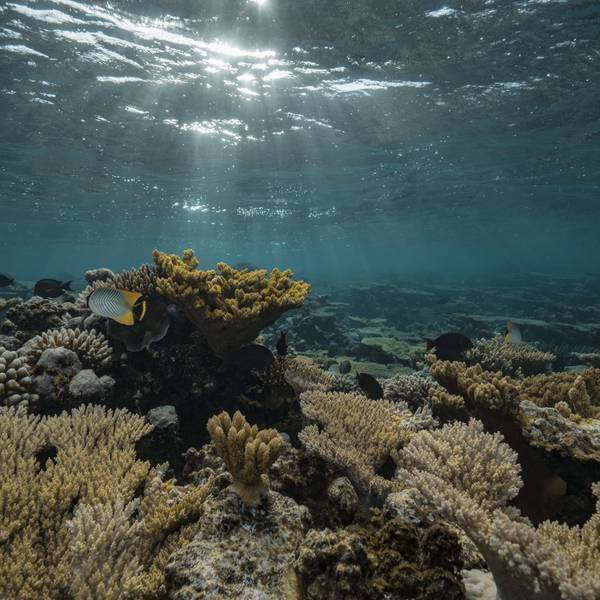
Indeed, dead coral reefs "are perhaps the starkest reminders--like the melting Arctic--that a thickening blanket of greenhouse gases is irrevocably changing the face of the Earth," Inside Climate News wrote on Wednesday.
And, as the National Oceanic and Atmospheric Administration's Coral Reef Watch warned in April, those "ghostly underwater graveyards" are only going to grow.
"There's even worse news ahead," Mark Eakin, coordinator of NOAA's Coral Reef Watch, told Inside Climate News. "There are a lot of places with similar mortality rates. We've got bleaching going on from the east coast of Africa to French Polynesia. Right now, it's basically covering half the Southern Hemisphere."
A separate study published Tuesday in the journal Nature found that overfishing and polluted run-off from farms and lawns made corals more vulnerable to above-average temperatures.
"Although the research showed that controlling pollution and overfishing can help corals survive in a warming world," John Upton reported on the study for Climate Centeral, "the scientists said curbing pollution from fuel burning, farming and deforestation, which is causing water temperatures to rise, would be the best way to protect them in the long run."
Deron Burkepile, a University of California-Santa Barbara ecologist involved with the research, told Upton: "We have to start controlling carbon emissions and start cooling our planet again for coral reefs to really have a chance in the future."
In fact, Inside Climate News warned that "[a]t the current rate of emissions, the average global temperature is expected to rise at least 2.5 degrees Celsius by 2100, a level that would be fatal to nearly all reefs."
Even a temperature rise of 1.5 degrees by 2050 would put 90 percent of coral reefs at risk, said Michiel Schaeffer, a scientist with the Berlin-based research institution Climate Analytics.
Meanwhile, the ocean conservation group Oceana used World Oceans Day to warn of how "rubbish dumping and waste pollution"--the impacts of which it has witnessed during its many expeditions at sea--"is hampering global conservation efforts to protect marine habitats and to restore depleted fish stocks."
The group says it has seen marine litter far below the water's surface, a "worrying problem [that] is often overlooked in reports on plastic pollution, which tend to focus on waste floating on the sea surface or in shallow waters."
"[W]e cannot continue to treat our seas as an out-of-sight, out-of-mind dumping ground," said Lasse Gustavsson, executive director of Oceana in Europe.
As ocean scientist and explorer Sylvia Earle wrote Wednesday at the Daily Beast: "If the ocean is in trouble, so are we. It is time to take care of the ocean as if our lives depend on it, because they do."
Dear Common Dreams reader, It’s been nearly 30 years since I co-founded Common Dreams with my late wife, Lina Newhouser. We had the radical notion that journalism should serve the public good, not corporate profits. It was clear to us from the outset what it would take to build such a project. No paid advertisements. No corporate sponsors. No millionaire publisher telling us what to think or do. Many people said we wouldn't last a year, but we proved those doubters wrong. Together with a tremendous team of journalists and dedicated staff, we built an independent media outlet free from the constraints of profits and corporate control. Our mission has always been simple: To inform. To inspire. To ignite change for the common good. Building Common Dreams was not easy. Our survival was never guaranteed. When you take on the most powerful forces—Wall Street greed, fossil fuel industry destruction, Big Tech lobbyists, and uber-rich oligarchs who have spent billions upon billions rigging the economy and democracy in their favor—the only bulwark you have is supporters who believe in your work. But here’s the urgent message from me today. It's never been this bad out there. And it's never been this hard to keep us going. At the very moment Common Dreams is most needed, the threats we face are intensifying. We need your support now more than ever. We don't accept corporate advertising and never will. We don't have a paywall because we don't think people should be blocked from critical news based on their ability to pay. Everything we do is funded by the donations of readers like you. When everyone does the little they can afford, we are strong. But if that support retreats or dries up, so do we. Will you donate now to make sure Common Dreams not only survives but thrives? —Craig Brown, Co-founder |
Threatened by climate change, pollution, overfishing, and oil spills, the world's oceans are suffering, scientists warned on Wednesday--the day designated by the United Nations as one to honor the deep blue sea.
From widespread coral bleaching to floundering fish species to garbage stretching across the water's surface and hundreds of feet down, it's clear that human activity is taking its toll on the world's oceans, which cover more than 70 percent of the Earth's surface.
Indeed, dead coral reefs "are perhaps the starkest reminders--like the melting Arctic--that a thickening blanket of greenhouse gases is irrevocably changing the face of the Earth," Inside Climate News wrote on Wednesday.
And, as the National Oceanic and Atmospheric Administration's Coral Reef Watch warned in April, those "ghostly underwater graveyards" are only going to grow.
"There's even worse news ahead," Mark Eakin, coordinator of NOAA's Coral Reef Watch, told Inside Climate News. "There are a lot of places with similar mortality rates. We've got bleaching going on from the east coast of Africa to French Polynesia. Right now, it's basically covering half the Southern Hemisphere."
A separate study published Tuesday in the journal Nature found that overfishing and polluted run-off from farms and lawns made corals more vulnerable to above-average temperatures.
"Although the research showed that controlling pollution and overfishing can help corals survive in a warming world," John Upton reported on the study for Climate Centeral, "the scientists said curbing pollution from fuel burning, farming and deforestation, which is causing water temperatures to rise, would be the best way to protect them in the long run."
Deron Burkepile, a University of California-Santa Barbara ecologist involved with the research, told Upton: "We have to start controlling carbon emissions and start cooling our planet again for coral reefs to really have a chance in the future."
In fact, Inside Climate News warned that "[a]t the current rate of emissions, the average global temperature is expected to rise at least 2.5 degrees Celsius by 2100, a level that would be fatal to nearly all reefs."
Even a temperature rise of 1.5 degrees by 2050 would put 90 percent of coral reefs at risk, said Michiel Schaeffer, a scientist with the Berlin-based research institution Climate Analytics.
Meanwhile, the ocean conservation group Oceana used World Oceans Day to warn of how "rubbish dumping and waste pollution"--the impacts of which it has witnessed during its many expeditions at sea--"is hampering global conservation efforts to protect marine habitats and to restore depleted fish stocks."
The group says it has seen marine litter far below the water's surface, a "worrying problem [that] is often overlooked in reports on plastic pollution, which tend to focus on waste floating on the sea surface or in shallow waters."
"[W]e cannot continue to treat our seas as an out-of-sight, out-of-mind dumping ground," said Lasse Gustavsson, executive director of Oceana in Europe.
As ocean scientist and explorer Sylvia Earle wrote Wednesday at the Daily Beast: "If the ocean is in trouble, so are we. It is time to take care of the ocean as if our lives depend on it, because they do."
Threatened by climate change, pollution, overfishing, and oil spills, the world's oceans are suffering, scientists warned on Wednesday--the day designated by the United Nations as one to honor the deep blue sea.
From widespread coral bleaching to floundering fish species to garbage stretching across the water's surface and hundreds of feet down, it's clear that human activity is taking its toll on the world's oceans, which cover more than 70 percent of the Earth's surface.
Indeed, dead coral reefs "are perhaps the starkest reminders--like the melting Arctic--that a thickening blanket of greenhouse gases is irrevocably changing the face of the Earth," Inside Climate News wrote on Wednesday.
And, as the National Oceanic and Atmospheric Administration's Coral Reef Watch warned in April, those "ghostly underwater graveyards" are only going to grow.
"There's even worse news ahead," Mark Eakin, coordinator of NOAA's Coral Reef Watch, told Inside Climate News. "There are a lot of places with similar mortality rates. We've got bleaching going on from the east coast of Africa to French Polynesia. Right now, it's basically covering half the Southern Hemisphere."
A separate study published Tuesday in the journal Nature found that overfishing and polluted run-off from farms and lawns made corals more vulnerable to above-average temperatures.
"Although the research showed that controlling pollution and overfishing can help corals survive in a warming world," John Upton reported on the study for Climate Centeral, "the scientists said curbing pollution from fuel burning, farming and deforestation, which is causing water temperatures to rise, would be the best way to protect them in the long run."
Deron Burkepile, a University of California-Santa Barbara ecologist involved with the research, told Upton: "We have to start controlling carbon emissions and start cooling our planet again for coral reefs to really have a chance in the future."
In fact, Inside Climate News warned that "[a]t the current rate of emissions, the average global temperature is expected to rise at least 2.5 degrees Celsius by 2100, a level that would be fatal to nearly all reefs."
Even a temperature rise of 1.5 degrees by 2050 would put 90 percent of coral reefs at risk, said Michiel Schaeffer, a scientist with the Berlin-based research institution Climate Analytics.
Meanwhile, the ocean conservation group Oceana used World Oceans Day to warn of how "rubbish dumping and waste pollution"--the impacts of which it has witnessed during its many expeditions at sea--"is hampering global conservation efforts to protect marine habitats and to restore depleted fish stocks."
The group says it has seen marine litter far below the water's surface, a "worrying problem [that] is often overlooked in reports on plastic pollution, which tend to focus on waste floating on the sea surface or in shallow waters."
"[W]e cannot continue to treat our seas as an out-of-sight, out-of-mind dumping ground," said Lasse Gustavsson, executive director of Oceana in Europe.
As ocean scientist and explorer Sylvia Earle wrote Wednesday at the Daily Beast: "If the ocean is in trouble, so are we. It is time to take care of the ocean as if our lives depend on it, because they do."