SUBSCRIBE TO OUR FREE NEWSLETTER
Daily news & progressive opinion—funded by the people, not the corporations—delivered straight to your inbox.
5
#000000
#FFFFFF
To donate by check, phone, or other method, see our More Ways to Give page.
Daily news & progressive opinion—funded by the people, not the corporations—delivered straight to your inbox.
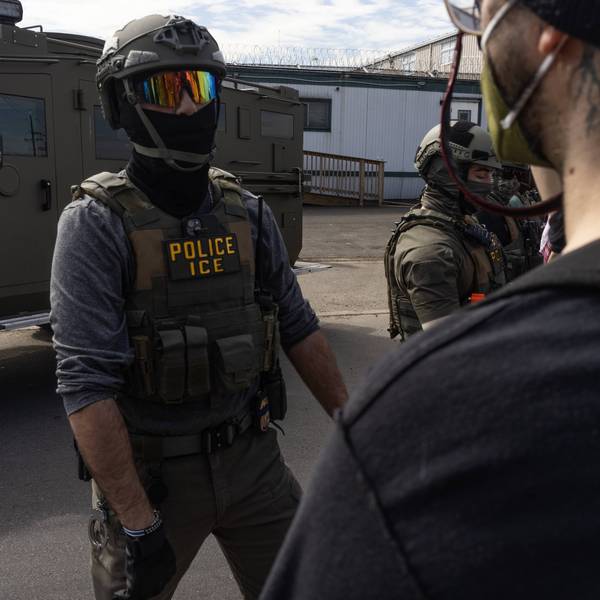
When President Barack Obama last year banned the federal government from selling certain military equipment to police departments, civil liberties advocates cautiously welcomed the move as a positive development in curtailing militarized police forces.
In announcing the step on May 18, 2015, Obama said, "We've seen how militarized gear can sometimes give people the feeling like there's an occupied force, as opposed to a force that is part of that community it is protecting and serving."
But according to two of the law enforcement leaders who met with Obama and Vice President Joe Biden days after a gunman shot dead five Dallas police officers, the welcome may be short-lived, as Obama has "agreed to review each banned item," Reuters exclusively reported Thursday.
The ban--announced, as USA Today reported at the time, "following widespread criticism of a paramilitary-like response to riots" in Ferguson, Missouri following the police killing of Michael Brown, but also, as Common Dreams has reported, after decades of "quiet militarization of police departments" --covered tracked armored vehicles, bayonets, grenade launchers, and .50-caliber ammunition.
Less than a week after those two police organization heads, Jim Pasco, executive director of the Fraternal Order of Police, and Bill Johnson, executive director of the National Association of Police Organizations, participated in that White House meeting--undertook ostensibly because Obama and Biden "wanted to hear directly from law enforcement officials about their ideas on best practices for building trust between law enforcement and the communities they serve"--a gunman shot dead three Baton Rouge, La. law enforcement officers.
Reuters reports: "At last week's meeting, law enforcement leaders urged Obama to reinstate military equipment such as helmets, grenade launchers, and tracked armored vehicles to enhance officers' safety and their ability to respond to violent riots."
Yet, even if Obama backtracks on the ban, analysts noted that it wasn't as if it offered a panacea to a long-standing problem.
Justin Hansford, assistant professor at the University of St. Louis School of Law, for example, noted in the wake of the ban announcement that "neither Mike Brown, Freddie Gray, nor Eric Garner were killed with grenade launders or tanks. Racial targeting and anti-black police violence can survive demilitarization. At the base, the danger is that this is a way to 'deracialize' the debate, and make it about anything other than race."
Further, as Peter Kraska, an expert on police militarization, wrote last year, "police militarization is a 25-year long trend that has only grown in momentum over time. The restrictions on militaristic gear directed by the White House while important symbolically, will certainly not substantively impact this trend in and of itself. Police militarization at this point is as much a cultural problem as it is a material one, and reversing the cultural trend toward police militarization will require more far reaching efforts."
Dear Common Dreams reader, It’s been nearly 30 years since I co-founded Common Dreams with my late wife, Lina Newhouser. We had the radical notion that journalism should serve the public good, not corporate profits. It was clear to us from the outset what it would take to build such a project. No paid advertisements. No corporate sponsors. No millionaire publisher telling us what to think or do. Many people said we wouldn't last a year, but we proved those doubters wrong. Together with a tremendous team of journalists and dedicated staff, we built an independent media outlet free from the constraints of profits and corporate control. Our mission has always been simple: To inform. To inspire. To ignite change for the common good. Building Common Dreams was not easy. Our survival was never guaranteed. When you take on the most powerful forces—Wall Street greed, fossil fuel industry destruction, Big Tech lobbyists, and uber-rich oligarchs who have spent billions upon billions rigging the economy and democracy in their favor—the only bulwark you have is supporters who believe in your work. But here’s the urgent message from me today. It's never been this bad out there. And it's never been this hard to keep us going. At the very moment Common Dreams is most needed, the threats we face are intensifying. We need your support now more than ever. We don't accept corporate advertising and never will. We don't have a paywall because we don't think people should be blocked from critical news based on their ability to pay. Everything we do is funded by the donations of readers like you. When everyone does the little they can afford, we are strong. But if that support retreats or dries up, so do we. Will you donate now to make sure Common Dreams not only survives but thrives? —Craig Brown, Co-founder |
When President Barack Obama last year banned the federal government from selling certain military equipment to police departments, civil liberties advocates cautiously welcomed the move as a positive development in curtailing militarized police forces.
In announcing the step on May 18, 2015, Obama said, "We've seen how militarized gear can sometimes give people the feeling like there's an occupied force, as opposed to a force that is part of that community it is protecting and serving."
But according to two of the law enforcement leaders who met with Obama and Vice President Joe Biden days after a gunman shot dead five Dallas police officers, the welcome may be short-lived, as Obama has "agreed to review each banned item," Reuters exclusively reported Thursday.
The ban--announced, as USA Today reported at the time, "following widespread criticism of a paramilitary-like response to riots" in Ferguson, Missouri following the police killing of Michael Brown, but also, as Common Dreams has reported, after decades of "quiet militarization of police departments" --covered tracked armored vehicles, bayonets, grenade launchers, and .50-caliber ammunition.
Less than a week after those two police organization heads, Jim Pasco, executive director of the Fraternal Order of Police, and Bill Johnson, executive director of the National Association of Police Organizations, participated in that White House meeting--undertook ostensibly because Obama and Biden "wanted to hear directly from law enforcement officials about their ideas on best practices for building trust between law enforcement and the communities they serve"--a gunman shot dead three Baton Rouge, La. law enforcement officers.
Reuters reports: "At last week's meeting, law enforcement leaders urged Obama to reinstate military equipment such as helmets, grenade launchers, and tracked armored vehicles to enhance officers' safety and their ability to respond to violent riots."
Yet, even if Obama backtracks on the ban, analysts noted that it wasn't as if it offered a panacea to a long-standing problem.
Justin Hansford, assistant professor at the University of St. Louis School of Law, for example, noted in the wake of the ban announcement that "neither Mike Brown, Freddie Gray, nor Eric Garner were killed with grenade launders or tanks. Racial targeting and anti-black police violence can survive demilitarization. At the base, the danger is that this is a way to 'deracialize' the debate, and make it about anything other than race."
Further, as Peter Kraska, an expert on police militarization, wrote last year, "police militarization is a 25-year long trend that has only grown in momentum over time. The restrictions on militaristic gear directed by the White House while important symbolically, will certainly not substantively impact this trend in and of itself. Police militarization at this point is as much a cultural problem as it is a material one, and reversing the cultural trend toward police militarization will require more far reaching efforts."
When President Barack Obama last year banned the federal government from selling certain military equipment to police departments, civil liberties advocates cautiously welcomed the move as a positive development in curtailing militarized police forces.
In announcing the step on May 18, 2015, Obama said, "We've seen how militarized gear can sometimes give people the feeling like there's an occupied force, as opposed to a force that is part of that community it is protecting and serving."
But according to two of the law enforcement leaders who met with Obama and Vice President Joe Biden days after a gunman shot dead five Dallas police officers, the welcome may be short-lived, as Obama has "agreed to review each banned item," Reuters exclusively reported Thursday.
The ban--announced, as USA Today reported at the time, "following widespread criticism of a paramilitary-like response to riots" in Ferguson, Missouri following the police killing of Michael Brown, but also, as Common Dreams has reported, after decades of "quiet militarization of police departments" --covered tracked armored vehicles, bayonets, grenade launchers, and .50-caliber ammunition.
Less than a week after those two police organization heads, Jim Pasco, executive director of the Fraternal Order of Police, and Bill Johnson, executive director of the National Association of Police Organizations, participated in that White House meeting--undertook ostensibly because Obama and Biden "wanted to hear directly from law enforcement officials about their ideas on best practices for building trust between law enforcement and the communities they serve"--a gunman shot dead three Baton Rouge, La. law enforcement officers.
Reuters reports: "At last week's meeting, law enforcement leaders urged Obama to reinstate military equipment such as helmets, grenade launchers, and tracked armored vehicles to enhance officers' safety and their ability to respond to violent riots."
Yet, even if Obama backtracks on the ban, analysts noted that it wasn't as if it offered a panacea to a long-standing problem.
Justin Hansford, assistant professor at the University of St. Louis School of Law, for example, noted in the wake of the ban announcement that "neither Mike Brown, Freddie Gray, nor Eric Garner were killed with grenade launders or tanks. Racial targeting and anti-black police violence can survive demilitarization. At the base, the danger is that this is a way to 'deracialize' the debate, and make it about anything other than race."
Further, as Peter Kraska, an expert on police militarization, wrote last year, "police militarization is a 25-year long trend that has only grown in momentum over time. The restrictions on militaristic gear directed by the White House while important symbolically, will certainly not substantively impact this trend in and of itself. Police militarization at this point is as much a cultural problem as it is a material one, and reversing the cultural trend toward police militarization will require more far reaching efforts."