SUBSCRIBE TO OUR FREE NEWSLETTER
Daily news & progressive opinion—funded by the people, not the corporations—delivered straight to your inbox.
5
#000000
#FFFFFF
To donate by check, phone, or other method, see our More Ways to Give page.
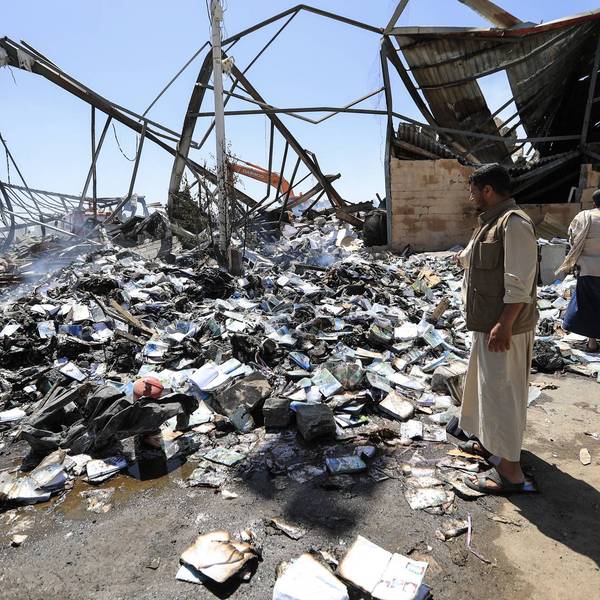
Another Saudi-led coalition airstrike in northern Yemen killed 11 civilians on Friday--only one day after U.S. Secretary of State John Kerry visited Saudi Arabia, purportedly to urge Saudi King Salman to seek a "political solution" to the Saudi-led coalition's bombing campaign in Yemen.
And despite Kerry's words about seeking peace in Yemen, the U.S. continues to supply Saudi Arabia with weapons that have been used to kill civilians in that country.
Associated Press (AP) reports on the aftermath of the latest attack:
In Yemen, the SABA agency, which is under control of the Houthis, reported that two houses located in the district of Baqam in the city of Saada were destroyed by airstrikes overnight. Rescue efforts were delayed due to fears of subsequent strikes as fighter jets continued to fly over the same district, it added. The report said the death toll was expected to rise because some of the wounded were in critical condition.
Houthi supporters and activists posted photographs on social media showing lifeless bodies of children and charred remains in the aftermath on the attack. The postings and SABA's report could not be independently verified because of difficulties reaching witnesses in the remote area.
U.N. human rights chief Zeid Ra'ad Al Hussein on Thursday called for an international investigation into human rights abuses in the war-torn country. "Civilians in Yemen have suffered unbearably over the years from the effects of a number of simultaneous and overlapping armed conflicts," the commissioner said. "And they continue to suffer, absent any form of accountability and justice, while those responsible for the violations and abuses against them enjoy impunity."
The attack also came as Saudi Arabia claimed that Iran, its regional rival, is supplying Houthis in Yemen with missiles. While Iran's foreign minister dismissed the statements as "baseless accusations," Kerry said he was "deeply troubled" after allegedly viewing Saudi photographs that showed Iranian missiles along the Saudi-Yemeni border, according to AP.

Yemen researcher at Human Rights Watch Kristine Beckerle told AP that through its continued arms sales to Saudi Arabia, the U.S. "isn't just signaling support for Saudi Arabia, it is in fact supporting Saudi Arabia in Yemen."
"By participating in attacks that violate the laws of war and by providing weapons and munitions to a military force that can be expected to use them unlawfully, the U.S. risks complicity in violations by coalition forces," Human Rights Watch wrote in a letter to Kerry last week.
The U.N. estimates that 3,799 Yemeni civilians have been killed since March 2015, AP reports, adding that the "U.N. and rights groups estimate at least 9,000 people overall have died. Some 3 million people have also been displaced inside the Arab world's poorest country."
Another Saudi-led coalition airstrike in northern Yemen killed 11 civilians on Friday--only one day after U.S. Secretary of State John Kerry visited Saudi Arabia, purportedly to urge Saudi King Salman to seek a "political solution" to the Saudi-led coalition's bombing campaign in Yemen.
And despite Kerry's words about seeking peace in Yemen, the U.S. continues to supply Saudi Arabia with weapons that have been used to kill civilians in that country.
Associated Press (AP) reports on the aftermath of the latest attack:
In Yemen, the SABA agency, which is under control of the Houthis, reported that two houses located in the district of Baqam in the city of Saada were destroyed by airstrikes overnight. Rescue efforts were delayed due to fears of subsequent strikes as fighter jets continued to fly over the same district, it added. The report said the death toll was expected to rise because some of the wounded were in critical condition.
Houthi supporters and activists posted photographs on social media showing lifeless bodies of children and charred remains in the aftermath on the attack. The postings and SABA's report could not be independently verified because of difficulties reaching witnesses in the remote area.
U.N. human rights chief Zeid Ra'ad Al Hussein on Thursday called for an international investigation into human rights abuses in the war-torn country. "Civilians in Yemen have suffered unbearably over the years from the effects of a number of simultaneous and overlapping armed conflicts," the commissioner said. "And they continue to suffer, absent any form of accountability and justice, while those responsible for the violations and abuses against them enjoy impunity."
The attack also came as Saudi Arabia claimed that Iran, its regional rival, is supplying Houthis in Yemen with missiles. While Iran's foreign minister dismissed the statements as "baseless accusations," Kerry said he was "deeply troubled" after allegedly viewing Saudi photographs that showed Iranian missiles along the Saudi-Yemeni border, according to AP.
Yemen researcher at Human Rights Watch Kristine Beckerle told AP that through its continued arms sales to Saudi Arabia, the U.S. "isn't just signaling support for Saudi Arabia, it is in fact supporting Saudi Arabia in Yemen."
"By participating in attacks that violate the laws of war and by providing weapons and munitions to a military force that can be expected to use them unlawfully, the U.S. risks complicity in violations by coalition forces," Human Rights Watch wrote in a letter to Kerry last week.
The U.N. estimates that 3,799 Yemeni civilians have been killed since March 2015, AP reports, adding that the "U.N. and rights groups estimate at least 9,000 people overall have died. Some 3 million people have also been displaced inside the Arab world's poorest country."
Another Saudi-led coalition airstrike in northern Yemen killed 11 civilians on Friday--only one day after U.S. Secretary of State John Kerry visited Saudi Arabia, purportedly to urge Saudi King Salman to seek a "political solution" to the Saudi-led coalition's bombing campaign in Yemen.
And despite Kerry's words about seeking peace in Yemen, the U.S. continues to supply Saudi Arabia with weapons that have been used to kill civilians in that country.
Associated Press (AP) reports on the aftermath of the latest attack:
In Yemen, the SABA agency, which is under control of the Houthis, reported that two houses located in the district of Baqam in the city of Saada were destroyed by airstrikes overnight. Rescue efforts were delayed due to fears of subsequent strikes as fighter jets continued to fly over the same district, it added. The report said the death toll was expected to rise because some of the wounded were in critical condition.
Houthi supporters and activists posted photographs on social media showing lifeless bodies of children and charred remains in the aftermath on the attack. The postings and SABA's report could not be independently verified because of difficulties reaching witnesses in the remote area.
U.N. human rights chief Zeid Ra'ad Al Hussein on Thursday called for an international investigation into human rights abuses in the war-torn country. "Civilians in Yemen have suffered unbearably over the years from the effects of a number of simultaneous and overlapping armed conflicts," the commissioner said. "And they continue to suffer, absent any form of accountability and justice, while those responsible for the violations and abuses against them enjoy impunity."
The attack also came as Saudi Arabia claimed that Iran, its regional rival, is supplying Houthis in Yemen with missiles. While Iran's foreign minister dismissed the statements as "baseless accusations," Kerry said he was "deeply troubled" after allegedly viewing Saudi photographs that showed Iranian missiles along the Saudi-Yemeni border, according to AP.
Yemen researcher at Human Rights Watch Kristine Beckerle told AP that through its continued arms sales to Saudi Arabia, the U.S. "isn't just signaling support for Saudi Arabia, it is in fact supporting Saudi Arabia in Yemen."
"By participating in attacks that violate the laws of war and by providing weapons and munitions to a military force that can be expected to use them unlawfully, the U.S. risks complicity in violations by coalition forces," Human Rights Watch wrote in a letter to Kerry last week.
The U.N. estimates that 3,799 Yemeni civilians have been killed since March 2015, AP reports, adding that the "U.N. and rights groups estimate at least 9,000 people overall have died. Some 3 million people have also been displaced inside the Arab world's poorest country."