

Mere months after atmospheric carbon dioxide permanently surpassed a symbolic threshold of 400 parts per million, scientists have more bad news: emissions of methane, a more potent greenhouse gas, have skyrocketed in the past 20 years--and show no sign of slowing.
That's according to a new analysis published Monday in the journal Environmental Research Letters.
The report, The Growing Role of Methane in Anthropogenic Climate Change, finds that "methane concentrations in the air began to surge around 2007 and grew precipitously in 2014 and 2015," observes Phys.org.
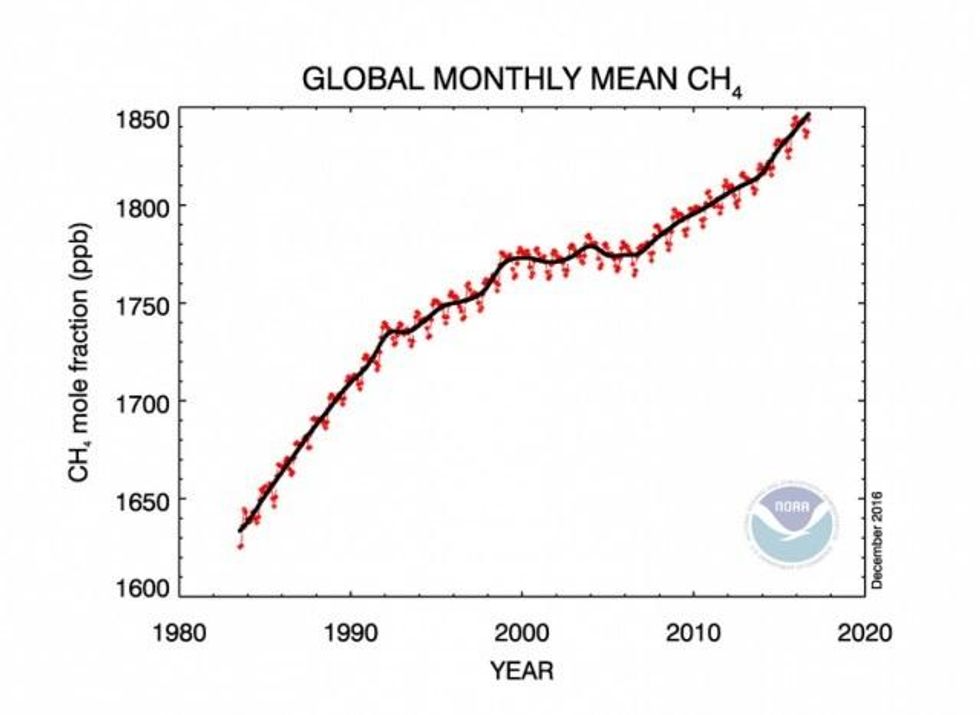
Methane is 28 times more efficient than carbon dioxide at trapping heat from the sun, making its short-term effects on global warming far more severe.
Agence France-Press reports that "the pace of recent [methane] emissions aligns with the most pessimistic scenarios laid out by the U.N.'s top science authority, the Intergovernmental Panel on Climate Change."
Indeed, the rising rate of methane emissions poses a threat to ambitious global goals to limit warming to 1.5oC by 2100, as laid out in the Paris climate accord, experts note. And the current rise of 1oC over preindustrial levels is already resulting in extreme weather and widespread extinctions.
When looking for the source of the rapid increase, the authors of the paper take note of the global rise in fossil fuel extraction--such as the fracking boom in the U.S. and the growing coal industry in China--as one culprit, but they concluded that the research mainly finds the agricultural sector to blame for the methane spike.
"We think agriculture is the number one contributor to the increase," Rob Jackson, an earth scientist at Stanford University who co-wrote the study, told the Washington Post, which adds:
Jackson said some of the rise is "almost certainly" coming from livestock and specifically cattle, and also pointed to rice paddies, landfills, and the management of manure in agriculture.
"According to the Food and Agriculture Organization of the United Nations," reports Phys.org, "livestock operations around the world expanded from producing 1,300 million head of cattle in 1994 to nearly 1,500 million in 2014--with a similar increase in rice cultivation in many Asian countries."
The report's authors suggest renewed efforts to tackle greenhouse gas emissions from agriculture, which other recent research supports as a critical tactic in the fight to mitigate climate change.
"When it comes to methane, there has been a lot of focus on the fossil fuel industry, but we need to look just as hard if not harder at agriculture," Jackson told Phys.org. "The situation certainly isn't hopeless. It's a real opportunity."
Mere months after atmospheric carbon dioxide permanently surpassed a symbolic threshold of 400 parts per million, scientists have more bad news: emissions of methane, a more potent greenhouse gas, have skyrocketed in the past 20 years--and show no sign of slowing.
That's according to a new analysis published Monday in the journal Environmental Research Letters.
The report, The Growing Role of Methane in Anthropogenic Climate Change, finds that "methane concentrations in the air began to surge around 2007 and grew precipitously in 2014 and 2015," observes Phys.org.
Methane is 28 times more efficient than carbon dioxide at trapping heat from the sun, making its short-term effects on global warming far more severe.
Agence France-Press reports that "the pace of recent [methane] emissions aligns with the most pessimistic scenarios laid out by the U.N.'s top science authority, the Intergovernmental Panel on Climate Change."
Indeed, the rising rate of methane emissions poses a threat to ambitious global goals to limit warming to 1.5oC by 2100, as laid out in the Paris climate accord, experts note. And the current rise of 1oC over preindustrial levels is already resulting in extreme weather and widespread extinctions.
When looking for the source of the rapid increase, the authors of the paper take note of the global rise in fossil fuel extraction--such as the fracking boom in the U.S. and the growing coal industry in China--as one culprit, but they concluded that the research mainly finds the agricultural sector to blame for the methane spike.
"We think agriculture is the number one contributor to the increase," Rob Jackson, an earth scientist at Stanford University who co-wrote the study, told the Washington Post, which adds:
Jackson said some of the rise is "almost certainly" coming from livestock and specifically cattle, and also pointed to rice paddies, landfills, and the management of manure in agriculture.
"According to the Food and Agriculture Organization of the United Nations," reports Phys.org, "livestock operations around the world expanded from producing 1,300 million head of cattle in 1994 to nearly 1,500 million in 2014--with a similar increase in rice cultivation in many Asian countries."
The report's authors suggest renewed efforts to tackle greenhouse gas emissions from agriculture, which other recent research supports as a critical tactic in the fight to mitigate climate change.
"When it comes to methane, there has been a lot of focus on the fossil fuel industry, but we need to look just as hard if not harder at agriculture," Jackson told Phys.org. "The situation certainly isn't hopeless. It's a real opportunity."
Mere months after atmospheric carbon dioxide permanently surpassed a symbolic threshold of 400 parts per million, scientists have more bad news: emissions of methane, a more potent greenhouse gas, have skyrocketed in the past 20 years--and show no sign of slowing.
That's according to a new analysis published Monday in the journal Environmental Research Letters.
The report, The Growing Role of Methane in Anthropogenic Climate Change, finds that "methane concentrations in the air began to surge around 2007 and grew precipitously in 2014 and 2015," observes Phys.org.
Methane is 28 times more efficient than carbon dioxide at trapping heat from the sun, making its short-term effects on global warming far more severe.
Agence France-Press reports that "the pace of recent [methane] emissions aligns with the most pessimistic scenarios laid out by the U.N.'s top science authority, the Intergovernmental Panel on Climate Change."
Indeed, the rising rate of methane emissions poses a threat to ambitious global goals to limit warming to 1.5oC by 2100, as laid out in the Paris climate accord, experts note. And the current rise of 1oC over preindustrial levels is already resulting in extreme weather and widespread extinctions.
When looking for the source of the rapid increase, the authors of the paper take note of the global rise in fossil fuel extraction--such as the fracking boom in the U.S. and the growing coal industry in China--as one culprit, but they concluded that the research mainly finds the agricultural sector to blame for the methane spike.
"We think agriculture is the number one contributor to the increase," Rob Jackson, an earth scientist at Stanford University who co-wrote the study, told the Washington Post, which adds:
Jackson said some of the rise is "almost certainly" coming from livestock and specifically cattle, and also pointed to rice paddies, landfills, and the management of manure in agriculture.
"According to the Food and Agriculture Organization of the United Nations," reports Phys.org, "livestock operations around the world expanded from producing 1,300 million head of cattle in 1994 to nearly 1,500 million in 2014--with a similar increase in rice cultivation in many Asian countries."
The report's authors suggest renewed efforts to tackle greenhouse gas emissions from agriculture, which other recent research supports as a critical tactic in the fight to mitigate climate change.
"When it comes to methane, there has been a lot of focus on the fossil fuel industry, but we need to look just as hard if not harder at agriculture," Jackson told Phys.org. "The situation certainly isn't hopeless. It's a real opportunity."