Sanders Says Trump's "Dangerous" Nuclear Arms Race Talk Must Be Challenged
'Presidents, Republicans and Democrats, have understood that our goal must be to reduce the number of nuclear weapons, not expand them.'
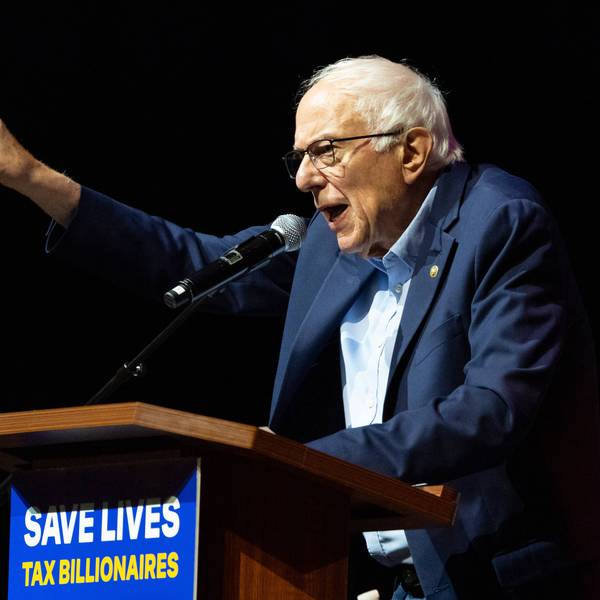
Sen. Bernie Sanders has made it known that Donald Trump should not go unchallenged by his congressional colleagues as troubling comments by the President-elect about nuclear weapons this week sparked alarm across the United States and the world.
Following an initial out-of-the-blue tweet Thursday saying the U.S. should "expand" its nuclear arsenal followed by "clarifying" remarks Friday to MSNBC in which Trump said, "Let it be an arms race," Sanders responded: "It's a miracle a nuclear weapon hasn't been used in war since 1945. Congress can't allow the Tweeter in Chief to start a nuclear arms race."
Subsequently, he added:
Though Trump's press team was tied in knots as they tried (but failed) to walk back or explain Trump's nuclear talk, Sanders far from alone in expressing grave concern over the seriousness of what was said.
"Can a tweet start an arms race? This one may just have done that," Joseph Cirincione, president of Ploughshares Fund, a global security foundation, told NBC News.
On Saturday, a New York Times editorial argued that by "casually hinting at a seismic shift in fundamental policies, the president-elect is playing a risky game."
The Times continued, "For decades, American policy has been designed to stabilize relations between Russia and the United States and to deter other countries from acquiring nuclear weapons. Careless taunts risk undoing that progress."
But is everyone making too much of this?
Laicie Heeley, a nuclear expert at the non-partisan Stimson Center, doesn't think so.
Heeley told Agence France-Presse Trump's comments this week are "reckless," especially without providing details or context for what he said. "To make such a loaded statement without context or follow-up is irresponsible at best," she explained. "We could be talking about a return to the Cold War here, when the threat of a nuclear catastrophe was very real."
And Melissa Batchelor Warnke, a contributor to the Los Angeles Times, said that for all the other controversial and troubling things Trump has said and done--both during his campaign and since being elected--these casual and "absolutely frightening" comments about nuclear weapons and proliferation should be treated with special concern.
"Because of the difficulty detecting a signal in the noise, we can lose sight of what's at stake," Warnke wrote Friday. While not dismissing his many other troubling statements, Warnke argues Trump's positions on nuclear weapons are "exceptional" in their implications. "Donald Trump's prime campaign promise was that Donald Trump would always win. He would win through strength, intimidation and stick-swinging. But nobody wins in nuclear war. It doesn't happen. The use of nuclear weapons is a sin for which none is forgiven; a nuclear exchange is a potential extermination event.'
She continued, "When nuclear escalation is on the table, every journalist in America should get a new beat, and that beat should be reporting on how to avert nuclear war. We have covered this, but not with enough urgency. Each time the President of the United States speaks cavalierly or competitively about nuclear weapons, that should be a six-column headline in every paper in America. It isn't; it hasn't been."
In turn, many other journalists and political commentators, including Ring of Fire's Sydney Robinson, welcomed Sanders' promise to hold Trump to account on the issue.
"Trump's promise to begin a nuclear arms race is incredibly concerning for the entire globe," Robinson wrote Saturday, "and we hope that Senator Sanders and others will do more in the future to protect the nation from such dangerous outcomes."
We are at a crossroads
This country and this world are at a monumental crossroads. In a few short weeks, US voters will have an opportunity to beat back the forces of fascism and confront the billionaires who are rigging the economy, our media system, and our democracy, making it increasingly impossible for ordinary people to get by. We’re not just talking about the election. We’re talking about what must be done once these fascist elements are vanquished from power. We need a bolder set of solutions than what either major party has so far been willing to offer and a working-class movement ready to fight like hell for it. Trump didn't emerge from nowhere. The conditions that fueled MAGA authoritarianism were created by decades of radical neoliberal economic policies and a corrupt political system dominated by corporate interests. They slashed taxes on the super-rich, promising that the benefits would trickle down. They said giveaways to the corporate titans would make life more affordable for the rest of us. It was all bullshit. And when a bitter, betrayed populace searches for someone to blame, right-wing demagogues have little trouble finding scapegoats. People know when they're being lied to, but you won't hear any of this from the corporate media. Only independent journalism—powered and funded by people who believe in building a better world—can deliver truly trustworthy daily news. Our Fall Campaign is underway, and we need your help. To power our newsroom through the rest of the year, we need to raise $125,000 by midnight on October 31. So if you share our vision, please contribute whatever you can to sustain our work. |
Sen. Bernie Sanders has made it known that Donald Trump should not go unchallenged by his congressional colleagues as troubling comments by the President-elect about nuclear weapons this week sparked alarm across the United States and the world.
Following an initial out-of-the-blue tweet Thursday saying the U.S. should "expand" its nuclear arsenal followed by "clarifying" remarks Friday to MSNBC in which Trump said, "Let it be an arms race," Sanders responded: "It's a miracle a nuclear weapon hasn't been used in war since 1945. Congress can't allow the Tweeter in Chief to start a nuclear arms race."
Subsequently, he added:
Though Trump's press team was tied in knots as they tried (but failed) to walk back or explain Trump's nuclear talk, Sanders far from alone in expressing grave concern over the seriousness of what was said.
"Can a tweet start an arms race? This one may just have done that," Joseph Cirincione, president of Ploughshares Fund, a global security foundation, told NBC News.
On Saturday, a New York Times editorial argued that by "casually hinting at a seismic shift in fundamental policies, the president-elect is playing a risky game."
The Times continued, "For decades, American policy has been designed to stabilize relations between Russia and the United States and to deter other countries from acquiring nuclear weapons. Careless taunts risk undoing that progress."
But is everyone making too much of this?
Laicie Heeley, a nuclear expert at the non-partisan Stimson Center, doesn't think so.
Heeley told Agence France-Presse Trump's comments this week are "reckless," especially without providing details or context for what he said. "To make such a loaded statement without context or follow-up is irresponsible at best," she explained. "We could be talking about a return to the Cold War here, when the threat of a nuclear catastrophe was very real."
And Melissa Batchelor Warnke, a contributor to the Los Angeles Times, said that for all the other controversial and troubling things Trump has said and done--both during his campaign and since being elected--these casual and "absolutely frightening" comments about nuclear weapons and proliferation should be treated with special concern.
"Because of the difficulty detecting a signal in the noise, we can lose sight of what's at stake," Warnke wrote Friday. While not dismissing his many other troubling statements, Warnke argues Trump's positions on nuclear weapons are "exceptional" in their implications. "Donald Trump's prime campaign promise was that Donald Trump would always win. He would win through strength, intimidation and stick-swinging. But nobody wins in nuclear war. It doesn't happen. The use of nuclear weapons is a sin for which none is forgiven; a nuclear exchange is a potential extermination event.'
She continued, "When nuclear escalation is on the table, every journalist in America should get a new beat, and that beat should be reporting on how to avert nuclear war. We have covered this, but not with enough urgency. Each time the President of the United States speaks cavalierly or competitively about nuclear weapons, that should be a six-column headline in every paper in America. It isn't; it hasn't been."
In turn, many other journalists and political commentators, including Ring of Fire's Sydney Robinson, welcomed Sanders' promise to hold Trump to account on the issue.
"Trump's promise to begin a nuclear arms race is incredibly concerning for the entire globe," Robinson wrote Saturday, "and we hope that Senator Sanders and others will do more in the future to protect the nation from such dangerous outcomes."
Sen. Bernie Sanders has made it known that Donald Trump should not go unchallenged by his congressional colleagues as troubling comments by the President-elect about nuclear weapons this week sparked alarm across the United States and the world.
Following an initial out-of-the-blue tweet Thursday saying the U.S. should "expand" its nuclear arsenal followed by "clarifying" remarks Friday to MSNBC in which Trump said, "Let it be an arms race," Sanders responded: "It's a miracle a nuclear weapon hasn't been used in war since 1945. Congress can't allow the Tweeter in Chief to start a nuclear arms race."
Subsequently, he added:
Though Trump's press team was tied in knots as they tried (but failed) to walk back or explain Trump's nuclear talk, Sanders far from alone in expressing grave concern over the seriousness of what was said.
"Can a tweet start an arms race? This one may just have done that," Joseph Cirincione, president of Ploughshares Fund, a global security foundation, told NBC News.
On Saturday, a New York Times editorial argued that by "casually hinting at a seismic shift in fundamental policies, the president-elect is playing a risky game."
The Times continued, "For decades, American policy has been designed to stabilize relations between Russia and the United States and to deter other countries from acquiring nuclear weapons. Careless taunts risk undoing that progress."
But is everyone making too much of this?
Laicie Heeley, a nuclear expert at the non-partisan Stimson Center, doesn't think so.
Heeley told Agence France-Presse Trump's comments this week are "reckless," especially without providing details or context for what he said. "To make such a loaded statement without context or follow-up is irresponsible at best," she explained. "We could be talking about a return to the Cold War here, when the threat of a nuclear catastrophe was very real."
And Melissa Batchelor Warnke, a contributor to the Los Angeles Times, said that for all the other controversial and troubling things Trump has said and done--both during his campaign and since being elected--these casual and "absolutely frightening" comments about nuclear weapons and proliferation should be treated with special concern.
"Because of the difficulty detecting a signal in the noise, we can lose sight of what's at stake," Warnke wrote Friday. While not dismissing his many other troubling statements, Warnke argues Trump's positions on nuclear weapons are "exceptional" in their implications. "Donald Trump's prime campaign promise was that Donald Trump would always win. He would win through strength, intimidation and stick-swinging. But nobody wins in nuclear war. It doesn't happen. The use of nuclear weapons is a sin for which none is forgiven; a nuclear exchange is a potential extermination event.'
She continued, "When nuclear escalation is on the table, every journalist in America should get a new beat, and that beat should be reporting on how to avert nuclear war. We have covered this, but not with enough urgency. Each time the President of the United States speaks cavalierly or competitively about nuclear weapons, that should be a six-column headline in every paper in America. It isn't; it hasn't been."
In turn, many other journalists and political commentators, including Ring of Fire's Sydney Robinson, welcomed Sanders' promise to hold Trump to account on the issue.
"Trump's promise to begin a nuclear arms race is incredibly concerning for the entire globe," Robinson wrote Saturday, "and we hope that Senator Sanders and others will do more in the future to protect the nation from such dangerous outcomes."