SUBSCRIBE TO OUR FREE NEWSLETTER
Daily news & progressive opinion—funded by the people, not the corporations—delivered straight to your inbox.
5
#000000
#FFFFFF
To donate by check, phone, or other method, see our More Ways to Give page.
Daily news & progressive opinion—funded by the people, not the corporations—delivered straight to your inbox.
Amid the clamor over the pending repeal of the Affordable Care Act (ACA), President-elect Donald Trump may have unintentionally offered his support for a solution typically championed by those on the progressive left: Medicare-for-All.
Weighing in on the partisan battle to uphold and amend or scrap the system known as Obamacare, the incoming president tweeted:
Trump's call for "a healthcare plan that really works" was met with flurry of responses pointing to the publicly-funded, single-payer model that seemed to fit the bill.
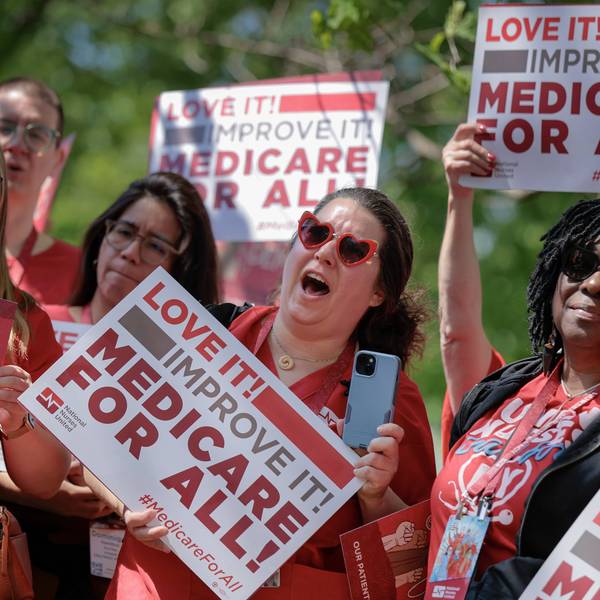
"Trump knows that single payer is the better system," RoseAnn DeMoro, executive director of National Nurses United, told Common Dreams. "He has business interests in other countries and knows the cost savings."
"But," she added, "he is seduced by the profits that can be garnered off of our health, I assume, or he would yank the curtain away from this shallow discussion on healthcare."
Referring to the current Congressional debate, DeMoro continued: "Single payer, expanded Medicare-for-All, is kept off the American agenda because it doesn't allow massive billions to be extracted from our people to the huge financial interests that control our health, from pharma to insurance companies to hospitals, down to the doctors offices. It is the biggest sham of a debate we have had in this country."
Trump's directive to "get together" and build a "healthcare plan that really works" contradicts his previous advice for Republicans to "be careful" in their eager repeal of the law, saying: "It will fall of its own weight."
The shift came about the same time it was reported that Trump supporters might actually want a plan that looks more like Medicare-for-All.
Writing for the New York Times on Thursday, Drew Altman, president and chief executive of the Henry J. Kaiser Family Foundation, discussed the findings of six focus groups conducted by the foundation in the Rust Belt region--"three with Trump voters who are enrolled in the Affordable Care Act marketplaces, and three with Trump voters receiving Medicaid."
"They were not, by and large, angry about their health care," Altman noted, "they were simply afraid they will be unable to afford coverage for themselves and their families."
He continued:
They spoke anxiously about rising premiums, deductibles, copays and drug costs. They were especially upset by surprise bills for services they believed were covered. They said their coverage was hopelessly complex. Those with marketplace insurance--for which they were eligible for subsidies--saw Medicaid as a much better deal than their insurance and were resentful that people with incomes lower than theirs could get it. They expressed animosity for drug and insurance companies, and sounded as much like Bernie Sanders supporters as Trump voters.
When "asked about policies found in several Republican plans to replace the Affordable Care Act--including a tax credit to help defray the cost of premiums, a tax-preferred savings account and a large deductible typical of catastrophic coverage--several of these Trump voters recoiled, calling such proposals 'not insurance at all,'" he wrote. They also "expressed disbelief" when they were told Trump "might embrace a plan that included these elements."
What's more, Altman noted, "they were unmoved by the principle of risk-sharing, and trusted that Mr. Trump would find a way to protect people with pre-existing medical conditions without a mandate, which most viewed as 'un-American.'"
Sen. Bernie Sanders (I-Vt.), who had made Medicare-for-All a pillar of his presidential campaign, took to the Senate floor on Wednesday to denounce the Republican budget, which laid the groundwork for repealing the ACA, as well as "end[ing] Medicare as it presently exists."
"Let us be clear," he said, "the United States of America is the only major country on Earth...that does not guarantee healthcare to all people as a right."
"I believe that healthcare for all is a human right," Sanders continued, adding (and sounding very much like the president-elect): "I would have hoped that we would be working together to figure out what is a complicated issue, as to how we could move forward to guarantee healthcare to all people in a cost effective way, but that is not what we are debating today."
Similarly, Don McCanne, health policy fellow with Physicians for a National Health Program, said Wednesday that with the current health financing system "in shambles," it is "ironic" that Republicans and Democrats "are debating mere tweaks that will affect how many will not have affordable access to health care when the debate should be over whether we continue to tolerate our overpriced system that leaves so many out, when we can adopt a proven health care financing system that makes health care truly accessible and affordable for everyone."
"That, of course," he added, "would be a single payer national health program--an improved Medicare that covers everyone."
Echoing Sanders' speech, his staff account tweeted early Thursday:
Dear Common Dreams reader, It’s been nearly 30 years since I co-founded Common Dreams with my late wife, Lina Newhouser. We had the radical notion that journalism should serve the public good, not corporate profits. It was clear to us from the outset what it would take to build such a project. No paid advertisements. No corporate sponsors. No millionaire publisher telling us what to think or do. Many people said we wouldn't last a year, but we proved those doubters wrong. Together with a tremendous team of journalists and dedicated staff, we built an independent media outlet free from the constraints of profits and corporate control. Our mission has always been simple: To inform. To inspire. To ignite change for the common good. Building Common Dreams was not easy. Our survival was never guaranteed. When you take on the most powerful forces—Wall Street greed, fossil fuel industry destruction, Big Tech lobbyists, and uber-rich oligarchs who have spent billions upon billions rigging the economy and democracy in their favor—the only bulwark you have is supporters who believe in your work. But here’s the urgent message from me today. It's never been this bad out there. And it's never been this hard to keep us going. At the very moment Common Dreams is most needed, the threats we face are intensifying. We need your support now more than ever. We don't accept corporate advertising and never will. We don't have a paywall because we don't think people should be blocked from critical news based on their ability to pay. Everything we do is funded by the donations of readers like you. When everyone does the little they can afford, we are strong. But if that support retreats or dries up, so do we. Will you donate now to make sure Common Dreams not only survives but thrives? —Craig Brown, Co-founder |
Amid the clamor over the pending repeal of the Affordable Care Act (ACA), President-elect Donald Trump may have unintentionally offered his support for a solution typically championed by those on the progressive left: Medicare-for-All.
Weighing in on the partisan battle to uphold and amend or scrap the system known as Obamacare, the incoming president tweeted:
Trump's call for "a healthcare plan that really works" was met with flurry of responses pointing to the publicly-funded, single-payer model that seemed to fit the bill.
"Trump knows that single payer is the better system," RoseAnn DeMoro, executive director of National Nurses United, told Common Dreams. "He has business interests in other countries and knows the cost savings."
"But," she added, "he is seduced by the profits that can be garnered off of our health, I assume, or he would yank the curtain away from this shallow discussion on healthcare."
Referring to the current Congressional debate, DeMoro continued: "Single payer, expanded Medicare-for-All, is kept off the American agenda because it doesn't allow massive billions to be extracted from our people to the huge financial interests that control our health, from pharma to insurance companies to hospitals, down to the doctors offices. It is the biggest sham of a debate we have had in this country."
Trump's directive to "get together" and build a "healthcare plan that really works" contradicts his previous advice for Republicans to "be careful" in their eager repeal of the law, saying: "It will fall of its own weight."
The shift came about the same time it was reported that Trump supporters might actually want a plan that looks more like Medicare-for-All.
Writing for the New York Times on Thursday, Drew Altman, president and chief executive of the Henry J. Kaiser Family Foundation, discussed the findings of six focus groups conducted by the foundation in the Rust Belt region--"three with Trump voters who are enrolled in the Affordable Care Act marketplaces, and three with Trump voters receiving Medicaid."
"They were not, by and large, angry about their health care," Altman noted, "they were simply afraid they will be unable to afford coverage for themselves and their families."
He continued:
They spoke anxiously about rising premiums, deductibles, copays and drug costs. They were especially upset by surprise bills for services they believed were covered. They said their coverage was hopelessly complex. Those with marketplace insurance--for which they were eligible for subsidies--saw Medicaid as a much better deal than their insurance and were resentful that people with incomes lower than theirs could get it. They expressed animosity for drug and insurance companies, and sounded as much like Bernie Sanders supporters as Trump voters.
When "asked about policies found in several Republican plans to replace the Affordable Care Act--including a tax credit to help defray the cost of premiums, a tax-preferred savings account and a large deductible typical of catastrophic coverage--several of these Trump voters recoiled, calling such proposals 'not insurance at all,'" he wrote. They also "expressed disbelief" when they were told Trump "might embrace a plan that included these elements."
What's more, Altman noted, "they were unmoved by the principle of risk-sharing, and trusted that Mr. Trump would find a way to protect people with pre-existing medical conditions without a mandate, which most viewed as 'un-American.'"
Sen. Bernie Sanders (I-Vt.), who had made Medicare-for-All a pillar of his presidential campaign, took to the Senate floor on Wednesday to denounce the Republican budget, which laid the groundwork for repealing the ACA, as well as "end[ing] Medicare as it presently exists."
"Let us be clear," he said, "the United States of America is the only major country on Earth...that does not guarantee healthcare to all people as a right."
"I believe that healthcare for all is a human right," Sanders continued, adding (and sounding very much like the president-elect): "I would have hoped that we would be working together to figure out what is a complicated issue, as to how we could move forward to guarantee healthcare to all people in a cost effective way, but that is not what we are debating today."
Similarly, Don McCanne, health policy fellow with Physicians for a National Health Program, said Wednesday that with the current health financing system "in shambles," it is "ironic" that Republicans and Democrats "are debating mere tweaks that will affect how many will not have affordable access to health care when the debate should be over whether we continue to tolerate our overpriced system that leaves so many out, when we can adopt a proven health care financing system that makes health care truly accessible and affordable for everyone."
"That, of course," he added, "would be a single payer national health program--an improved Medicare that covers everyone."
Echoing Sanders' speech, his staff account tweeted early Thursday:
Amid the clamor over the pending repeal of the Affordable Care Act (ACA), President-elect Donald Trump may have unintentionally offered his support for a solution typically championed by those on the progressive left: Medicare-for-All.
Weighing in on the partisan battle to uphold and amend or scrap the system known as Obamacare, the incoming president tweeted:
Trump's call for "a healthcare plan that really works" was met with flurry of responses pointing to the publicly-funded, single-payer model that seemed to fit the bill.
"Trump knows that single payer is the better system," RoseAnn DeMoro, executive director of National Nurses United, told Common Dreams. "He has business interests in other countries and knows the cost savings."
"But," she added, "he is seduced by the profits that can be garnered off of our health, I assume, or he would yank the curtain away from this shallow discussion on healthcare."
Referring to the current Congressional debate, DeMoro continued: "Single payer, expanded Medicare-for-All, is kept off the American agenda because it doesn't allow massive billions to be extracted from our people to the huge financial interests that control our health, from pharma to insurance companies to hospitals, down to the doctors offices. It is the biggest sham of a debate we have had in this country."
Trump's directive to "get together" and build a "healthcare plan that really works" contradicts his previous advice for Republicans to "be careful" in their eager repeal of the law, saying: "It will fall of its own weight."
The shift came about the same time it was reported that Trump supporters might actually want a plan that looks more like Medicare-for-All.
Writing for the New York Times on Thursday, Drew Altman, president and chief executive of the Henry J. Kaiser Family Foundation, discussed the findings of six focus groups conducted by the foundation in the Rust Belt region--"three with Trump voters who are enrolled in the Affordable Care Act marketplaces, and three with Trump voters receiving Medicaid."
"They were not, by and large, angry about their health care," Altman noted, "they were simply afraid they will be unable to afford coverage for themselves and their families."
He continued:
They spoke anxiously about rising premiums, deductibles, copays and drug costs. They were especially upset by surprise bills for services they believed were covered. They said their coverage was hopelessly complex. Those with marketplace insurance--for which they were eligible for subsidies--saw Medicaid as a much better deal than their insurance and were resentful that people with incomes lower than theirs could get it. They expressed animosity for drug and insurance companies, and sounded as much like Bernie Sanders supporters as Trump voters.
When "asked about policies found in several Republican plans to replace the Affordable Care Act--including a tax credit to help defray the cost of premiums, a tax-preferred savings account and a large deductible typical of catastrophic coverage--several of these Trump voters recoiled, calling such proposals 'not insurance at all,'" he wrote. They also "expressed disbelief" when they were told Trump "might embrace a plan that included these elements."
What's more, Altman noted, "they were unmoved by the principle of risk-sharing, and trusted that Mr. Trump would find a way to protect people with pre-existing medical conditions without a mandate, which most viewed as 'un-American.'"
Sen. Bernie Sanders (I-Vt.), who had made Medicare-for-All a pillar of his presidential campaign, took to the Senate floor on Wednesday to denounce the Republican budget, which laid the groundwork for repealing the ACA, as well as "end[ing] Medicare as it presently exists."
"Let us be clear," he said, "the United States of America is the only major country on Earth...that does not guarantee healthcare to all people as a right."
"I believe that healthcare for all is a human right," Sanders continued, adding (and sounding very much like the president-elect): "I would have hoped that we would be working together to figure out what is a complicated issue, as to how we could move forward to guarantee healthcare to all people in a cost effective way, but that is not what we are debating today."
Similarly, Don McCanne, health policy fellow with Physicians for a National Health Program, said Wednesday that with the current health financing system "in shambles," it is "ironic" that Republicans and Democrats "are debating mere tweaks that will affect how many will not have affordable access to health care when the debate should be over whether we continue to tolerate our overpriced system that leaves so many out, when we can adopt a proven health care financing system that makes health care truly accessible and affordable for everyone."
"That, of course," he added, "would be a single payer national health program--an improved Medicare that covers everyone."
Echoing Sanders' speech, his staff account tweeted early Thursday: