SUBSCRIBE TO OUR FREE NEWSLETTER
Daily news & progressive opinion—funded by the people, not the corporations—delivered straight to your inbox.
5
#000000
#FFFFFF
To donate by check, phone, or other method, see our More Ways to Give page.
Daily news & progressive opinion—funded by the people, not the corporations—delivered straight to your inbox.
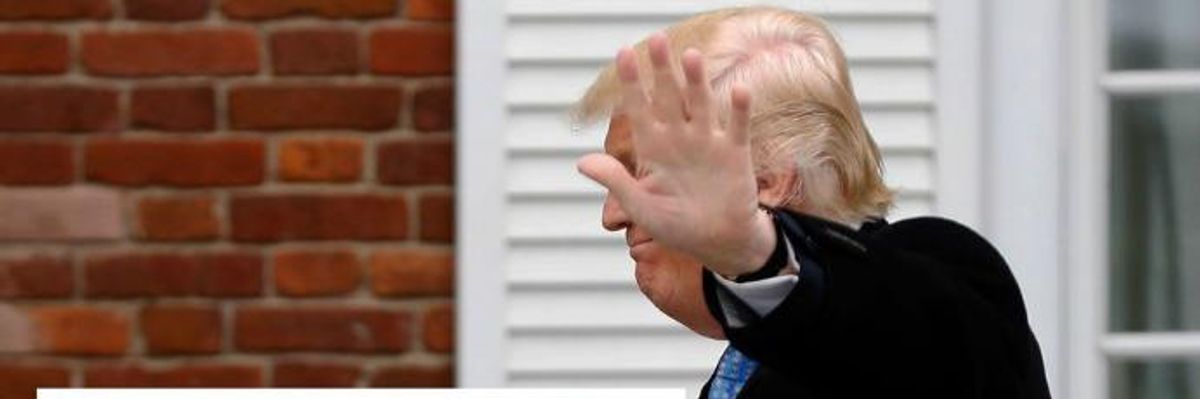
"We're pleased with the court's decision, which reflects a careful application of core First Amendment principles to government censorship on a new communications platform," said Jameel Jaffer, executive director of the Knight First Amendment Institute. (Photo: Twitter/Screenshot)
In a decision free speech advocates celebrated as a "historic moment for the First Amendment" and online freedom of expression, a federal judge ruled (pdf) on Wednesday that President Donald Trump cannot block Twitter users for their political views or criticism of his policies.
"We're pleased with the court's decision, which reflects a careful application of core First Amendment principles to government censorship on a new communications platform," said Jameel Jaffer, executive director of the Knight First Amendment Institute, a free speech advocacy group that brought the "groundbreaking" case on behalf of seven individuals Trump has blocked from seeing his Twitter posts.
"The president's practice of blocking critics on Twitter is pernicious and unconstitutional, and we hope this ruling will bring it to an end," Jaffer added.
In her opinion issued on Wednesday, U.S. District Court Judge Naomi Reice Buchwald agreed with the Knight Institute's argument that Trump's Twitter feed qualifies as a "public forum," and argued that blocking users from viewing and interacting with the president's frequent posts and tirades simply because of their political views is a violation of users' First Amendment rights.
"The viewpoint-based exclusion of the individual plaintiffs from that designated public forum is proscribed by the First Amendment and cannot be justified by the president's personal First Amendment interests," Buchwald wrote. "Because no government official is above the law and because all government officials are presumed to follow the law once the judiciary has said what the law is, we must assume that the president and [White House social media director Dan] Scavino will remedy the blocking we have held to be unconstitutional."
The Knight Institute's lawsuit, filed last July, took on particular significance as it could be one of many cases that "help society interpret free speech and First Amendment in [the] digital age," Alberto Ibarguen, CEO of the James L. Knight Foundation, noted in a tweet on Wednesday.
Katie Fallow, a senior staff attorney at the Knight Institute who led oral arguments in the case, said the court's application of the First Amendment to the president's habit of blocking users on Twitter "should guide all of the public officials who are communicating with their constituents through social media."
Dear Common Dreams reader, It’s been nearly 30 years since I co-founded Common Dreams with my late wife, Lina Newhouser. We had the radical notion that journalism should serve the public good, not corporate profits. It was clear to us from the outset what it would take to build such a project. No paid advertisements. No corporate sponsors. No millionaire publisher telling us what to think or do. Many people said we wouldn't last a year, but we proved those doubters wrong. Together with a tremendous team of journalists and dedicated staff, we built an independent media outlet free from the constraints of profits and corporate control. Our mission has always been simple: To inform. To inspire. To ignite change for the common good. Building Common Dreams was not easy. Our survival was never guaranteed. When you take on the most powerful forces—Wall Street greed, fossil fuel industry destruction, Big Tech lobbyists, and uber-rich oligarchs who have spent billions upon billions rigging the economy and democracy in their favor—the only bulwark you have is supporters who believe in your work. But here’s the urgent message from me today. It's never been this bad out there. And it's never been this hard to keep us going. At the very moment Common Dreams is most needed, the threats we face are intensifying. We need your support now more than ever. We don't accept corporate advertising and never will. We don't have a paywall because we don't think people should be blocked from critical news based on their ability to pay. Everything we do is funded by the donations of readers like you. When everyone does the little they can afford, we are strong. But if that support retreats or dries up, so do we. Will you donate now to make sure Common Dreams not only survives but thrives? —Craig Brown, Co-founder |
In a decision free speech advocates celebrated as a "historic moment for the First Amendment" and online freedom of expression, a federal judge ruled (pdf) on Wednesday that President Donald Trump cannot block Twitter users for their political views or criticism of his policies.
"We're pleased with the court's decision, which reflects a careful application of core First Amendment principles to government censorship on a new communications platform," said Jameel Jaffer, executive director of the Knight First Amendment Institute, a free speech advocacy group that brought the "groundbreaking" case on behalf of seven individuals Trump has blocked from seeing his Twitter posts.
"The president's practice of blocking critics on Twitter is pernicious and unconstitutional, and we hope this ruling will bring it to an end," Jaffer added.
In her opinion issued on Wednesday, U.S. District Court Judge Naomi Reice Buchwald agreed with the Knight Institute's argument that Trump's Twitter feed qualifies as a "public forum," and argued that blocking users from viewing and interacting with the president's frequent posts and tirades simply because of their political views is a violation of users' First Amendment rights.
"The viewpoint-based exclusion of the individual plaintiffs from that designated public forum is proscribed by the First Amendment and cannot be justified by the president's personal First Amendment interests," Buchwald wrote. "Because no government official is above the law and because all government officials are presumed to follow the law once the judiciary has said what the law is, we must assume that the president and [White House social media director Dan] Scavino will remedy the blocking we have held to be unconstitutional."
The Knight Institute's lawsuit, filed last July, took on particular significance as it could be one of many cases that "help society interpret free speech and First Amendment in [the] digital age," Alberto Ibarguen, CEO of the James L. Knight Foundation, noted in a tweet on Wednesday.
Katie Fallow, a senior staff attorney at the Knight Institute who led oral arguments in the case, said the court's application of the First Amendment to the president's habit of blocking users on Twitter "should guide all of the public officials who are communicating with their constituents through social media."
In a decision free speech advocates celebrated as a "historic moment for the First Amendment" and online freedom of expression, a federal judge ruled (pdf) on Wednesday that President Donald Trump cannot block Twitter users for their political views or criticism of his policies.
"We're pleased with the court's decision, which reflects a careful application of core First Amendment principles to government censorship on a new communications platform," said Jameel Jaffer, executive director of the Knight First Amendment Institute, a free speech advocacy group that brought the "groundbreaking" case on behalf of seven individuals Trump has blocked from seeing his Twitter posts.
"The president's practice of blocking critics on Twitter is pernicious and unconstitutional, and we hope this ruling will bring it to an end," Jaffer added.
In her opinion issued on Wednesday, U.S. District Court Judge Naomi Reice Buchwald agreed with the Knight Institute's argument that Trump's Twitter feed qualifies as a "public forum," and argued that blocking users from viewing and interacting with the president's frequent posts and tirades simply because of their political views is a violation of users' First Amendment rights.
"The viewpoint-based exclusion of the individual plaintiffs from that designated public forum is proscribed by the First Amendment and cannot be justified by the president's personal First Amendment interests," Buchwald wrote. "Because no government official is above the law and because all government officials are presumed to follow the law once the judiciary has said what the law is, we must assume that the president and [White House social media director Dan] Scavino will remedy the blocking we have held to be unconstitutional."
The Knight Institute's lawsuit, filed last July, took on particular significance as it could be one of many cases that "help society interpret free speech and First Amendment in [the] digital age," Alberto Ibarguen, CEO of the James L. Knight Foundation, noted in a tweet on Wednesday.
Katie Fallow, a senior staff attorney at the Knight Institute who led oral arguments in the case, said the court's application of the First Amendment to the president's habit of blocking users on Twitter "should guide all of the public officials who are communicating with their constituents through social media."