SUBSCRIBE TO OUR FREE NEWSLETTER
Daily news & progressive opinion—funded by the people, not the corporations—delivered straight to your inbox.
5
#000000
#FFFFFF
To donate by check, phone, or other method, see our More Ways to Give page.
Daily news & progressive opinion—funded by the people, not the corporations—delivered straight to your inbox.
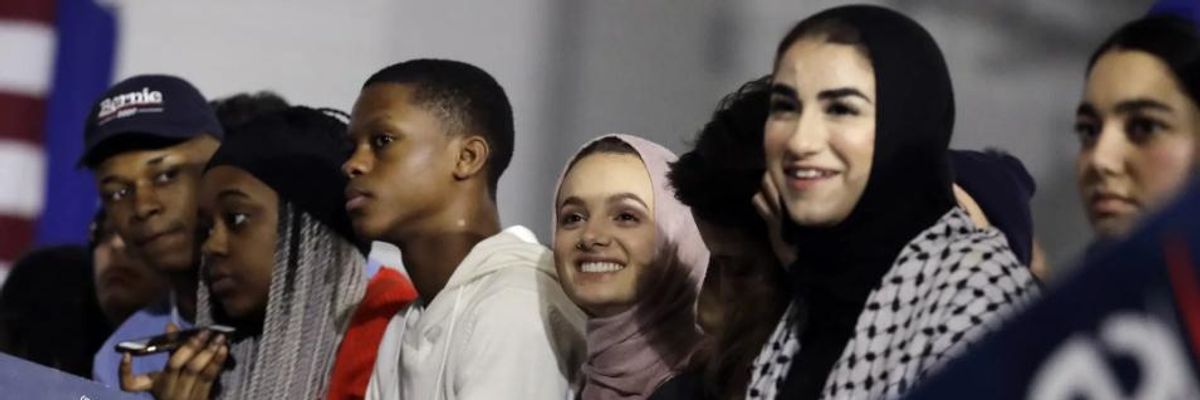
Supporters wait for Bernie Sanders in Chicago. (Photo: Nam Y Huh/AP)
Addressing a crowd of more than 12,500 people gathered inside Chicago's Navy Pier Festival Hall Sunday night, Sen. Bernie Sanders (I-Vt.) outlined how his personal involvement in the civil rights movement during the 1960s shaped his plan to pursue racial, economic, and environmental justice as a 2020 presidential contender.
"Real change never takes place from the top on down. It always takes place from the bottom up."
--Sen. Bernie Sanders
"My activities here in Chicago taught me a very important lesson that I have never forgotten," said the Vermont senator, referring to his time as a student activist at the University of Chicago. "And that is that, whether it is the struggle against corporate greed, against racism, sexism, homophobia, environmental devastation, or war and militarism, real change never takes place from the top on down. It always takes place from the bottom up."
The Chicago rally came just 24 hours after Sanders drew around 13,000 to an event in his hometown of Brooklyn, New York on Saturday, during which the senator detailed his childhood experiences in a lower-middle-class family.
Both rallies marked the first campaign events of Sanders' bid for the 2020 Democratic presidential nomination, which got off to a fast start last week with $10 million in donations averaging around $27 each and over a million people signing up as volunteers.
While still centered on the policy platform that drove his 2016 presidential run--including big-ticket agenda items like Medicare for All, free public college, a $15 federal minimum wage, and more--the opening rallies of Sanders' 2020 bid prominently featured elements of the senator's biography that supporters believe can provide a powerful contrast with President Donald Trump's lavish upbringing and bolster the campaign's populist message.
"Chicago provided me, for the first time in my life, the opportunity to put two and two together in understanding how the real world worked," Sanders said. "To understand what power was about in this country and who the people were who had that power. Those years enabled me to understand a little bit about how wars get started."
Moving from personal history to the systemic racial and economic injustices that persist in the present, Sanders vowed to pursue a bold agenda to close the racial wealth gap, reform the criminal justice system, confront racial inequities in the healthcare system and "end voter suppression in this country."
"Have we made progress in civil rights in this country since the early 1960s when I lived [in Chicago]? No question about it," Sanders said. "Do we still have a long way to go to end the institutional racism which permeates almost every aspect of our society? Absolutely."
The Vermont senator vowed to "change a system in which tens of thousands every single year get criminal records for possessing marijuana, but not one major Wall Street executive went to jail for destroying our economy in 2008."
Sanders also highlighted Sandra Bland, Laquan McDonald, Michael Brown, and other African Americans who have been killed by police in recent years to argue for large-scale police reforms.
Noting that ideas previously characterized as "crazy and extreme" by the Democratic establishment are now considered mainstream , Sanders declared, "We are now on the brink of not just winning an election, but transforming this country."
"If we stand together believing in justice and human dignity, if we believe in love and compassion, the truth is there is nothing we cannot accomplish," the Vermont senator concluded. "Let us go forward together."
Watch the full Chicago event:
Dear Common Dreams reader, It’s been nearly 30 years since I co-founded Common Dreams with my late wife, Lina Newhouser. We had the radical notion that journalism should serve the public good, not corporate profits. It was clear to us from the outset what it would take to build such a project. No paid advertisements. No corporate sponsors. No millionaire publisher telling us what to think or do. Many people said we wouldn't last a year, but we proved those doubters wrong. Together with a tremendous team of journalists and dedicated staff, we built an independent media outlet free from the constraints of profits and corporate control. Our mission has always been simple: To inform. To inspire. To ignite change for the common good. Building Common Dreams was not easy. Our survival was never guaranteed. When you take on the most powerful forces—Wall Street greed, fossil fuel industry destruction, Big Tech lobbyists, and uber-rich oligarchs who have spent billions upon billions rigging the economy and democracy in their favor—the only bulwark you have is supporters who believe in your work. But here’s the urgent message from me today. It's never been this bad out there. And it's never been this hard to keep us going. At the very moment Common Dreams is most needed, the threats we face are intensifying. We need your support now more than ever. We don't accept corporate advertising and never will. We don't have a paywall because we don't think people should be blocked from critical news based on their ability to pay. Everything we do is funded by the donations of readers like you. When everyone does the little they can afford, we are strong. But if that support retreats or dries up, so do we. Will you donate now to make sure Common Dreams not only survives but thrives? —Craig Brown, Co-founder |
Addressing a crowd of more than 12,500 people gathered inside Chicago's Navy Pier Festival Hall Sunday night, Sen. Bernie Sanders (I-Vt.) outlined how his personal involvement in the civil rights movement during the 1960s shaped his plan to pursue racial, economic, and environmental justice as a 2020 presidential contender.
"Real change never takes place from the top on down. It always takes place from the bottom up."
--Sen. Bernie Sanders
"My activities here in Chicago taught me a very important lesson that I have never forgotten," said the Vermont senator, referring to his time as a student activist at the University of Chicago. "And that is that, whether it is the struggle against corporate greed, against racism, sexism, homophobia, environmental devastation, or war and militarism, real change never takes place from the top on down. It always takes place from the bottom up."
The Chicago rally came just 24 hours after Sanders drew around 13,000 to an event in his hometown of Brooklyn, New York on Saturday, during which the senator detailed his childhood experiences in a lower-middle-class family.
Both rallies marked the first campaign events of Sanders' bid for the 2020 Democratic presidential nomination, which got off to a fast start last week with $10 million in donations averaging around $27 each and over a million people signing up as volunteers.
While still centered on the policy platform that drove his 2016 presidential run--including big-ticket agenda items like Medicare for All, free public college, a $15 federal minimum wage, and more--the opening rallies of Sanders' 2020 bid prominently featured elements of the senator's biography that supporters believe can provide a powerful contrast with President Donald Trump's lavish upbringing and bolster the campaign's populist message.
"Chicago provided me, for the first time in my life, the opportunity to put two and two together in understanding how the real world worked," Sanders said. "To understand what power was about in this country and who the people were who had that power. Those years enabled me to understand a little bit about how wars get started."
Moving from personal history to the systemic racial and economic injustices that persist in the present, Sanders vowed to pursue a bold agenda to close the racial wealth gap, reform the criminal justice system, confront racial inequities in the healthcare system and "end voter suppression in this country."
"Have we made progress in civil rights in this country since the early 1960s when I lived [in Chicago]? No question about it," Sanders said. "Do we still have a long way to go to end the institutional racism which permeates almost every aspect of our society? Absolutely."
The Vermont senator vowed to "change a system in which tens of thousands every single year get criminal records for possessing marijuana, but not one major Wall Street executive went to jail for destroying our economy in 2008."
Sanders also highlighted Sandra Bland, Laquan McDonald, Michael Brown, and other African Americans who have been killed by police in recent years to argue for large-scale police reforms.
Noting that ideas previously characterized as "crazy and extreme" by the Democratic establishment are now considered mainstream , Sanders declared, "We are now on the brink of not just winning an election, but transforming this country."
"If we stand together believing in justice and human dignity, if we believe in love and compassion, the truth is there is nothing we cannot accomplish," the Vermont senator concluded. "Let us go forward together."
Watch the full Chicago event:
Addressing a crowd of more than 12,500 people gathered inside Chicago's Navy Pier Festival Hall Sunday night, Sen. Bernie Sanders (I-Vt.) outlined how his personal involvement in the civil rights movement during the 1960s shaped his plan to pursue racial, economic, and environmental justice as a 2020 presidential contender.
"Real change never takes place from the top on down. It always takes place from the bottom up."
--Sen. Bernie Sanders
"My activities here in Chicago taught me a very important lesson that I have never forgotten," said the Vermont senator, referring to his time as a student activist at the University of Chicago. "And that is that, whether it is the struggle against corporate greed, against racism, sexism, homophobia, environmental devastation, or war and militarism, real change never takes place from the top on down. It always takes place from the bottom up."
The Chicago rally came just 24 hours after Sanders drew around 13,000 to an event in his hometown of Brooklyn, New York on Saturday, during which the senator detailed his childhood experiences in a lower-middle-class family.
Both rallies marked the first campaign events of Sanders' bid for the 2020 Democratic presidential nomination, which got off to a fast start last week with $10 million in donations averaging around $27 each and over a million people signing up as volunteers.
While still centered on the policy platform that drove his 2016 presidential run--including big-ticket agenda items like Medicare for All, free public college, a $15 federal minimum wage, and more--the opening rallies of Sanders' 2020 bid prominently featured elements of the senator's biography that supporters believe can provide a powerful contrast with President Donald Trump's lavish upbringing and bolster the campaign's populist message.
"Chicago provided me, for the first time in my life, the opportunity to put two and two together in understanding how the real world worked," Sanders said. "To understand what power was about in this country and who the people were who had that power. Those years enabled me to understand a little bit about how wars get started."
Moving from personal history to the systemic racial and economic injustices that persist in the present, Sanders vowed to pursue a bold agenda to close the racial wealth gap, reform the criminal justice system, confront racial inequities in the healthcare system and "end voter suppression in this country."
"Have we made progress in civil rights in this country since the early 1960s when I lived [in Chicago]? No question about it," Sanders said. "Do we still have a long way to go to end the institutional racism which permeates almost every aspect of our society? Absolutely."
The Vermont senator vowed to "change a system in which tens of thousands every single year get criminal records for possessing marijuana, but not one major Wall Street executive went to jail for destroying our economy in 2008."
Sanders also highlighted Sandra Bland, Laquan McDonald, Michael Brown, and other African Americans who have been killed by police in recent years to argue for large-scale police reforms.
Noting that ideas previously characterized as "crazy and extreme" by the Democratic establishment are now considered mainstream , Sanders declared, "We are now on the brink of not just winning an election, but transforming this country."
"If we stand together believing in justice and human dignity, if we believe in love and compassion, the truth is there is nothing we cannot accomplish," the Vermont senator concluded. "Let us go forward together."
Watch the full Chicago event: