

SUBSCRIBE TO OUR FREE NEWSLETTER
Daily news & progressive opinion—funded by the people, not the corporations—delivered straight to your inbox.
5
#000000
#FFFFFF
To donate by check, phone, or other method, see our More Ways to Give page.
Daily news & progressive opinion—funded by the people, not the corporations—delivered straight to your inbox.
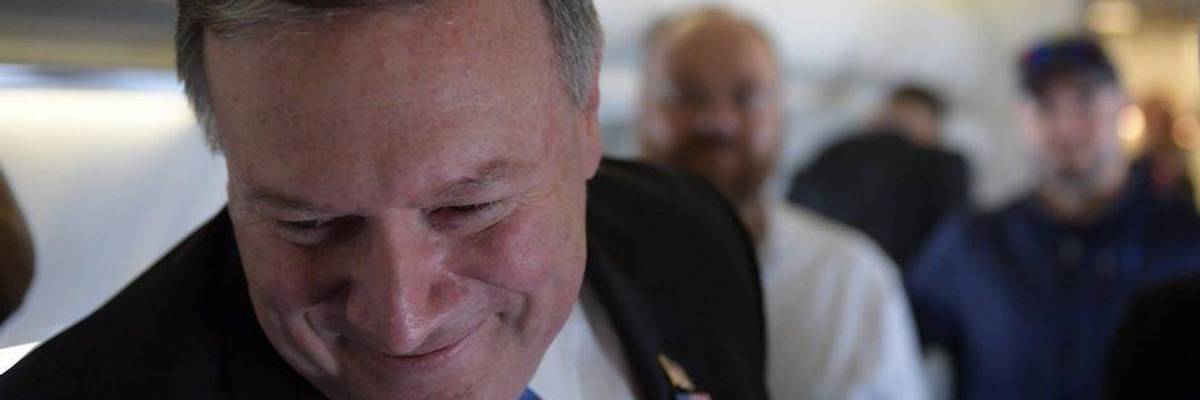
Secretary of State Mike Pompeo en route to Brussels for NATO meeting, April 2018. (Photo: U.S. State Department Twitter)
A secretive State Department briefing restricted to all but faith-based reporters is raising questions among reporters about access and press freedoms.
On Monday evening, Secretary of State Mike Pompeo held a phone briefing for reporters from the religious press. Secular news agencies--including the main networks and newspapers--were not invited to participate in the call.
The State Department said it will not release the names of the attendees or transcripts from the meeting.
Despite repeated inquiries and complaints from members of the press corps who are based at the department, the State Department on Monday night said they would not be providing a transcript of the call, a list of faith-based media outlets who were allowed to participate or the criteria to be invited.
Michele Kelemen from NPR wondered why the department was being so secretive: "usually we see a transcript or at least know who was invited. Why not this time?"
In a statement provided to CNN about the call, the department argued that there was nothing inherently out of place in agency regulations about the Monday briefing.
"Department press briefings, teleconferences on a myriad of policy issues, briefings and sprays by the Secretary of State and other officials," the department said, "are open to any interested domestic or international press."
"Other engagements are more targeted or designed for topic, region, or audience-specific media," the statement added. "This has always been the case."
According to MSNBC reporter Andrea Mitchell, however, that isn't exactly true.
"Can't recall religion being a test before for journalists," Mitchell said in a tweet.
BuzzFeed reporter Dominic Holden asked the department exactly how targeted the event was, he said, and how narrowly defined was "faith based media." Were there Muslim reporters there, Holden wondered?
"They avoided direct questions," said Holden.
I asked State. Dept about its "faith-based media" call -- which outlets were invited and how many Muslim reporters were on the call?
They avoided direct questions but said some media events are "more targeted." pic.twitter.com/NtipYnmU6k
-- Dominic Holden (@dominicholden) March 18, 2019
Dear Common Dreams reader, It’s been nearly 30 years since I co-founded Common Dreams with my late wife, Lina Newhouser. We had the radical notion that journalism should serve the public good, not corporate profits. It was clear to us from the outset what it would take to build such a project. No paid advertisements. No corporate sponsors. No millionaire publisher telling us what to think or do. Many people said we wouldn't last a year, but we proved those doubters wrong. Together with a tremendous team of journalists and dedicated staff, we built an independent media outlet free from the constraints of profits and corporate control. Our mission has always been simple: To inform. To inspire. To ignite change for the common good. Building Common Dreams was not easy. Our survival was never guaranteed. When you take on the most powerful forces—Wall Street greed, fossil fuel industry destruction, Big Tech lobbyists, and uber-rich oligarchs who have spent billions upon billions rigging the economy and democracy in their favor—the only bulwark you have is supporters who believe in your work. But here’s the urgent message from me today. It's never been this bad out there. And it's never been this hard to keep us going. At the very moment Common Dreams is most needed, the threats we face are intensifying. We need your support now more than ever. We don't accept corporate advertising and never will. We don't have a paywall because we don't think people should be blocked from critical news based on their ability to pay. Everything we do is funded by the donations of readers like you. When everyone does the little they can afford, we are strong. But if that support retreats or dries up, so do we. Will you donate now to make sure Common Dreams not only survives but thrives? —Craig Brown, Co-founder |
A secretive State Department briefing restricted to all but faith-based reporters is raising questions among reporters about access and press freedoms.
On Monday evening, Secretary of State Mike Pompeo held a phone briefing for reporters from the religious press. Secular news agencies--including the main networks and newspapers--were not invited to participate in the call.
The State Department said it will not release the names of the attendees or transcripts from the meeting.
Despite repeated inquiries and complaints from members of the press corps who are based at the department, the State Department on Monday night said they would not be providing a transcript of the call, a list of faith-based media outlets who were allowed to participate or the criteria to be invited.
Michele Kelemen from NPR wondered why the department was being so secretive: "usually we see a transcript or at least know who was invited. Why not this time?"
In a statement provided to CNN about the call, the department argued that there was nothing inherently out of place in agency regulations about the Monday briefing.
"Department press briefings, teleconferences on a myriad of policy issues, briefings and sprays by the Secretary of State and other officials," the department said, "are open to any interested domestic or international press."
"Other engagements are more targeted or designed for topic, region, or audience-specific media," the statement added. "This has always been the case."
According to MSNBC reporter Andrea Mitchell, however, that isn't exactly true.
"Can't recall religion being a test before for journalists," Mitchell said in a tweet.
BuzzFeed reporter Dominic Holden asked the department exactly how targeted the event was, he said, and how narrowly defined was "faith based media." Were there Muslim reporters there, Holden wondered?
"They avoided direct questions," said Holden.
I asked State. Dept about its "faith-based media" call -- which outlets were invited and how many Muslim reporters were on the call?
They avoided direct questions but said some media events are "more targeted." pic.twitter.com/NtipYnmU6k
-- Dominic Holden (@dominicholden) March 18, 2019
A secretive State Department briefing restricted to all but faith-based reporters is raising questions among reporters about access and press freedoms.
On Monday evening, Secretary of State Mike Pompeo held a phone briefing for reporters from the religious press. Secular news agencies--including the main networks and newspapers--were not invited to participate in the call.
The State Department said it will not release the names of the attendees or transcripts from the meeting.
Despite repeated inquiries and complaints from members of the press corps who are based at the department, the State Department on Monday night said they would not be providing a transcript of the call, a list of faith-based media outlets who were allowed to participate or the criteria to be invited.
Michele Kelemen from NPR wondered why the department was being so secretive: "usually we see a transcript or at least know who was invited. Why not this time?"
In a statement provided to CNN about the call, the department argued that there was nothing inherently out of place in agency regulations about the Monday briefing.
"Department press briefings, teleconferences on a myriad of policy issues, briefings and sprays by the Secretary of State and other officials," the department said, "are open to any interested domestic or international press."
"Other engagements are more targeted or designed for topic, region, or audience-specific media," the statement added. "This has always been the case."
According to MSNBC reporter Andrea Mitchell, however, that isn't exactly true.
"Can't recall religion being a test before for journalists," Mitchell said in a tweet.
BuzzFeed reporter Dominic Holden asked the department exactly how targeted the event was, he said, and how narrowly defined was "faith based media." Were there Muslim reporters there, Holden wondered?
"They avoided direct questions," said Holden.
I asked State. Dept about its "faith-based media" call -- which outlets were invited and how many Muslim reporters were on the call?
They avoided direct questions but said some media events are "more targeted." pic.twitter.com/NtipYnmU6k
-- Dominic Holden (@dominicholden) March 18, 2019

