

SUBSCRIBE TO OUR FREE NEWSLETTER
Daily news & progressive opinion—funded by the people, not the corporations—delivered straight to your inbox.
5
#000000
#FFFFFF
To donate by check, phone, or other method, see our More Ways to Give page.
Daily news & progressive opinion—funded by the people, not the corporations—delivered straight to your inbox.
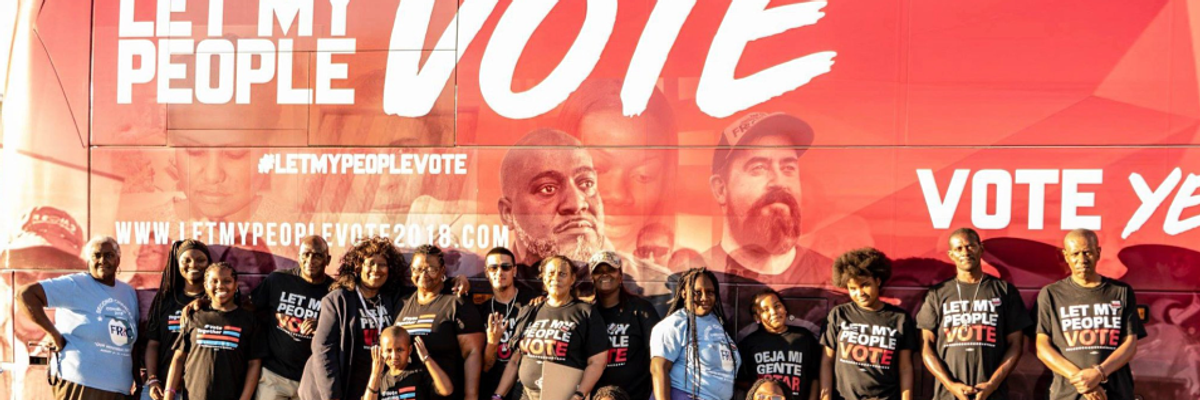
Florida voters in November overwhelmingly approved a constitutional amendment to restore voting rights to 1.4 million people with past felony convictions. (Photo: Public Citizen/Twitter)
Civil rights advocates Tuesday slammed Republicans in Florida for passing a bill that would severely undermine a law approved by voters last year that restored voting rights to residents with felony convictions.
Four months ago, Florida voters passed Amendment 4 in a state referendum to allow many of the state's former felons to vote. But on Tuesday, the Republican-controlled House Criminal Justice Subcommittee passed CRJ 3 in a party-line vote.
While the passage of Amendment 4 was celebrated by voting rights advocates nationwide, the new GOP measure would undermine the hard won victory by requiring former felons to pay all court fees in order to have their right to vote granted.
Critics including Rep. Alexandria Ocasio-Cortez (D-N.Y.) and Public Citizen denounced CRJ 3 as a poll tax.
More than 64 percent of Florida voters approved Amendment 4 in November, restoring voting rights to about 1.4 million former felons. Convicted murderers and felony sex offenders are excluded under the amendment, and felons must complete all terms of their sentence including parole and probation to be permitted to vote.
The ACLU of Florida said Tuesday that by forcing Floridians with felony convictions to pay courts as well, CRJ 3 "would effectively disenfranchise two categories of returning citizens for life: those with very small financial obligations that they will never be able to pay due to poverty and those with financial obligations for non-violent property crimes."
The group's political director, Kirk Bailey, called the bill "an affront to Florida voters" which "will inevitably prevent individuals from voting based on the size of one's bank account."
"If this bill passes, it will undoubtedly continue to disenfranchise those who have already served their time and paid their debt to society," Bailey said in a statement. "This is exactly what we were worried about from the beginning - legislative attempts to undermine the will of the people who voted for second chances and to rid Florida of the last vestiges of its Jim Crow era past."
"The House bill raises serious constitutional concerns," he added. "We urge lawmakers to uphold the will of Florida voters and withdraw this deficient bill."
Dear Common Dreams reader, It’s been nearly 30 years since I co-founded Common Dreams with my late wife, Lina Newhouser. We had the radical notion that journalism should serve the public good, not corporate profits. It was clear to us from the outset what it would take to build such a project. No paid advertisements. No corporate sponsors. No millionaire publisher telling us what to think or do. Many people said we wouldn't last a year, but we proved those doubters wrong. Together with a tremendous team of journalists and dedicated staff, we built an independent media outlet free from the constraints of profits and corporate control. Our mission has always been simple: To inform. To inspire. To ignite change for the common good. Building Common Dreams was not easy. Our survival was never guaranteed. When you take on the most powerful forces—Wall Street greed, fossil fuel industry destruction, Big Tech lobbyists, and uber-rich oligarchs who have spent billions upon billions rigging the economy and democracy in their favor—the only bulwark you have is supporters who believe in your work. But here’s the urgent message from me today. It's never been this bad out there. And it's never been this hard to keep us going. At the very moment Common Dreams is most needed, the threats we face are intensifying. We need your support now more than ever. We don't accept corporate advertising and never will. We don't have a paywall because we don't think people should be blocked from critical news based on their ability to pay. Everything we do is funded by the donations of readers like you. When everyone does the little they can afford, we are strong. But if that support retreats or dries up, so do we. Will you donate now to make sure Common Dreams not only survives but thrives? —Craig Brown, Co-founder |
Civil rights advocates Tuesday slammed Republicans in Florida for passing a bill that would severely undermine a law approved by voters last year that restored voting rights to residents with felony convictions.
Four months ago, Florida voters passed Amendment 4 in a state referendum to allow many of the state's former felons to vote. But on Tuesday, the Republican-controlled House Criminal Justice Subcommittee passed CRJ 3 in a party-line vote.
While the passage of Amendment 4 was celebrated by voting rights advocates nationwide, the new GOP measure would undermine the hard won victory by requiring former felons to pay all court fees in order to have their right to vote granted.
Critics including Rep. Alexandria Ocasio-Cortez (D-N.Y.) and Public Citizen denounced CRJ 3 as a poll tax.
More than 64 percent of Florida voters approved Amendment 4 in November, restoring voting rights to about 1.4 million former felons. Convicted murderers and felony sex offenders are excluded under the amendment, and felons must complete all terms of their sentence including parole and probation to be permitted to vote.
The ACLU of Florida said Tuesday that by forcing Floridians with felony convictions to pay courts as well, CRJ 3 "would effectively disenfranchise two categories of returning citizens for life: those with very small financial obligations that they will never be able to pay due to poverty and those with financial obligations for non-violent property crimes."
The group's political director, Kirk Bailey, called the bill "an affront to Florida voters" which "will inevitably prevent individuals from voting based on the size of one's bank account."
"If this bill passes, it will undoubtedly continue to disenfranchise those who have already served their time and paid their debt to society," Bailey said in a statement. "This is exactly what we were worried about from the beginning - legislative attempts to undermine the will of the people who voted for second chances and to rid Florida of the last vestiges of its Jim Crow era past."
"The House bill raises serious constitutional concerns," he added. "We urge lawmakers to uphold the will of Florida voters and withdraw this deficient bill."
Civil rights advocates Tuesday slammed Republicans in Florida for passing a bill that would severely undermine a law approved by voters last year that restored voting rights to residents with felony convictions.
Four months ago, Florida voters passed Amendment 4 in a state referendum to allow many of the state's former felons to vote. But on Tuesday, the Republican-controlled House Criminal Justice Subcommittee passed CRJ 3 in a party-line vote.
While the passage of Amendment 4 was celebrated by voting rights advocates nationwide, the new GOP measure would undermine the hard won victory by requiring former felons to pay all court fees in order to have their right to vote granted.
Critics including Rep. Alexandria Ocasio-Cortez (D-N.Y.) and Public Citizen denounced CRJ 3 as a poll tax.
More than 64 percent of Florida voters approved Amendment 4 in November, restoring voting rights to about 1.4 million former felons. Convicted murderers and felony sex offenders are excluded under the amendment, and felons must complete all terms of their sentence including parole and probation to be permitted to vote.
The ACLU of Florida said Tuesday that by forcing Floridians with felony convictions to pay courts as well, CRJ 3 "would effectively disenfranchise two categories of returning citizens for life: those with very small financial obligations that they will never be able to pay due to poverty and those with financial obligations for non-violent property crimes."
The group's political director, Kirk Bailey, called the bill "an affront to Florida voters" which "will inevitably prevent individuals from voting based on the size of one's bank account."
"If this bill passes, it will undoubtedly continue to disenfranchise those who have already served their time and paid their debt to society," Bailey said in a statement. "This is exactly what we were worried about from the beginning - legislative attempts to undermine the will of the people who voted for second chances and to rid Florida of the last vestiges of its Jim Crow era past."
"The House bill raises serious constitutional concerns," he added. "We urge lawmakers to uphold the will of Florida voters and withdraw this deficient bill."

