SUBSCRIBE TO OUR FREE NEWSLETTER
Daily news & progressive opinion—funded by the people, not the corporations—delivered straight to your inbox.
5
#000000
#FFFFFF
To donate by check, phone, or other method, see our More Ways to Give page.
Daily news & progressive opinion—funded by the people, not the corporations—delivered straight to your inbox.
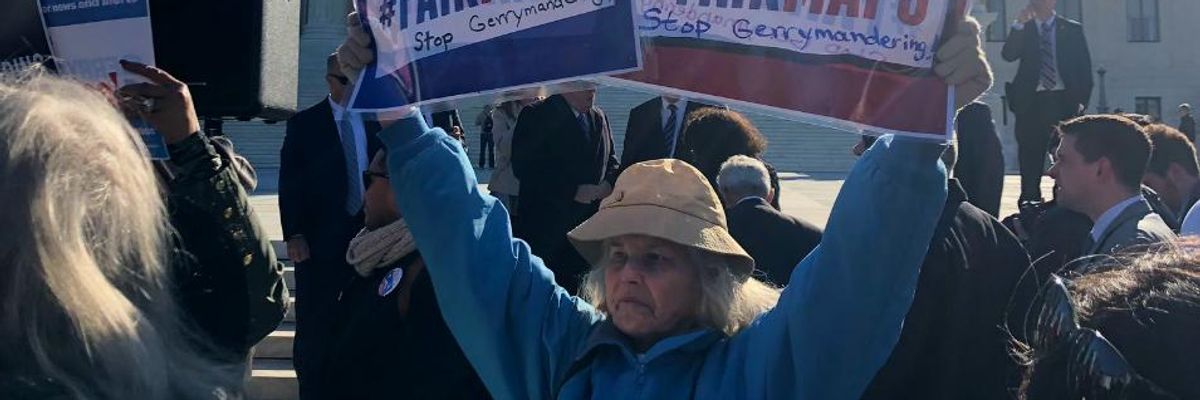
Critics of partisan gerrymandering gathered outside the U.S. Supreme Court on Tuesday as the justices heard arguments for cases challenging maps in North Carolina and Maryland. (Photo: @PFAW/Twitter)
Even as voting rights advocates urge the U.S. Supreme Court to "be on the right side of history" by putting voters and not lawmakers first, the court's right-wing majority indicated Tuesday it may refuse to impose constitutional limits on extreme partisan gerrymandering.
"Citizens in all 50 states deserve to be able to choose their representatives--and not the other way around."
--Paul Smith, CLC
"A familiar pattern repeated itself," the Washington Post reported Tuesday after two hours of oral arguments about politically motivated maps. "Liberal justices saw it as a threat to democracy that requires action while conservatives wondered how courts could ever decide when a political process becomes too political."
Justices on Tuesday heard arguments for both Lamone v. Benisek and Rucho v. Common Cause, which has been consolidated with Rucho v. League of Women Voters of North Carolina (LWVNC).
The political maps in these cases, which local leaders have acknowledged were intentionally drawn to benefit the political parties in power, gave an advantage to Republicans in North Carolina and Democrats in Maryland.
"Both Republicans and Democrats are guilty of rigging the system by drawing lines to maximize their own party's advantage, so these cases present the justices with a unique opportunity," said Paul Smith, vice president at the Campaign Legal Center (CLC) and counsel of record for Rucho v. LWVNC. "Voters nationwide are ready for a ruling that will put the voters and not lawmakers first."
Recent nationwide polling commissioned by CLC has shown (pdf) "broad, bipartisan support for the Supreme Court to set clear rules for when gerrymandering violates the Constitution," and advocates for voting rights gathered outside of the court building in Washington, D.C. on Tuesday.
"The court needs to be on the right side of history and stop politicians from infringing on the people's right to freely choose their representatives through voting," said Common Cause president Karen Hobert Flynn, calling the case in North Carolina "the most egregious partisan gerrymander the Supreme Court has ever seen."
However, current members of the nation's high court--which has ruled on racial but not partisan gerrymandering and "sidestepped the central questions" in another pair of cases last year--don't seem inclined crack down on constitutionally dubious map drawing.
Concluding that the justices on Tuesday "appeared unlikely" to put forth a new test to target partisan gerrymandering when they release their rulings, expected in June, NBC News reported:
The two newest justices, both appointed by President Donald Trump, said the Supreme Court should be especially reluctant to open the door to challenges based on excessive partisanship, given that more states are adopting methods such as redistricting commissions that take the map-drawing assignment away from legislatures.
"I don't dispute that extreme partisanship is a real danger in our country," Justice Brett Kavanaugh said. "But there's a fair amount of activity going on in the states to deal with it."
Justice Neil Gorsuch expressed a similar concern. "Why should we wade into this when there are alternatives that exist?"
As journalist Ari Berman, who has written extensively about voting rights, put it: "Presented with two cases of extreme partisan gerrymandering, the Supreme Court's conservative majority hinted that it might preserve these politically motivated maps in order to avoid what it seemed to regard as the most dangerous possible outcome: equal representation for all citizens."
"If court upholds extreme partisan gerrymandering that will allow Republicans to rig elections for next decade," Berman added on Twitter. "Pay attention to this."
"It is still possible for voters in North Carolina and Maryland to have fair maps drawn in time for the pivotal 2020 elections," said CLC's Smith. "Citizens in all 50 states deserve to be able to choose their representatives--and not the other way around."
Dear Common Dreams reader, It’s been nearly 30 years since I co-founded Common Dreams with my late wife, Lina Newhouser. We had the radical notion that journalism should serve the public good, not corporate profits. It was clear to us from the outset what it would take to build such a project. No paid advertisements. No corporate sponsors. No millionaire publisher telling us what to think or do. Many people said we wouldn't last a year, but we proved those doubters wrong. Together with a tremendous team of journalists and dedicated staff, we built an independent media outlet free from the constraints of profits and corporate control. Our mission has always been simple: To inform. To inspire. To ignite change for the common good. Building Common Dreams was not easy. Our survival was never guaranteed. When you take on the most powerful forces—Wall Street greed, fossil fuel industry destruction, Big Tech lobbyists, and uber-rich oligarchs who have spent billions upon billions rigging the economy and democracy in their favor—the only bulwark you have is supporters who believe in your work. But here’s the urgent message from me today. It's never been this bad out there. And it's never been this hard to keep us going. At the very moment Common Dreams is most needed, the threats we face are intensifying. We need your support now more than ever. We don't accept corporate advertising and never will. We don't have a paywall because we don't think people should be blocked from critical news based on their ability to pay. Everything we do is funded by the donations of readers like you. When everyone does the little they can afford, we are strong. But if that support retreats or dries up, so do we. Will you donate now to make sure Common Dreams not only survives but thrives? —Craig Brown, Co-founder |
Even as voting rights advocates urge the U.S. Supreme Court to "be on the right side of history" by putting voters and not lawmakers first, the court's right-wing majority indicated Tuesday it may refuse to impose constitutional limits on extreme partisan gerrymandering.
"Citizens in all 50 states deserve to be able to choose their representatives--and not the other way around."
--Paul Smith, CLC
"A familiar pattern repeated itself," the Washington Post reported Tuesday after two hours of oral arguments about politically motivated maps. "Liberal justices saw it as a threat to democracy that requires action while conservatives wondered how courts could ever decide when a political process becomes too political."
Justices on Tuesday heard arguments for both Lamone v. Benisek and Rucho v. Common Cause, which has been consolidated with Rucho v. League of Women Voters of North Carolina (LWVNC).
The political maps in these cases, which local leaders have acknowledged were intentionally drawn to benefit the political parties in power, gave an advantage to Republicans in North Carolina and Democrats in Maryland.
"Both Republicans and Democrats are guilty of rigging the system by drawing lines to maximize their own party's advantage, so these cases present the justices with a unique opportunity," said Paul Smith, vice president at the Campaign Legal Center (CLC) and counsel of record for Rucho v. LWVNC. "Voters nationwide are ready for a ruling that will put the voters and not lawmakers first."
Recent nationwide polling commissioned by CLC has shown (pdf) "broad, bipartisan support for the Supreme Court to set clear rules for when gerrymandering violates the Constitution," and advocates for voting rights gathered outside of the court building in Washington, D.C. on Tuesday.
"The court needs to be on the right side of history and stop politicians from infringing on the people's right to freely choose their representatives through voting," said Common Cause president Karen Hobert Flynn, calling the case in North Carolina "the most egregious partisan gerrymander the Supreme Court has ever seen."
However, current members of the nation's high court--which has ruled on racial but not partisan gerrymandering and "sidestepped the central questions" in another pair of cases last year--don't seem inclined crack down on constitutionally dubious map drawing.
Concluding that the justices on Tuesday "appeared unlikely" to put forth a new test to target partisan gerrymandering when they release their rulings, expected in June, NBC News reported:
The two newest justices, both appointed by President Donald Trump, said the Supreme Court should be especially reluctant to open the door to challenges based on excessive partisanship, given that more states are adopting methods such as redistricting commissions that take the map-drawing assignment away from legislatures.
"I don't dispute that extreme partisanship is a real danger in our country," Justice Brett Kavanaugh said. "But there's a fair amount of activity going on in the states to deal with it."
Justice Neil Gorsuch expressed a similar concern. "Why should we wade into this when there are alternatives that exist?"
As journalist Ari Berman, who has written extensively about voting rights, put it: "Presented with two cases of extreme partisan gerrymandering, the Supreme Court's conservative majority hinted that it might preserve these politically motivated maps in order to avoid what it seemed to regard as the most dangerous possible outcome: equal representation for all citizens."
"If court upholds extreme partisan gerrymandering that will allow Republicans to rig elections for next decade," Berman added on Twitter. "Pay attention to this."
"It is still possible for voters in North Carolina and Maryland to have fair maps drawn in time for the pivotal 2020 elections," said CLC's Smith. "Citizens in all 50 states deserve to be able to choose their representatives--and not the other way around."
Even as voting rights advocates urge the U.S. Supreme Court to "be on the right side of history" by putting voters and not lawmakers first, the court's right-wing majority indicated Tuesday it may refuse to impose constitutional limits on extreme partisan gerrymandering.
"Citizens in all 50 states deserve to be able to choose their representatives--and not the other way around."
--Paul Smith, CLC
"A familiar pattern repeated itself," the Washington Post reported Tuesday after two hours of oral arguments about politically motivated maps. "Liberal justices saw it as a threat to democracy that requires action while conservatives wondered how courts could ever decide when a political process becomes too political."
Justices on Tuesday heard arguments for both Lamone v. Benisek and Rucho v. Common Cause, which has been consolidated with Rucho v. League of Women Voters of North Carolina (LWVNC).
The political maps in these cases, which local leaders have acknowledged were intentionally drawn to benefit the political parties in power, gave an advantage to Republicans in North Carolina and Democrats in Maryland.
"Both Republicans and Democrats are guilty of rigging the system by drawing lines to maximize their own party's advantage, so these cases present the justices with a unique opportunity," said Paul Smith, vice president at the Campaign Legal Center (CLC) and counsel of record for Rucho v. LWVNC. "Voters nationwide are ready for a ruling that will put the voters and not lawmakers first."
Recent nationwide polling commissioned by CLC has shown (pdf) "broad, bipartisan support for the Supreme Court to set clear rules for when gerrymandering violates the Constitution," and advocates for voting rights gathered outside of the court building in Washington, D.C. on Tuesday.
"The court needs to be on the right side of history and stop politicians from infringing on the people's right to freely choose their representatives through voting," said Common Cause president Karen Hobert Flynn, calling the case in North Carolina "the most egregious partisan gerrymander the Supreme Court has ever seen."
However, current members of the nation's high court--which has ruled on racial but not partisan gerrymandering and "sidestepped the central questions" in another pair of cases last year--don't seem inclined crack down on constitutionally dubious map drawing.
Concluding that the justices on Tuesday "appeared unlikely" to put forth a new test to target partisan gerrymandering when they release their rulings, expected in June, NBC News reported:
The two newest justices, both appointed by President Donald Trump, said the Supreme Court should be especially reluctant to open the door to challenges based on excessive partisanship, given that more states are adopting methods such as redistricting commissions that take the map-drawing assignment away from legislatures.
"I don't dispute that extreme partisanship is a real danger in our country," Justice Brett Kavanaugh said. "But there's a fair amount of activity going on in the states to deal with it."
Justice Neil Gorsuch expressed a similar concern. "Why should we wade into this when there are alternatives that exist?"
As journalist Ari Berman, who has written extensively about voting rights, put it: "Presented with two cases of extreme partisan gerrymandering, the Supreme Court's conservative majority hinted that it might preserve these politically motivated maps in order to avoid what it seemed to regard as the most dangerous possible outcome: equal representation for all citizens."
"If court upholds extreme partisan gerrymandering that will allow Republicans to rig elections for next decade," Berman added on Twitter. "Pay attention to this."
"It is still possible for voters in North Carolina and Maryland to have fair maps drawn in time for the pivotal 2020 elections," said CLC's Smith. "Citizens in all 50 states deserve to be able to choose their representatives--and not the other way around."