SUBSCRIBE TO OUR FREE NEWSLETTER
Daily news & progressive opinion—funded by the people, not the corporations—delivered straight to your inbox.
5
#000000
#FFFFFF
To donate by check, phone, or other method, see our More Ways to Give page.
Daily news & progressive opinion—funded by the people, not the corporations—delivered straight to your inbox.
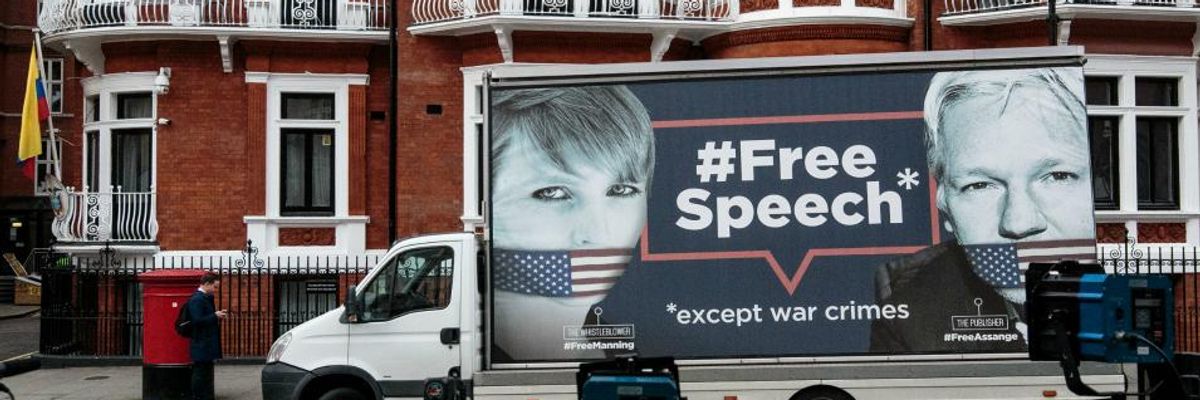
A van with a billboard in support of American whistleblower Chelsea Manning and Wikileaks founder Julian Assange is parked outside the Ecuadorian Embassy in London on April 5, 2019. (Photo: Jack Taylor/Getty Images)
While Ecuador denies plans to revoke Julian Assange's political asylum, a top United Nations human rights official has vowed to investigate fresh rumors, noting that if the WikiLeaks founder is expelled from the Ecuadorian Embassy in London, he likely would be arrested by British authorities and extradited to the United States.
U.N. Special Rapporteur on Torture Nils Melzer warned in a statement Friday that "such a response could expose him to a real risk of serious violations of his human rights, including his freedom of expression, his right to a fair trial, and the prohibition of cruel, inhuman, or degrading treatment or punishment."
Melzer, who is preparing a formal request to visit Assange in London, called on Ecuadorian authorities to refrain from kicking the journalist and publisher out of the embassy or otherwise suspending his political asylum "until such time as the full protection of his human rights can be guaranteed."
The U.N. official also claimed that, according to information he has received, Assange is "at risk of extreme vulnerability, and his health is in serious decline." Given that, Melzer said Ecuador should continue providing the asylee "with adequate living conditions and access to appropriate medical care."
Should Assange come under British jurisdiction, Melzer said, the United Kingdom should refrain from sending him anywhere "until his right to asylum under refugee law or subsidiary protection under international human rights law has been determined in a transparent and impartial proceeding granting all due process and fair trial guarantees, including the right to appeal."
Assange has lived at the embassy since 2012 to avoid extradition to Sweden--which dropped its request last year--or the United States, where he would likely be prosecuted for publishing classified information, including evidence of U.S. war crimes.
Earlier this year, Assange's legal team filed an application with the Washington, D.C.-based Inter-American Commission of Human Rights (IACHR), in an effort to block his extradition to the United States and unseal the Justice Department's secret charges against him, which were accidentally revealed to the public in November.
During Assange's stay at the embassy over the past seven years, rumors of his looming extradition have been common, especially amid reports that his relationship with the Ecuadorian government has soured. The most recent concerns come directly from WikiLeaks.
The group tweeted Thursday that a "high level source within the Ecuadorian state" claimed Assange's pending expulsion from the embassy would happen within "hours to days." The pretext for the potential move is supposedly a recent leak and subsequent scandal that Ecuadorian President Lenin Moreno blames on WikiLeaks, which dismissed Moreno's charges as "completely bogus."
Following the tweet, local police in London told The Associated Press that because there is an active arrest warrant for Assange, they would be "obliged to execute that warrant should he leave the embassy." Officers were stationed outside the facility Friday morning.
The Daily Mail, a British newspaper, reported that "the London force has rented an apartment overlooking the embassy's front door to keep the building under constant surveillance."
Protesters also gathered outside the embassy in support of Assange, with some spelling "no expulsion" on the sidewalk using LED lights.
Assange's legal team said in a statement Friday that expelling him from the embassy in London would "violate international refugee law."
The Daily Mail reported that Jaime Marchan, Ecuador's ambassador to the U.K., told a journalist in London: "There is no change in the Senor Julian Assange's situation. To say we are going to take him out the embassy is an offense to Ecuador."
Ecuadorian Foreign Minister Jose Valencia responded early Friday in a series of tweets in Spanish.
"Rumors of the 'imminent' departure of Assange come from months ago," Valencia said. "The government will not comment on the current unfounded rumors, which are also insulting. Ecuador makes its decisions in a sovereign way and independent of other countries."
"Diplomatic asylum is a sovereign power of a state," he added, "which has the right to grant or withdraw it unilaterally when it considers it justified."
Dear Common Dreams reader, It’s been nearly 30 years since I co-founded Common Dreams with my late wife, Lina Newhouser. We had the radical notion that journalism should serve the public good, not corporate profits. It was clear to us from the outset what it would take to build such a project. No paid advertisements. No corporate sponsors. No millionaire publisher telling us what to think or do. Many people said we wouldn't last a year, but we proved those doubters wrong. Together with a tremendous team of journalists and dedicated staff, we built an independent media outlet free from the constraints of profits and corporate control. Our mission has always been simple: To inform. To inspire. To ignite change for the common good. Building Common Dreams was not easy. Our survival was never guaranteed. When you take on the most powerful forces—Wall Street greed, fossil fuel industry destruction, Big Tech lobbyists, and uber-rich oligarchs who have spent billions upon billions rigging the economy and democracy in their favor—the only bulwark you have is supporters who believe in your work. But here’s the urgent message from me today. It's never been this bad out there. And it's never been this hard to keep us going. At the very moment Common Dreams is most needed, the threats we face are intensifying. We need your support now more than ever. We don't accept corporate advertising and never will. We don't have a paywall because we don't think people should be blocked from critical news based on their ability to pay. Everything we do is funded by the donations of readers like you. When everyone does the little they can afford, we are strong. But if that support retreats or dries up, so do we. Will you donate now to make sure Common Dreams not only survives but thrives? —Craig Brown, Co-founder |
While Ecuador denies plans to revoke Julian Assange's political asylum, a top United Nations human rights official has vowed to investigate fresh rumors, noting that if the WikiLeaks founder is expelled from the Ecuadorian Embassy in London, he likely would be arrested by British authorities and extradited to the United States.
U.N. Special Rapporteur on Torture Nils Melzer warned in a statement Friday that "such a response could expose him to a real risk of serious violations of his human rights, including his freedom of expression, his right to a fair trial, and the prohibition of cruel, inhuman, or degrading treatment or punishment."
Melzer, who is preparing a formal request to visit Assange in London, called on Ecuadorian authorities to refrain from kicking the journalist and publisher out of the embassy or otherwise suspending his political asylum "until such time as the full protection of his human rights can be guaranteed."
The U.N. official also claimed that, according to information he has received, Assange is "at risk of extreme vulnerability, and his health is in serious decline." Given that, Melzer said Ecuador should continue providing the asylee "with adequate living conditions and access to appropriate medical care."
Should Assange come under British jurisdiction, Melzer said, the United Kingdom should refrain from sending him anywhere "until his right to asylum under refugee law or subsidiary protection under international human rights law has been determined in a transparent and impartial proceeding granting all due process and fair trial guarantees, including the right to appeal."
Assange has lived at the embassy since 2012 to avoid extradition to Sweden--which dropped its request last year--or the United States, where he would likely be prosecuted for publishing classified information, including evidence of U.S. war crimes.
Earlier this year, Assange's legal team filed an application with the Washington, D.C.-based Inter-American Commission of Human Rights (IACHR), in an effort to block his extradition to the United States and unseal the Justice Department's secret charges against him, which were accidentally revealed to the public in November.
During Assange's stay at the embassy over the past seven years, rumors of his looming extradition have been common, especially amid reports that his relationship with the Ecuadorian government has soured. The most recent concerns come directly from WikiLeaks.
The group tweeted Thursday that a "high level source within the Ecuadorian state" claimed Assange's pending expulsion from the embassy would happen within "hours to days." The pretext for the potential move is supposedly a recent leak and subsequent scandal that Ecuadorian President Lenin Moreno blames on WikiLeaks, which dismissed Moreno's charges as "completely bogus."
Following the tweet, local police in London told The Associated Press that because there is an active arrest warrant for Assange, they would be "obliged to execute that warrant should he leave the embassy." Officers were stationed outside the facility Friday morning.
The Daily Mail, a British newspaper, reported that "the London force has rented an apartment overlooking the embassy's front door to keep the building under constant surveillance."
Protesters also gathered outside the embassy in support of Assange, with some spelling "no expulsion" on the sidewalk using LED lights.
Assange's legal team said in a statement Friday that expelling him from the embassy in London would "violate international refugee law."
The Daily Mail reported that Jaime Marchan, Ecuador's ambassador to the U.K., told a journalist in London: "There is no change in the Senor Julian Assange's situation. To say we are going to take him out the embassy is an offense to Ecuador."
Ecuadorian Foreign Minister Jose Valencia responded early Friday in a series of tweets in Spanish.
"Rumors of the 'imminent' departure of Assange come from months ago," Valencia said. "The government will not comment on the current unfounded rumors, which are also insulting. Ecuador makes its decisions in a sovereign way and independent of other countries."
"Diplomatic asylum is a sovereign power of a state," he added, "which has the right to grant or withdraw it unilaterally when it considers it justified."
While Ecuador denies plans to revoke Julian Assange's political asylum, a top United Nations human rights official has vowed to investigate fresh rumors, noting that if the WikiLeaks founder is expelled from the Ecuadorian Embassy in London, he likely would be arrested by British authorities and extradited to the United States.
U.N. Special Rapporteur on Torture Nils Melzer warned in a statement Friday that "such a response could expose him to a real risk of serious violations of his human rights, including his freedom of expression, his right to a fair trial, and the prohibition of cruel, inhuman, or degrading treatment or punishment."
Melzer, who is preparing a formal request to visit Assange in London, called on Ecuadorian authorities to refrain from kicking the journalist and publisher out of the embassy or otherwise suspending his political asylum "until such time as the full protection of his human rights can be guaranteed."
The U.N. official also claimed that, according to information he has received, Assange is "at risk of extreme vulnerability, and his health is in serious decline." Given that, Melzer said Ecuador should continue providing the asylee "with adequate living conditions and access to appropriate medical care."
Should Assange come under British jurisdiction, Melzer said, the United Kingdom should refrain from sending him anywhere "until his right to asylum under refugee law or subsidiary protection under international human rights law has been determined in a transparent and impartial proceeding granting all due process and fair trial guarantees, including the right to appeal."
Assange has lived at the embassy since 2012 to avoid extradition to Sweden--which dropped its request last year--or the United States, where he would likely be prosecuted for publishing classified information, including evidence of U.S. war crimes.
Earlier this year, Assange's legal team filed an application with the Washington, D.C.-based Inter-American Commission of Human Rights (IACHR), in an effort to block his extradition to the United States and unseal the Justice Department's secret charges against him, which were accidentally revealed to the public in November.
During Assange's stay at the embassy over the past seven years, rumors of his looming extradition have been common, especially amid reports that his relationship with the Ecuadorian government has soured. The most recent concerns come directly from WikiLeaks.
The group tweeted Thursday that a "high level source within the Ecuadorian state" claimed Assange's pending expulsion from the embassy would happen within "hours to days." The pretext for the potential move is supposedly a recent leak and subsequent scandal that Ecuadorian President Lenin Moreno blames on WikiLeaks, which dismissed Moreno's charges as "completely bogus."
Following the tweet, local police in London told The Associated Press that because there is an active arrest warrant for Assange, they would be "obliged to execute that warrant should he leave the embassy." Officers were stationed outside the facility Friday morning.
The Daily Mail, a British newspaper, reported that "the London force has rented an apartment overlooking the embassy's front door to keep the building under constant surveillance."
Protesters also gathered outside the embassy in support of Assange, with some spelling "no expulsion" on the sidewalk using LED lights.
Assange's legal team said in a statement Friday that expelling him from the embassy in London would "violate international refugee law."
The Daily Mail reported that Jaime Marchan, Ecuador's ambassador to the U.K., told a journalist in London: "There is no change in the Senor Julian Assange's situation. To say we are going to take him out the embassy is an offense to Ecuador."
Ecuadorian Foreign Minister Jose Valencia responded early Friday in a series of tweets in Spanish.
"Rumors of the 'imminent' departure of Assange come from months ago," Valencia said. "The government will not comment on the current unfounded rumors, which are also insulting. Ecuador makes its decisions in a sovereign way and independent of other countries."
"Diplomatic asylum is a sovereign power of a state," he added, "which has the right to grant or withdraw it unilaterally when it considers it justified."