

SUBSCRIBE TO OUR FREE NEWSLETTER
Daily news & progressive opinion—funded by the people, not the corporations—delivered straight to your inbox.
5
#000000
#FFFFFF
To donate by check, phone, or other method, see our More Ways to Give page.
Daily news & progressive opinion—funded by the people, not the corporations—delivered straight to your inbox.
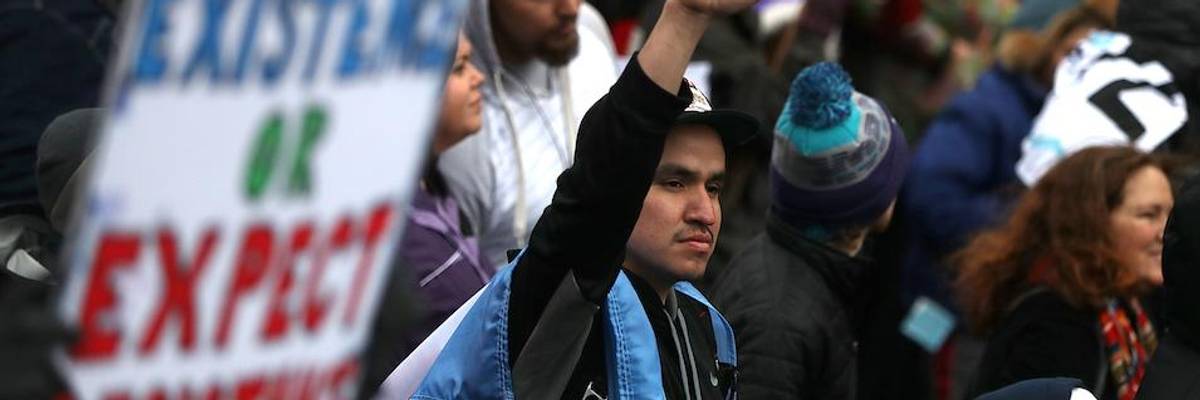
Protesters march during a demonstration against the Dakota Access Pipeline on March 10, 2017 in Washington, D.C. (Photo: Justin Sullivan/Getty Images)
A Louisiana lawsuit filed Wednesday aimed at laws targeting pipeline protesters is the latest front in a battle over freedom of speech and environmentally damaging infrastructure projects.
"As more of these laws begin to appear (and pass!), more environmentalists are taking a stand. They must."
--Yessenia Funes
Reporting from The Intercept, details how three states--Texas, Louisiana, and South Dakota--are facing or, in the case of Texas, will face, lawsuits challenging the anti-protest laws.
Civil rights activists argue that the effect of the laws is to tamp down protest, an unconstitutional attack on free speech. In Texas, as Common Dreams reported earlier this month, both the state House and Senate passed versions of a bill that would make interfering with public infrastructure like pipelines a third degree felony--on par with attempted murder and indecent exposure to a child.
"It's hard to convince or even ask people with children to organize against pipelines if a mother will risk a felony," Jennifer Falcon, spokesperson for Texas-based organization Society of Native Nations, told The Intercept.
The laws all make it a felony to trespass on property defined as "critical infrastructure," an amorphous term that can be used broadly to imprison people fighting against planet-killing pipeline projects.
Texans will have to wait for the state's law to be used to charge someone before challenging the rule, lawyers told the Society of Native Nations. But other states are already seeing the effects of harsh, anti-protester legislation.
Louisiana's law, according to The Center For Constitutional Rights, added an amendment written by lobbying group Louisiana Mid-Continent Oil and Gas Association (LMOGA) which is "so vague, overly broad, and sweeping in scope that people in the state cannot be sure of where in the vicinity of Louisiana's vast 125,000-mile network of pipelines they can legally be present, who decides where they can be present, or what conduct is prohibited that can subject them to up to five years in prison, with or without hard labor."
"This law was designed, really, to intimidate us," said Anne White Hat, an activist with the Indigenous Women's Council of the L'eau Est La Vie Camp who faces 10 years in prison in Louisiana for protesting in Louisiana under the law.
The Center filed a lawsuit against the vague and unconstitutional law Wednesday.
The ACLU filed a suit March 28 in South Dakota that aims to push back against state laws there that give the state "the authority to sue any individual or organization for 'riot-boosting,' or encouraging a protest where acts of violence occur."
Per the ACLU suit:
By equating peaceful organization and support of protest with "riot boosting" and incitement to riot, the plaintiffs' ability to speak out against the Keystone XL Pipeline is stifled. The Riot Boosting Act unconstitutionally targets protected speech, which cannot be properly characterized as incitement to violence or speech incident to criminal conduct, and threatens liability on speakers regardless of their intent or likelihood that violence will occur.
"The response of the government to protest ought to be engaging on the issue, listening to the concerns of the people that are speaking out, and trying to respect and work with them," ACLU lawyer Vera Eidelman said, "not stifle First Amendment rights."
The lawsuits are part of a broader struggle, said Earth3r staff writer Yessenia Funes.
"As more of these laws begin to appear (and pass!), more environmentalists are taking a stand," wrote Funes. "They must. As climate change charges up hurricanes and fuels rainstorms, many feel they have no other choice."
Dear Common Dreams reader, It’s been nearly 30 years since I co-founded Common Dreams with my late wife, Lina Newhouser. We had the radical notion that journalism should serve the public good, not corporate profits. It was clear to us from the outset what it would take to build such a project. No paid advertisements. No corporate sponsors. No millionaire publisher telling us what to think or do. Many people said we wouldn't last a year, but we proved those doubters wrong. Together with a tremendous team of journalists and dedicated staff, we built an independent media outlet free from the constraints of profits and corporate control. Our mission has always been simple: To inform. To inspire. To ignite change for the common good. Building Common Dreams was not easy. Our survival was never guaranteed. When you take on the most powerful forces—Wall Street greed, fossil fuel industry destruction, Big Tech lobbyists, and uber-rich oligarchs who have spent billions upon billions rigging the economy and democracy in their favor—the only bulwark you have is supporters who believe in your work. But here’s the urgent message from me today. It's never been this bad out there. And it's never been this hard to keep us going. At the very moment Common Dreams is most needed, the threats we face are intensifying. We need your support now more than ever. We don't accept corporate advertising and never will. We don't have a paywall because we don't think people should be blocked from critical news based on their ability to pay. Everything we do is funded by the donations of readers like you. When everyone does the little they can afford, we are strong. But if that support retreats or dries up, so do we. Will you donate now to make sure Common Dreams not only survives but thrives? —Craig Brown, Co-founder |
A Louisiana lawsuit filed Wednesday aimed at laws targeting pipeline protesters is the latest front in a battle over freedom of speech and environmentally damaging infrastructure projects.
"As more of these laws begin to appear (and pass!), more environmentalists are taking a stand. They must."
--Yessenia Funes
Reporting from The Intercept, details how three states--Texas, Louisiana, and South Dakota--are facing or, in the case of Texas, will face, lawsuits challenging the anti-protest laws.
Civil rights activists argue that the effect of the laws is to tamp down protest, an unconstitutional attack on free speech. In Texas, as Common Dreams reported earlier this month, both the state House and Senate passed versions of a bill that would make interfering with public infrastructure like pipelines a third degree felony--on par with attempted murder and indecent exposure to a child.
"It's hard to convince or even ask people with children to organize against pipelines if a mother will risk a felony," Jennifer Falcon, spokesperson for Texas-based organization Society of Native Nations, told The Intercept.
The laws all make it a felony to trespass on property defined as "critical infrastructure," an amorphous term that can be used broadly to imprison people fighting against planet-killing pipeline projects.
Texans will have to wait for the state's law to be used to charge someone before challenging the rule, lawyers told the Society of Native Nations. But other states are already seeing the effects of harsh, anti-protester legislation.
Louisiana's law, according to The Center For Constitutional Rights, added an amendment written by lobbying group Louisiana Mid-Continent Oil and Gas Association (LMOGA) which is "so vague, overly broad, and sweeping in scope that people in the state cannot be sure of where in the vicinity of Louisiana's vast 125,000-mile network of pipelines they can legally be present, who decides where they can be present, or what conduct is prohibited that can subject them to up to five years in prison, with or without hard labor."
"This law was designed, really, to intimidate us," said Anne White Hat, an activist with the Indigenous Women's Council of the L'eau Est La Vie Camp who faces 10 years in prison in Louisiana for protesting in Louisiana under the law.
The Center filed a lawsuit against the vague and unconstitutional law Wednesday.
The ACLU filed a suit March 28 in South Dakota that aims to push back against state laws there that give the state "the authority to sue any individual or organization for 'riot-boosting,' or encouraging a protest where acts of violence occur."
Per the ACLU suit:
By equating peaceful organization and support of protest with "riot boosting" and incitement to riot, the plaintiffs' ability to speak out against the Keystone XL Pipeline is stifled. The Riot Boosting Act unconstitutionally targets protected speech, which cannot be properly characterized as incitement to violence or speech incident to criminal conduct, and threatens liability on speakers regardless of their intent or likelihood that violence will occur.
"The response of the government to protest ought to be engaging on the issue, listening to the concerns of the people that are speaking out, and trying to respect and work with them," ACLU lawyer Vera Eidelman said, "not stifle First Amendment rights."
The lawsuits are part of a broader struggle, said Earth3r staff writer Yessenia Funes.
"As more of these laws begin to appear (and pass!), more environmentalists are taking a stand," wrote Funes. "They must. As climate change charges up hurricanes and fuels rainstorms, many feel they have no other choice."
A Louisiana lawsuit filed Wednesday aimed at laws targeting pipeline protesters is the latest front in a battle over freedom of speech and environmentally damaging infrastructure projects.
"As more of these laws begin to appear (and pass!), more environmentalists are taking a stand. They must."
--Yessenia Funes
Reporting from The Intercept, details how three states--Texas, Louisiana, and South Dakota--are facing or, in the case of Texas, will face, lawsuits challenging the anti-protest laws.
Civil rights activists argue that the effect of the laws is to tamp down protest, an unconstitutional attack on free speech. In Texas, as Common Dreams reported earlier this month, both the state House and Senate passed versions of a bill that would make interfering with public infrastructure like pipelines a third degree felony--on par with attempted murder and indecent exposure to a child.
"It's hard to convince or even ask people with children to organize against pipelines if a mother will risk a felony," Jennifer Falcon, spokesperson for Texas-based organization Society of Native Nations, told The Intercept.
The laws all make it a felony to trespass on property defined as "critical infrastructure," an amorphous term that can be used broadly to imprison people fighting against planet-killing pipeline projects.
Texans will have to wait for the state's law to be used to charge someone before challenging the rule, lawyers told the Society of Native Nations. But other states are already seeing the effects of harsh, anti-protester legislation.
Louisiana's law, according to The Center For Constitutional Rights, added an amendment written by lobbying group Louisiana Mid-Continent Oil and Gas Association (LMOGA) which is "so vague, overly broad, and sweeping in scope that people in the state cannot be sure of where in the vicinity of Louisiana's vast 125,000-mile network of pipelines they can legally be present, who decides where they can be present, or what conduct is prohibited that can subject them to up to five years in prison, with or without hard labor."
"This law was designed, really, to intimidate us," said Anne White Hat, an activist with the Indigenous Women's Council of the L'eau Est La Vie Camp who faces 10 years in prison in Louisiana for protesting in Louisiana under the law.
The Center filed a lawsuit against the vague and unconstitutional law Wednesday.
The ACLU filed a suit March 28 in South Dakota that aims to push back against state laws there that give the state "the authority to sue any individual or organization for 'riot-boosting,' or encouraging a protest where acts of violence occur."
Per the ACLU suit:
By equating peaceful organization and support of protest with "riot boosting" and incitement to riot, the plaintiffs' ability to speak out against the Keystone XL Pipeline is stifled. The Riot Boosting Act unconstitutionally targets protected speech, which cannot be properly characterized as incitement to violence or speech incident to criminal conduct, and threatens liability on speakers regardless of their intent or likelihood that violence will occur.
"The response of the government to protest ought to be engaging on the issue, listening to the concerns of the people that are speaking out, and trying to respect and work with them," ACLU lawyer Vera Eidelman said, "not stifle First Amendment rights."
The lawsuits are part of a broader struggle, said Earth3r staff writer Yessenia Funes.
"As more of these laws begin to appear (and pass!), more environmentalists are taking a stand," wrote Funes. "They must. As climate change charges up hurricanes and fuels rainstorms, many feel they have no other choice."

