SUBSCRIBE TO OUR FREE NEWSLETTER
Daily news & progressive opinion—funded by the people, not the corporations—delivered straight to your inbox.
5
#000000
#FFFFFF
To donate by check, phone, or other method, see our More Ways to Give page.
Daily news & progressive opinion—funded by the people, not the corporations—delivered straight to your inbox.
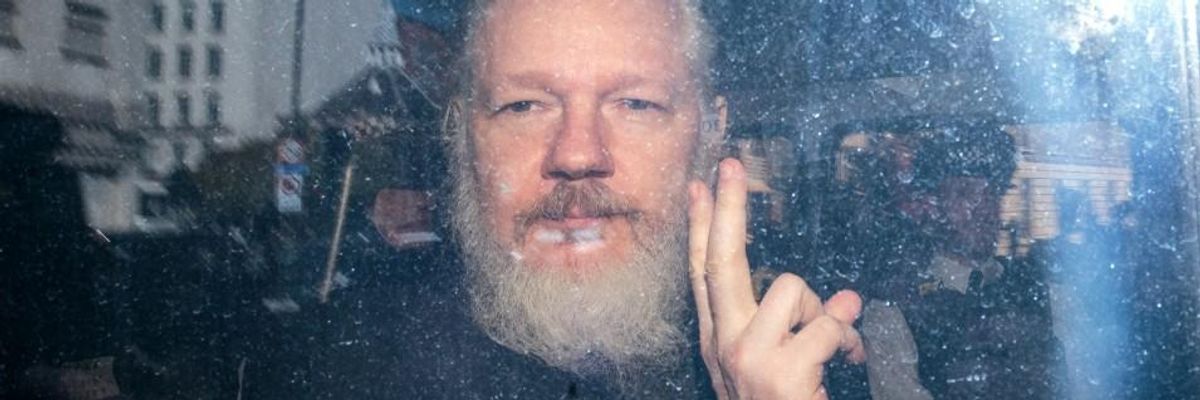
"This is not about Julian Assange. This is about the use of the Espionage Act to charge a recipient and publisher of classified information." (Photo: Jack Taylor/Getty Images)
Though many Democrats have so far remained silent, Sens. Elizabeth Warren, Ron Wyden, and Bernie Sanders are among the few high-profile party members to join free press advocates in condemning Espionage charges against Wikileaks publisher Julian Assange.
The political and journalism worlds reacted to the Trump administration's decision Thursday to charge Assange with 17 counts of violating the Espionage Act with concern for those celebrating the prosecution and dismay over those remaining silent on the issue.
"Espionage charges against Assange are a threat to press freedom."
--Karen vanden Heuvel
Assange was indicted by a federal grand jury Thursday. The charges are seen by many proponents of press freedom on both the right and the left as part of an effort from the White House to criminalize dissent by journalism and to produce a chilling effect on reporters exposing classified documents that the government would prefer remain hidden.
Despite the unpopularity of the Trump administration among Democrats, however, at press time only three members of the party's congressional delegation has spoken up: Wyden, of Oregon; Warren, of Massachusetts; and Independent Sanders of Vermont.
In a statement, Wyden said that he was "extremely concerned about the precedent this may set and potential dangers to the work of journalists and the First Amendment."
"This is not about Julian Assange," said Wyden. "This is about the use of the Espionage Act to charge a recipient and publisher of classified information."
"Let me be clear: it is a disturbing attack on the First Amendment for the Trump administration to decide who is or is not a reporter for the purposes of a criminal prosecution," Sanders said in a tweet Friday. "Donald Trump must obey the Constitution, which protects the publication of news about our government."
Warren, in a statement sent to The Intercept, differentiated between Assange and the free press.
"Assange is a bad actor who has harmed U.S. national security -- and he should be held accountable," said Warren. "But Trump should not be using this case as a pretext to wage war on the First Amendment and go after the free press who hold the powerful accountable everyday."
Critics of Assange have claimed that the Wikileaks founder is not a journalist, so his "crimes" are not applicable to journalists and journalism as a whole. But, as Knight First Amendment Institute staff attorney Carrie DeCell pointed out in a twitter thread, that's not the case.
"The government argues that Assange violated the Espionage Act by soliciting, obtaining, and then publishing classified information," DeCell tweeted. "That's exactly what good national security and investigative journalists do every day."
Further, as The Atlantic's Adam Serwer said in a series of tweets, anyone rejoicing over Assange's indictments is missing the forest for the trees.
"Some of you are so eager to punish Assange for helping Trump that you're willing to hand Trump a tool for prosecuting the reporters exposing his corruption," said Serwer. "That's plainly idiotic."
"Please stop and think," Serwer added. "If publishing classified information is prosecutable, than any outlet that does so can be prosecuted."
Margaret Kimberley, "Freedom Rider" columnist for Black Agenda Report, pointed to a case in France where journalists are being called in for questioning for publishing classified materials as part of the same story.
"This will happen more and more in the wake of the persecution of Julian Assange," said Kimberley.
In a column at The Intercept, journalist James Risen put the indictment into context.
"If the government gets to decide what constitutes journalism," Risen wrote, "what's to stop it from making similar rulings about any outlet whose coverage it doesn't like?"
The Nation editor and publisher Katrina vanden Heuvel made the stakes clear in a tweet.
"Espionage charges against Assange are a threat to press freedom," said vanden Heuvel.
Assange also got support from The Washington Post's executive editor, Marty Baron. In a statement, Baron said that the Trump administration was making a jump from hostility to the press to criminalizing journalism.
"With this new indictment of Julian Assange," said Baron, "the government is advancing a legal argument that places such important work in jeopardy."
Baron was joined in his denunciation of the indictment by the editors of The New York Times and The Wall Street Journal.
Times executive editor Dean Baquet said in a statement the government was threatening a "basic tenet of press freedom."
"Obtaining and publishing information that the government would prefer to keep secret is vital to journalism and democracy," said Baquet. "The new indictment is a deeply troubling step toward giving the government greater control over what Americans are allowed to know."
While Wall Street Journal editor-in-chief Matt Murray wasn't inclined to discuss the specific details of the Assange case, he did, in a statement to the Daily Beast, decry "the deeply troubling implications for traditional journalism and freedom of the press in this country."
"The right to publish uncomfortable, important information that the government would prefer to be kept secret is central to a truly free press," said Murray.
In a statement, the Committee to Protect Journalists executive director Joel Simon said that the charges were "an attack on the First Amendment and a threat to all journalists everywhere who publish information that governments would like to keep secret."
"Press freedom in the United States and around the world is imperiled by this prosecution," Simon said.
It's unclear if the indictments will help or hurt the U.S. case for extradition. Assange is being held in U.K. jail awaiting a hearing--and, as The Intercept's Robert Mackey wrote in a column Friday, the charges may make it difficult for American officials to make a clear argument for Assange's transfer to the U.S.
The uproar could make it easier for Assange's lawyers in the U.K. -- where he is currently serving a 50-week jail term for violating bail -- to argue that he is wanted in the United States primarily for embarrassing the Pentagon and State Department, by publishing true information obtained from a whistleblower, making the charges against him political in nature, rather than criminal.
However, as journalist Freke Vujst said on Twitter, that might be the plan--maybe the U.S. doesn't want to try Assange but instead wants to use his case to intimidate other journalists.
"Why did they not stick with its more limited first indictment?" wondered Vujst. "Could it be because US does not really want to put Assange before a US court of law?"
Dear Common Dreams reader, It’s been nearly 30 years since I co-founded Common Dreams with my late wife, Lina Newhouser. We had the radical notion that journalism should serve the public good, not corporate profits. It was clear to us from the outset what it would take to build such a project. No paid advertisements. No corporate sponsors. No millionaire publisher telling us what to think or do. Many people said we wouldn't last a year, but we proved those doubters wrong. Together with a tremendous team of journalists and dedicated staff, we built an independent media outlet free from the constraints of profits and corporate control. Our mission has always been simple: To inform. To inspire. To ignite change for the common good. Building Common Dreams was not easy. Our survival was never guaranteed. When you take on the most powerful forces—Wall Street greed, fossil fuel industry destruction, Big Tech lobbyists, and uber-rich oligarchs who have spent billions upon billions rigging the economy and democracy in their favor—the only bulwark you have is supporters who believe in your work. But here’s the urgent message from me today. It's never been this bad out there. And it's never been this hard to keep us going. At the very moment Common Dreams is most needed, the threats we face are intensifying. We need your support now more than ever. We don't accept corporate advertising and never will. We don't have a paywall because we don't think people should be blocked from critical news based on their ability to pay. Everything we do is funded by the donations of readers like you. When everyone does the little they can afford, we are strong. But if that support retreats or dries up, so do we. Will you donate now to make sure Common Dreams not only survives but thrives? —Craig Brown, Co-founder |
Though many Democrats have so far remained silent, Sens. Elizabeth Warren, Ron Wyden, and Bernie Sanders are among the few high-profile party members to join free press advocates in condemning Espionage charges against Wikileaks publisher Julian Assange.
The political and journalism worlds reacted to the Trump administration's decision Thursday to charge Assange with 17 counts of violating the Espionage Act with concern for those celebrating the prosecution and dismay over those remaining silent on the issue.
"Espionage charges against Assange are a threat to press freedom."
--Karen vanden Heuvel
Assange was indicted by a federal grand jury Thursday. The charges are seen by many proponents of press freedom on both the right and the left as part of an effort from the White House to criminalize dissent by journalism and to produce a chilling effect on reporters exposing classified documents that the government would prefer remain hidden.
Despite the unpopularity of the Trump administration among Democrats, however, at press time only three members of the party's congressional delegation has spoken up: Wyden, of Oregon; Warren, of Massachusetts; and Independent Sanders of Vermont.
In a statement, Wyden said that he was "extremely concerned about the precedent this may set and potential dangers to the work of journalists and the First Amendment."
"This is not about Julian Assange," said Wyden. "This is about the use of the Espionage Act to charge a recipient and publisher of classified information."
"Let me be clear: it is a disturbing attack on the First Amendment for the Trump administration to decide who is or is not a reporter for the purposes of a criminal prosecution," Sanders said in a tweet Friday. "Donald Trump must obey the Constitution, which protects the publication of news about our government."
Warren, in a statement sent to The Intercept, differentiated between Assange and the free press.
"Assange is a bad actor who has harmed U.S. national security -- and he should be held accountable," said Warren. "But Trump should not be using this case as a pretext to wage war on the First Amendment and go after the free press who hold the powerful accountable everyday."
Critics of Assange have claimed that the Wikileaks founder is not a journalist, so his "crimes" are not applicable to journalists and journalism as a whole. But, as Knight First Amendment Institute staff attorney Carrie DeCell pointed out in a twitter thread, that's not the case.
"The government argues that Assange violated the Espionage Act by soliciting, obtaining, and then publishing classified information," DeCell tweeted. "That's exactly what good national security and investigative journalists do every day."
Further, as The Atlantic's Adam Serwer said in a series of tweets, anyone rejoicing over Assange's indictments is missing the forest for the trees.
"Some of you are so eager to punish Assange for helping Trump that you're willing to hand Trump a tool for prosecuting the reporters exposing his corruption," said Serwer. "That's plainly idiotic."
"Please stop and think," Serwer added. "If publishing classified information is prosecutable, than any outlet that does so can be prosecuted."
Margaret Kimberley, "Freedom Rider" columnist for Black Agenda Report, pointed to a case in France where journalists are being called in for questioning for publishing classified materials as part of the same story.
"This will happen more and more in the wake of the persecution of Julian Assange," said Kimberley.
In a column at The Intercept, journalist James Risen put the indictment into context.
"If the government gets to decide what constitutes journalism," Risen wrote, "what's to stop it from making similar rulings about any outlet whose coverage it doesn't like?"
The Nation editor and publisher Katrina vanden Heuvel made the stakes clear in a tweet.
"Espionage charges against Assange are a threat to press freedom," said vanden Heuvel.
Assange also got support from The Washington Post's executive editor, Marty Baron. In a statement, Baron said that the Trump administration was making a jump from hostility to the press to criminalizing journalism.
"With this new indictment of Julian Assange," said Baron, "the government is advancing a legal argument that places such important work in jeopardy."
Baron was joined in his denunciation of the indictment by the editors of The New York Times and The Wall Street Journal.
Times executive editor Dean Baquet said in a statement the government was threatening a "basic tenet of press freedom."
"Obtaining and publishing information that the government would prefer to keep secret is vital to journalism and democracy," said Baquet. "The new indictment is a deeply troubling step toward giving the government greater control over what Americans are allowed to know."
While Wall Street Journal editor-in-chief Matt Murray wasn't inclined to discuss the specific details of the Assange case, he did, in a statement to the Daily Beast, decry "the deeply troubling implications for traditional journalism and freedom of the press in this country."
"The right to publish uncomfortable, important information that the government would prefer to be kept secret is central to a truly free press," said Murray.
In a statement, the Committee to Protect Journalists executive director Joel Simon said that the charges were "an attack on the First Amendment and a threat to all journalists everywhere who publish information that governments would like to keep secret."
"Press freedom in the United States and around the world is imperiled by this prosecution," Simon said.
It's unclear if the indictments will help or hurt the U.S. case for extradition. Assange is being held in U.K. jail awaiting a hearing--and, as The Intercept's Robert Mackey wrote in a column Friday, the charges may make it difficult for American officials to make a clear argument for Assange's transfer to the U.S.
The uproar could make it easier for Assange's lawyers in the U.K. -- where he is currently serving a 50-week jail term for violating bail -- to argue that he is wanted in the United States primarily for embarrassing the Pentagon and State Department, by publishing true information obtained from a whistleblower, making the charges against him political in nature, rather than criminal.
However, as journalist Freke Vujst said on Twitter, that might be the plan--maybe the U.S. doesn't want to try Assange but instead wants to use his case to intimidate other journalists.
"Why did they not stick with its more limited first indictment?" wondered Vujst. "Could it be because US does not really want to put Assange before a US court of law?"
Though many Democrats have so far remained silent, Sens. Elizabeth Warren, Ron Wyden, and Bernie Sanders are among the few high-profile party members to join free press advocates in condemning Espionage charges against Wikileaks publisher Julian Assange.
The political and journalism worlds reacted to the Trump administration's decision Thursday to charge Assange with 17 counts of violating the Espionage Act with concern for those celebrating the prosecution and dismay over those remaining silent on the issue.
"Espionage charges against Assange are a threat to press freedom."
--Karen vanden Heuvel
Assange was indicted by a federal grand jury Thursday. The charges are seen by many proponents of press freedom on both the right and the left as part of an effort from the White House to criminalize dissent by journalism and to produce a chilling effect on reporters exposing classified documents that the government would prefer remain hidden.
Despite the unpopularity of the Trump administration among Democrats, however, at press time only three members of the party's congressional delegation has spoken up: Wyden, of Oregon; Warren, of Massachusetts; and Independent Sanders of Vermont.
In a statement, Wyden said that he was "extremely concerned about the precedent this may set and potential dangers to the work of journalists and the First Amendment."
"This is not about Julian Assange," said Wyden. "This is about the use of the Espionage Act to charge a recipient and publisher of classified information."
"Let me be clear: it is a disturbing attack on the First Amendment for the Trump administration to decide who is or is not a reporter for the purposes of a criminal prosecution," Sanders said in a tweet Friday. "Donald Trump must obey the Constitution, which protects the publication of news about our government."
Warren, in a statement sent to The Intercept, differentiated between Assange and the free press.
"Assange is a bad actor who has harmed U.S. national security -- and he should be held accountable," said Warren. "But Trump should not be using this case as a pretext to wage war on the First Amendment and go after the free press who hold the powerful accountable everyday."
Critics of Assange have claimed that the Wikileaks founder is not a journalist, so his "crimes" are not applicable to journalists and journalism as a whole. But, as Knight First Amendment Institute staff attorney Carrie DeCell pointed out in a twitter thread, that's not the case.
"The government argues that Assange violated the Espionage Act by soliciting, obtaining, and then publishing classified information," DeCell tweeted. "That's exactly what good national security and investigative journalists do every day."
Further, as The Atlantic's Adam Serwer said in a series of tweets, anyone rejoicing over Assange's indictments is missing the forest for the trees.
"Some of you are so eager to punish Assange for helping Trump that you're willing to hand Trump a tool for prosecuting the reporters exposing his corruption," said Serwer. "That's plainly idiotic."
"Please stop and think," Serwer added. "If publishing classified information is prosecutable, than any outlet that does so can be prosecuted."
Margaret Kimberley, "Freedom Rider" columnist for Black Agenda Report, pointed to a case in France where journalists are being called in for questioning for publishing classified materials as part of the same story.
"This will happen more and more in the wake of the persecution of Julian Assange," said Kimberley.
In a column at The Intercept, journalist James Risen put the indictment into context.
"If the government gets to decide what constitutes journalism," Risen wrote, "what's to stop it from making similar rulings about any outlet whose coverage it doesn't like?"
The Nation editor and publisher Katrina vanden Heuvel made the stakes clear in a tweet.
"Espionage charges against Assange are a threat to press freedom," said vanden Heuvel.
Assange also got support from The Washington Post's executive editor, Marty Baron. In a statement, Baron said that the Trump administration was making a jump from hostility to the press to criminalizing journalism.
"With this new indictment of Julian Assange," said Baron, "the government is advancing a legal argument that places such important work in jeopardy."
Baron was joined in his denunciation of the indictment by the editors of The New York Times and The Wall Street Journal.
Times executive editor Dean Baquet said in a statement the government was threatening a "basic tenet of press freedom."
"Obtaining and publishing information that the government would prefer to keep secret is vital to journalism and democracy," said Baquet. "The new indictment is a deeply troubling step toward giving the government greater control over what Americans are allowed to know."
While Wall Street Journal editor-in-chief Matt Murray wasn't inclined to discuss the specific details of the Assange case, he did, in a statement to the Daily Beast, decry "the deeply troubling implications for traditional journalism and freedom of the press in this country."
"The right to publish uncomfortable, important information that the government would prefer to be kept secret is central to a truly free press," said Murray.
In a statement, the Committee to Protect Journalists executive director Joel Simon said that the charges were "an attack on the First Amendment and a threat to all journalists everywhere who publish information that governments would like to keep secret."
"Press freedom in the United States and around the world is imperiled by this prosecution," Simon said.
It's unclear if the indictments will help or hurt the U.S. case for extradition. Assange is being held in U.K. jail awaiting a hearing--and, as The Intercept's Robert Mackey wrote in a column Friday, the charges may make it difficult for American officials to make a clear argument for Assange's transfer to the U.S.
The uproar could make it easier for Assange's lawyers in the U.K. -- where he is currently serving a 50-week jail term for violating bail -- to argue that he is wanted in the United States primarily for embarrassing the Pentagon and State Department, by publishing true information obtained from a whistleblower, making the charges against him political in nature, rather than criminal.
However, as journalist Freke Vujst said on Twitter, that might be the plan--maybe the U.S. doesn't want to try Assange but instead wants to use his case to intimidate other journalists.
"Why did they not stick with its more limited first indictment?" wondered Vujst. "Could it be because US does not really want to put Assange before a US court of law?"