SUBSCRIBE TO OUR FREE NEWSLETTER
Daily news & progressive opinion—funded by the people, not the corporations—delivered straight to your inbox.
5
#000000
#FFFFFF
To donate by check, phone, or other method, see our More Ways to Give page.
Daily news & progressive opinion—funded by the people, not the corporations—delivered straight to your inbox.
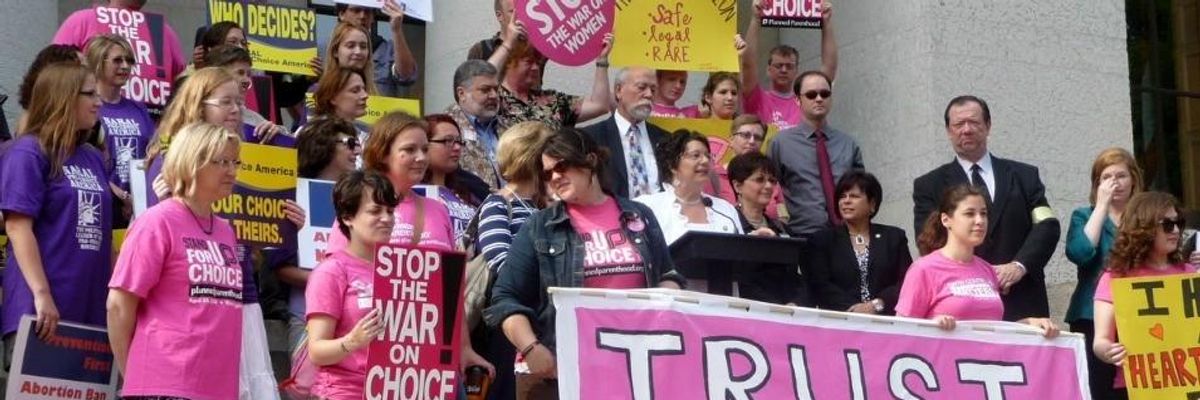
The U.S. Supreme Court upheld a law passed in Indiana requiring abortion providers to bury or cremate fetal remains, a measure that pro-choice groups have denounced as extreme. (Photo: ProgressOhio/Flickr/cc)
Pro-choice groups called a U.S. Supreme Court decision on a restrictive abortion law a "mixed ruling" on Tuesday, expressing relief that the court did not rule on whether women should be permitted abortion care in certain situations but decrying the ruling's overall message about women's right to choose abortion.
In a 7-2 ruling, the court upheld part of an Indiana law--signed by then-Gov. Mike Pence in 2016--which requires abortion providers to cremate or bury fetal remains instead of disposing of them in medical offices with other medical waste. Justices Ruth Bader Ginsburg and Sonia Sotomayor dissented.
NARAL Pro-Choice America argued Tuesday that the law has no legitimate purpose, a point the U.S. Seventh Circuit Court of Appeals had made in an earlier ruling. Forcing medical providers to add another step to obtaining abortion care creates a new barrier for women, NARAL said.
"This law does absolutely nothing to improve healthcare," the group tweeted. "It's meant to shame women and cut off access by driving up the costs of an abortion procedure."
Lawyer Amee Vanderpool wrote on Twitter that the ruling "gives credence to another argument down the road that a fetus has rights similar to a living human," and could threaten Roe v. Wade.
The court declined to hand down a decision on another portion of the fetal remains law, which would prohibit women in Indiana from obtaining abortions in certain situations, including to terminate a pregnancy because of fetal abnormalities.
The court "expresses no view on the merits" of the issue, the ruling reads, of "whether Indiana may prohibit the knowing provision of sex-, race-, and disability-selective abortions by abortion providers."
But, Justice Clarence Thomas, wrote in a 20-page opinion, the court "will soon need to confront the constitutionality of a law like Indiana's" due to what he saw as "the potential for abortion to become a tool of eugenic manipulation."
Thomas's opinion along with the court's decision to uphold the fetal remains law amounted to "a rhetorical assault against women who get abortions," wrote lawyer and journalist Mark Joseph Stern.
The ACLU applauded the high court's decision not to rule on situations in which women in Indiana should be denied the right to abortion care, but called the decision a "mixed ruling.
The court, ACLU Reproductive Freedom Project director Jennifer Dalven said, "let another unwarranted restriction on abortion stand."
"While the ruling is limited, the law is part of a larger trend of state laws designed to stigmatize and drive abortion care of out of reach," said Dalven.
Dear Common Dreams reader, It’s been nearly 30 years since I co-founded Common Dreams with my late wife, Lina Newhouser. We had the radical notion that journalism should serve the public good, not corporate profits. It was clear to us from the outset what it would take to build such a project. No paid advertisements. No corporate sponsors. No millionaire publisher telling us what to think or do. Many people said we wouldn't last a year, but we proved those doubters wrong. Together with a tremendous team of journalists and dedicated staff, we built an independent media outlet free from the constraints of profits and corporate control. Our mission has always been simple: To inform. To inspire. To ignite change for the common good. Building Common Dreams was not easy. Our survival was never guaranteed. When you take on the most powerful forces—Wall Street greed, fossil fuel industry destruction, Big Tech lobbyists, and uber-rich oligarchs who have spent billions upon billions rigging the economy and democracy in their favor—the only bulwark you have is supporters who believe in your work. But here’s the urgent message from me today. It's never been this bad out there. And it's never been this hard to keep us going. At the very moment Common Dreams is most needed, the threats we face are intensifying. We need your support now more than ever. We don't accept corporate advertising and never will. We don't have a paywall because we don't think people should be blocked from critical news based on their ability to pay. Everything we do is funded by the donations of readers like you. When everyone does the little they can afford, we are strong. But if that support retreats or dries up, so do we. Will you donate now to make sure Common Dreams not only survives but thrives? —Craig Brown, Co-founder |
Pro-choice groups called a U.S. Supreme Court decision on a restrictive abortion law a "mixed ruling" on Tuesday, expressing relief that the court did not rule on whether women should be permitted abortion care in certain situations but decrying the ruling's overall message about women's right to choose abortion.
In a 7-2 ruling, the court upheld part of an Indiana law--signed by then-Gov. Mike Pence in 2016--which requires abortion providers to cremate or bury fetal remains instead of disposing of them in medical offices with other medical waste. Justices Ruth Bader Ginsburg and Sonia Sotomayor dissented.
NARAL Pro-Choice America argued Tuesday that the law has no legitimate purpose, a point the U.S. Seventh Circuit Court of Appeals had made in an earlier ruling. Forcing medical providers to add another step to obtaining abortion care creates a new barrier for women, NARAL said.
"This law does absolutely nothing to improve healthcare," the group tweeted. "It's meant to shame women and cut off access by driving up the costs of an abortion procedure."
Lawyer Amee Vanderpool wrote on Twitter that the ruling "gives credence to another argument down the road that a fetus has rights similar to a living human," and could threaten Roe v. Wade.
The court declined to hand down a decision on another portion of the fetal remains law, which would prohibit women in Indiana from obtaining abortions in certain situations, including to terminate a pregnancy because of fetal abnormalities.
The court "expresses no view on the merits" of the issue, the ruling reads, of "whether Indiana may prohibit the knowing provision of sex-, race-, and disability-selective abortions by abortion providers."
But, Justice Clarence Thomas, wrote in a 20-page opinion, the court "will soon need to confront the constitutionality of a law like Indiana's" due to what he saw as "the potential for abortion to become a tool of eugenic manipulation."
Thomas's opinion along with the court's decision to uphold the fetal remains law amounted to "a rhetorical assault against women who get abortions," wrote lawyer and journalist Mark Joseph Stern.
The ACLU applauded the high court's decision not to rule on situations in which women in Indiana should be denied the right to abortion care, but called the decision a "mixed ruling.
The court, ACLU Reproductive Freedom Project director Jennifer Dalven said, "let another unwarranted restriction on abortion stand."
"While the ruling is limited, the law is part of a larger trend of state laws designed to stigmatize and drive abortion care of out of reach," said Dalven.
Pro-choice groups called a U.S. Supreme Court decision on a restrictive abortion law a "mixed ruling" on Tuesday, expressing relief that the court did not rule on whether women should be permitted abortion care in certain situations but decrying the ruling's overall message about women's right to choose abortion.
In a 7-2 ruling, the court upheld part of an Indiana law--signed by then-Gov. Mike Pence in 2016--which requires abortion providers to cremate or bury fetal remains instead of disposing of them in medical offices with other medical waste. Justices Ruth Bader Ginsburg and Sonia Sotomayor dissented.
NARAL Pro-Choice America argued Tuesday that the law has no legitimate purpose, a point the U.S. Seventh Circuit Court of Appeals had made in an earlier ruling. Forcing medical providers to add another step to obtaining abortion care creates a new barrier for women, NARAL said.
"This law does absolutely nothing to improve healthcare," the group tweeted. "It's meant to shame women and cut off access by driving up the costs of an abortion procedure."
Lawyer Amee Vanderpool wrote on Twitter that the ruling "gives credence to another argument down the road that a fetus has rights similar to a living human," and could threaten Roe v. Wade.
The court declined to hand down a decision on another portion of the fetal remains law, which would prohibit women in Indiana from obtaining abortions in certain situations, including to terminate a pregnancy because of fetal abnormalities.
The court "expresses no view on the merits" of the issue, the ruling reads, of "whether Indiana may prohibit the knowing provision of sex-, race-, and disability-selective abortions by abortion providers."
But, Justice Clarence Thomas, wrote in a 20-page opinion, the court "will soon need to confront the constitutionality of a law like Indiana's" due to what he saw as "the potential for abortion to become a tool of eugenic manipulation."
Thomas's opinion along with the court's decision to uphold the fetal remains law amounted to "a rhetorical assault against women who get abortions," wrote lawyer and journalist Mark Joseph Stern.
The ACLU applauded the high court's decision not to rule on situations in which women in Indiana should be denied the right to abortion care, but called the decision a "mixed ruling.
The court, ACLU Reproductive Freedom Project director Jennifer Dalven said, "let another unwarranted restriction on abortion stand."
"While the ruling is limited, the law is part of a larger trend of state laws designed to stigmatize and drive abortion care of out of reach," said Dalven.