SUBSCRIBE TO OUR FREE NEWSLETTER
Daily news & progressive opinion—funded by the people, not the corporations—delivered straight to your inbox.
5
#000000
#FFFFFF
To donate by check, phone, or other method, see our More Ways to Give page.
Daily news & progressive opinion—funded by the people, not the corporations—delivered straight to your inbox.
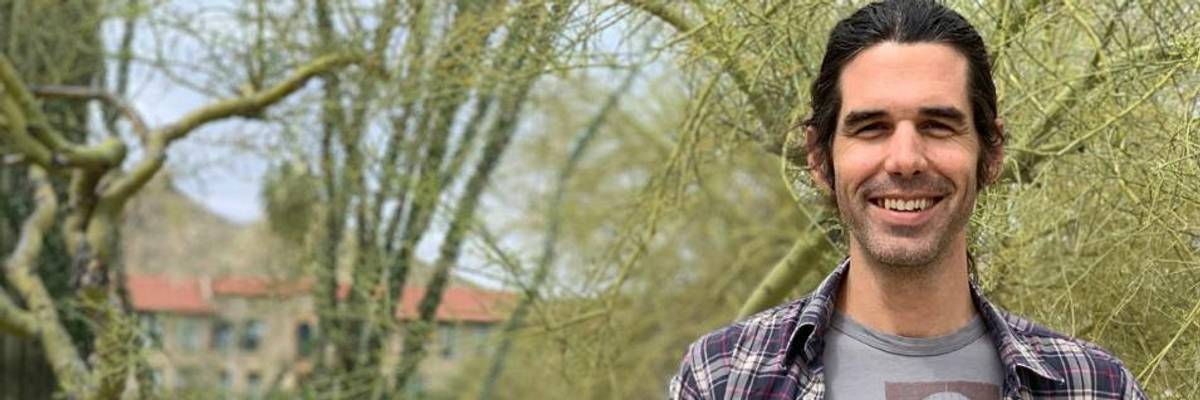
Scott Warren faces up to 20 years in prison for providing humanitarian aid to migrants in the Arizona desert. (Photo: Alli Jarrar/Amnesty International)
Human rights advocates accused the U.S. Justice Department of "criminalizing compassion" as a federal trial began in Arizona Wednesday for activist Scott Warren, who faces up to 20 years in prison for providing humanitarian aid to migrants in the desert.
Warren, a 36-year-old college geography instructor from Ajo, Arizona, is a volunteer for the humanitarian organization No More Deaths/No Mas Muertes, an official ministry of the Unitarian Universalist Church of Tucson. He was arrested by Border Patrol agents in 2018 and faces three felony counts for providing food, water, clean clothes, and beds to two migrants.
I'm back in Arizona today to attend the felony trial of Scott Warren, who faces up to 20 yrs. in prison for his humanitarian aid work.
Scott, the wider community of aid workers in the region & their efforts, became the focus for my latest film with @theintercept: https://t.co/8NK1QnSJ4Y
-- L Saunders (@_LSaunders_) May 29, 2019
Warren's parents, Pam and Mark, launched a MoveOn.org petition earlier this month calling on federal authorities to drop all charges, which has garnered nearly 130,000 signatures. Amnesty International issued that same demand on May 15, in an open letter to Michael Bailey, the U.S. attorney for the District of Arizona.
The charges against Warren "are an unjust criminalization of direct humanitarian assistance" and "appear to constitute a politically motivated violation of his protected rights as a Human Rights Defender," Amnesty International's Americas regional director Erika Guevara-Rosas wrote to Bailey.
"Providing humanitarian aid is never a crime," Guevara-Rosas added in a statement last week. "If Dr. Warren were convicted and imprisoned on these absurd charges, he would be a prisoner of conscience, detained for his volunteer activities motivated by humanitarian principles and his religious beliefs."
On the eve of the trial, Warren detailed his lifesaving work with No More Deaths in an op-ed for The Washington Post.
In the Sonoran Desert, the temperature can reach 120 degrees during the day and plummet at night. Water is scarce. Tighter border policies have forced migrants into harsher and more remote territory, and many who attempt to traverse this landscape don't survive. Along what's become known as the Ajo corridor, dozens of bodies are found each year; many more are assumed to be undiscovered.
Local residents and volunteers organize hikes into this desert to offer humanitarian aid. We haul jugs of water and buckets filled with canned food, socks, electrolytes, and basic first-aid supplies to a few sites along the mountain and canyon paths. Other times, we get a report that someone has gone missing, and our mission becomes search and rescue--or, more often, to recover the bodies and bones of those who have died.
According to Warren, the volunteers previously coexisted with Border Patrol agents, but those days are long gone.
In recent years, "government authorities have cracked down on humanitarian aid: denying permits to enter the Cabeza Prieta National Wildlife Refuge, and kicking over and slashing water jugs," he wrote. "They are also aggressively prosecuting volunteers."
Warren warned that "my case in particular may set a dangerous precedent, as the government expands its definitions of 'transportation' and 'harboring'" under federal law. In addition to humanitarian workers, there are worries such treatment could be applied to families with mixed citizenship status who provide for undocumented relatives.
"Though this possibility would have seemed far-fetched a few years ago, it has become frighteningly real," wrote Warren. "The Trump administration's policies--warehousing asylees, separating families, caging children--seek to impose hardship and cruelty. For this strategy to work, it must also stamp out kindness."
Amnesty's Guevara-Rosas, in her statement last week, noted that "the U.S. government is legally required to prevent the arbitrary deaths of migrants and asylum-seekers in border areas. Yet instead, authorities have willfully destroyed humanitarian aid provisions in deadly desert terrain and are criminally prosecuting humanitarian volunteers in order to deter them from saving lives."
In response to Warren's trial, she said that "the U.S. government should immediately adopt and implement exemptions from criminal prosecution under 'smuggling' and 'harboring' charges, for the provision of humanitarian aid."
The second paragraph of this post has been amended with the year Scott Warren was arrested.
Dear Common Dreams reader, It’s been nearly 30 years since I co-founded Common Dreams with my late wife, Lina Newhouser. We had the radical notion that journalism should serve the public good, not corporate profits. It was clear to us from the outset what it would take to build such a project. No paid advertisements. No corporate sponsors. No millionaire publisher telling us what to think or do. Many people said we wouldn't last a year, but we proved those doubters wrong. Together with a tremendous team of journalists and dedicated staff, we built an independent media outlet free from the constraints of profits and corporate control. Our mission has always been simple: To inform. To inspire. To ignite change for the common good. Building Common Dreams was not easy. Our survival was never guaranteed. When you take on the most powerful forces—Wall Street greed, fossil fuel industry destruction, Big Tech lobbyists, and uber-rich oligarchs who have spent billions upon billions rigging the economy and democracy in their favor—the only bulwark you have is supporters who believe in your work. But here’s the urgent message from me today. It's never been this bad out there. And it's never been this hard to keep us going. At the very moment Common Dreams is most needed, the threats we face are intensifying. We need your support now more than ever. We don't accept corporate advertising and never will. We don't have a paywall because we don't think people should be blocked from critical news based on their ability to pay. Everything we do is funded by the donations of readers like you. When everyone does the little they can afford, we are strong. But if that support retreats or dries up, so do we. Will you donate now to make sure Common Dreams not only survives but thrives? —Craig Brown, Co-founder |
Human rights advocates accused the U.S. Justice Department of "criminalizing compassion" as a federal trial began in Arizona Wednesday for activist Scott Warren, who faces up to 20 years in prison for providing humanitarian aid to migrants in the desert.
Warren, a 36-year-old college geography instructor from Ajo, Arizona, is a volunteer for the humanitarian organization No More Deaths/No Mas Muertes, an official ministry of the Unitarian Universalist Church of Tucson. He was arrested by Border Patrol agents in 2018 and faces three felony counts for providing food, water, clean clothes, and beds to two migrants.
I'm back in Arizona today to attend the felony trial of Scott Warren, who faces up to 20 yrs. in prison for his humanitarian aid work.
Scott, the wider community of aid workers in the region & their efforts, became the focus for my latest film with @theintercept: https://t.co/8NK1QnSJ4Y
-- L Saunders (@_LSaunders_) May 29, 2019
Warren's parents, Pam and Mark, launched a MoveOn.org petition earlier this month calling on federal authorities to drop all charges, which has garnered nearly 130,000 signatures. Amnesty International issued that same demand on May 15, in an open letter to Michael Bailey, the U.S. attorney for the District of Arizona.
The charges against Warren "are an unjust criminalization of direct humanitarian assistance" and "appear to constitute a politically motivated violation of his protected rights as a Human Rights Defender," Amnesty International's Americas regional director Erika Guevara-Rosas wrote to Bailey.
"Providing humanitarian aid is never a crime," Guevara-Rosas added in a statement last week. "If Dr. Warren were convicted and imprisoned on these absurd charges, he would be a prisoner of conscience, detained for his volunteer activities motivated by humanitarian principles and his religious beliefs."
On the eve of the trial, Warren detailed his lifesaving work with No More Deaths in an op-ed for The Washington Post.
In the Sonoran Desert, the temperature can reach 120 degrees during the day and plummet at night. Water is scarce. Tighter border policies have forced migrants into harsher and more remote territory, and many who attempt to traverse this landscape don't survive. Along what's become known as the Ajo corridor, dozens of bodies are found each year; many more are assumed to be undiscovered.
Local residents and volunteers organize hikes into this desert to offer humanitarian aid. We haul jugs of water and buckets filled with canned food, socks, electrolytes, and basic first-aid supplies to a few sites along the mountain and canyon paths. Other times, we get a report that someone has gone missing, and our mission becomes search and rescue--or, more often, to recover the bodies and bones of those who have died.
According to Warren, the volunteers previously coexisted with Border Patrol agents, but those days are long gone.
In recent years, "government authorities have cracked down on humanitarian aid: denying permits to enter the Cabeza Prieta National Wildlife Refuge, and kicking over and slashing water jugs," he wrote. "They are also aggressively prosecuting volunteers."
Warren warned that "my case in particular may set a dangerous precedent, as the government expands its definitions of 'transportation' and 'harboring'" under federal law. In addition to humanitarian workers, there are worries such treatment could be applied to families with mixed citizenship status who provide for undocumented relatives.
"Though this possibility would have seemed far-fetched a few years ago, it has become frighteningly real," wrote Warren. "The Trump administration's policies--warehousing asylees, separating families, caging children--seek to impose hardship and cruelty. For this strategy to work, it must also stamp out kindness."
Amnesty's Guevara-Rosas, in her statement last week, noted that "the U.S. government is legally required to prevent the arbitrary deaths of migrants and asylum-seekers in border areas. Yet instead, authorities have willfully destroyed humanitarian aid provisions in deadly desert terrain and are criminally prosecuting humanitarian volunteers in order to deter them from saving lives."
In response to Warren's trial, she said that "the U.S. government should immediately adopt and implement exemptions from criminal prosecution under 'smuggling' and 'harboring' charges, for the provision of humanitarian aid."
The second paragraph of this post has been amended with the year Scott Warren was arrested.
Human rights advocates accused the U.S. Justice Department of "criminalizing compassion" as a federal trial began in Arizona Wednesday for activist Scott Warren, who faces up to 20 years in prison for providing humanitarian aid to migrants in the desert.
Warren, a 36-year-old college geography instructor from Ajo, Arizona, is a volunteer for the humanitarian organization No More Deaths/No Mas Muertes, an official ministry of the Unitarian Universalist Church of Tucson. He was arrested by Border Patrol agents in 2018 and faces three felony counts for providing food, water, clean clothes, and beds to two migrants.
I'm back in Arizona today to attend the felony trial of Scott Warren, who faces up to 20 yrs. in prison for his humanitarian aid work.
Scott, the wider community of aid workers in the region & their efforts, became the focus for my latest film with @theintercept: https://t.co/8NK1QnSJ4Y
-- L Saunders (@_LSaunders_) May 29, 2019
Warren's parents, Pam and Mark, launched a MoveOn.org petition earlier this month calling on federal authorities to drop all charges, which has garnered nearly 130,000 signatures. Amnesty International issued that same demand on May 15, in an open letter to Michael Bailey, the U.S. attorney for the District of Arizona.
The charges against Warren "are an unjust criminalization of direct humanitarian assistance" and "appear to constitute a politically motivated violation of his protected rights as a Human Rights Defender," Amnesty International's Americas regional director Erika Guevara-Rosas wrote to Bailey.
"Providing humanitarian aid is never a crime," Guevara-Rosas added in a statement last week. "If Dr. Warren were convicted and imprisoned on these absurd charges, he would be a prisoner of conscience, detained for his volunteer activities motivated by humanitarian principles and his religious beliefs."
On the eve of the trial, Warren detailed his lifesaving work with No More Deaths in an op-ed for The Washington Post.
In the Sonoran Desert, the temperature can reach 120 degrees during the day and plummet at night. Water is scarce. Tighter border policies have forced migrants into harsher and more remote territory, and many who attempt to traverse this landscape don't survive. Along what's become known as the Ajo corridor, dozens of bodies are found each year; many more are assumed to be undiscovered.
Local residents and volunteers organize hikes into this desert to offer humanitarian aid. We haul jugs of water and buckets filled with canned food, socks, electrolytes, and basic first-aid supplies to a few sites along the mountain and canyon paths. Other times, we get a report that someone has gone missing, and our mission becomes search and rescue--or, more often, to recover the bodies and bones of those who have died.
According to Warren, the volunteers previously coexisted with Border Patrol agents, but those days are long gone.
In recent years, "government authorities have cracked down on humanitarian aid: denying permits to enter the Cabeza Prieta National Wildlife Refuge, and kicking over and slashing water jugs," he wrote. "They are also aggressively prosecuting volunteers."
Warren warned that "my case in particular may set a dangerous precedent, as the government expands its definitions of 'transportation' and 'harboring'" under federal law. In addition to humanitarian workers, there are worries such treatment could be applied to families with mixed citizenship status who provide for undocumented relatives.
"Though this possibility would have seemed far-fetched a few years ago, it has become frighteningly real," wrote Warren. "The Trump administration's policies--warehousing asylees, separating families, caging children--seek to impose hardship and cruelty. For this strategy to work, it must also stamp out kindness."
Amnesty's Guevara-Rosas, in her statement last week, noted that "the U.S. government is legally required to prevent the arbitrary deaths of migrants and asylum-seekers in border areas. Yet instead, authorities have willfully destroyed humanitarian aid provisions in deadly desert terrain and are criminally prosecuting humanitarian volunteers in order to deter them from saving lives."
In response to Warren's trial, she said that "the U.S. government should immediately adopt and implement exemptions from criminal prosecution under 'smuggling' and 'harboring' charges, for the provision of humanitarian aid."
The second paragraph of this post has been amended with the year Scott Warren was arrested.