SUBSCRIBE TO OUR FREE NEWSLETTER
Daily news & progressive opinion—funded by the people, not the corporations—delivered straight to your inbox.
5
#000000
#FFFFFF
To donate by check, phone, or other method, see our More Ways to Give page.
Daily news & progressive opinion—funded by the people, not the corporations—delivered straight to your inbox.
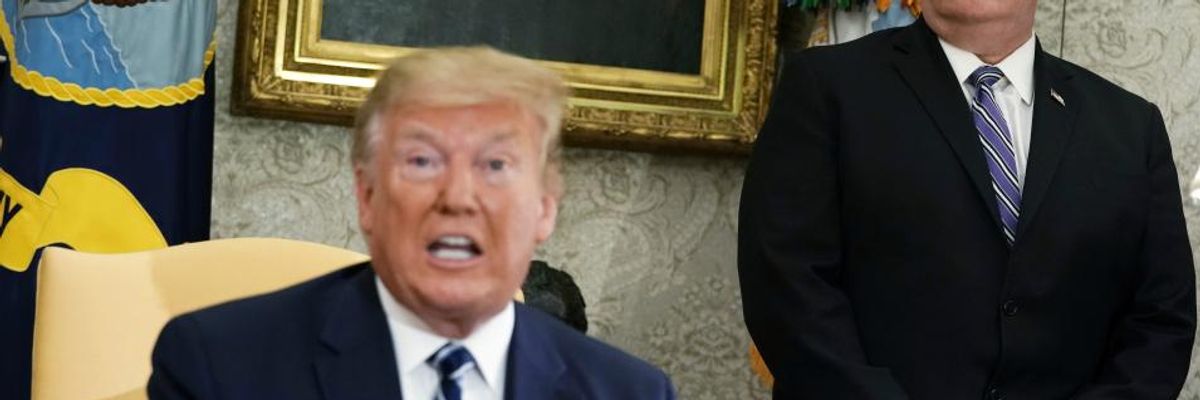
Secretary of State Mike Pompeo looks on as President Donald Trump speaks during a meeting with Canadian Prime Minister Justin Trudeau in the Oval Office of the White House June 20, 2019 in Washington, D.C. (Photo: Alex Wong/Getty Images)
Just hours after he brought the United States to the brink of war Thursday night by approving a military strike against Iran, President Donald Trump abruptly called off the attack before any missiles were fired.
"The place we have arrived at tonight on Iran is Donald Trump's choice. He chose escalation over diplomacy, without any idea how to get out of the downward spiral he set in motion."
--Sen. Chris Murphy
That's according to the New York Times, which reported that as late as 7 pm Thursday, "military and diplomatic officials were expecting a strike, after intense discussions and debate at the White House among the president's top national security officials and congressional leaders."
"The operation was underway in its early stages when it was called off," the Times reported. "Planes were in the air and ships were in position."
Iranian officials told Reuters Friday that Tehran received a message from Trump "through Oman overnight warning that a U.S. attack on Iran was imminent."
Citing anonymous senior administration officials involved in or briefed on the plan to attack Iran, the Times reported that it is "not clear whether Mr. Trump simply changed his mind on the strikes or whether the administration altered course because of logistics or strategy. It was also not clear whether the attacks might still go forward."
Trump confirmed in a series of tweets Friday morning that he ordered the strikes and then called them off:
The military strike--which was approved after Iran shot down an American surveillance drone that it said violated its airspace--was reportedly backed by national security adviser John Bolton, Secretary of State Mike Pompeo, and CIA director Gina Haspel, a team critics have described as the president's "war cabinet."
According to the Times, Trump "initially approved attacks on a handful of Iranian targets, like radar and missile batteries."
The Times' reporting, later confirmed by ABC News and other outlets, was met with alarm by lawmakers and anti-war critics who have been warning for months that the Trump administration's belligerence towards Iran could lead to an all-out military conflict.
"Since day one of the Trump administration it has been clear that this is where we were heading," tweeted Stephen Miles, executive director of Win Without War. "A completely reckless foreign policy in which decisions are based on personal vengeance and zero regard for consequences. A team of advisors obsessed with going to war [with] Iran."
Sen. Chris Murphy (D-Conn.) said in response to the Times report that the "place we have arrived at tonight on Iran is Donald Trump's choice."
"He chose escalation over diplomacy," Murphy tweeted, "without any idea how to get out of the downward spiral he set in motion."
Trump's reported approval of military strikes against Iran came after hours of growing tensions, with the president telling reporters they would "soon find out" whether his administration plans to attack Iran following the downing of a U.S. surveillance aircraft.
Iran said the drone violated its airspace and accused U.S. officials of ignoring "repeated radio warnings."
After American military officials claimed the drone was in international airspace when Iran shot it down, Iranian Foreign Minister Javad Zarif tweeted that the "U.S. is lying."
With the U.S. once more on the precipice of an unauthorized war, The Nation's John Nichols asked, "Where is the Congress?"
"Decisions about war and peace should not be left to the whims of a president who is ill-prepared, ill-informed, and ill-advised," Nichols wrote.
In a series of tweets late Thursday, Rep. Ilhan Omar (D-Minn.)--who has been an outspoken opponent of military action against Iran--urged Americans to pressure their representatives to stop a potentially catastrophic war.
Omar went on to address Trump directly, writing, "As a survivor of war, I want to tell you: going to war does not make you strong. It makes you weak."
"Sending teenagers to die, or return with lifelong wounds seen and unseen, does not make you a bigger person. It makes you smaller," Omar wrote. "I have seen firsthand the effects of war. Even in the best of cases, it never has the outcome you expect. War is death, displacement, and terror. War is hell."
Dear Common Dreams reader, It’s been nearly 30 years since I co-founded Common Dreams with my late wife, Lina Newhouser. We had the radical notion that journalism should serve the public good, not corporate profits. It was clear to us from the outset what it would take to build such a project. No paid advertisements. No corporate sponsors. No millionaire publisher telling us what to think or do. Many people said we wouldn't last a year, but we proved those doubters wrong. Together with a tremendous team of journalists and dedicated staff, we built an independent media outlet free from the constraints of profits and corporate control. Our mission has always been simple: To inform. To inspire. To ignite change for the common good. Building Common Dreams was not easy. Our survival was never guaranteed. When you take on the most powerful forces—Wall Street greed, fossil fuel industry destruction, Big Tech lobbyists, and uber-rich oligarchs who have spent billions upon billions rigging the economy and democracy in their favor—the only bulwark you have is supporters who believe in your work. But here’s the urgent message from me today. It's never been this bad out there. And it's never been this hard to keep us going. At the very moment Common Dreams is most needed, the threats we face are intensifying. We need your support now more than ever. We don't accept corporate advertising and never will. We don't have a paywall because we don't think people should be blocked from critical news based on their ability to pay. Everything we do is funded by the donations of readers like you. When everyone does the little they can afford, we are strong. But if that support retreats or dries up, so do we. Will you donate now to make sure Common Dreams not only survives but thrives? —Craig Brown, Co-founder |
Just hours after he brought the United States to the brink of war Thursday night by approving a military strike against Iran, President Donald Trump abruptly called off the attack before any missiles were fired.
"The place we have arrived at tonight on Iran is Donald Trump's choice. He chose escalation over diplomacy, without any idea how to get out of the downward spiral he set in motion."
--Sen. Chris Murphy
That's according to the New York Times, which reported that as late as 7 pm Thursday, "military and diplomatic officials were expecting a strike, after intense discussions and debate at the White House among the president's top national security officials and congressional leaders."
"The operation was underway in its early stages when it was called off," the Times reported. "Planes were in the air and ships were in position."
Iranian officials told Reuters Friday that Tehran received a message from Trump "through Oman overnight warning that a U.S. attack on Iran was imminent."
Citing anonymous senior administration officials involved in or briefed on the plan to attack Iran, the Times reported that it is "not clear whether Mr. Trump simply changed his mind on the strikes or whether the administration altered course because of logistics or strategy. It was also not clear whether the attacks might still go forward."
Trump confirmed in a series of tweets Friday morning that he ordered the strikes and then called them off:
The military strike--which was approved after Iran shot down an American surveillance drone that it said violated its airspace--was reportedly backed by national security adviser John Bolton, Secretary of State Mike Pompeo, and CIA director Gina Haspel, a team critics have described as the president's "war cabinet."
According to the Times, Trump "initially approved attacks on a handful of Iranian targets, like radar and missile batteries."
The Times' reporting, later confirmed by ABC News and other outlets, was met with alarm by lawmakers and anti-war critics who have been warning for months that the Trump administration's belligerence towards Iran could lead to an all-out military conflict.
"Since day one of the Trump administration it has been clear that this is where we were heading," tweeted Stephen Miles, executive director of Win Without War. "A completely reckless foreign policy in which decisions are based on personal vengeance and zero regard for consequences. A team of advisors obsessed with going to war [with] Iran."
Sen. Chris Murphy (D-Conn.) said in response to the Times report that the "place we have arrived at tonight on Iran is Donald Trump's choice."
"He chose escalation over diplomacy," Murphy tweeted, "without any idea how to get out of the downward spiral he set in motion."
Trump's reported approval of military strikes against Iran came after hours of growing tensions, with the president telling reporters they would "soon find out" whether his administration plans to attack Iran following the downing of a U.S. surveillance aircraft.
Iran said the drone violated its airspace and accused U.S. officials of ignoring "repeated radio warnings."
After American military officials claimed the drone was in international airspace when Iran shot it down, Iranian Foreign Minister Javad Zarif tweeted that the "U.S. is lying."
With the U.S. once more on the precipice of an unauthorized war, The Nation's John Nichols asked, "Where is the Congress?"
"Decisions about war and peace should not be left to the whims of a president who is ill-prepared, ill-informed, and ill-advised," Nichols wrote.
In a series of tweets late Thursday, Rep. Ilhan Omar (D-Minn.)--who has been an outspoken opponent of military action against Iran--urged Americans to pressure their representatives to stop a potentially catastrophic war.
Omar went on to address Trump directly, writing, "As a survivor of war, I want to tell you: going to war does not make you strong. It makes you weak."
"Sending teenagers to die, or return with lifelong wounds seen and unseen, does not make you a bigger person. It makes you smaller," Omar wrote. "I have seen firsthand the effects of war. Even in the best of cases, it never has the outcome you expect. War is death, displacement, and terror. War is hell."
Just hours after he brought the United States to the brink of war Thursday night by approving a military strike against Iran, President Donald Trump abruptly called off the attack before any missiles were fired.
"The place we have arrived at tonight on Iran is Donald Trump's choice. He chose escalation over diplomacy, without any idea how to get out of the downward spiral he set in motion."
--Sen. Chris Murphy
That's according to the New York Times, which reported that as late as 7 pm Thursday, "military and diplomatic officials were expecting a strike, after intense discussions and debate at the White House among the president's top national security officials and congressional leaders."
"The operation was underway in its early stages when it was called off," the Times reported. "Planes were in the air and ships were in position."
Iranian officials told Reuters Friday that Tehran received a message from Trump "through Oman overnight warning that a U.S. attack on Iran was imminent."
Citing anonymous senior administration officials involved in or briefed on the plan to attack Iran, the Times reported that it is "not clear whether Mr. Trump simply changed his mind on the strikes or whether the administration altered course because of logistics or strategy. It was also not clear whether the attacks might still go forward."
Trump confirmed in a series of tweets Friday morning that he ordered the strikes and then called them off:
The military strike--which was approved after Iran shot down an American surveillance drone that it said violated its airspace--was reportedly backed by national security adviser John Bolton, Secretary of State Mike Pompeo, and CIA director Gina Haspel, a team critics have described as the president's "war cabinet."
According to the Times, Trump "initially approved attacks on a handful of Iranian targets, like radar and missile batteries."
The Times' reporting, later confirmed by ABC News and other outlets, was met with alarm by lawmakers and anti-war critics who have been warning for months that the Trump administration's belligerence towards Iran could lead to an all-out military conflict.
"Since day one of the Trump administration it has been clear that this is where we were heading," tweeted Stephen Miles, executive director of Win Without War. "A completely reckless foreign policy in which decisions are based on personal vengeance and zero regard for consequences. A team of advisors obsessed with going to war [with] Iran."
Sen. Chris Murphy (D-Conn.) said in response to the Times report that the "place we have arrived at tonight on Iran is Donald Trump's choice."
"He chose escalation over diplomacy," Murphy tweeted, "without any idea how to get out of the downward spiral he set in motion."
Trump's reported approval of military strikes against Iran came after hours of growing tensions, with the president telling reporters they would "soon find out" whether his administration plans to attack Iran following the downing of a U.S. surveillance aircraft.
Iran said the drone violated its airspace and accused U.S. officials of ignoring "repeated radio warnings."
After American military officials claimed the drone was in international airspace when Iran shot it down, Iranian Foreign Minister Javad Zarif tweeted that the "U.S. is lying."
With the U.S. once more on the precipice of an unauthorized war, The Nation's John Nichols asked, "Where is the Congress?"
"Decisions about war and peace should not be left to the whims of a president who is ill-prepared, ill-informed, and ill-advised," Nichols wrote.
In a series of tweets late Thursday, Rep. Ilhan Omar (D-Minn.)--who has been an outspoken opponent of military action against Iran--urged Americans to pressure their representatives to stop a potentially catastrophic war.
Omar went on to address Trump directly, writing, "As a survivor of war, I want to tell you: going to war does not make you strong. It makes you weak."
"Sending teenagers to die, or return with lifelong wounds seen and unseen, does not make you a bigger person. It makes you smaller," Omar wrote. "I have seen firsthand the effects of war. Even in the best of cases, it never has the outcome you expect. War is death, displacement, and terror. War is hell."