SUBSCRIBE TO OUR FREE NEWSLETTER
Daily news & progressive opinion—funded by the people, not the corporations—delivered straight to your inbox.
5
#000000
#FFFFFF
To donate by check, phone, or other method, see our More Ways to Give page.
Daily news & progressive opinion—funded by the people, not the corporations—delivered straight to your inbox.
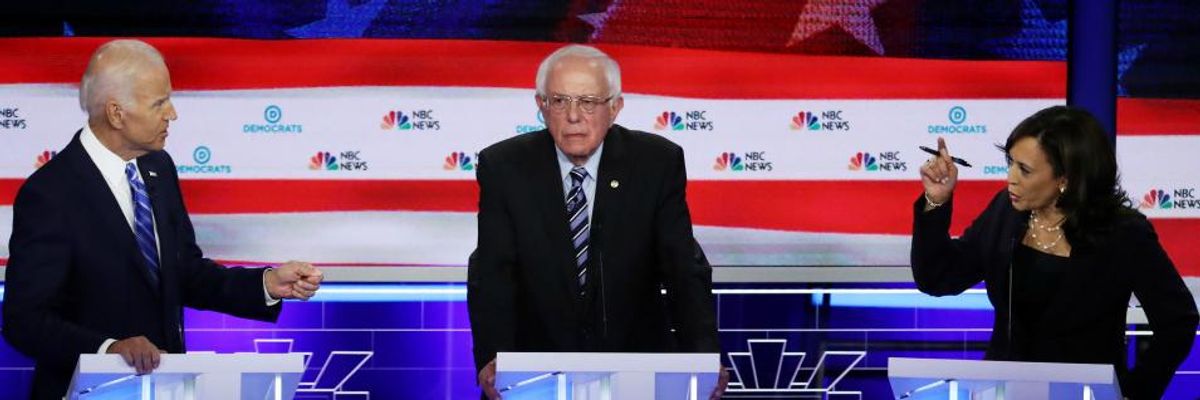
Sen. Kamala Harris (D-Calif.) and former Vice President Joe Biden speak as Sen. Bernie Sanders (I-Vt.) looks on during the second night of the first Democratic presidential debate on June 27, 2019 in Miami, Florida. (Photo: Drew Angerer/Getty Images)
Sen. Kamala Harris directly confronted Joe Biden over his civil rights record during Thursday night's Democratic presidential debate, highlighting the former vice president's opposition to school busing as a senator in the 1970s and his fond recollection of the "civility" of notorious segregationists.
After saying it was "hurtful" to hear Biden offer kind words earlier this month about two senators who "built their reputations and career on the segregation of race in this country"--James O. Eastland and Herman Talmadge--Harris invoked "a little girl in California who was part of the second class to integrate her public schools, and she was bused to school every day."
"And that little girl was me," Harris said.
"So I will tell you that, on this subject, it cannot be an intellectual debate among Democrats," added the senator from California. "We have to take it seriously. We have to act swiftly."
Watch the full exchange:
Biden responded by accusing Harris of mischaracterizing his record, claiming he "did not oppose busing in America."
"What I opposed is busing ordered by the Department of Education. That's what I opposed," Biden said.
But critics were quick to poke holes in the former vice president's account of his past.
"Biden's claim tonight that he only opposed federally mandated busing and did not generally oppose 'busing in America' was a flagrant misrepresentation of his position in the '70s and '80s," tweeted CNN reporter Daniel Dale. "He'd made crystal clear he opposed busing as a concept, as a matter of principle."
Responding to Biden's claim that he only opposed busing mandated by the federal government, Harris again highlighted her personal experience, noting that she "was part of the second class to integrate Berkeley, California public schools almost two decades after Brown v. Board of Education," the 1954 Supreme Court ruling that racial segregation in public schools is unconstitutional.
"There was a failure of states to integrate public schools in America... So that's where the federal government must step in," said Harris. "That's why we have the Voting Rights Act and the Civil Rights Act. That's why we need to pass the Equality Act. That's why we need to pass the [Equal Rights Amendment], because there are moments in history where states fail to preserve the civil rights of all people."
Dear Common Dreams reader, It’s been nearly 30 years since I co-founded Common Dreams with my late wife, Lina Newhouser. We had the radical notion that journalism should serve the public good, not corporate profits. It was clear to us from the outset what it would take to build such a project. No paid advertisements. No corporate sponsors. No millionaire publisher telling us what to think or do. Many people said we wouldn't last a year, but we proved those doubters wrong. Together with a tremendous team of journalists and dedicated staff, we built an independent media outlet free from the constraints of profits and corporate control. Our mission has always been simple: To inform. To inspire. To ignite change for the common good. Building Common Dreams was not easy. Our survival was never guaranteed. When you take on the most powerful forces—Wall Street greed, fossil fuel industry destruction, Big Tech lobbyists, and uber-rich oligarchs who have spent billions upon billions rigging the economy and democracy in their favor—the only bulwark you have is supporters who believe in your work. But here’s the urgent message from me today. It's never been this bad out there. And it's never been this hard to keep us going. At the very moment Common Dreams is most needed, the threats we face are intensifying. We need your support now more than ever. We don't accept corporate advertising and never will. We don't have a paywall because we don't think people should be blocked from critical news based on their ability to pay. Everything we do is funded by the donations of readers like you. When everyone does the little they can afford, we are strong. But if that support retreats or dries up, so do we. Will you donate now to make sure Common Dreams not only survives but thrives? —Craig Brown, Co-founder |
Sen. Kamala Harris directly confronted Joe Biden over his civil rights record during Thursday night's Democratic presidential debate, highlighting the former vice president's opposition to school busing as a senator in the 1970s and his fond recollection of the "civility" of notorious segregationists.
After saying it was "hurtful" to hear Biden offer kind words earlier this month about two senators who "built their reputations and career on the segregation of race in this country"--James O. Eastland and Herman Talmadge--Harris invoked "a little girl in California who was part of the second class to integrate her public schools, and she was bused to school every day."
"And that little girl was me," Harris said.
"So I will tell you that, on this subject, it cannot be an intellectual debate among Democrats," added the senator from California. "We have to take it seriously. We have to act swiftly."
Watch the full exchange:
Biden responded by accusing Harris of mischaracterizing his record, claiming he "did not oppose busing in America."
"What I opposed is busing ordered by the Department of Education. That's what I opposed," Biden said.
But critics were quick to poke holes in the former vice president's account of his past.
"Biden's claim tonight that he only opposed federally mandated busing and did not generally oppose 'busing in America' was a flagrant misrepresentation of his position in the '70s and '80s," tweeted CNN reporter Daniel Dale. "He'd made crystal clear he opposed busing as a concept, as a matter of principle."
Responding to Biden's claim that he only opposed busing mandated by the federal government, Harris again highlighted her personal experience, noting that she "was part of the second class to integrate Berkeley, California public schools almost two decades after Brown v. Board of Education," the 1954 Supreme Court ruling that racial segregation in public schools is unconstitutional.
"There was a failure of states to integrate public schools in America... So that's where the federal government must step in," said Harris. "That's why we have the Voting Rights Act and the Civil Rights Act. That's why we need to pass the Equality Act. That's why we need to pass the [Equal Rights Amendment], because there are moments in history where states fail to preserve the civil rights of all people."
Sen. Kamala Harris directly confronted Joe Biden over his civil rights record during Thursday night's Democratic presidential debate, highlighting the former vice president's opposition to school busing as a senator in the 1970s and his fond recollection of the "civility" of notorious segregationists.
After saying it was "hurtful" to hear Biden offer kind words earlier this month about two senators who "built their reputations and career on the segregation of race in this country"--James O. Eastland and Herman Talmadge--Harris invoked "a little girl in California who was part of the second class to integrate her public schools, and she was bused to school every day."
"And that little girl was me," Harris said.
"So I will tell you that, on this subject, it cannot be an intellectual debate among Democrats," added the senator from California. "We have to take it seriously. We have to act swiftly."
Watch the full exchange:
Biden responded by accusing Harris of mischaracterizing his record, claiming he "did not oppose busing in America."
"What I opposed is busing ordered by the Department of Education. That's what I opposed," Biden said.
But critics were quick to poke holes in the former vice president's account of his past.
"Biden's claim tonight that he only opposed federally mandated busing and did not generally oppose 'busing in America' was a flagrant misrepresentation of his position in the '70s and '80s," tweeted CNN reporter Daniel Dale. "He'd made crystal clear he opposed busing as a concept, as a matter of principle."
Responding to Biden's claim that he only opposed busing mandated by the federal government, Harris again highlighted her personal experience, noting that she "was part of the second class to integrate Berkeley, California public schools almost two decades after Brown v. Board of Education," the 1954 Supreme Court ruling that racial segregation in public schools is unconstitutional.
"There was a failure of states to integrate public schools in America... So that's where the federal government must step in," said Harris. "That's why we have the Voting Rights Act and the Civil Rights Act. That's why we need to pass the Equality Act. That's why we need to pass the [Equal Rights Amendment], because there are moments in history where states fail to preserve the civil rights of all people."