SUBSCRIBE TO OUR FREE NEWSLETTER
Daily news & progressive opinion—funded by the people, not the corporations—delivered straight to your inbox.
5
#000000
#FFFFFF
To donate by check, phone, or other method, see our More Ways to Give page.
Daily news & progressive opinion—funded by the people, not the corporations—delivered straight to your inbox.
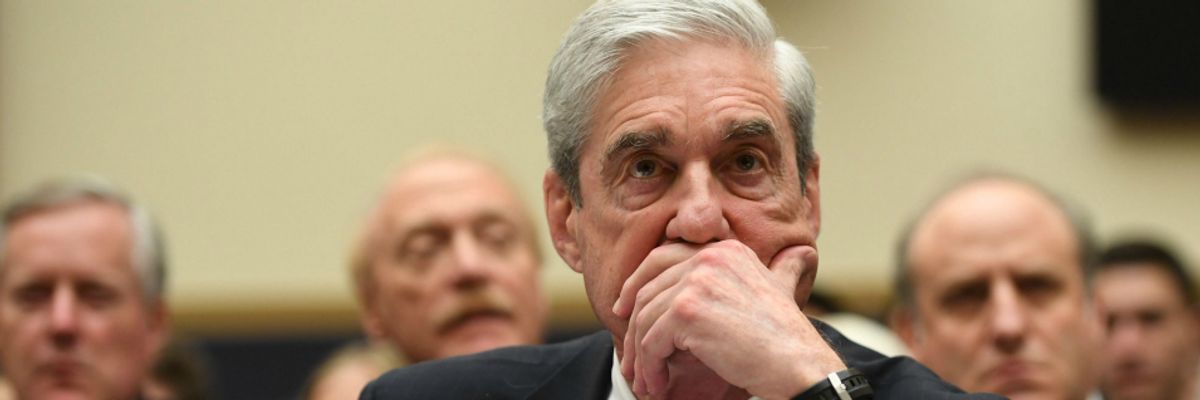
Former Special Prosecutor Robert Mueller is seen during is testimony before Congress on July 24, 2019, in Washington, DC. - Three months after releasing the final report on his probe into the 2016 election, much of the American public remains unclear about the former special counsel's findings on whether Trump criminally obstructed justice and whether his campaign colluded with Russians. (Photo: Saul Loeb/AFP)
Amid congressional testimony on Wednesday in which former special counsel Robert Mueller reiterated publicly that President Donald Trump "was not exculpated" of wrongdoing in his report, Democratic Congressman Ted Lieu of California also provided a succinct recap of why the only reason Mueller did not recommend charges against the president was because of an existing Office of Legal Counsel (OLC) memo stating that a sitting president could not be indicted.
"The reason, again, that you did not indict Donald Trump is because of OLC opinion stating that you cannot indict a sitting president. Correct?" Leiu asked.
And answered Mueller: "That is correct."
Watch:
Notably, after Leiu listed the "elements" of possible obstruction found in the report, Mueller said he wanted to be clear that just because those elements are listed does not mean that he would necessarily agree with Lieu's effort to prove that Trump did obstruct justice.
Despite that--even as Vox's Alex Ward warned it was not "exactly as big as you think it is"-- the exchange was treated as significant by many watching the hearing. As the progressive advocacy group Public Interest tweeted:
The exchange was characterized by some observers as "huge" and a "notable statement under oath" by Mueller:
Later in the day, during his appearance before the House Intelligence Committee, Mueller walked back a key portion of his response to Lieu:
Why did the exchange as it originally occurred matter? According to reporting by VICE News:
Mueller just told Lieu, for the first time, that government policy against indicting a sitting president was the key point that kept him from attempting to nail Trump for obstruction of justice.
An opinion by the DOJ Office of Legal Counsel argues that charging a sitting president would be unconstitutional -- although plenty of lawyers, including former Clinton investigator Ken Starr, think that view wouldn't survive a challenge in the Supreme Court.
Mueller is essentially confirming that he could say the president did not commit a crime but was blocked from saying the president did commit one, said Paul Rosenzweig, a former member of Starr's team, who's been watching the hearings closely.
"He viewed the OLC prohibition as a one-way ratchet," Rosenzweig said. "He could exonerate, but he could not indict."
Mueller may not have meant to go there today, but taken literally, he just pretty much stated that he would have indicted Trump if he'd been allowed to, Rosenzweig said.
While Mueller has stood by the mandate, he also stated during Wednesday's hearing before the House Judiciary Committee that a president, while not able to be charged while in office, could be later indicted on obstruction of justice or other changes.
"Could you charge the president with a crime after he left office?" Rep. Ken Buck (R-Colo.) asked Mueller.
"Yes," Mueller replied.
Updated: This article has been updated from its original to include Mueller's later clarification of what he said to Rep. Lieu.
Dear Common Dreams reader, It’s been nearly 30 years since I co-founded Common Dreams with my late wife, Lina Newhouser. We had the radical notion that journalism should serve the public good, not corporate profits. It was clear to us from the outset what it would take to build such a project. No paid advertisements. No corporate sponsors. No millionaire publisher telling us what to think or do. Many people said we wouldn't last a year, but we proved those doubters wrong. Together with a tremendous team of journalists and dedicated staff, we built an independent media outlet free from the constraints of profits and corporate control. Our mission has always been simple: To inform. To inspire. To ignite change for the common good. Building Common Dreams was not easy. Our survival was never guaranteed. When you take on the most powerful forces—Wall Street greed, fossil fuel industry destruction, Big Tech lobbyists, and uber-rich oligarchs who have spent billions upon billions rigging the economy and democracy in their favor—the only bulwark you have is supporters who believe in your work. But here’s the urgent message from me today. It's never been this bad out there. And it's never been this hard to keep us going. At the very moment Common Dreams is most needed, the threats we face are intensifying. We need your support now more than ever. We don't accept corporate advertising and never will. We don't have a paywall because we don't think people should be blocked from critical news based on their ability to pay. Everything we do is funded by the donations of readers like you. When everyone does the little they can afford, we are strong. But if that support retreats or dries up, so do we. Will you donate now to make sure Common Dreams not only survives but thrives? —Craig Brown, Co-founder |
Amid congressional testimony on Wednesday in which former special counsel Robert Mueller reiterated publicly that President Donald Trump "was not exculpated" of wrongdoing in his report, Democratic Congressman Ted Lieu of California also provided a succinct recap of why the only reason Mueller did not recommend charges against the president was because of an existing Office of Legal Counsel (OLC) memo stating that a sitting president could not be indicted.
"The reason, again, that you did not indict Donald Trump is because of OLC opinion stating that you cannot indict a sitting president. Correct?" Leiu asked.
And answered Mueller: "That is correct."
Watch:
Notably, after Leiu listed the "elements" of possible obstruction found in the report, Mueller said he wanted to be clear that just because those elements are listed does not mean that he would necessarily agree with Lieu's effort to prove that Trump did obstruct justice.
Despite that--even as Vox's Alex Ward warned it was not "exactly as big as you think it is"-- the exchange was treated as significant by many watching the hearing. As the progressive advocacy group Public Interest tweeted:
The exchange was characterized by some observers as "huge" and a "notable statement under oath" by Mueller:
Later in the day, during his appearance before the House Intelligence Committee, Mueller walked back a key portion of his response to Lieu:
Why did the exchange as it originally occurred matter? According to reporting by VICE News:
Mueller just told Lieu, for the first time, that government policy against indicting a sitting president was the key point that kept him from attempting to nail Trump for obstruction of justice.
An opinion by the DOJ Office of Legal Counsel argues that charging a sitting president would be unconstitutional -- although plenty of lawyers, including former Clinton investigator Ken Starr, think that view wouldn't survive a challenge in the Supreme Court.
Mueller is essentially confirming that he could say the president did not commit a crime but was blocked from saying the president did commit one, said Paul Rosenzweig, a former member of Starr's team, who's been watching the hearings closely.
"He viewed the OLC prohibition as a one-way ratchet," Rosenzweig said. "He could exonerate, but he could not indict."
Mueller may not have meant to go there today, but taken literally, he just pretty much stated that he would have indicted Trump if he'd been allowed to, Rosenzweig said.
While Mueller has stood by the mandate, he also stated during Wednesday's hearing before the House Judiciary Committee that a president, while not able to be charged while in office, could be later indicted on obstruction of justice or other changes.
"Could you charge the president with a crime after he left office?" Rep. Ken Buck (R-Colo.) asked Mueller.
"Yes," Mueller replied.
Updated: This article has been updated from its original to include Mueller's later clarification of what he said to Rep. Lieu.
Amid congressional testimony on Wednesday in which former special counsel Robert Mueller reiterated publicly that President Donald Trump "was not exculpated" of wrongdoing in his report, Democratic Congressman Ted Lieu of California also provided a succinct recap of why the only reason Mueller did not recommend charges against the president was because of an existing Office of Legal Counsel (OLC) memo stating that a sitting president could not be indicted.
"The reason, again, that you did not indict Donald Trump is because of OLC opinion stating that you cannot indict a sitting president. Correct?" Leiu asked.
And answered Mueller: "That is correct."
Watch:
Notably, after Leiu listed the "elements" of possible obstruction found in the report, Mueller said he wanted to be clear that just because those elements are listed does not mean that he would necessarily agree with Lieu's effort to prove that Trump did obstruct justice.
Despite that--even as Vox's Alex Ward warned it was not "exactly as big as you think it is"-- the exchange was treated as significant by many watching the hearing. As the progressive advocacy group Public Interest tweeted:
The exchange was characterized by some observers as "huge" and a "notable statement under oath" by Mueller:
Later in the day, during his appearance before the House Intelligence Committee, Mueller walked back a key portion of his response to Lieu:
Why did the exchange as it originally occurred matter? According to reporting by VICE News:
Mueller just told Lieu, for the first time, that government policy against indicting a sitting president was the key point that kept him from attempting to nail Trump for obstruction of justice.
An opinion by the DOJ Office of Legal Counsel argues that charging a sitting president would be unconstitutional -- although plenty of lawyers, including former Clinton investigator Ken Starr, think that view wouldn't survive a challenge in the Supreme Court.
Mueller is essentially confirming that he could say the president did not commit a crime but was blocked from saying the president did commit one, said Paul Rosenzweig, a former member of Starr's team, who's been watching the hearings closely.
"He viewed the OLC prohibition as a one-way ratchet," Rosenzweig said. "He could exonerate, but he could not indict."
Mueller may not have meant to go there today, but taken literally, he just pretty much stated that he would have indicted Trump if he'd been allowed to, Rosenzweig said.
While Mueller has stood by the mandate, he also stated during Wednesday's hearing before the House Judiciary Committee that a president, while not able to be charged while in office, could be later indicted on obstruction of justice or other changes.
"Could you charge the president with a crime after he left office?" Rep. Ken Buck (R-Colo.) asked Mueller.
"Yes," Mueller replied.
Updated: This article has been updated from its original to include Mueller's later clarification of what he said to Rep. Lieu.