SUBSCRIBE TO OUR FREE NEWSLETTER
Daily news & progressive opinion—funded by the people, not the corporations—delivered straight to your inbox.
5
#000000
#FFFFFF
To donate by check, phone, or other method, see our More Ways to Give page.
Daily news & progressive opinion—funded by the people, not the corporations—delivered straight to your inbox.
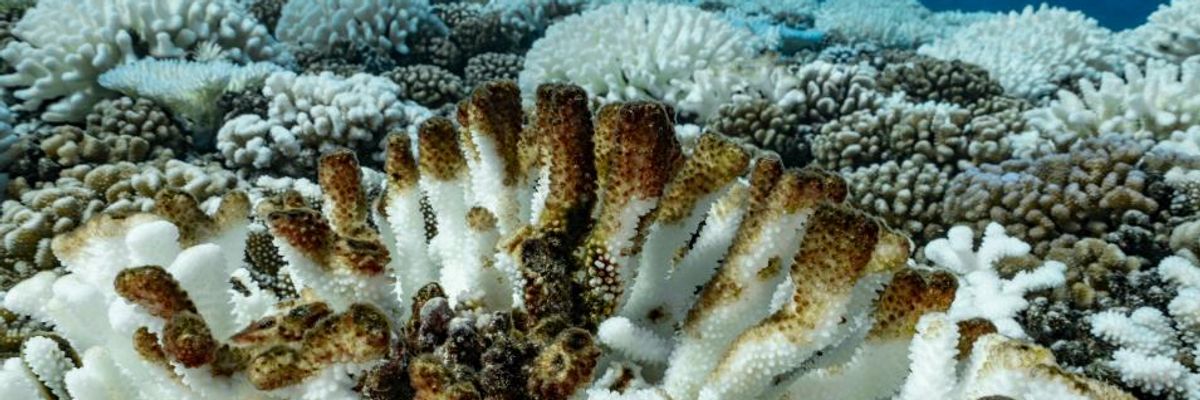
A view of major bleaching on the coral reefs of the Society Islands on May 9, 2019 in Moorea, French Polynesia, where major bleaching is occurring. (Photo: Alexis Rosenfeld/Getty Images).
As the human-caused climate crisis drives up ocean temperatures at a rate that has scientists worried, a study published Thursday in the journal Current Biology reveals that warming waters are an even bigger threat to coral reefs than experts previously realized.
"Climate scientists talk about 'unknown unknowns'--impacts that we haven't anticipated from existing knowledge and experience. This discovery fits into this category."
--Scott Heron, study co-author
Past research has raised alarm about how ocean pollution and rising temperatures cause coral bleaching--which is when coral expels algae, its main food source, and turns white. Although more susceptible to disease and death, bleached coral can recover if temperatures fall, so some scientists have been hopeful that urgent climate action could revive impacted reefs.
However, the new study--conducted by researchers at the University of New South Wales Sydney, the University of Newcastle, the University of Technology Sydney, James Cook University, and the National Oceanographic and Atmospheric Administration (NOAA)--heightens concerns about the future of coral reefs in a warming world.
According to the study:
Severe marine heatwaves have recently become a common feature of global ocean conditions due to a rapidly changing climate. These increasingly severe thermal conditions are causing an unprecedented increase in the frequency and severity of mortality events in marine ecosystems, including on coral reefs... [M]arine heatwave events on coral reefs are biologically distinct to how coral bleaching has been understood to date.
"Until now, we have described coral bleaching as an event where the symbiotic relationship between coral and its microbes breaks down and corals lose their main source of nutrition, and the coral can die if the symbiosis is not restored," co-author Tracy Ainsworth, an associate professor at Australia's University of New South Wales Sydney, explained in a statement.
"But what we are now seeing is that severe marine heatwave events can have a far more severe impact than coral bleaching," Ainsworth continued. "The water temperatures are so warm that the coral animal doesn't bleach--in terms of a loss of its symbiosis--the animal dies and its underlying skeleton is all that remains."
"We find that the skeleton is immediately overgrown by rapid growth of algae and bacteria," said co-author Bill Leggat, an associate professor at the U.K.'s University of Newcastle. By CT scanning the coral skeleton, Leggat said, the team found that "this process is devastating not just for the animal tissue, but also for the skeleton that is left behind, which is rapidly eroded and weakened."
Laura Richardson at the U.K.-based Bangor University's School of Ocean Sciences--who was not involved in the study--told BBC News that the team's significant discovery was "the rapidity with which the reef skeleton breaks down when you have these severe heatwaves."
"Given that the degradation of coral reefs will result in the collapse of ecosystem services that sustain over half a billion people, we urgently need actions both globally and locally that protect and conserve these truly wonderful places."
--Tracy Ainsworth, study co-author
They are the first researchers, as Richardson noted, to document that such events are causing "almost instant mortality of corals."
"Climate scientists talk about 'unknown unknowns'--impacts that we haven't anticipated from existing knowledge and experience," said study co-author Scott Heron of Australia's James Cook University. "This discovery fits into this category."
"As we begin now to understand this impact," Heron added, "the question is how many more of these 'unknown unknowns' might there still be that could bring faster and greater damage to coral reefs from climate change."
Though the study generated alarm, the researchers expressed hope that it will spur public outcry for policymakers to pursue bolder efforts to combat the climate crisis--and, specifically, protect coral reefs, particularly considering the anticipated consequences of inaction.
PBS News Hour reported that "without the option to recover, the world may start seeing corals die off faster than expected. And the death of corals would come with a steep cost for humans: flood protection that's worth tens of millions in the U.S. alone, plus an estimated value of almost $30 billion each year globally in tourism, fishing, and other benefits."
"Across the globe coral reefs are still a source of inspiration and awe of the natural world, as well as being critically important to the communities that rely upon them," said Ainsworth. "Given that the degradation of coral reefs will result in the collapse of ecosystem services that sustain over half a billion people, we urgently need actions both globally and locally that protect and conserve these truly wonderful places."
Dear Common Dreams reader, It’s been nearly 30 years since I co-founded Common Dreams with my late wife, Lina Newhouser. We had the radical notion that journalism should serve the public good, not corporate profits. It was clear to us from the outset what it would take to build such a project. No paid advertisements. No corporate sponsors. No millionaire publisher telling us what to think or do. Many people said we wouldn't last a year, but we proved those doubters wrong. Together with a tremendous team of journalists and dedicated staff, we built an independent media outlet free from the constraints of profits and corporate control. Our mission has always been simple: To inform. To inspire. To ignite change for the common good. Building Common Dreams was not easy. Our survival was never guaranteed. When you take on the most powerful forces—Wall Street greed, fossil fuel industry destruction, Big Tech lobbyists, and uber-rich oligarchs who have spent billions upon billions rigging the economy and democracy in their favor—the only bulwark you have is supporters who believe in your work. But here’s the urgent message from me today. It's never been this bad out there. And it's never been this hard to keep us going. At the very moment Common Dreams is most needed, the threats we face are intensifying. We need your support now more than ever. We don't accept corporate advertising and never will. We don't have a paywall because we don't think people should be blocked from critical news based on their ability to pay. Everything we do is funded by the donations of readers like you. When everyone does the little they can afford, we are strong. But if that support retreats or dries up, so do we. Will you donate now to make sure Common Dreams not only survives but thrives? —Craig Brown, Co-founder |
As the human-caused climate crisis drives up ocean temperatures at a rate that has scientists worried, a study published Thursday in the journal Current Biology reveals that warming waters are an even bigger threat to coral reefs than experts previously realized.
"Climate scientists talk about 'unknown unknowns'--impacts that we haven't anticipated from existing knowledge and experience. This discovery fits into this category."
--Scott Heron, study co-author
Past research has raised alarm about how ocean pollution and rising temperatures cause coral bleaching--which is when coral expels algae, its main food source, and turns white. Although more susceptible to disease and death, bleached coral can recover if temperatures fall, so some scientists have been hopeful that urgent climate action could revive impacted reefs.
However, the new study--conducted by researchers at the University of New South Wales Sydney, the University of Newcastle, the University of Technology Sydney, James Cook University, and the National Oceanographic and Atmospheric Administration (NOAA)--heightens concerns about the future of coral reefs in a warming world.
According to the study:
Severe marine heatwaves have recently become a common feature of global ocean conditions due to a rapidly changing climate. These increasingly severe thermal conditions are causing an unprecedented increase in the frequency and severity of mortality events in marine ecosystems, including on coral reefs... [M]arine heatwave events on coral reefs are biologically distinct to how coral bleaching has been understood to date.
"Until now, we have described coral bleaching as an event where the symbiotic relationship between coral and its microbes breaks down and corals lose their main source of nutrition, and the coral can die if the symbiosis is not restored," co-author Tracy Ainsworth, an associate professor at Australia's University of New South Wales Sydney, explained in a statement.
"But what we are now seeing is that severe marine heatwave events can have a far more severe impact than coral bleaching," Ainsworth continued. "The water temperatures are so warm that the coral animal doesn't bleach--in terms of a loss of its symbiosis--the animal dies and its underlying skeleton is all that remains."
"We find that the skeleton is immediately overgrown by rapid growth of algae and bacteria," said co-author Bill Leggat, an associate professor at the U.K.'s University of Newcastle. By CT scanning the coral skeleton, Leggat said, the team found that "this process is devastating not just for the animal tissue, but also for the skeleton that is left behind, which is rapidly eroded and weakened."
Laura Richardson at the U.K.-based Bangor University's School of Ocean Sciences--who was not involved in the study--told BBC News that the team's significant discovery was "the rapidity with which the reef skeleton breaks down when you have these severe heatwaves."
"Given that the degradation of coral reefs will result in the collapse of ecosystem services that sustain over half a billion people, we urgently need actions both globally and locally that protect and conserve these truly wonderful places."
--Tracy Ainsworth, study co-author
They are the first researchers, as Richardson noted, to document that such events are causing "almost instant mortality of corals."
"Climate scientists talk about 'unknown unknowns'--impacts that we haven't anticipated from existing knowledge and experience," said study co-author Scott Heron of Australia's James Cook University. "This discovery fits into this category."
"As we begin now to understand this impact," Heron added, "the question is how many more of these 'unknown unknowns' might there still be that could bring faster and greater damage to coral reefs from climate change."
Though the study generated alarm, the researchers expressed hope that it will spur public outcry for policymakers to pursue bolder efforts to combat the climate crisis--and, specifically, protect coral reefs, particularly considering the anticipated consequences of inaction.
PBS News Hour reported that "without the option to recover, the world may start seeing corals die off faster than expected. And the death of corals would come with a steep cost for humans: flood protection that's worth tens of millions in the U.S. alone, plus an estimated value of almost $30 billion each year globally in tourism, fishing, and other benefits."
"Across the globe coral reefs are still a source of inspiration and awe of the natural world, as well as being critically important to the communities that rely upon them," said Ainsworth. "Given that the degradation of coral reefs will result in the collapse of ecosystem services that sustain over half a billion people, we urgently need actions both globally and locally that protect and conserve these truly wonderful places."
As the human-caused climate crisis drives up ocean temperatures at a rate that has scientists worried, a study published Thursday in the journal Current Biology reveals that warming waters are an even bigger threat to coral reefs than experts previously realized.
"Climate scientists talk about 'unknown unknowns'--impacts that we haven't anticipated from existing knowledge and experience. This discovery fits into this category."
--Scott Heron, study co-author
Past research has raised alarm about how ocean pollution and rising temperatures cause coral bleaching--which is when coral expels algae, its main food source, and turns white. Although more susceptible to disease and death, bleached coral can recover if temperatures fall, so some scientists have been hopeful that urgent climate action could revive impacted reefs.
However, the new study--conducted by researchers at the University of New South Wales Sydney, the University of Newcastle, the University of Technology Sydney, James Cook University, and the National Oceanographic and Atmospheric Administration (NOAA)--heightens concerns about the future of coral reefs in a warming world.
According to the study:
Severe marine heatwaves have recently become a common feature of global ocean conditions due to a rapidly changing climate. These increasingly severe thermal conditions are causing an unprecedented increase in the frequency and severity of mortality events in marine ecosystems, including on coral reefs... [M]arine heatwave events on coral reefs are biologically distinct to how coral bleaching has been understood to date.
"Until now, we have described coral bleaching as an event where the symbiotic relationship between coral and its microbes breaks down and corals lose their main source of nutrition, and the coral can die if the symbiosis is not restored," co-author Tracy Ainsworth, an associate professor at Australia's University of New South Wales Sydney, explained in a statement.
"But what we are now seeing is that severe marine heatwave events can have a far more severe impact than coral bleaching," Ainsworth continued. "The water temperatures are so warm that the coral animal doesn't bleach--in terms of a loss of its symbiosis--the animal dies and its underlying skeleton is all that remains."
"We find that the skeleton is immediately overgrown by rapid growth of algae and bacteria," said co-author Bill Leggat, an associate professor at the U.K.'s University of Newcastle. By CT scanning the coral skeleton, Leggat said, the team found that "this process is devastating not just for the animal tissue, but also for the skeleton that is left behind, which is rapidly eroded and weakened."
Laura Richardson at the U.K.-based Bangor University's School of Ocean Sciences--who was not involved in the study--told BBC News that the team's significant discovery was "the rapidity with which the reef skeleton breaks down when you have these severe heatwaves."
"Given that the degradation of coral reefs will result in the collapse of ecosystem services that sustain over half a billion people, we urgently need actions both globally and locally that protect and conserve these truly wonderful places."
--Tracy Ainsworth, study co-author
They are the first researchers, as Richardson noted, to document that such events are causing "almost instant mortality of corals."
"Climate scientists talk about 'unknown unknowns'--impacts that we haven't anticipated from existing knowledge and experience," said study co-author Scott Heron of Australia's James Cook University. "This discovery fits into this category."
"As we begin now to understand this impact," Heron added, "the question is how many more of these 'unknown unknowns' might there still be that could bring faster and greater damage to coral reefs from climate change."
Though the study generated alarm, the researchers expressed hope that it will spur public outcry for policymakers to pursue bolder efforts to combat the climate crisis--and, specifically, protect coral reefs, particularly considering the anticipated consequences of inaction.
PBS News Hour reported that "without the option to recover, the world may start seeing corals die off faster than expected. And the death of corals would come with a steep cost for humans: flood protection that's worth tens of millions in the U.S. alone, plus an estimated value of almost $30 billion each year globally in tourism, fishing, and other benefits."
"Across the globe coral reefs are still a source of inspiration and awe of the natural world, as well as being critically important to the communities that rely upon them," said Ainsworth. "Given that the degradation of coral reefs will result in the collapse of ecosystem services that sustain over half a billion people, we urgently need actions both globally and locally that protect and conserve these truly wonderful places."