

SUBSCRIBE TO OUR FREE NEWSLETTER
Daily news & progressive opinion—funded by the people, not the corporations—delivered straight to your inbox.
5
#000000
#FFFFFF
To donate by check, phone, or other method, see our More Ways to Give page.
Daily news & progressive opinion—funded by the people, not the corporations—delivered straight to your inbox.
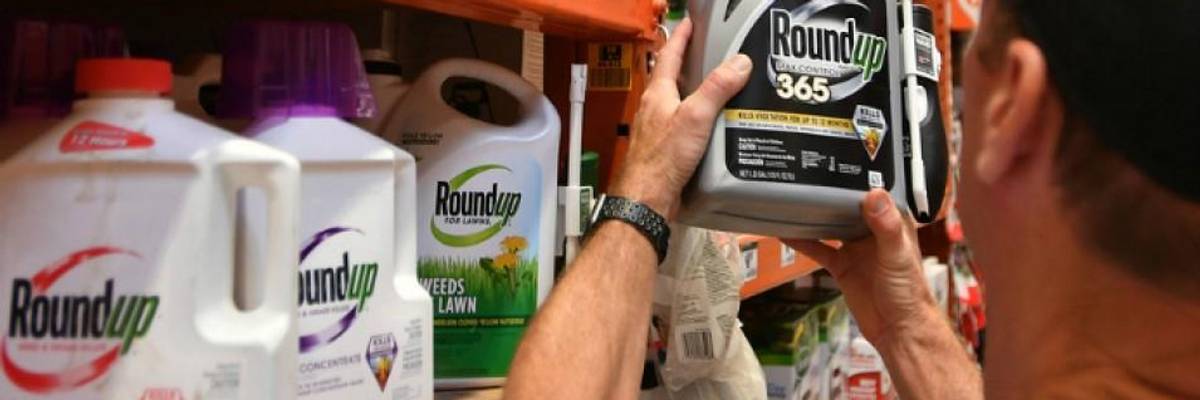
"It's a little bit sad," said Brett Hartl, government affairs director for the Center for Biological Diversity, "the EPA is the biggest cheerleader and defender of glyphosate." (Photo: AFP/Getty Images)
President Donald Trump's Environmental Protection Agency was accused of being a pesticide "cheerleader" last week after the agency said it would not approval labels that say that glyphosate--the active ingredient in Roundup and other weedkillers--is known to cause cancer.
In a statement released Thursday announcing the move, the EPA dug in on its assertion that glyphosate does not cause cancer, though critics have said that is "an industry-friendly conclusion that's simply not based on the best available science."
The new guidance takes aim at California's 2017 move, in adherence with its Proposition 65, to add glyphosate to its list of chemicals known to cause cancer and require warning labels. The state cited the World Health Organization's International Agency for Research on Cancer 2015 assessment that glyphosate is "probably carcinogenic to humans."
The EPA, however, said those labels provided consumers with false information.
"We will not allow California's flawed program to dictate federal policy," said EPA Administrator Andrew Wheeler in the statement.
The EPA also sent a letter to manufactures on Aug. 7 saying that "pesticide products bearing the Proposition 65 warning statement due to the presence of glyphosate are misbranded" under the Federal Insecticide, Fungicide, and Rodenticide Act (FIFRA).
The letter, signed by Michael Goodis, head of EPA's registration division in its Office of Pesticide Programs, said EPA would not approve labeling with that warning, and that "EPA requests the submission of draft amended labeling that removes such language within ninety days of the date of this letter."
Brett Hartl, government affairs director for the Center for Biological Diversity, suggested the EPA wasn't living up to its own name.
"It's a little bit sad the EPA is the biggest cheerleader and defender of glyphosate," Hartl told The Associated Press. "It's the Environmental Protection Agency, not the pesticide protection agency."
California and the IARC weren't alone in seeing a link between glyphosate and cancer.
Three U.S. juries have found Roundup responsible for plaintiffs' cancers, ordering Monsanto, which was acquired by the German pharmaceutical giant Bayer last year, to pay out tens of millions of dollars to victims.
Legal battles continue for the company. It's appealing the verdicts, but thousands of other people are suing the company for similar damages.
Dear Common Dreams reader, It’s been nearly 30 years since I co-founded Common Dreams with my late wife, Lina Newhouser. We had the radical notion that journalism should serve the public good, not corporate profits. It was clear to us from the outset what it would take to build such a project. No paid advertisements. No corporate sponsors. No millionaire publisher telling us what to think or do. Many people said we wouldn't last a year, but we proved those doubters wrong. Together with a tremendous team of journalists and dedicated staff, we built an independent media outlet free from the constraints of profits and corporate control. Our mission has always been simple: To inform. To inspire. To ignite change for the common good. Building Common Dreams was not easy. Our survival was never guaranteed. When you take on the most powerful forces—Wall Street greed, fossil fuel industry destruction, Big Tech lobbyists, and uber-rich oligarchs who have spent billions upon billions rigging the economy and democracy in their favor—the only bulwark you have is supporters who believe in your work. But here’s the urgent message from me today. It's never been this bad out there. And it's never been this hard to keep us going. At the very moment Common Dreams is most needed, the threats we face are intensifying. We need your support now more than ever. We don't accept corporate advertising and never will. We don't have a paywall because we don't think people should be blocked from critical news based on their ability to pay. Everything we do is funded by the donations of readers like you. When everyone does the little they can afford, we are strong. But if that support retreats or dries up, so do we. Will you donate now to make sure Common Dreams not only survives but thrives? —Craig Brown, Co-founder |
President Donald Trump's Environmental Protection Agency was accused of being a pesticide "cheerleader" last week after the agency said it would not approval labels that say that glyphosate--the active ingredient in Roundup and other weedkillers--is known to cause cancer.
In a statement released Thursday announcing the move, the EPA dug in on its assertion that glyphosate does not cause cancer, though critics have said that is "an industry-friendly conclusion that's simply not based on the best available science."
The new guidance takes aim at California's 2017 move, in adherence with its Proposition 65, to add glyphosate to its list of chemicals known to cause cancer and require warning labels. The state cited the World Health Organization's International Agency for Research on Cancer 2015 assessment that glyphosate is "probably carcinogenic to humans."
The EPA, however, said those labels provided consumers with false information.
"We will not allow California's flawed program to dictate federal policy," said EPA Administrator Andrew Wheeler in the statement.
The EPA also sent a letter to manufactures on Aug. 7 saying that "pesticide products bearing the Proposition 65 warning statement due to the presence of glyphosate are misbranded" under the Federal Insecticide, Fungicide, and Rodenticide Act (FIFRA).
The letter, signed by Michael Goodis, head of EPA's registration division in its Office of Pesticide Programs, said EPA would not approve labeling with that warning, and that "EPA requests the submission of draft amended labeling that removes such language within ninety days of the date of this letter."
Brett Hartl, government affairs director for the Center for Biological Diversity, suggested the EPA wasn't living up to its own name.
"It's a little bit sad the EPA is the biggest cheerleader and defender of glyphosate," Hartl told The Associated Press. "It's the Environmental Protection Agency, not the pesticide protection agency."
California and the IARC weren't alone in seeing a link between glyphosate and cancer.
Three U.S. juries have found Roundup responsible for plaintiffs' cancers, ordering Monsanto, which was acquired by the German pharmaceutical giant Bayer last year, to pay out tens of millions of dollars to victims.
Legal battles continue for the company. It's appealing the verdicts, but thousands of other people are suing the company for similar damages.
President Donald Trump's Environmental Protection Agency was accused of being a pesticide "cheerleader" last week after the agency said it would not approval labels that say that glyphosate--the active ingredient in Roundup and other weedkillers--is known to cause cancer.
In a statement released Thursday announcing the move, the EPA dug in on its assertion that glyphosate does not cause cancer, though critics have said that is "an industry-friendly conclusion that's simply not based on the best available science."
The new guidance takes aim at California's 2017 move, in adherence with its Proposition 65, to add glyphosate to its list of chemicals known to cause cancer and require warning labels. The state cited the World Health Organization's International Agency for Research on Cancer 2015 assessment that glyphosate is "probably carcinogenic to humans."
The EPA, however, said those labels provided consumers with false information.
"We will not allow California's flawed program to dictate federal policy," said EPA Administrator Andrew Wheeler in the statement.
The EPA also sent a letter to manufactures on Aug. 7 saying that "pesticide products bearing the Proposition 65 warning statement due to the presence of glyphosate are misbranded" under the Federal Insecticide, Fungicide, and Rodenticide Act (FIFRA).
The letter, signed by Michael Goodis, head of EPA's registration division in its Office of Pesticide Programs, said EPA would not approve labeling with that warning, and that "EPA requests the submission of draft amended labeling that removes such language within ninety days of the date of this letter."
Brett Hartl, government affairs director for the Center for Biological Diversity, suggested the EPA wasn't living up to its own name.
"It's a little bit sad the EPA is the biggest cheerleader and defender of glyphosate," Hartl told The Associated Press. "It's the Environmental Protection Agency, not the pesticide protection agency."
California and the IARC weren't alone in seeing a link between glyphosate and cancer.
Three U.S. juries have found Roundup responsible for plaintiffs' cancers, ordering Monsanto, which was acquired by the German pharmaceutical giant Bayer last year, to pay out tens of millions of dollars to victims.
Legal battles continue for the company. It's appealing the verdicts, but thousands of other people are suing the company for similar damages.

