SUBSCRIBE TO OUR FREE NEWSLETTER
Daily news & progressive opinion—funded by the people, not the corporations—delivered straight to your inbox.
5
#000000
#FFFFFF
To donate by check, phone, or other method, see our More Ways to Give page.
Daily news & progressive opinion—funded by the people, not the corporations—delivered straight to your inbox.
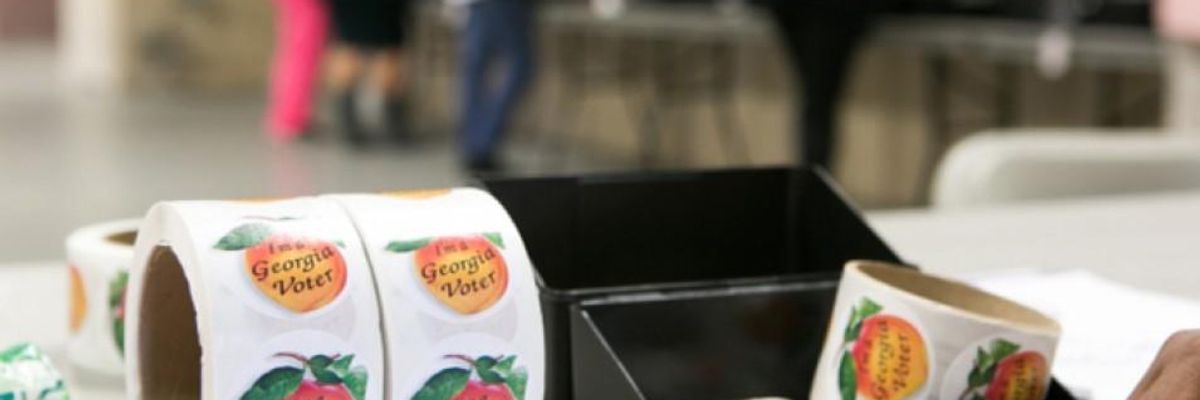
Georgia was among the southern states where hundreds of polling places have been closed since the U.S. Supreme Court overturned part of the Voting Rights Act in 2013, a new report by the Leadership Conference on Civil Rights revealed. (Photo: Jessica McGowan/Getty Images)
Civil rights advocates said Tuesday that The U.S. Supreme Court must restore a key provision of the Voting Rights Act after a sweeping new report showed how the court's decision led to the closure of nearly 1,700 polling places across the American South.
The Leadership Conference Education Fund's study, "Democracy Diverted," revealed Tuesday that nearly 1,200 of the polling places were closed between the 2014 and 2018 midterm elections, "underscoring the scale of this assault on U.S. democracy."
The group is the research and education arm of the Leadership Conference on Civil Rights Under Law, the nation's largest coalition of civil rights groups.
"We must recognize that closures are taking place at alarming speed amid broader efforts to prevent people of color from voting," said Vanita Gupta, president and CEO of the Leadership Conference. "And meanwhile, states are under no obligation to evaluate the discriminatory impacts of such closures. This is exactly why we need to restore the Voting Rights Act and all of its protections."
In its 2013 ruling on Shelby County vs. Holder, the Supreme Court invalidated Section 5 of the Voting Rights Act. The provision mandated that voting precincts and counties with a history of racial discrimination must seek "preclearance" or approval of any changes in voting rules that could affect minority voters' access to the polls.
Gupta testified before the House Judiciary Committee on Tuesday hours after the report was released, explaining Shelby County vs. Holder's far-reaching impact on marginalized communities, especially under the Trump administration.
"Restoring preclearance is all the more important under an administration that refuses to challenge discriminatory voting measures," Gupta said. "Not a single case has been opened, including barriers to registration, restrictive voter ID requirements, and polling place closures."
States across the South have shuttered hundreds of polling locations in the wake of the decision, with many of the closures in counties heavily populated by black and Latinx voters.
Texas, Arizona, and Georgia were the worst offenders between 2012 and 2018, the Leadership Conference revealed.
Texas alone closed 750 locations, and 13 out 15 counties in Arizona--a state where 30 percent of the population is Latinox--shuttered polling places. Maricopa County, where 31 percent of residents are Latinx, closed more locations than any of the 757 counties the Leadership Conference examined.
"Without Section 5 of the VRA, we cannot assess the impact these mass closures have on communities of color," the group said.
In Georgia, where nearly a third of the population is African American, seven counties were left with a single polling place. Voters in Warren County, which is 61 percent black, saw 83 percent of their polling locations shut down while Lumpkin County closed 89 percent of its polling places.
On social media, Heather Hargreaves, manager for Democrat Tom Steyer's 2020 presidential campaign, suggested the closure of nearly 2,000 polling places across the South--like Republicans' opposition to laws expanding access to the polls for all Americans--reveals the party's fear of a true democracy.
The Supreme Court's failure to defend all Americans' right to participate in the democratic process, said Gupta, "will only lead to more of the same: a democracy for some, but not for all."
Dear Common Dreams reader, It’s been nearly 30 years since I co-founded Common Dreams with my late wife, Lina Newhouser. We had the radical notion that journalism should serve the public good, not corporate profits. It was clear to us from the outset what it would take to build such a project. No paid advertisements. No corporate sponsors. No millionaire publisher telling us what to think or do. Many people said we wouldn't last a year, but we proved those doubters wrong. Together with a tremendous team of journalists and dedicated staff, we built an independent media outlet free from the constraints of profits and corporate control. Our mission has always been simple: To inform. To inspire. To ignite change for the common good. Building Common Dreams was not easy. Our survival was never guaranteed. When you take on the most powerful forces—Wall Street greed, fossil fuel industry destruction, Big Tech lobbyists, and uber-rich oligarchs who have spent billions upon billions rigging the economy and democracy in their favor—the only bulwark you have is supporters who believe in your work. But here’s the urgent message from me today. It's never been this bad out there. And it's never been this hard to keep us going. At the very moment Common Dreams is most needed, the threats we face are intensifying. We need your support now more than ever. We don't accept corporate advertising and never will. We don't have a paywall because we don't think people should be blocked from critical news based on their ability to pay. Everything we do is funded by the donations of readers like you. When everyone does the little they can afford, we are strong. But if that support retreats or dries up, so do we. Will you donate now to make sure Common Dreams not only survives but thrives? —Craig Brown, Co-founder |
Civil rights advocates said Tuesday that The U.S. Supreme Court must restore a key provision of the Voting Rights Act after a sweeping new report showed how the court's decision led to the closure of nearly 1,700 polling places across the American South.
The Leadership Conference Education Fund's study, "Democracy Diverted," revealed Tuesday that nearly 1,200 of the polling places were closed between the 2014 and 2018 midterm elections, "underscoring the scale of this assault on U.S. democracy."
The group is the research and education arm of the Leadership Conference on Civil Rights Under Law, the nation's largest coalition of civil rights groups.
"We must recognize that closures are taking place at alarming speed amid broader efforts to prevent people of color from voting," said Vanita Gupta, president and CEO of the Leadership Conference. "And meanwhile, states are under no obligation to evaluate the discriminatory impacts of such closures. This is exactly why we need to restore the Voting Rights Act and all of its protections."
In its 2013 ruling on Shelby County vs. Holder, the Supreme Court invalidated Section 5 of the Voting Rights Act. The provision mandated that voting precincts and counties with a history of racial discrimination must seek "preclearance" or approval of any changes in voting rules that could affect minority voters' access to the polls.
Gupta testified before the House Judiciary Committee on Tuesday hours after the report was released, explaining Shelby County vs. Holder's far-reaching impact on marginalized communities, especially under the Trump administration.
"Restoring preclearance is all the more important under an administration that refuses to challenge discriminatory voting measures," Gupta said. "Not a single case has been opened, including barriers to registration, restrictive voter ID requirements, and polling place closures."
States across the South have shuttered hundreds of polling locations in the wake of the decision, with many of the closures in counties heavily populated by black and Latinx voters.
Texas, Arizona, and Georgia were the worst offenders between 2012 and 2018, the Leadership Conference revealed.
Texas alone closed 750 locations, and 13 out 15 counties in Arizona--a state where 30 percent of the population is Latinox--shuttered polling places. Maricopa County, where 31 percent of residents are Latinx, closed more locations than any of the 757 counties the Leadership Conference examined.
"Without Section 5 of the VRA, we cannot assess the impact these mass closures have on communities of color," the group said.
In Georgia, where nearly a third of the population is African American, seven counties were left with a single polling place. Voters in Warren County, which is 61 percent black, saw 83 percent of their polling locations shut down while Lumpkin County closed 89 percent of its polling places.
On social media, Heather Hargreaves, manager for Democrat Tom Steyer's 2020 presidential campaign, suggested the closure of nearly 2,000 polling places across the South--like Republicans' opposition to laws expanding access to the polls for all Americans--reveals the party's fear of a true democracy.
The Supreme Court's failure to defend all Americans' right to participate in the democratic process, said Gupta, "will only lead to more of the same: a democracy for some, but not for all."
Civil rights advocates said Tuesday that The U.S. Supreme Court must restore a key provision of the Voting Rights Act after a sweeping new report showed how the court's decision led to the closure of nearly 1,700 polling places across the American South.
The Leadership Conference Education Fund's study, "Democracy Diverted," revealed Tuesday that nearly 1,200 of the polling places were closed between the 2014 and 2018 midterm elections, "underscoring the scale of this assault on U.S. democracy."
The group is the research and education arm of the Leadership Conference on Civil Rights Under Law, the nation's largest coalition of civil rights groups.
"We must recognize that closures are taking place at alarming speed amid broader efforts to prevent people of color from voting," said Vanita Gupta, president and CEO of the Leadership Conference. "And meanwhile, states are under no obligation to evaluate the discriminatory impacts of such closures. This is exactly why we need to restore the Voting Rights Act and all of its protections."
In its 2013 ruling on Shelby County vs. Holder, the Supreme Court invalidated Section 5 of the Voting Rights Act. The provision mandated that voting precincts and counties with a history of racial discrimination must seek "preclearance" or approval of any changes in voting rules that could affect minority voters' access to the polls.
Gupta testified before the House Judiciary Committee on Tuesday hours after the report was released, explaining Shelby County vs. Holder's far-reaching impact on marginalized communities, especially under the Trump administration.
"Restoring preclearance is all the more important under an administration that refuses to challenge discriminatory voting measures," Gupta said. "Not a single case has been opened, including barriers to registration, restrictive voter ID requirements, and polling place closures."
States across the South have shuttered hundreds of polling locations in the wake of the decision, with many of the closures in counties heavily populated by black and Latinx voters.
Texas, Arizona, and Georgia were the worst offenders between 2012 and 2018, the Leadership Conference revealed.
Texas alone closed 750 locations, and 13 out 15 counties in Arizona--a state where 30 percent of the population is Latinox--shuttered polling places. Maricopa County, where 31 percent of residents are Latinx, closed more locations than any of the 757 counties the Leadership Conference examined.
"Without Section 5 of the VRA, we cannot assess the impact these mass closures have on communities of color," the group said.
In Georgia, where nearly a third of the population is African American, seven counties were left with a single polling place. Voters in Warren County, which is 61 percent black, saw 83 percent of their polling locations shut down while Lumpkin County closed 89 percent of its polling places.
On social media, Heather Hargreaves, manager for Democrat Tom Steyer's 2020 presidential campaign, suggested the closure of nearly 2,000 polling places across the South--like Republicans' opposition to laws expanding access to the polls for all Americans--reveals the party's fear of a true democracy.
The Supreme Court's failure to defend all Americans' right to participate in the democratic process, said Gupta, "will only lead to more of the same: a democracy for some, but not for all."