SUBSCRIBE TO OUR FREE NEWSLETTER
Daily news & progressive opinion—funded by the people, not the corporations—delivered straight to your inbox.
5
#000000
#FFFFFF
To donate by check, phone, or other method, see our More Ways to Give page.
Daily news & progressive opinion—funded by the people, not the corporations—delivered straight to your inbox.
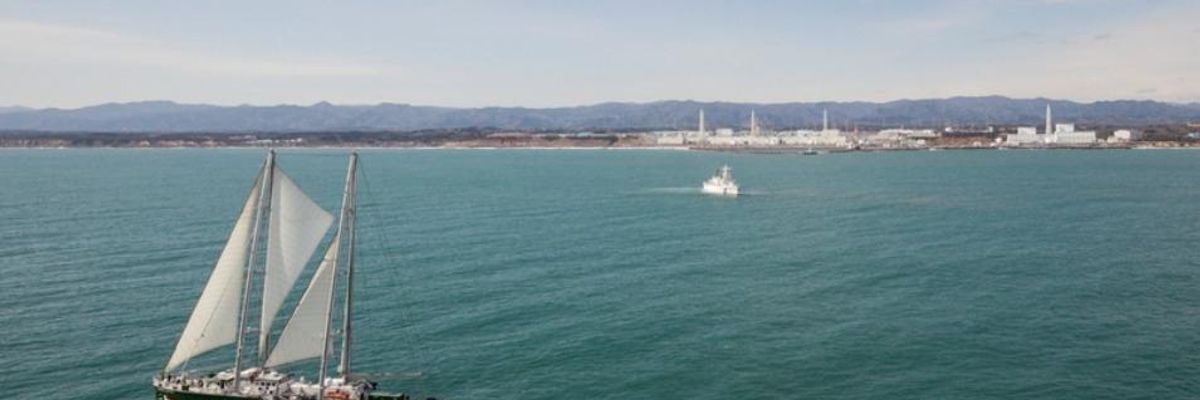
Greenpeace ship Rainbow Warrior sailing past the destroyed Fukushima Daiichi nuclear plant, five years after the plant's accident. (Photo: Christian Aslund/Greenpeace)
The far-reaching dangers of nuclear power were on full display Tuesday as Japan's environmental minister recommended releasing more than one million tons of radioactive wastewater from the Fukushima Daiichi plant into the Pacific Ocean nearly a decade after a tsunami caused a meltdown at the coastal facility.
"There are no other options" other than dumping the water into the ocean and diluting it, Yoshiaki Harada said at a news conference in Tokyo.
Chief cabinet secretary Yoshihide Suga disputed Harada's claim, saying the government has not settled on a method of disposing of the wastewater. Other options include vaporizing the water and storing it on land.
But critics on social media said the suggestion of pouring contaminated water into the Pacific is more than enough evidence that the risks associated with nuclear power are too great to continue running plants like Fukushima.
The wastewater has been stored in tanks at Fukushima since the 2011 tsunami, when a meltdown at the plant forced the evacuation of tens of thousands of people.
For years since the disaster, the plant has pumped tens of thousands of tons of water to help cool its damaged reactor cores and keep them from melting. After the water is used and contaminated with radionuclides and radioactive isotopes, it is stored in the tanks, but the plant expects to run out of room in 2022.
The Atomic Energy Society of Japan said recently that it could take 17 years for water to meet safety standards after it is diluted.
Greenpeace, which has long called on the Japanese government to invest in technology to remove radioactivity from the water, said the environmental minister's proposal is unacceptable.
"The government must commit to the only environmentally acceptable option for managing this water crisis which is long-term storage and processing to remove radioactivity, including tritium," Shaun Burnie, a senior nuclear specialist the group's German office, told France 24.
The government of neighboring South Korea expressed grave concerns over the potential plan to dump the water into the Pacific, saying it planned to work closely with Japan to come up with an alternative.
"The South Korean government is well aware of the impact of the treatment of the contaminated water from the Fukushima nuclear power plant on the health and safety of the people of both countries, and to the entire nation," the government said.
Dear Common Dreams reader, It’s been nearly 30 years since I co-founded Common Dreams with my late wife, Lina Newhouser. We had the radical notion that journalism should serve the public good, not corporate profits. It was clear to us from the outset what it would take to build such a project. No paid advertisements. No corporate sponsors. No millionaire publisher telling us what to think or do. Many people said we wouldn't last a year, but we proved those doubters wrong. Together with a tremendous team of journalists and dedicated staff, we built an independent media outlet free from the constraints of profits and corporate control. Our mission has always been simple: To inform. To inspire. To ignite change for the common good. Building Common Dreams was not easy. Our survival was never guaranteed. When you take on the most powerful forces—Wall Street greed, fossil fuel industry destruction, Big Tech lobbyists, and uber-rich oligarchs who have spent billions upon billions rigging the economy and democracy in their favor—the only bulwark you have is supporters who believe in your work. But here’s the urgent message from me today. It's never been this bad out there. And it's never been this hard to keep us going. At the very moment Common Dreams is most needed, the threats we face are intensifying. We need your support now more than ever. We don't accept corporate advertising and never will. We don't have a paywall because we don't think people should be blocked from critical news based on their ability to pay. Everything we do is funded by the donations of readers like you. When everyone does the little they can afford, we are strong. But if that support retreats or dries up, so do we. Will you donate now to make sure Common Dreams not only survives but thrives? —Craig Brown, Co-founder |
The far-reaching dangers of nuclear power were on full display Tuesday as Japan's environmental minister recommended releasing more than one million tons of radioactive wastewater from the Fukushima Daiichi plant into the Pacific Ocean nearly a decade after a tsunami caused a meltdown at the coastal facility.
"There are no other options" other than dumping the water into the ocean and diluting it, Yoshiaki Harada said at a news conference in Tokyo.
Chief cabinet secretary Yoshihide Suga disputed Harada's claim, saying the government has not settled on a method of disposing of the wastewater. Other options include vaporizing the water and storing it on land.
But critics on social media said the suggestion of pouring contaminated water into the Pacific is more than enough evidence that the risks associated with nuclear power are too great to continue running plants like Fukushima.
The wastewater has been stored in tanks at Fukushima since the 2011 tsunami, when a meltdown at the plant forced the evacuation of tens of thousands of people.
For years since the disaster, the plant has pumped tens of thousands of tons of water to help cool its damaged reactor cores and keep them from melting. After the water is used and contaminated with radionuclides and radioactive isotopes, it is stored in the tanks, but the plant expects to run out of room in 2022.
The Atomic Energy Society of Japan said recently that it could take 17 years for water to meet safety standards after it is diluted.
Greenpeace, which has long called on the Japanese government to invest in technology to remove radioactivity from the water, said the environmental minister's proposal is unacceptable.
"The government must commit to the only environmentally acceptable option for managing this water crisis which is long-term storage and processing to remove radioactivity, including tritium," Shaun Burnie, a senior nuclear specialist the group's German office, told France 24.
The government of neighboring South Korea expressed grave concerns over the potential plan to dump the water into the Pacific, saying it planned to work closely with Japan to come up with an alternative.
"The South Korean government is well aware of the impact of the treatment of the contaminated water from the Fukushima nuclear power plant on the health and safety of the people of both countries, and to the entire nation," the government said.
The far-reaching dangers of nuclear power were on full display Tuesday as Japan's environmental minister recommended releasing more than one million tons of radioactive wastewater from the Fukushima Daiichi plant into the Pacific Ocean nearly a decade after a tsunami caused a meltdown at the coastal facility.
"There are no other options" other than dumping the water into the ocean and diluting it, Yoshiaki Harada said at a news conference in Tokyo.
Chief cabinet secretary Yoshihide Suga disputed Harada's claim, saying the government has not settled on a method of disposing of the wastewater. Other options include vaporizing the water and storing it on land.
But critics on social media said the suggestion of pouring contaminated water into the Pacific is more than enough evidence that the risks associated with nuclear power are too great to continue running plants like Fukushima.
The wastewater has been stored in tanks at Fukushima since the 2011 tsunami, when a meltdown at the plant forced the evacuation of tens of thousands of people.
For years since the disaster, the plant has pumped tens of thousands of tons of water to help cool its damaged reactor cores and keep them from melting. After the water is used and contaminated with radionuclides and radioactive isotopes, it is stored in the tanks, but the plant expects to run out of room in 2022.
The Atomic Energy Society of Japan said recently that it could take 17 years for water to meet safety standards after it is diluted.
Greenpeace, which has long called on the Japanese government to invest in technology to remove radioactivity from the water, said the environmental minister's proposal is unacceptable.
"The government must commit to the only environmentally acceptable option for managing this water crisis which is long-term storage and processing to remove radioactivity, including tritium," Shaun Burnie, a senior nuclear specialist the group's German office, told France 24.
The government of neighboring South Korea expressed grave concerns over the potential plan to dump the water into the Pacific, saying it planned to work closely with Japan to come up with an alternative.
"The South Korean government is well aware of the impact of the treatment of the contaminated water from the Fukushima nuclear power plant on the health and safety of the people of both countries, and to the entire nation," the government said.