

SUBSCRIBE TO OUR FREE NEWSLETTER
Daily news & progressive opinion—funded by the people, not the corporations—delivered straight to your inbox.
5
#000000
#FFFFFF
To donate by check, phone, or other method, see our More Ways to Give page.
Daily news & progressive opinion—funded by the people, not the corporations—delivered straight to your inbox.
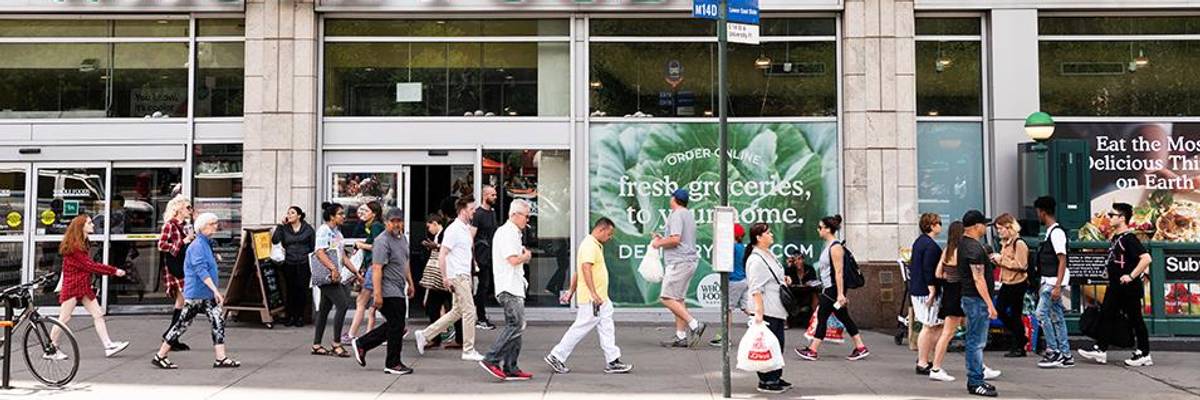
Whole Foods Market in Union Square in New York City. Whole Foods owner Jeff Bezos slashed benefits for employees on Thursday. (Photo by Michael Brochstein/SOPA Images/LightRocket via Getty Images)
Amazon founder Jeff Bezos on Thursday cut benefits for part-time workers at his grocery chain Whole Foods, drawing criticism from the left for a move that could leave thousands of people without health insurance.
"Jeff Bezos is the richest man in the world," Boston-based activist Jonathan Cohn said on Twitter. "This is disgusting."
"Recall that one of Bezos's first acts as publisher of the Washington Post was to cut his staff's retirement benefits."
--writer Elon Green
Business Insider reporter Hayley Peterson broke the story. The decision will affect 1,900 of the business's 95,000 workers--the ones who work part-time, or around 20 hours a week.
"We are providing team members with resources to find alternative healthcare coverage options, or to explore full-time, healthcare-eligible positions starting at 30 hours per week," a Whole Foods spokesperson told Peterson. "All Whole Foods Market team members continue to receive employment benefits including a 20% in-store discount."
One employee, who has been working for the company for 15 years but felt anonymity was necessary to avoid retribution for speaking out, said she was devastated by the news.
"I am in shock," said the employee. "I've worked here 15 years. This is why I keep the job--because of my benefits."
Producer Jennifer Solotaroff took to Twitter to tell her story of being a Whole Foods employee and to explain to her audience the importance of benefits for the company's part-time staff.
"I worked at Whole Foods and it was the kind of job where people were able to work and go about their life," said Solotaroff. "Employees were taken care of and you could feel it--the morale was great, it was a diverse environment, and employees felt supported. So much of that had to do with coverage."
The news of Bezos's decision didn't come as a surprise to writer Elon Green.
"Recall that one of Bezos's first acts as publisher of The Washington Post was to cut his staff's retirement benefits," Green tweeted.
The move came less than a month after Bezos signed a pledge to invest in workers, The Verge explained:
Last month, Amazon joined a number of other tech companies and Fortune 500 firms in signing a letter outlining the purpose of a corporation as something not just designed to return shareholder value, but also to serve employees and the community. "Each of our stakeholders is essential," the pledge read. "We commit to deliver value to all of them, for the future success of our companies, our communities and our country."
That disconnect between words and actions, Business Insider columnist Bob Bryan said, proves there's no substitute for solidarity.
"The Whole Foods decision is not just hypocritical of Bezos, but also proves why workers should never put too much trust in kind words from CEOs and instead push for lasting changes to uphold their interests and those of their coworkers," Bryan wrote.
Dear Common Dreams reader, It’s been nearly 30 years since I co-founded Common Dreams with my late wife, Lina Newhouser. We had the radical notion that journalism should serve the public good, not corporate profits. It was clear to us from the outset what it would take to build such a project. No paid advertisements. No corporate sponsors. No millionaire publisher telling us what to think or do. Many people said we wouldn't last a year, but we proved those doubters wrong. Together with a tremendous team of journalists and dedicated staff, we built an independent media outlet free from the constraints of profits and corporate control. Our mission has always been simple: To inform. To inspire. To ignite change for the common good. Building Common Dreams was not easy. Our survival was never guaranteed. When you take on the most powerful forces—Wall Street greed, fossil fuel industry destruction, Big Tech lobbyists, and uber-rich oligarchs who have spent billions upon billions rigging the economy and democracy in their favor—the only bulwark you have is supporters who believe in your work. But here’s the urgent message from me today. It's never been this bad out there. And it's never been this hard to keep us going. At the very moment Common Dreams is most needed, the threats we face are intensifying. We need your support now more than ever. We don't accept corporate advertising and never will. We don't have a paywall because we don't think people should be blocked from critical news based on their ability to pay. Everything we do is funded by the donations of readers like you. When everyone does the little they can afford, we are strong. But if that support retreats or dries up, so do we. Will you donate now to make sure Common Dreams not only survives but thrives? —Craig Brown, Co-founder |
Amazon founder Jeff Bezos on Thursday cut benefits for part-time workers at his grocery chain Whole Foods, drawing criticism from the left for a move that could leave thousands of people without health insurance.
"Jeff Bezos is the richest man in the world," Boston-based activist Jonathan Cohn said on Twitter. "This is disgusting."
"Recall that one of Bezos's first acts as publisher of the Washington Post was to cut his staff's retirement benefits."
--writer Elon Green
Business Insider reporter Hayley Peterson broke the story. The decision will affect 1,900 of the business's 95,000 workers--the ones who work part-time, or around 20 hours a week.
"We are providing team members with resources to find alternative healthcare coverage options, or to explore full-time, healthcare-eligible positions starting at 30 hours per week," a Whole Foods spokesperson told Peterson. "All Whole Foods Market team members continue to receive employment benefits including a 20% in-store discount."
One employee, who has been working for the company for 15 years but felt anonymity was necessary to avoid retribution for speaking out, said she was devastated by the news.
"I am in shock," said the employee. "I've worked here 15 years. This is why I keep the job--because of my benefits."
Producer Jennifer Solotaroff took to Twitter to tell her story of being a Whole Foods employee and to explain to her audience the importance of benefits for the company's part-time staff.
"I worked at Whole Foods and it was the kind of job where people were able to work and go about their life," said Solotaroff. "Employees were taken care of and you could feel it--the morale was great, it was a diverse environment, and employees felt supported. So much of that had to do with coverage."
The news of Bezos's decision didn't come as a surprise to writer Elon Green.
"Recall that one of Bezos's first acts as publisher of The Washington Post was to cut his staff's retirement benefits," Green tweeted.
The move came less than a month after Bezos signed a pledge to invest in workers, The Verge explained:
Last month, Amazon joined a number of other tech companies and Fortune 500 firms in signing a letter outlining the purpose of a corporation as something not just designed to return shareholder value, but also to serve employees and the community. "Each of our stakeholders is essential," the pledge read. "We commit to deliver value to all of them, for the future success of our companies, our communities and our country."
That disconnect between words and actions, Business Insider columnist Bob Bryan said, proves there's no substitute for solidarity.
"The Whole Foods decision is not just hypocritical of Bezos, but also proves why workers should never put too much trust in kind words from CEOs and instead push for lasting changes to uphold their interests and those of their coworkers," Bryan wrote.
Amazon founder Jeff Bezos on Thursday cut benefits for part-time workers at his grocery chain Whole Foods, drawing criticism from the left for a move that could leave thousands of people without health insurance.
"Jeff Bezos is the richest man in the world," Boston-based activist Jonathan Cohn said on Twitter. "This is disgusting."
"Recall that one of Bezos's first acts as publisher of the Washington Post was to cut his staff's retirement benefits."
--writer Elon Green
Business Insider reporter Hayley Peterson broke the story. The decision will affect 1,900 of the business's 95,000 workers--the ones who work part-time, or around 20 hours a week.
"We are providing team members with resources to find alternative healthcare coverage options, or to explore full-time, healthcare-eligible positions starting at 30 hours per week," a Whole Foods spokesperson told Peterson. "All Whole Foods Market team members continue to receive employment benefits including a 20% in-store discount."
One employee, who has been working for the company for 15 years but felt anonymity was necessary to avoid retribution for speaking out, said she was devastated by the news.
"I am in shock," said the employee. "I've worked here 15 years. This is why I keep the job--because of my benefits."
Producer Jennifer Solotaroff took to Twitter to tell her story of being a Whole Foods employee and to explain to her audience the importance of benefits for the company's part-time staff.
"I worked at Whole Foods and it was the kind of job where people were able to work and go about their life," said Solotaroff. "Employees were taken care of and you could feel it--the morale was great, it was a diverse environment, and employees felt supported. So much of that had to do with coverage."
The news of Bezos's decision didn't come as a surprise to writer Elon Green.
"Recall that one of Bezos's first acts as publisher of The Washington Post was to cut his staff's retirement benefits," Green tweeted.
The move came less than a month after Bezos signed a pledge to invest in workers, The Verge explained:
Last month, Amazon joined a number of other tech companies and Fortune 500 firms in signing a letter outlining the purpose of a corporation as something not just designed to return shareholder value, but also to serve employees and the community. "Each of our stakeholders is essential," the pledge read. "We commit to deliver value to all of them, for the future success of our companies, our communities and our country."
That disconnect between words and actions, Business Insider columnist Bob Bryan said, proves there's no substitute for solidarity.
"The Whole Foods decision is not just hypocritical of Bezos, but also proves why workers should never put too much trust in kind words from CEOs and instead push for lasting changes to uphold their interests and those of their coworkers," Bryan wrote.

