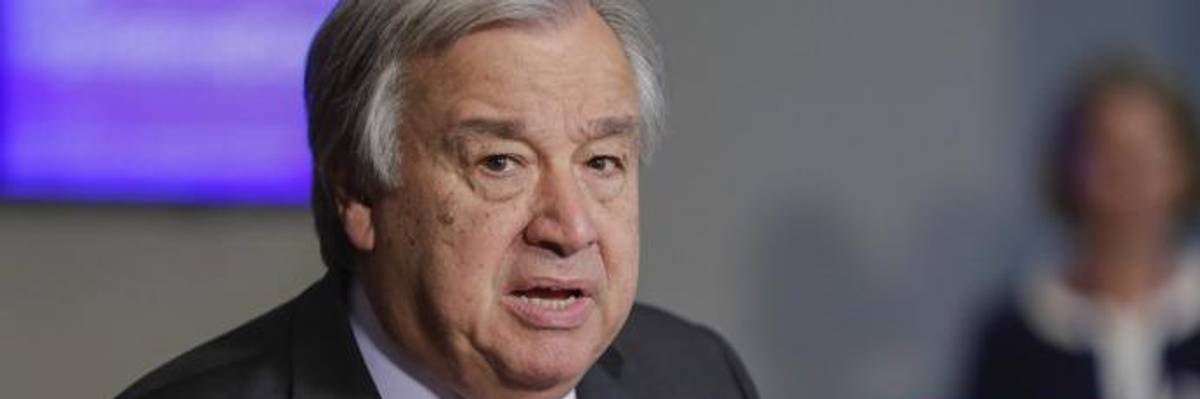
Secretary-General Antonio Guterres at the United Nations in New York City on June 18, 2019. (Photo: EuropaNewswire/Gado/Getty Images)
'This Really Is Something': UN Chief Praised for Move to Block Coal-Backing Nations From Speaking at Climate Summit
The U.N. had already announced that only leaders with a clear climate action plan would be allowed to speak, and it appears the secretary-general is following through on that directive.
United Nations Secretary-General Antonio Guterres drew praise Wednesday for taking what supporters called a "powerful stand" to address the climate crisis. Guterres will reportedly exclude major economies, including the United States, from talking at the upcoming U.N. Climate Action Summit because of their failure to produce appropriately ambitious climate plans and their ongoing support for coal.
"This really is something. Thanks to Antonio Guterres," tweeted 350.org co-founder Bill McKibben.
Leslie Hook reported at the Financial Times Tuesday on the exclusions, citing a draft schedule of the summit, set take place Monday. Australia, Japan, South Korea, and South Africa will be snubbed over their continued support for coal. Brazil and Saudi Arabia, both of whom have criticized the Paris climate accord, will also be blocked. The Trump White House, which announced its plans to ditch the deal, will also not be afforded a speaking slot, Hook reported.
Justin Guay, director for global climate strategy at the Australia-based Sunrise Project, framed the move by Guterres as potentially unprecedented.
Clean air campaigner Callum Grieve, in a tweet, suggested it was no surprise. "Did they not get the memo?" he wrote.
Indeed, a FAQ for the summit states:
The summit will focus on tangible climate actions. It will not be a summit of national speeches. Rather, the summit will consist of selected commitments of coalitions of countries, companies, and civil society announcing a range of truly ambitious and credible actions and commitments as well as any national announcement in line with the secretary-general's objective for the summit.
It adds:
The summit will serve as a public platform [...] only for leaders--member states, as well as finance, business, civil society, and local leaders from public and private sectors--who are ready to:
- mobilize and raise political ambition that will result in enhanced and irreversible commitments to action in national climate plans to significantly cut emissions; strengthen climate resilience; and making public and private finance flows consistent with a pathway towards low greenhouse gas emissions and climate-resilient development;
- galvanize bottom-up action from cities, regions, civil society, but also private sector;
- contribute to the multi-stakeholder coalitions that will develop ambitious solutions in the action areas of the Summit: global transition to renewable energy; sustainable and resilient infrastructures and cities; sustainable agriculture and management of forests and oceans; resilience and adaptation to climate impacts; and alignment of public and private finance with a net zero economy.
Writing for news collaboration Covering Climate Now this week, Mark Hertsgaard also noted that Guterres had laid down the gauntlet to world leaders:
Don't bring a speech--bring a plan, Guterres famously told heads of state and government in the months leading up to this summit, and it appears that only leaders who followed his instructions will be allowed to speak at the plenary session. To gain a slot, a country had to commit to doing one of three things, said U.N. officials: be carbon neutral by 2050; "significantly" increase how much it will cut emissions (or, in U.N. jargon, significantly strengthen its Nationally Determined Contribution); or make a "meaningful" pledge to the Green Climate Fund, a pool of money provided by wealthy countries to help developing countries leave fossil fuels behind and increase their resilience against climate disruption. U.N. officials expect that 60 to 70 countries will have made sufficiently solid commitments by next Monday that their leaders will be invited to outline their country's plans from the dais, with each leader granted a mere three minutes to speak.
Vox climate writer David Roberts also praised Guterres for the strong move against coal.
"In the endlessly formal, scrupulously polite world of diplomacy, this is a big deal: the U.N. general-secretary is publicly shaming countries that fund new coal plants," Roberts tweeted. "This kind of social license--or withdrawal of social license--matters!"

Urgent. It's never been this bad.
Dear Common Dreams reader, It’s been nearly 30 years since I co-founded Common Dreams with my late wife, Lina Newhouser. We had the radical notion that journalism should serve the public good, not corporate profits. It was clear to us from the outset what it would take to build such a project. No paid advertisements. No corporate sponsors. No millionaire publisher telling us what to think or do. Many people said we wouldn't last a year, but we proved those doubters wrong. Together with a tremendous team of journalists and dedicated staff, we built an independent media outlet free from the constraints of profits and corporate control. Our mission from the outset was simple. To inform. To inspire. To ignite change for the common good. Building Common Dreams was not easy. Our survival was never guaranteed. When you take on the most powerful forces—Wall Street greed, fossil fuel industry destruction, Big Tech lobbyists, and uber-rich oligarchs who have spent billions upon billions rigging the economy and democracy in their favor—the only bulwark you have is supporters who believe in your work. But here’s the urgent message from me today. It’s never been this bad out there. And it’s never been this hard to keep us going. At the very moment Common Dreams is most needed and doing some of its best and most important work, the threats we face are intensifying. Right now, with just two days to go in our Spring Campaign, we're falling short of our make-or-break goal. When everyone does the little they can afford, we are strong. But if that support retreats or dries up, so do we. Can you make a gift right now to make sure Common Dreams not only survives but thrives? There is no backup plan or rainy day fund. There is only you. —Craig Brown, Co-founder |
United Nations Secretary-General Antonio Guterres drew praise Wednesday for taking what supporters called a "powerful stand" to address the climate crisis. Guterres will reportedly exclude major economies, including the United States, from talking at the upcoming U.N. Climate Action Summit because of their failure to produce appropriately ambitious climate plans and their ongoing support for coal.
"This really is something. Thanks to Antonio Guterres," tweeted 350.org co-founder Bill McKibben.
Leslie Hook reported at the Financial Times Tuesday on the exclusions, citing a draft schedule of the summit, set take place Monday. Australia, Japan, South Korea, and South Africa will be snubbed over their continued support for coal. Brazil and Saudi Arabia, both of whom have criticized the Paris climate accord, will also be blocked. The Trump White House, which announced its plans to ditch the deal, will also not be afforded a speaking slot, Hook reported.
Justin Guay, director for global climate strategy at the Australia-based Sunrise Project, framed the move by Guterres as potentially unprecedented.
Clean air campaigner Callum Grieve, in a tweet, suggested it was no surprise. "Did they not get the memo?" he wrote.
Indeed, a FAQ for the summit states:
The summit will focus on tangible climate actions. It will not be a summit of national speeches. Rather, the summit will consist of selected commitments of coalitions of countries, companies, and civil society announcing a range of truly ambitious and credible actions and commitments as well as any national announcement in line with the secretary-general's objective for the summit.
It adds:
The summit will serve as a public platform [...] only for leaders--member states, as well as finance, business, civil society, and local leaders from public and private sectors--who are ready to:
- mobilize and raise political ambition that will result in enhanced and irreversible commitments to action in national climate plans to significantly cut emissions; strengthen climate resilience; and making public and private finance flows consistent with a pathway towards low greenhouse gas emissions and climate-resilient development;
- galvanize bottom-up action from cities, regions, civil society, but also private sector;
- contribute to the multi-stakeholder coalitions that will develop ambitious solutions in the action areas of the Summit: global transition to renewable energy; sustainable and resilient infrastructures and cities; sustainable agriculture and management of forests and oceans; resilience and adaptation to climate impacts; and alignment of public and private finance with a net zero economy.
Writing for news collaboration Covering Climate Now this week, Mark Hertsgaard also noted that Guterres had laid down the gauntlet to world leaders:
Don't bring a speech--bring a plan, Guterres famously told heads of state and government in the months leading up to this summit, and it appears that only leaders who followed his instructions will be allowed to speak at the plenary session. To gain a slot, a country had to commit to doing one of three things, said U.N. officials: be carbon neutral by 2050; "significantly" increase how much it will cut emissions (or, in U.N. jargon, significantly strengthen its Nationally Determined Contribution); or make a "meaningful" pledge to the Green Climate Fund, a pool of money provided by wealthy countries to help developing countries leave fossil fuels behind and increase their resilience against climate disruption. U.N. officials expect that 60 to 70 countries will have made sufficiently solid commitments by next Monday that their leaders will be invited to outline their country's plans from the dais, with each leader granted a mere three minutes to speak.
Vox climate writer David Roberts also praised Guterres for the strong move against coal.
"In the endlessly formal, scrupulously polite world of diplomacy, this is a big deal: the U.N. general-secretary is publicly shaming countries that fund new coal plants," Roberts tweeted. "This kind of social license--or withdrawal of social license--matters!"
United Nations Secretary-General Antonio Guterres drew praise Wednesday for taking what supporters called a "powerful stand" to address the climate crisis. Guterres will reportedly exclude major economies, including the United States, from talking at the upcoming U.N. Climate Action Summit because of their failure to produce appropriately ambitious climate plans and their ongoing support for coal.
"This really is something. Thanks to Antonio Guterres," tweeted 350.org co-founder Bill McKibben.
Leslie Hook reported at the Financial Times Tuesday on the exclusions, citing a draft schedule of the summit, set take place Monday. Australia, Japan, South Korea, and South Africa will be snubbed over their continued support for coal. Brazil and Saudi Arabia, both of whom have criticized the Paris climate accord, will also be blocked. The Trump White House, which announced its plans to ditch the deal, will also not be afforded a speaking slot, Hook reported.
Justin Guay, director for global climate strategy at the Australia-based Sunrise Project, framed the move by Guterres as potentially unprecedented.
Clean air campaigner Callum Grieve, in a tweet, suggested it was no surprise. "Did they not get the memo?" he wrote.
Indeed, a FAQ for the summit states:
The summit will focus on tangible climate actions. It will not be a summit of national speeches. Rather, the summit will consist of selected commitments of coalitions of countries, companies, and civil society announcing a range of truly ambitious and credible actions and commitments as well as any national announcement in line with the secretary-general's objective for the summit.
It adds:
The summit will serve as a public platform [...] only for leaders--member states, as well as finance, business, civil society, and local leaders from public and private sectors--who are ready to:
- mobilize and raise political ambition that will result in enhanced and irreversible commitments to action in national climate plans to significantly cut emissions; strengthen climate resilience; and making public and private finance flows consistent with a pathway towards low greenhouse gas emissions and climate-resilient development;
- galvanize bottom-up action from cities, regions, civil society, but also private sector;
- contribute to the multi-stakeholder coalitions that will develop ambitious solutions in the action areas of the Summit: global transition to renewable energy; sustainable and resilient infrastructures and cities; sustainable agriculture and management of forests and oceans; resilience and adaptation to climate impacts; and alignment of public and private finance with a net zero economy.
Writing for news collaboration Covering Climate Now this week, Mark Hertsgaard also noted that Guterres had laid down the gauntlet to world leaders:
Don't bring a speech--bring a plan, Guterres famously told heads of state and government in the months leading up to this summit, and it appears that only leaders who followed his instructions will be allowed to speak at the plenary session. To gain a slot, a country had to commit to doing one of three things, said U.N. officials: be carbon neutral by 2050; "significantly" increase how much it will cut emissions (or, in U.N. jargon, significantly strengthen its Nationally Determined Contribution); or make a "meaningful" pledge to the Green Climate Fund, a pool of money provided by wealthy countries to help developing countries leave fossil fuels behind and increase their resilience against climate disruption. U.N. officials expect that 60 to 70 countries will have made sufficiently solid commitments by next Monday that their leaders will be invited to outline their country's plans from the dais, with each leader granted a mere three minutes to speak.
Vox climate writer David Roberts also praised Guterres for the strong move against coal.
"In the endlessly formal, scrupulously polite world of diplomacy, this is a big deal: the U.N. general-secretary is publicly shaming countries that fund new coal plants," Roberts tweeted. "This kind of social license--or withdrawal of social license--matters!"