SUBSCRIBE TO OUR FREE NEWSLETTER
Daily news & progressive opinion—funded by the people, not the corporations—delivered straight to your inbox.
5
#000000
#FFFFFF
To donate by check, phone, or other method, see our More Ways to Give page.
Daily news & progressive opinion—funded by the people, not the corporations—delivered straight to your inbox.
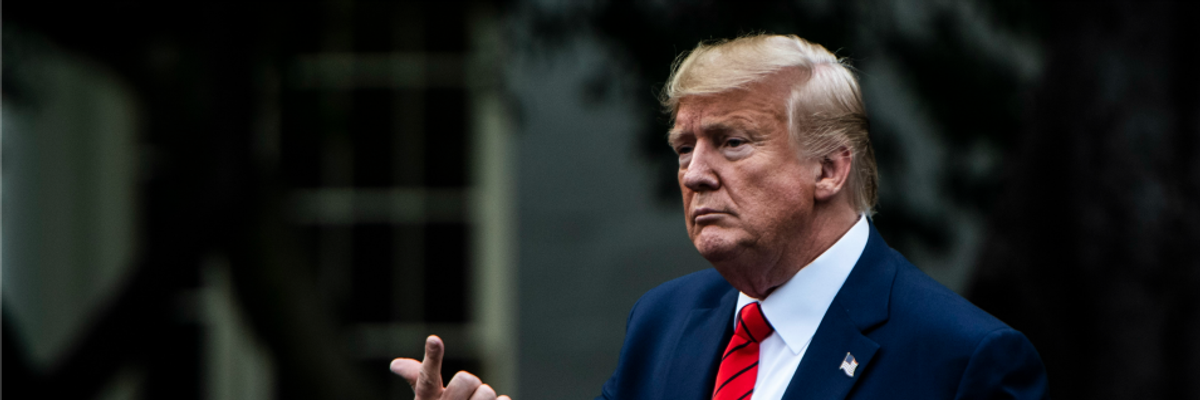
President Donald Trump walks to the Oval Office after attending a ceremony at the South Portico of the White House on Thursday, September 26, 2019 in Washington, D.C. (Photo: Jabin Botsford/The Washington Post via Getty Images)
Lawyers representing the whistleblower who filed a complaint about President Donald Trump's call with Ukraine's leader warned in a letter over the weekend that Trump has put the safety of their client at risk by describing the anonymous individual as a traitor and issuing open threats of retaliation.
"The purpose of this letter is to formally notify you of serious concerns we have regarding our client's personal safety," Andrew Bakaj, the lead attorney for the whistleblower, wrote (pdf) to Acting Director of National Intelligence Joseph Maguire. "The events of the past week have heightened our concerns that our client's identity will be disclosed publicly and that, as a result, our client will be put in harm's way."
"We expect this situation to worsen, and to become even more dangerous for our client and any other whistleblowers."
--Andrew Bakaj, lead attorney for whistleblower
Bakaj cited Trump's suggestion behind closed doors last week that the people who informed the whistleblower should be executed as an example of the president endangering the safety of his client.
"The fact that the president's statement was directed to 'the person that gave the whistleblower the information' does nothing to assuage our concerns for our client's safety," wrote Bakaj. "Unfortunately, we expect this situation to worsen, and to become even more dangerous for our client and any other whistleblowers, as Congress seeks to investigate this matter."
The letter was sent hours before Trump took to Twitter Sunday night to accuse the person who informed the whistleblower of "spying on the U.S. president" and threaten "big consequences."
"Like every American, I deserve to meet my accuser, especially when this accuser, the so-called 'whistleblower,' represented a perfect conversation with a foreign leader in a totally inaccurate and fraudulent way," Trump tweeted. "In addition, I want to meet not only my accuser, who presented SECOND and THIRD HAND INFORMATION, but also the person who illegally gave this information."
Trump's tweets sparked alarm among human rights advocates, who warned the president is clearly attempting to intimidate the whistleblower and others who may be considering sounding the alarm about his behavior.
"Threats against a whistleblower are not only illegal--the Whistleblower Protection Act of 1989--but also indicative of a cover-up," said Kenneth Roth, executive director of Human Rights Watch.
Political scientist Miranda Yaver said in response to Trump's tweets, "If we saw this behavior in another country, the word 'democracy' wouldn't leap to mind."
The whistleblower's complaint, made public last week, alleged a frantic effort by the White House to cover up Trump's conversation with Ukrainian leader Volodymyr Zelensky, in which the U.S. president asked Zelensky to investigate former Vice President Joe Biden.
"In the days following the phone call, I learned from multiple U.S. officials that senior White House officials had intervened to 'lock down' all records of the phone call, especially the official word-for-word transcript of the call that was produced--as is customary--by the White House situation room," the whistleblower said.
Ari Berman, journalist for Mother Jones, said the complaint details misconduct that is "as bad, if not worse, than Watergate."
"Instead of hiring burglars to investigate political rival," Berman said, "Trump asked a foreign government to do it for him and then tried to cover it up."
Dear Common Dreams reader, It’s been nearly 30 years since I co-founded Common Dreams with my late wife, Lina Newhouser. We had the radical notion that journalism should serve the public good, not corporate profits. It was clear to us from the outset what it would take to build such a project. No paid advertisements. No corporate sponsors. No millionaire publisher telling us what to think or do. Many people said we wouldn't last a year, but we proved those doubters wrong. Together with a tremendous team of journalists and dedicated staff, we built an independent media outlet free from the constraints of profits and corporate control. Our mission has always been simple: To inform. To inspire. To ignite change for the common good. Building Common Dreams was not easy. Our survival was never guaranteed. When you take on the most powerful forces—Wall Street greed, fossil fuel industry destruction, Big Tech lobbyists, and uber-rich oligarchs who have spent billions upon billions rigging the economy and democracy in their favor—the only bulwark you have is supporters who believe in your work. But here’s the urgent message from me today. It's never been this bad out there. And it's never been this hard to keep us going. At the very moment Common Dreams is most needed, the threats we face are intensifying. We need your support now more than ever. We don't accept corporate advertising and never will. We don't have a paywall because we don't think people should be blocked from critical news based on their ability to pay. Everything we do is funded by the donations of readers like you. When everyone does the little they can afford, we are strong. But if that support retreats or dries up, so do we. Will you donate now to make sure Common Dreams not only survives but thrives? —Craig Brown, Co-founder |
Lawyers representing the whistleblower who filed a complaint about President Donald Trump's call with Ukraine's leader warned in a letter over the weekend that Trump has put the safety of their client at risk by describing the anonymous individual as a traitor and issuing open threats of retaliation.
"The purpose of this letter is to formally notify you of serious concerns we have regarding our client's personal safety," Andrew Bakaj, the lead attorney for the whistleblower, wrote (pdf) to Acting Director of National Intelligence Joseph Maguire. "The events of the past week have heightened our concerns that our client's identity will be disclosed publicly and that, as a result, our client will be put in harm's way."
"We expect this situation to worsen, and to become even more dangerous for our client and any other whistleblowers."
--Andrew Bakaj, lead attorney for whistleblower
Bakaj cited Trump's suggestion behind closed doors last week that the people who informed the whistleblower should be executed as an example of the president endangering the safety of his client.
"The fact that the president's statement was directed to 'the person that gave the whistleblower the information' does nothing to assuage our concerns for our client's safety," wrote Bakaj. "Unfortunately, we expect this situation to worsen, and to become even more dangerous for our client and any other whistleblowers, as Congress seeks to investigate this matter."
The letter was sent hours before Trump took to Twitter Sunday night to accuse the person who informed the whistleblower of "spying on the U.S. president" and threaten "big consequences."
"Like every American, I deserve to meet my accuser, especially when this accuser, the so-called 'whistleblower,' represented a perfect conversation with a foreign leader in a totally inaccurate and fraudulent way," Trump tweeted. "In addition, I want to meet not only my accuser, who presented SECOND and THIRD HAND INFORMATION, but also the person who illegally gave this information."
Trump's tweets sparked alarm among human rights advocates, who warned the president is clearly attempting to intimidate the whistleblower and others who may be considering sounding the alarm about his behavior.
"Threats against a whistleblower are not only illegal--the Whistleblower Protection Act of 1989--but also indicative of a cover-up," said Kenneth Roth, executive director of Human Rights Watch.
Political scientist Miranda Yaver said in response to Trump's tweets, "If we saw this behavior in another country, the word 'democracy' wouldn't leap to mind."
The whistleblower's complaint, made public last week, alleged a frantic effort by the White House to cover up Trump's conversation with Ukrainian leader Volodymyr Zelensky, in which the U.S. president asked Zelensky to investigate former Vice President Joe Biden.
"In the days following the phone call, I learned from multiple U.S. officials that senior White House officials had intervened to 'lock down' all records of the phone call, especially the official word-for-word transcript of the call that was produced--as is customary--by the White House situation room," the whistleblower said.
Ari Berman, journalist for Mother Jones, said the complaint details misconduct that is "as bad, if not worse, than Watergate."
"Instead of hiring burglars to investigate political rival," Berman said, "Trump asked a foreign government to do it for him and then tried to cover it up."
Lawyers representing the whistleblower who filed a complaint about President Donald Trump's call with Ukraine's leader warned in a letter over the weekend that Trump has put the safety of their client at risk by describing the anonymous individual as a traitor and issuing open threats of retaliation.
"The purpose of this letter is to formally notify you of serious concerns we have regarding our client's personal safety," Andrew Bakaj, the lead attorney for the whistleblower, wrote (pdf) to Acting Director of National Intelligence Joseph Maguire. "The events of the past week have heightened our concerns that our client's identity will be disclosed publicly and that, as a result, our client will be put in harm's way."
"We expect this situation to worsen, and to become even more dangerous for our client and any other whistleblowers."
--Andrew Bakaj, lead attorney for whistleblower
Bakaj cited Trump's suggestion behind closed doors last week that the people who informed the whistleblower should be executed as an example of the president endangering the safety of his client.
"The fact that the president's statement was directed to 'the person that gave the whistleblower the information' does nothing to assuage our concerns for our client's safety," wrote Bakaj. "Unfortunately, we expect this situation to worsen, and to become even more dangerous for our client and any other whistleblowers, as Congress seeks to investigate this matter."
The letter was sent hours before Trump took to Twitter Sunday night to accuse the person who informed the whistleblower of "spying on the U.S. president" and threaten "big consequences."
"Like every American, I deserve to meet my accuser, especially when this accuser, the so-called 'whistleblower,' represented a perfect conversation with a foreign leader in a totally inaccurate and fraudulent way," Trump tweeted. "In addition, I want to meet not only my accuser, who presented SECOND and THIRD HAND INFORMATION, but also the person who illegally gave this information."
Trump's tweets sparked alarm among human rights advocates, who warned the president is clearly attempting to intimidate the whistleblower and others who may be considering sounding the alarm about his behavior.
"Threats against a whistleblower are not only illegal--the Whistleblower Protection Act of 1989--but also indicative of a cover-up," said Kenneth Roth, executive director of Human Rights Watch.
Political scientist Miranda Yaver said in response to Trump's tweets, "If we saw this behavior in another country, the word 'democracy' wouldn't leap to mind."
The whistleblower's complaint, made public last week, alleged a frantic effort by the White House to cover up Trump's conversation with Ukrainian leader Volodymyr Zelensky, in which the U.S. president asked Zelensky to investigate former Vice President Joe Biden.
"In the days following the phone call, I learned from multiple U.S. officials that senior White House officials had intervened to 'lock down' all records of the phone call, especially the official word-for-word transcript of the call that was produced--as is customary--by the White House situation room," the whistleblower said.
Ari Berman, journalist for Mother Jones, said the complaint details misconduct that is "as bad, if not worse, than Watergate."
"Instead of hiring burglars to investigate political rival," Berman said, "Trump asked a foreign government to do it for him and then tried to cover it up."