SUBSCRIBE TO OUR FREE NEWSLETTER
Daily news & progressive opinion—funded by the people, not the corporations—delivered straight to your inbox.
5
#000000
#FFFFFF
To donate by check, phone, or other method, see our More Ways to Give page.
Daily news & progressive opinion—funded by the people, not the corporations—delivered straight to your inbox.
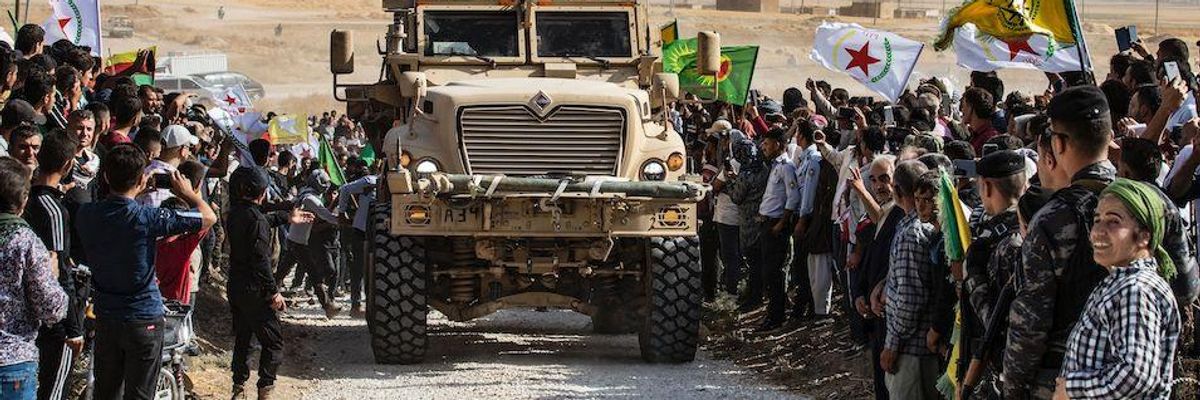
Syrian Kurds gather around a U.S. armoured vehicle during a demonstration against Turkish threats next to a U.S.-led international coalition base on the outskirts of Ras al-Ain town in Syria's Hasakeh province near the Turkish border on October 6, 2019. (Photo: Delil Souleiman/AFP/Getty Images)
In a move that was cast by critics as both irresponsible and a betrayal of key allies in the Middle East, President Donald Trump announced Sunday that U.S. forces are withdrawing from north-eastern Syria and leaving the region's Kurdish population vulnerable to slaughter as neighboring Turkey readies an invasion.
"Trump inviting Turkey to 'move forward with long-planned operation in Northern Syria' is deeply chilling."
--Daniel Nichanian, Justice Collaborative
"The Americans are traitors," a Kurdish official told NBC News as the news broke late Sunday night. "They have abandoned us to a Turkish massacre."
In a statement Sunday, the Trump administration said that U.S. forces would stand down in advance of a "long-planned operation into Northern Syria" by Turkey.
"The United States Armed Forces will not support or be involved in the operation, and United States forces, having defeated the ISIS territorial 'Caliphate,' will no longer be in the immediate area," said the White House.
In a tweet, Sen. Bernie Sanders (I-Vt.) said the withdrawl was "likely to result in more suffering and instability."
The Syrian Democratic Forces, a coalition of Kurds, Arabs, and Turkmen fighters led by the People's Protection Units (YPG) who helped defeat the Islamic State (ISIS) in the region, said in a statement they were prepared to fight against the Turkish incursion.
"Turkey's unprovoked attack on our areas will have a negative impact on our fight against ISIS and the stability and peace we have created in the region in the recent years," the coalition said. "As the Syrian Democratic Forces, we are determined to defend our land at all costs."
In a tweet, U.S. progressive activist Nikhil Goyal characterized the decision as a "betrayal" by the Trump administration.
"This is a betrayal of the Kurds, one of the strongest allies of the United States in the fight against ISIS," said Goyal.
The timing, The Daily Beast's Michael Weiss wrote, lined up with a phone call between Trump and Turkey's leader.
The move came after Trump, in yet another decisive phone call that probably will be locked away, spoke with Turkish President Recep Tayyip Erdogan. Trump's decision was to have the United States accede to a NATO ally's invasion of a de facto U.S. protectorate--an invasion which has been long in the making and is expressly designed to gobble up a crucial U.S. ally.
Trump's move to help Erdogan's operation was in defiance of his own military commanders, who advised the president to not withdraw from the area. Pentagon officials reportedly disagree with the decision and, according to The New York Times, "while it was clear the generals wanted to bar Turkey from the safe zone and keep American troops there, Mr. Trump clearly wanted the troops out."
"This is a betrayal of the Kurds, one of the strongest allies of the United States in the fight against ISIS."
--Nikhil Goyal
On Monday, Trump tweeted that the U.S. was washing its hands of the region.
"Turkey, Europe, Syria, Iran, Iraq, Russia, and the Kurds will now have to figure the situation out," the president said.
In a tweet, Justice Collaborative fellow Daniel Nichanian put the withdrawl in context of Turkey's history with the Kurds.
"Given violence, repression, and massacres of Kurds in Turkey (and continued imprisonment there of political prisoner Selahattin Demirtas, head of the pro-Kurdish party HKP), Trump inviting Turkey to 'move forward with long-planned operation in Northern Syria' is deeply chilling," tweeted Nichanian.
Last week, in a column warning of a Turkish invasion, Reese Erlich wrote that a war in the northeast of Syria "could kill hundreds or perhaps thousands of civilians." The only viable solution, Erlich continued, is a deal between the Syrian Kurds and the Syrian government.
"The crisis could end if the YPG and Syrian government negotiated a political settlement that allowed for democratic reforms and Kurdish autonomy," wrote Erlich.
Though chilling, Trump's move to withdraw is hardly unique for American leaders, The Daily Beast's Asawin Suebsaeng pointed out.
"One way in which Trump is very consistent and stable when it comes to American presidential norms over the decades is betraying Kurds," Suebsang said.
Dear Common Dreams reader, It’s been nearly 30 years since I co-founded Common Dreams with my late wife, Lina Newhouser. We had the radical notion that journalism should serve the public good, not corporate profits. It was clear to us from the outset what it would take to build such a project. No paid advertisements. No corporate sponsors. No millionaire publisher telling us what to think or do. Many people said we wouldn't last a year, but we proved those doubters wrong. Together with a tremendous team of journalists and dedicated staff, we built an independent media outlet free from the constraints of profits and corporate control. Our mission has always been simple: To inform. To inspire. To ignite change for the common good. Building Common Dreams was not easy. Our survival was never guaranteed. When you take on the most powerful forces—Wall Street greed, fossil fuel industry destruction, Big Tech lobbyists, and uber-rich oligarchs who have spent billions upon billions rigging the economy and democracy in their favor—the only bulwark you have is supporters who believe in your work. But here’s the urgent message from me today. It's never been this bad out there. And it's never been this hard to keep us going. At the very moment Common Dreams is most needed, the threats we face are intensifying. We need your support now more than ever. We don't accept corporate advertising and never will. We don't have a paywall because we don't think people should be blocked from critical news based on their ability to pay. Everything we do is funded by the donations of readers like you. When everyone does the little they can afford, we are strong. But if that support retreats or dries up, so do we. Will you donate now to make sure Common Dreams not only survives but thrives? —Craig Brown, Co-founder |
In a move that was cast by critics as both irresponsible and a betrayal of key allies in the Middle East, President Donald Trump announced Sunday that U.S. forces are withdrawing from north-eastern Syria and leaving the region's Kurdish population vulnerable to slaughter as neighboring Turkey readies an invasion.
"Trump inviting Turkey to 'move forward with long-planned operation in Northern Syria' is deeply chilling."
--Daniel Nichanian, Justice Collaborative
"The Americans are traitors," a Kurdish official told NBC News as the news broke late Sunday night. "They have abandoned us to a Turkish massacre."
In a statement Sunday, the Trump administration said that U.S. forces would stand down in advance of a "long-planned operation into Northern Syria" by Turkey.
"The United States Armed Forces will not support or be involved in the operation, and United States forces, having defeated the ISIS territorial 'Caliphate,' will no longer be in the immediate area," said the White House.
In a tweet, Sen. Bernie Sanders (I-Vt.) said the withdrawl was "likely to result in more suffering and instability."
The Syrian Democratic Forces, a coalition of Kurds, Arabs, and Turkmen fighters led by the People's Protection Units (YPG) who helped defeat the Islamic State (ISIS) in the region, said in a statement they were prepared to fight against the Turkish incursion.
"Turkey's unprovoked attack on our areas will have a negative impact on our fight against ISIS and the stability and peace we have created in the region in the recent years," the coalition said. "As the Syrian Democratic Forces, we are determined to defend our land at all costs."
In a tweet, U.S. progressive activist Nikhil Goyal characterized the decision as a "betrayal" by the Trump administration.
"This is a betrayal of the Kurds, one of the strongest allies of the United States in the fight against ISIS," said Goyal.
The timing, The Daily Beast's Michael Weiss wrote, lined up with a phone call between Trump and Turkey's leader.
The move came after Trump, in yet another decisive phone call that probably will be locked away, spoke with Turkish President Recep Tayyip Erdogan. Trump's decision was to have the United States accede to a NATO ally's invasion of a de facto U.S. protectorate--an invasion which has been long in the making and is expressly designed to gobble up a crucial U.S. ally.
Trump's move to help Erdogan's operation was in defiance of his own military commanders, who advised the president to not withdraw from the area. Pentagon officials reportedly disagree with the decision and, according to The New York Times, "while it was clear the generals wanted to bar Turkey from the safe zone and keep American troops there, Mr. Trump clearly wanted the troops out."
"This is a betrayal of the Kurds, one of the strongest allies of the United States in the fight against ISIS."
--Nikhil Goyal
On Monday, Trump tweeted that the U.S. was washing its hands of the region.
"Turkey, Europe, Syria, Iran, Iraq, Russia, and the Kurds will now have to figure the situation out," the president said.
In a tweet, Justice Collaborative fellow Daniel Nichanian put the withdrawl in context of Turkey's history with the Kurds.
"Given violence, repression, and massacres of Kurds in Turkey (and continued imprisonment there of political prisoner Selahattin Demirtas, head of the pro-Kurdish party HKP), Trump inviting Turkey to 'move forward with long-planned operation in Northern Syria' is deeply chilling," tweeted Nichanian.
Last week, in a column warning of a Turkish invasion, Reese Erlich wrote that a war in the northeast of Syria "could kill hundreds or perhaps thousands of civilians." The only viable solution, Erlich continued, is a deal between the Syrian Kurds and the Syrian government.
"The crisis could end if the YPG and Syrian government negotiated a political settlement that allowed for democratic reforms and Kurdish autonomy," wrote Erlich.
Though chilling, Trump's move to withdraw is hardly unique for American leaders, The Daily Beast's Asawin Suebsaeng pointed out.
"One way in which Trump is very consistent and stable when it comes to American presidential norms over the decades is betraying Kurds," Suebsang said.
In a move that was cast by critics as both irresponsible and a betrayal of key allies in the Middle East, President Donald Trump announced Sunday that U.S. forces are withdrawing from north-eastern Syria and leaving the region's Kurdish population vulnerable to slaughter as neighboring Turkey readies an invasion.
"Trump inviting Turkey to 'move forward with long-planned operation in Northern Syria' is deeply chilling."
--Daniel Nichanian, Justice Collaborative
"The Americans are traitors," a Kurdish official told NBC News as the news broke late Sunday night. "They have abandoned us to a Turkish massacre."
In a statement Sunday, the Trump administration said that U.S. forces would stand down in advance of a "long-planned operation into Northern Syria" by Turkey.
"The United States Armed Forces will not support or be involved in the operation, and United States forces, having defeated the ISIS territorial 'Caliphate,' will no longer be in the immediate area," said the White House.
In a tweet, Sen. Bernie Sanders (I-Vt.) said the withdrawl was "likely to result in more suffering and instability."
The Syrian Democratic Forces, a coalition of Kurds, Arabs, and Turkmen fighters led by the People's Protection Units (YPG) who helped defeat the Islamic State (ISIS) in the region, said in a statement they were prepared to fight against the Turkish incursion.
"Turkey's unprovoked attack on our areas will have a negative impact on our fight against ISIS and the stability and peace we have created in the region in the recent years," the coalition said. "As the Syrian Democratic Forces, we are determined to defend our land at all costs."
In a tweet, U.S. progressive activist Nikhil Goyal characterized the decision as a "betrayal" by the Trump administration.
"This is a betrayal of the Kurds, one of the strongest allies of the United States in the fight against ISIS," said Goyal.
The timing, The Daily Beast's Michael Weiss wrote, lined up with a phone call between Trump and Turkey's leader.
The move came after Trump, in yet another decisive phone call that probably will be locked away, spoke with Turkish President Recep Tayyip Erdogan. Trump's decision was to have the United States accede to a NATO ally's invasion of a de facto U.S. protectorate--an invasion which has been long in the making and is expressly designed to gobble up a crucial U.S. ally.
Trump's move to help Erdogan's operation was in defiance of his own military commanders, who advised the president to not withdraw from the area. Pentagon officials reportedly disagree with the decision and, according to The New York Times, "while it was clear the generals wanted to bar Turkey from the safe zone and keep American troops there, Mr. Trump clearly wanted the troops out."
"This is a betrayal of the Kurds, one of the strongest allies of the United States in the fight against ISIS."
--Nikhil Goyal
On Monday, Trump tweeted that the U.S. was washing its hands of the region.
"Turkey, Europe, Syria, Iran, Iraq, Russia, and the Kurds will now have to figure the situation out," the president said.
In a tweet, Justice Collaborative fellow Daniel Nichanian put the withdrawl in context of Turkey's history with the Kurds.
"Given violence, repression, and massacres of Kurds in Turkey (and continued imprisonment there of political prisoner Selahattin Demirtas, head of the pro-Kurdish party HKP), Trump inviting Turkey to 'move forward with long-planned operation in Northern Syria' is deeply chilling," tweeted Nichanian.
Last week, in a column warning of a Turkish invasion, Reese Erlich wrote that a war in the northeast of Syria "could kill hundreds or perhaps thousands of civilians." The only viable solution, Erlich continued, is a deal between the Syrian Kurds and the Syrian government.
"The crisis could end if the YPG and Syrian government negotiated a political settlement that allowed for democratic reforms and Kurdish autonomy," wrote Erlich.
Though chilling, Trump's move to withdraw is hardly unique for American leaders, The Daily Beast's Asawin Suebsaeng pointed out.
"One way in which Trump is very consistent and stable when it comes to American presidential norms over the decades is betraying Kurds," Suebsang said.