SUBSCRIBE TO OUR FREE NEWSLETTER
Daily news & progressive opinion—funded by the people, not the corporations—delivered straight to your inbox.
5
#000000
#FFFFFF
To donate by check, phone, or other method, see our More Ways to Give page.
Daily news & progressive opinion—funded by the people, not the corporations—delivered straight to your inbox.
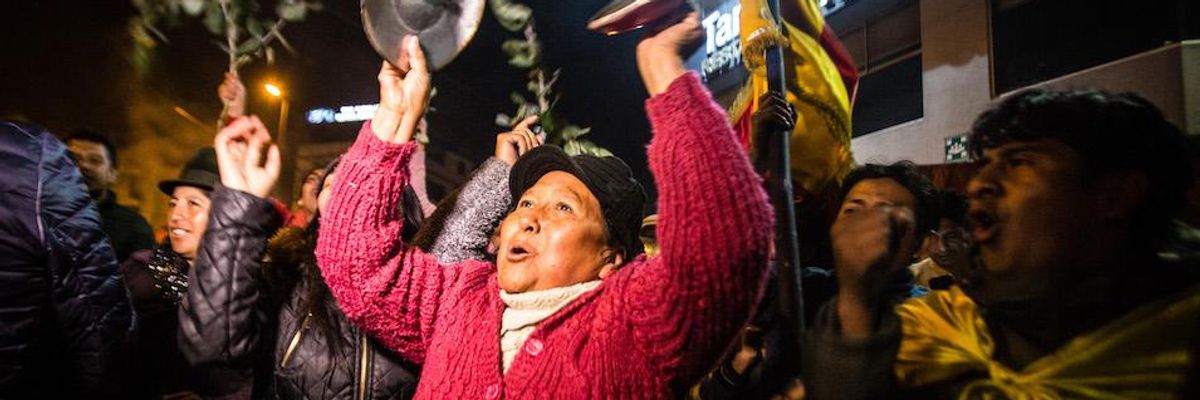
Celebration of the Ecuadorian Indians on 13 October 2019 in Quito, Ecuador, after Lenin Moreno issued the decree 883 on a national network. (Photo by Rafael Rodriguez/NurPhoto via Getty Images)
Indigenous groups in Ecuador celebrated Monday after news broke late Sunday that the country's leader, President Lenin Moreno, would make a deal with protestors that shut down the Latin American nation in nearly two weeks of demonstrations and scrap a controversial austerity package.
"I'm so happy I don't know what to say," said indigenous protester Rosa Matanago. "I don't have words, I'm so emotional. At least God touched the president's heart."
Moreno signed directive 883, restoring the subsidies, on Sunday evening.
The protest movement in Ecuador began on October 2 after a coalition of indigenous groups, the Confederation of Indigenous Nations in Ecuador (CONAIE), launched demonstrations against the Moreno government's proposal to eliminate fuel subsidies in an effort to reduce the country's debt to the International Monetary Fund (IMF). Moreno also proposed slashing salaries for public workers as a way to generate funding to pay down the IMF debt.
As Common Dreams reported on October 8, the protests led to Moreno temporarily relocating his government outside of the capital, Quito.
The New York Times on Monday explained the dispute at the heart of the clashes:
Elimination of the popular subsidies was a keystone of the broad austerity plan required by the IMF in order to extend Ecuador a credit line. The loan was meant to bolster the country's economy, which has deteriorated in recent years because of lower oil prices and a strengthening dollar that has left the country's exports more expensive.
CONAIE president Jaime Vargas told The Guardian that the work is just beginning to negotiate a way forward for Ecuador but that he was heartened by what the protest movement--which reportedly left seven demonstrators dead and over 2,100 wounded or arrested--accomplished.
"We want peace for our brothers and sisters in this country," said Vargas. "We don't want more repression."
Video of the celebrations of indigenous protesters spread across social media Monday.
Anti-war advocacy group CodePink urged caution from those celebrating the cessation in hostilities.
"This may be a victory for the indigenous people of Ecuador," the group tweeted, "but neoliberalism still reigns in the country."
Dear Common Dreams reader, It’s been nearly 30 years since I co-founded Common Dreams with my late wife, Lina Newhouser. We had the radical notion that journalism should serve the public good, not corporate profits. It was clear to us from the outset what it would take to build such a project. No paid advertisements. No corporate sponsors. No millionaire publisher telling us what to think or do. Many people said we wouldn't last a year, but we proved those doubters wrong. Together with a tremendous team of journalists and dedicated staff, we built an independent media outlet free from the constraints of profits and corporate control. Our mission has always been simple: To inform. To inspire. To ignite change for the common good. Building Common Dreams was not easy. Our survival was never guaranteed. When you take on the most powerful forces—Wall Street greed, fossil fuel industry destruction, Big Tech lobbyists, and uber-rich oligarchs who have spent billions upon billions rigging the economy and democracy in their favor—the only bulwark you have is supporters who believe in your work. But here’s the urgent message from me today. It's never been this bad out there. And it's never been this hard to keep us going. At the very moment Common Dreams is most needed, the threats we face are intensifying. We need your support now more than ever. We don't accept corporate advertising and never will. We don't have a paywall because we don't think people should be blocked from critical news based on their ability to pay. Everything we do is funded by the donations of readers like you. When everyone does the little they can afford, we are strong. But if that support retreats or dries up, so do we. Will you donate now to make sure Common Dreams not only survives but thrives? —Craig Brown, Co-founder |
Indigenous groups in Ecuador celebrated Monday after news broke late Sunday that the country's leader, President Lenin Moreno, would make a deal with protestors that shut down the Latin American nation in nearly two weeks of demonstrations and scrap a controversial austerity package.
"I'm so happy I don't know what to say," said indigenous protester Rosa Matanago. "I don't have words, I'm so emotional. At least God touched the president's heart."
Moreno signed directive 883, restoring the subsidies, on Sunday evening.
The protest movement in Ecuador began on October 2 after a coalition of indigenous groups, the Confederation of Indigenous Nations in Ecuador (CONAIE), launched demonstrations against the Moreno government's proposal to eliminate fuel subsidies in an effort to reduce the country's debt to the International Monetary Fund (IMF). Moreno also proposed slashing salaries for public workers as a way to generate funding to pay down the IMF debt.
As Common Dreams reported on October 8, the protests led to Moreno temporarily relocating his government outside of the capital, Quito.
The New York Times on Monday explained the dispute at the heart of the clashes:
Elimination of the popular subsidies was a keystone of the broad austerity plan required by the IMF in order to extend Ecuador a credit line. The loan was meant to bolster the country's economy, which has deteriorated in recent years because of lower oil prices and a strengthening dollar that has left the country's exports more expensive.
CONAIE president Jaime Vargas told The Guardian that the work is just beginning to negotiate a way forward for Ecuador but that he was heartened by what the protest movement--which reportedly left seven demonstrators dead and over 2,100 wounded or arrested--accomplished.
"We want peace for our brothers and sisters in this country," said Vargas. "We don't want more repression."
Video of the celebrations of indigenous protesters spread across social media Monday.
Anti-war advocacy group CodePink urged caution from those celebrating the cessation in hostilities.
"This may be a victory for the indigenous people of Ecuador," the group tweeted, "but neoliberalism still reigns in the country."
Indigenous groups in Ecuador celebrated Monday after news broke late Sunday that the country's leader, President Lenin Moreno, would make a deal with protestors that shut down the Latin American nation in nearly two weeks of demonstrations and scrap a controversial austerity package.
"I'm so happy I don't know what to say," said indigenous protester Rosa Matanago. "I don't have words, I'm so emotional. At least God touched the president's heart."
Moreno signed directive 883, restoring the subsidies, on Sunday evening.
The protest movement in Ecuador began on October 2 after a coalition of indigenous groups, the Confederation of Indigenous Nations in Ecuador (CONAIE), launched demonstrations against the Moreno government's proposal to eliminate fuel subsidies in an effort to reduce the country's debt to the International Monetary Fund (IMF). Moreno also proposed slashing salaries for public workers as a way to generate funding to pay down the IMF debt.
As Common Dreams reported on October 8, the protests led to Moreno temporarily relocating his government outside of the capital, Quito.
The New York Times on Monday explained the dispute at the heart of the clashes:
Elimination of the popular subsidies was a keystone of the broad austerity plan required by the IMF in order to extend Ecuador a credit line. The loan was meant to bolster the country's economy, which has deteriorated in recent years because of lower oil prices and a strengthening dollar that has left the country's exports more expensive.
CONAIE president Jaime Vargas told The Guardian that the work is just beginning to negotiate a way forward for Ecuador but that he was heartened by what the protest movement--which reportedly left seven demonstrators dead and over 2,100 wounded or arrested--accomplished.
"We want peace for our brothers and sisters in this country," said Vargas. "We don't want more repression."
Video of the celebrations of indigenous protesters spread across social media Monday.
Anti-war advocacy group CodePink urged caution from those celebrating the cessation in hostilities.
"This may be a victory for the indigenous people of Ecuador," the group tweeted, "but neoliberalism still reigns in the country."