

SUBSCRIBE TO OUR FREE NEWSLETTER
Daily news & progressive opinion—funded by the people, not the corporations—delivered straight to your inbox.
5
#000000
#FFFFFF
To donate by check, phone, or other method, see our More Ways to Give page.
Daily news & progressive opinion—funded by the people, not the corporations—delivered straight to your inbox.
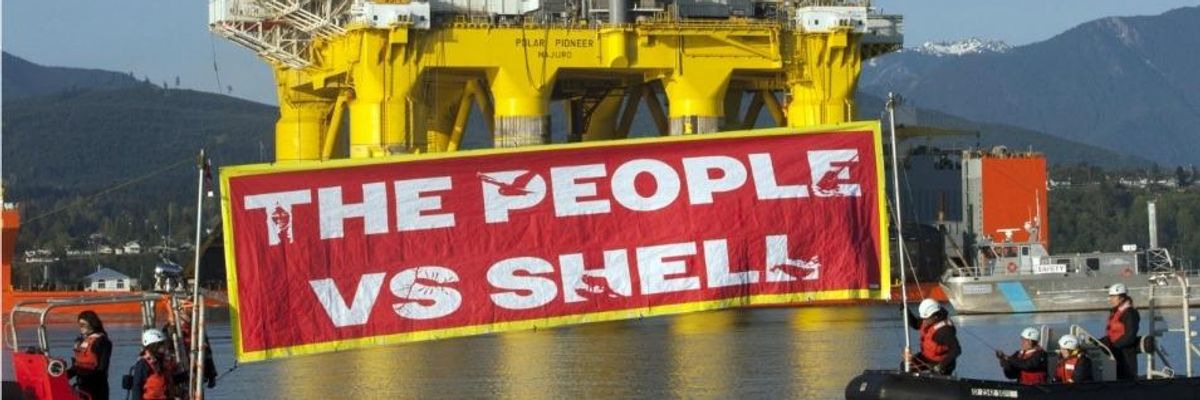
Social and environmental justice groups opposed to Shell's plans to drill for fossil fuels in Arctic waters organized a protest in kayaks on the shores of Seattle's Elliot Bay in 2015. (Photo: Greenpeace)
Climate activists and experts underscored the necessity of fighting to urgently end the use of fossil fuels worldwide after Royal Dutch Shell CEO Ben van Beurden claimed Monday that "we have no choice" but to invest in long-term oil and gas projects.
On Tuesday, Bill McKibben, co-founder of the global environmental advocacy group 350.org, declared that "we have no choice but to try and stop them."
The 61-year-old fossil fuel executive's comment was part of an exclusive interview published Monday by Reuters. According to the news agency:
A defiant van Beurden rejected a rising chorus from climate activists and parts of the investor community to transform radically the 112-year-old Anglo-Dutch company's traditional business model.
"Despite what a lot of activists say, it is entirely legitimate to invest in oil and gas because the world demands it," van Beurden said.
"We have no choice" but to invest in long-life projects, he added.
Shell, which is headquartered in the Netherlands and incorporated in the United Kingdom, is among the world's largest energy companies. Last year, the publicly traded company's revenue was $388.4 billion.
Based on an investor presentation from June, Reuters reported that "Shell plans to greenlight more than 35 new oil and gas projects by 2025."
On Twitter, biologist and activist Sandra Steingraber highlighted Shell's plans for the future--plans which directly conflict with global scientists' warnings that the world needs to rapidly transform energy systems, replacing fossil fuels with renewable sources, to prevent climate catastrophe.
Dharini Parthasarathy of Climate Action Network International (CAN) called out van Beurden as a "climate criminal" who refuses to abandon oil "despite the overwhelming evidence that we are on the brink of climate and ecological collapse."
Patrick Galey, a global science and environment correspondent for Agence France-Presse, posited that "when the trials of oil and gas executives come, this interview will be Exhibit A."
As Common Dreams reported in July, "lawsuits that aim to push governments to more ambitiously the address climate emergency and make polluting corporations pay for the damage caused by their sizable contributions to the global warming are growing in popularity around the world."
Examples include the state of Rhode Island's ongoing lawsuit that aims to make 21 fossil fuel giants--including BP, Chevron, ExxonMobil, and Shell--pay for knowingly "causing catastrophic consequences to Rhode Island, our economy, our communities, our residents, our ecosystems."
Another legal strategy that climate advocates are pursuing is using courts to force major energy companies to reform their business practices. In April, a coalition of environmental groups who argue that Shell has an obligation under Dutch law to act on the Paris climate goals delivered a court summons to the company in a bid to legally compel Shell to "cease its destruction of the climate, on behalf of more than 30,000 people from 70 countries."
Earlier this month, in response to Shell's latest quarterly outlook for investors, Andy Rowell of the group Oil Change International wrote that "while it may have dipped a toe into the renewable pool, Shell belligerently refuses to dive in to help achieve a livable future, despite decades of science imploring Big Oil to act."
"We do not trust Shell. We now know #ShellKnew, but carried on drilling," he added, referencing evidence that Shell scientists secretly warned company leaders decades ago about the threat that fossil fuel emissions pose to the planet.
"It could act, but it cares not to. At the end of the day, Shell still cares more about its shareholders than it does about society," Rowell concluded. "It cares more about profit than it does people. It cares more about cash than a safe climate. And that has to change, fast, because the hour glass is nearly empty."
The criticism of Shell and its chief executive over the company's continuing contributions to heating the planet come in the middle of a two-week series of protests and civil disobedience, organized by the global movement Extinction Rebellion, to pressure governments to pursue bold, science-based solutions to the climate crisis.
"The past week has been a moment in history: to simply list the thousands of arrests, the many tens of thousands undertaking civil disobedience, would not do it justice," Extinction Rebellion said Tuesday. "We have proven to the world that this rebellion is a truly global movement, growing rapidly within and between nations, and comprised of people with the selflessness, the creativity, and the courage to resist the madness of this ecocidal system."
Dear Common Dreams reader, It’s been nearly 30 years since I co-founded Common Dreams with my late wife, Lina Newhouser. We had the radical notion that journalism should serve the public good, not corporate profits. It was clear to us from the outset what it would take to build such a project. No paid advertisements. No corporate sponsors. No millionaire publisher telling us what to think or do. Many people said we wouldn't last a year, but we proved those doubters wrong. Together with a tremendous team of journalists and dedicated staff, we built an independent media outlet free from the constraints of profits and corporate control. Our mission has always been simple: To inform. To inspire. To ignite change for the common good. Building Common Dreams was not easy. Our survival was never guaranteed. When you take on the most powerful forces—Wall Street greed, fossil fuel industry destruction, Big Tech lobbyists, and uber-rich oligarchs who have spent billions upon billions rigging the economy and democracy in their favor—the only bulwark you have is supporters who believe in your work. But here’s the urgent message from me today. It's never been this bad out there. And it's never been this hard to keep us going. At the very moment Common Dreams is most needed, the threats we face are intensifying. We need your support now more than ever. We don't accept corporate advertising and never will. We don't have a paywall because we don't think people should be blocked from critical news based on their ability to pay. Everything we do is funded by the donations of readers like you. When everyone does the little they can afford, we are strong. But if that support retreats or dries up, so do we. Will you donate now to make sure Common Dreams not only survives but thrives? —Craig Brown, Co-founder |
Climate activists and experts underscored the necessity of fighting to urgently end the use of fossil fuels worldwide after Royal Dutch Shell CEO Ben van Beurden claimed Monday that "we have no choice" but to invest in long-term oil and gas projects.
On Tuesday, Bill McKibben, co-founder of the global environmental advocacy group 350.org, declared that "we have no choice but to try and stop them."
The 61-year-old fossil fuel executive's comment was part of an exclusive interview published Monday by Reuters. According to the news agency:
A defiant van Beurden rejected a rising chorus from climate activists and parts of the investor community to transform radically the 112-year-old Anglo-Dutch company's traditional business model.
"Despite what a lot of activists say, it is entirely legitimate to invest in oil and gas because the world demands it," van Beurden said.
"We have no choice" but to invest in long-life projects, he added.
Shell, which is headquartered in the Netherlands and incorporated in the United Kingdom, is among the world's largest energy companies. Last year, the publicly traded company's revenue was $388.4 billion.
Based on an investor presentation from June, Reuters reported that "Shell plans to greenlight more than 35 new oil and gas projects by 2025."
On Twitter, biologist and activist Sandra Steingraber highlighted Shell's plans for the future--plans which directly conflict with global scientists' warnings that the world needs to rapidly transform energy systems, replacing fossil fuels with renewable sources, to prevent climate catastrophe.
Dharini Parthasarathy of Climate Action Network International (CAN) called out van Beurden as a "climate criminal" who refuses to abandon oil "despite the overwhelming evidence that we are on the brink of climate and ecological collapse."
Patrick Galey, a global science and environment correspondent for Agence France-Presse, posited that "when the trials of oil and gas executives come, this interview will be Exhibit A."
As Common Dreams reported in July, "lawsuits that aim to push governments to more ambitiously the address climate emergency and make polluting corporations pay for the damage caused by their sizable contributions to the global warming are growing in popularity around the world."
Examples include the state of Rhode Island's ongoing lawsuit that aims to make 21 fossil fuel giants--including BP, Chevron, ExxonMobil, and Shell--pay for knowingly "causing catastrophic consequences to Rhode Island, our economy, our communities, our residents, our ecosystems."
Another legal strategy that climate advocates are pursuing is using courts to force major energy companies to reform their business practices. In April, a coalition of environmental groups who argue that Shell has an obligation under Dutch law to act on the Paris climate goals delivered a court summons to the company in a bid to legally compel Shell to "cease its destruction of the climate, on behalf of more than 30,000 people from 70 countries."
Earlier this month, in response to Shell's latest quarterly outlook for investors, Andy Rowell of the group Oil Change International wrote that "while it may have dipped a toe into the renewable pool, Shell belligerently refuses to dive in to help achieve a livable future, despite decades of science imploring Big Oil to act."
"We do not trust Shell. We now know #ShellKnew, but carried on drilling," he added, referencing evidence that Shell scientists secretly warned company leaders decades ago about the threat that fossil fuel emissions pose to the planet.
"It could act, but it cares not to. At the end of the day, Shell still cares more about its shareholders than it does about society," Rowell concluded. "It cares more about profit than it does people. It cares more about cash than a safe climate. And that has to change, fast, because the hour glass is nearly empty."
The criticism of Shell and its chief executive over the company's continuing contributions to heating the planet come in the middle of a two-week series of protests and civil disobedience, organized by the global movement Extinction Rebellion, to pressure governments to pursue bold, science-based solutions to the climate crisis.
"The past week has been a moment in history: to simply list the thousands of arrests, the many tens of thousands undertaking civil disobedience, would not do it justice," Extinction Rebellion said Tuesday. "We have proven to the world that this rebellion is a truly global movement, growing rapidly within and between nations, and comprised of people with the selflessness, the creativity, and the courage to resist the madness of this ecocidal system."
Climate activists and experts underscored the necessity of fighting to urgently end the use of fossil fuels worldwide after Royal Dutch Shell CEO Ben van Beurden claimed Monday that "we have no choice" but to invest in long-term oil and gas projects.
On Tuesday, Bill McKibben, co-founder of the global environmental advocacy group 350.org, declared that "we have no choice but to try and stop them."
The 61-year-old fossil fuel executive's comment was part of an exclusive interview published Monday by Reuters. According to the news agency:
A defiant van Beurden rejected a rising chorus from climate activists and parts of the investor community to transform radically the 112-year-old Anglo-Dutch company's traditional business model.
"Despite what a lot of activists say, it is entirely legitimate to invest in oil and gas because the world demands it," van Beurden said.
"We have no choice" but to invest in long-life projects, he added.
Shell, which is headquartered in the Netherlands and incorporated in the United Kingdom, is among the world's largest energy companies. Last year, the publicly traded company's revenue was $388.4 billion.
Based on an investor presentation from June, Reuters reported that "Shell plans to greenlight more than 35 new oil and gas projects by 2025."
On Twitter, biologist and activist Sandra Steingraber highlighted Shell's plans for the future--plans which directly conflict with global scientists' warnings that the world needs to rapidly transform energy systems, replacing fossil fuels with renewable sources, to prevent climate catastrophe.
Dharini Parthasarathy of Climate Action Network International (CAN) called out van Beurden as a "climate criminal" who refuses to abandon oil "despite the overwhelming evidence that we are on the brink of climate and ecological collapse."
Patrick Galey, a global science and environment correspondent for Agence France-Presse, posited that "when the trials of oil and gas executives come, this interview will be Exhibit A."
As Common Dreams reported in July, "lawsuits that aim to push governments to more ambitiously the address climate emergency and make polluting corporations pay for the damage caused by their sizable contributions to the global warming are growing in popularity around the world."
Examples include the state of Rhode Island's ongoing lawsuit that aims to make 21 fossil fuel giants--including BP, Chevron, ExxonMobil, and Shell--pay for knowingly "causing catastrophic consequences to Rhode Island, our economy, our communities, our residents, our ecosystems."
Another legal strategy that climate advocates are pursuing is using courts to force major energy companies to reform their business practices. In April, a coalition of environmental groups who argue that Shell has an obligation under Dutch law to act on the Paris climate goals delivered a court summons to the company in a bid to legally compel Shell to "cease its destruction of the climate, on behalf of more than 30,000 people from 70 countries."
Earlier this month, in response to Shell's latest quarterly outlook for investors, Andy Rowell of the group Oil Change International wrote that "while it may have dipped a toe into the renewable pool, Shell belligerently refuses to dive in to help achieve a livable future, despite decades of science imploring Big Oil to act."
"We do not trust Shell. We now know #ShellKnew, but carried on drilling," he added, referencing evidence that Shell scientists secretly warned company leaders decades ago about the threat that fossil fuel emissions pose to the planet.
"It could act, but it cares not to. At the end of the day, Shell still cares more about its shareholders than it does about society," Rowell concluded. "It cares more about profit than it does people. It cares more about cash than a safe climate. And that has to change, fast, because the hour glass is nearly empty."
The criticism of Shell and its chief executive over the company's continuing contributions to heating the planet come in the middle of a two-week series of protests and civil disobedience, organized by the global movement Extinction Rebellion, to pressure governments to pursue bold, science-based solutions to the climate crisis.
"The past week has been a moment in history: to simply list the thousands of arrests, the many tens of thousands undertaking civil disobedience, would not do it justice," Extinction Rebellion said Tuesday. "We have proven to the world that this rebellion is a truly global movement, growing rapidly within and between nations, and comprised of people with the selflessness, the creativity, and the courage to resist the madness of this ecocidal system."

